How Lawyers Handle Uninsured Driver Claims
Being involved in a motorcycle accident is terrifying enough, but discovering the at-fault driver doesn't have insurance can turn a terrible situation into an absolute nightmare. The immediate shock, pain, and property damage suddenly get compounded by overwhelming financial anxiety. You're left wondering how you'll cover mounting medical bills or repair your bike. This guide will meticulously break down how experienced lawyers tackle these complex and often frustrating uninsured driver claims, helping you understand your options and rights.
The Unfortunate Reality of Uninsured Drivers on Our Roads
It's a harsh truth that despite legal requirements, many drivers on the road operate without adequate insurance, or sometimes, no insurance at all. For motorcyclists, who are inherently more vulnerable than occupants of a passenger vehicle, this reality can be particularly devastating. When you're facing significant injuries and property damage, finding out the driver who caused it can't pay can feel like a punch to the gut. This isn't just a hypothetical scenario; it's a daily occurrence across states like Florida, where an estimated one in five drivers is uninsured, or even California, despite its universal helmet laws and generally higher insurance compliance, still sees a significant number of uninsured motorists.
Why Uninsured Drivers Pose a Greater Threat to Riders
The physical disparity between a motorcycle and almost any other vehicle on the road means that when a collision occurs, the rider bears the brunt of the impact. While a car driver might walk away with minor dents to their bumper, a motorcyclist is often dealing with severe injuries such as road rash, broken bones, or even traumatic brain injuries. When the responsible party lacks insurance, it means there's no immediate, clear path for financial compensation from their policy to cover these extensive damages. This situation directly amplifies the already severe consequences of a motorcycle crash, leaving riders feeling exposed and without recourse.
The Immediate Aftermath: Financial Fallout and Stress
Imagine you're cruising down I-10 in Arizona, enjoying the open road, when suddenly a distracted driver swerves into your lane, sending you tumbling. You're hurt, your bike is mangled, and the medical bills start piling up from the moment the ambulance arrives. Then, the police report or your initial investigation reveals the other driver either has no insurance or carries only the bare minimum liability coverage, which often isn't enough to cover even moderate motorcycle accident injuries. This isn't just about repairing your bike; it's about covering emergency room visits, specialist appointments, physical therapy, lost wages from being unable to work, and the pervasive pain and suffering that comes with such an ordeal. Without the at-fault driver's insurance to turn to, the financial burden can quickly become crippling, adding immense stress to an already traumatic recovery period.
Your Own Insurance: The Unexpected Lifeline in an Uninsured Claim
This is where your own insurance policy often becomes your most valuable asset. Many riders, thankfully, opt for specific coverages that protect them in situations involving uninsured or underinsured motorists. These coverages are not always standard, but they are absolutely critical, especially given the statistics on uninsured drivers. A skilled lawyer's first move in an uninsured driver claim is almost always to thoroughly review your policy to identify every potential avenue for recovery. They understand the intricacies of these policies and how to leverage them to your advantage.
Understanding Uninsured Motorist UM Coverage
Uninsured Motorist (UM) coverage is designed specifically for situations where the at-fault driver has no liability insurance or in the unfortunate event of a hit-and-run where the driver cannot be identified. This coverage essentially steps into the shoes of the uninsured driver's missing liability policy, paying for damages you would have otherwise claimed from them. It typically covers things like medical expenses, lost wages, and pain and suffering. It's a lifesaver, and in some states, like North Carolina, it's even a mandatory inclusion in auto policies, though you can reject it in writing. This coverage directly addresses the core problem of an uninsured driver, providing a financial safety net that many riders overlook until they desperately need it.
Deciphering Underinsured Motorist UIM Coverage
While UM coverage handles drivers with no insurance, Underinsured Motorist (UIM) coverage is for scenarios where the at-fault driver does have insurance, but their policy limits are simply too low to cover the full extent of your damages. For instance, if you incur $100,000 in medical bills and lost wages, but the at-fault driver only has a $25,000 liability policy, UIM coverage would kick in to cover the remaining $75,000 (up to your policy limits). Many severe motorcycle injuries, such as those that lead to a spinal cord injury or a traumatic brain injury, easily exceed the minimum liability limits required in most states. UIM coverage is the bridge that helps you recover the full compensation you deserve when the other driver's coverage falls short.
Stacking Coverage and Policy Limits
One of the most powerful strategies a lawyer can employ in an uninsured or underinsured claim is "stacking" coverage. Stacking allows you to combine the UM/UIM limits from multiple vehicles on your policy, or even from separate policies, to create a larger pool of available funds. For example, if you have two motorcycles and a car, each with $50,000 in UM/UIM coverage, and your policy allows stacking, you might be able to access $150,000 in coverage for a single accident. This significantly increases your potential payout, especially when you're dealing with catastrophic injuries. Not all states or policies allow stacking, so an attorney will review your specific insurance documents and the laws in your state, like in Pennsylvania where stacking is common, to determine if this option is available to you. Understanding these nuances is crucial for how insurance policy limits affect your payout and ensures no stone is left unturned in seeking maximum compensation.
Here's a quick look at the difference between these vital coverages:
| Feature | Uninsured Motorist (UM) Coverage | Underinsured Motorist (UIM) Coverage |
|---|---|---|
| Purpose | Covers damages when the at-fault driver has NO insurance or in a hit-and-run. | Covers damages when the at-fault driver's insurance is NOT ENOUGH to cover your losses. |
| Trigger Event | No third-party liability insurance available. | Third-party liability insurance exists but is insufficient. |
| Types of Damages Covered | Medical bills, lost wages, pain and suffering, property damage (sometimes). | Medical bills, lost wages, pain and suffering. |
| Source of Funds | Your own insurance policy. | Your own insurance policy (after exhausting the at-fault driver's policy). |
| Crucial For | Protecting against completely uninsured drivers or phantom vehicles. | Protecting against drivers with minimum or low-limit insurance. |
How a Lawyer Navigates the Uninsured Claim Process
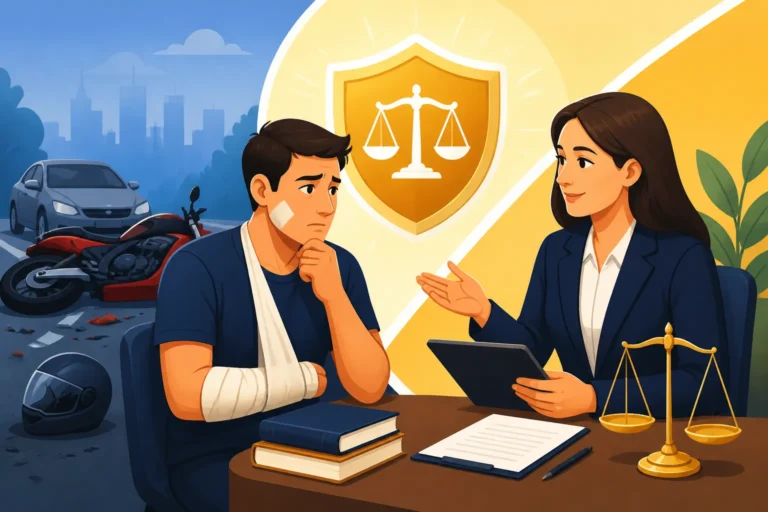
When you're dealing with the aftermath of a motorcycle accident, especially one involving an uninsured driver, the last thing you want to do is navigate complex insurance paperwork and legal jargon. This is precisely where a skilled motorcycle accident lawyer shines. They take on the burden, allowing you to focus on recovery. Their process is systematic, aimed at securing every possible dollar for your damages, even when the at-fault driver's pockets seem empty. Many riders use resources like LegalMatch to find an attorney who specializes in these complex situations.
Investigation and Evidence Gathering
Even though the at-fault driver might be uninsured, proving their negligence is still paramount. Your lawyer will meticulously gather evidence, just as they would in any other claim. This includes obtaining the police report, speaking with witnesses, reviewing traffic camera footage, and if necessary, hiring accident reconstruction experts. They will also collect all your medical records, bills, and documentation of lost wages to clearly establish the extent of your injuries and economic damages. This robust evidence package is then presented to your own insurance company to support your UM/UIM claim. Proving fault in a motorcycle accident is still crucial, as your own insurance company might try to argue you were partially responsible to reduce their payout, leading to a situation where they claim shared fault in motorcycle accidents.
Dealing with Your Own Insurance Company
You might think dealing with your own insurance company would be straightforward, but that's not always the case. Even your insurer, when paying out on a UM/UIM claim, will act to protect their bottom line. They might dispute the extent of your injuries, question your treatment, or even try to assign a percentage of fault to you to reduce their liability, referencing concepts like comparative negligence in motorcycle accidents. This is where a lawyer's expertise in how lawyers deal with insurance companies becomes invaluable. They handle all communication, respond to unreasonable requests, and fiercely negotiate on your behalf. They understand the tactics insurers use, such as trying to offer a lowball settlement early on, and will work to prevent you from accepting less than you deserve for your injuries and losses. This process is essential to maximize your motorcycle accident settlement.
Pursuing the At-Fault Driver Personally
In some cases, if your UM/UIM coverage isn't enough to cover your extensive damages, your lawyer might explore the possibility of pursuing a personal lawsuit against the uninsured at-fault driver directly. This is often a last resort because, by definition, an uninsured driver usually doesn't have significant assets or income to satisfy a large judgment. However, there are exceptions. The driver might have hidden assets, an inheritance, or perhaps a lucrative job that could be garnished over time. Your attorney will conduct an asset search to determine if this route is financially viable. It's a complex decision, weighed carefully based on the specific circumstances and the likelihood of actual recovery, but it's another option an experienced lawyer will consider to ensure you receive full compensation for your losses, especially for significant damages like pain and suffering in motorcycle settlements.
Common Challenges and How Lawyers Overcome Them
Dealing with an uninsured driver claim is inherently more challenging than a typical accident claim. The absence of a readily available third-party insurance policy creates unique hurdles. However, experienced motorcycle accident lawyers are well-versed in these challenges and have strategies to overcome them, ensuring their clients are not left high and dry.
Proving Damages Without the Other Driver's Policy
One of the biggest hurdles is the perception that if the other driver has no insurance, there's no money to be had. This isn't true when you have UM/UIM coverage, but it shifts the burden of proof even more squarely onto your shoulders and your lawyer's. Instead of just proving the other driver's fault and your damages to their insurer, you now have to prove these same elements to your own insurer. Your lawyer will meticulously document every aspect of your losses. This includes not only your current medical bills and lost wages but also projecting future medical costs, potential loss of earning capacity, and the subjective value of your pain and suffering. They rely heavily on detailed medical reports, expert testimony, and financial records to build an ironclad case. For instance, if you suffered a severe broken leg, your lawyer would work with medical experts to illustrate the long-term impact, not just the initial treatment.
Overcoming Rider Bias and Shared Fault
Unfortunately, a pervasive stereotype exists that motorcyclists are inherently risky drivers, making them more likely to be at fault in an accident. This "rider bias" can subtly influence how adjusters (even from your own company) evaluate your claim. Insurers might attempt to pin partial blame on you, arguing you were speeding, lane splitting where illegal, or otherwise contributing to the accident. Your lawyer will aggressively combat these attempts by presenting strong evidence that clearly establishes the other driver's fault. This includes leveraging dashcam footage, witness statements, and accident reconstruction reports. For example, if a car made a sudden left turn in front of you, a lawyer will emphasize that this is a common cause of motorcycle accidents and clearly the other driver's fault, challenging any insinuation that your presence on a motorcycle somehow made you responsible. They are adept at countering arguments about shared fault in motorcycle accidents that could reduce your payout.
Maximizing Your Payout from Limited Sources
When the at-fault driver is uninsured, the total pool of money for your compensation is generally limited to your own UM/UIM policy limits. This means your lawyer has to be incredibly strategic to maximize every dollar within those limits. They'll ensure that all economic damages, such as how medical bills affect your settlement and future care needs, are meticulously calculated. They'll also focus on demonstrating the full scope of your non-economic damages, like emotional distress, loss of enjoyment of life, and the true value of pain and suffering, which can significantly increase the claim's value within your policy's parameters. Furthermore, if you have other applicable coverages, such as personal injury protection (PIP) or medical payments (MedPay), your lawyer will coordinate these benefits to cover initial costs and preserve your UM/UIM limits for other damages. Their goal is to piece together all available resources, from your own policy to potentially any third-party liability if the uninsured driver was driving someone else's car, to ensure you receive the highest possible settlement. It's a complex puzzle, and a skilled legal professional, perhaps found through services like LegalMatch, is essential to solving it.
Conclusion
Navigating a motorcycle accident claim involving an uninsured driver is undoubtedly one of the most stressful and intricate legal challenges a rider can face. The complexities of UM/UIM coverage, the potential for personal lawsuits against the at-fault driver, and the need to rigorously prove damages to your own insurance company demand a level of expertise that most people simply don't possess. While it might feel like an uphill battle, you don't have to face it alone. Hiring a skilled motorcycle accident lawyer can make all the difference, transforming a seemingly hopeless situation into a manageable process with the potential for fair compensation. They serve as your advocate, investigator, and negotiator, ensuring your rights are protected and that you can focus on healing, rather than battling insurance companies or worrying about endless medical bills. If you find yourself in this unfortunate situation, seeking legal counsel sooner rather than later is always the wisest course of action.
Disclaimer
The information provided in this article is for general informational purposes only and does not constitute legal advice. Motorcycle accident claims are highly fact-specific, and the laws governing insurance coverage and liability vary significantly by state. It is crucial to consult with a qualified motorcycle accident attorney in your jurisdiction to discuss the specifics of your case and receive personalized legal guidance.