How Lawyers Pursue Multiple Defendants
Getting into a motorcycle accident is terrifying enough, but when you realize there might be more than one person or entity responsible for your crash and injuries, the whole situation can quickly feel overwhelming. You’re left wondering who you even file a claim against, how their insurance companies will interact, and if you'll ever see a fair resolution. This guide is here to walk you through how legal professionals approach these complex scenarios, specifically how lawyers pursue multiple defendants in a motorcycle accident claim.
Understanding the Complexity of Multi-Defendant Motorcycle Accidents
Motorcycle accidents are rarely simple, but when several parties could be at fault, the complexity multiplies exponentially. It's not just about one driver hitting you; it's about untangling a web of potential negligence that could involve everything from poorly maintained roads to faulty parts. This intricacy is precisely why these types of claims require a meticulous approach.
Why More Than One Party Might Be at Fault
It might seem straightforward that the driver who cut you off is to blame, but a deeper look often reveals more layers. Imagine you're riding your bike, and a car suddenly swerves into your lane. You react, but as you try to avoid a collision, your front tire catches on a massive, unmarked pothole, sending you sprawling. In this scenario, is it solely the car driver's fault? Or does the city or state highway department, responsible for road maintenance, also share some blame for the hazard?
Another common scenario involves defective motorcycle parts. Perhaps you were cruising down I-10 in Arizona when your brakes suddenly failed, leading to a collision with another vehicle. Here, while another driver might be tangentially involved, the primary issue could stem from the manufacturer of your motorcycle or the shop that last performed maintenance on your braking system. This introduces entirely new defendants and distinct legal avenues for recourse, vastly complicating the standard "car vs. motorcycle" accident claim. Sometimes, even the owner of a commercial vehicle, like a delivery truck, can be held liable for their driver's actions under certain legal doctrines.
The Challenges of Proving Liability Against Many
When multiple parties are involved, each one, or more accurately, their insurance companies and legal teams, will likely try to shift blame away from themselves. The car driver's insurer might argue that the pothole was the true cause, or that your riding style was reckless. The city might claim they weren't aware of the pothole or that it wasn't severe enough to warrant immediate repair. The motorcycle manufacturer might argue that the brake failure was due to improper maintenance, not a defect.
This blame game creates a significant challenge for an injured rider. You're trying to recover from injuries, deal with medical bills, and potentially lost wages, all while navigating a legal battle where everyone is pointing fingers. Proving liability against multiple entities requires a deep understanding of accident reconstruction, engineering principles, municipal codes, and product liability law. It’s not just about collecting a police report; it’s about building an ironclad case against each potential defendant, which demands extensive investigation and expert analysis to definitively establish what happened and who is responsible. For more insights on this complex area, consider reading about How Fault Is Determined in Motorcycle Accidents.
Identifying All Potential Defendants in Your Case
A crucial step in any motorcycle accident claim, especially one with multiple potential at-fault parties, is to thoroughly identify everyone who might bear responsibility. This isn't always obvious at first glance, and overlooking a potential defendant could mean leaving money on the table that you desperately need for your recovery.
Drivers and Vehicle Owners
Of course, the most immediate defendants are usually the drivers of other vehicles involved in the crash. This includes not just the person who directly hit you, but potentially other drivers whose actions (or inactions) contributed to the collision. For example, if one driver slammed on their brakes unexpectedly, causing a chain reaction that ultimately led to your crash, that first driver might share fault with the driver who physically struck your bike.
Furthermore, it's not always just the driver who is liable. In many states, the owner of a vehicle can be held responsible for damages caused by someone else driving their car, particularly if they negligently entrusted their vehicle to an unsafe driver or if they lent it to someone who then caused an accident. This "vicarious liability" can be a significant avenue for recovery, especially if the at-fault driver has minimal insurance but the vehicle owner has a robust policy. Remember, you might need to pursue claims against multiple insurance policies, adding another layer of complexity that a lawyer can expertly manage.
Government Entities and Road Conditions
It's a tough pill to swallow, but sometimes the very roads we ride on contribute to our accidents. Potholes, crumbling pavement, missing or obscured signage, malfunctioning traffic lights, or even poorly designed intersections can all lead to severe motorcycle crashes. If a road hazard played a role in your accident, a governmental entity—be it a city, county, or state department of transportation—could be a defendant.
Suing a government agency presents unique challenges. They often have sovereign immunity, meaning they're protected from lawsuits unless specific conditions are met, and they typically have very strict and short deadlines for filing a "notice of claim" – sometimes as little as 30 to 90 days after the incident. Missing this window can permanently bar your claim, regardless of the merits of your case. An attorney experienced in these types of claims knows these specific procedures and deadlines, crucial for pursuing Government Liability for Road Hazards.
Manufacturers and Repair Shops
Few things are scarier than a critical component of your motorcycle failing mid-ride. If your accident was caused or exacerbated by a defective part—such as faulty brakes, a tire blowout due to a manufacturing flaw, or a steering component failure—the manufacturer of that part, or even the motorcycle itself, could be held liable. This falls under product liability law, which asserts that manufacturers have a responsibility to produce safe products.
Similarly, if your motorcycle was recently serviced, and the repair shop's negligence led to the accident (e.g., they didn't properly tighten a wheel, or installed a defective part), they could also be named as a defendant. These cases often require forensic examination of the motorcycle parts and expert testimony from mechanical engineers. This is a highly specialized area of law, and an attorney would need to investigate if Manufacturer Liability for Defective Parts applies to your situation.
Other Parties to Consider
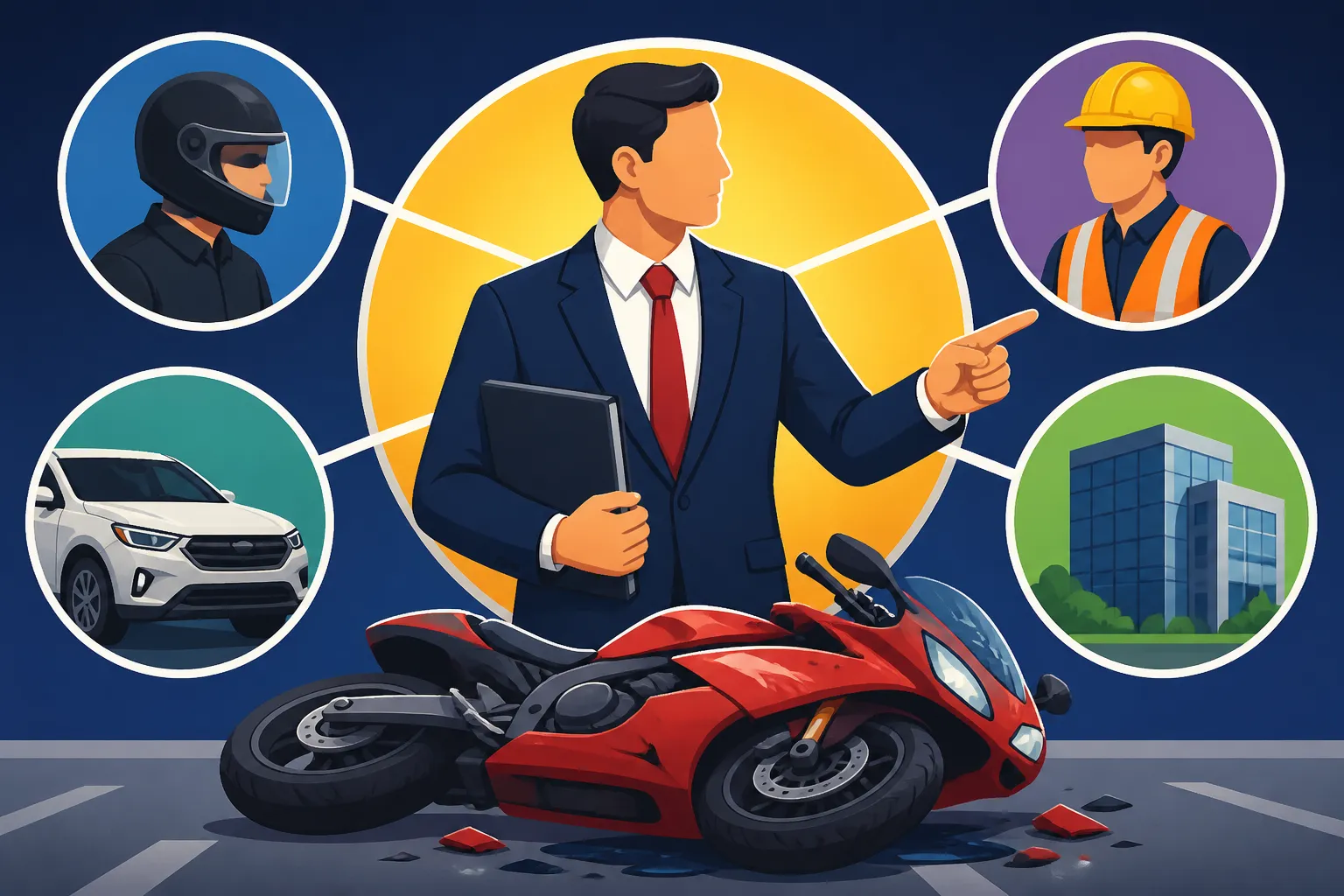
Beyond the obvious, there can be other, less common defendants. If a commercial truck driver caused your accident, their employer might also be held responsible. Construction companies working near the accident site might be liable if their equipment or debris created a hazard. Even pedestrians or bicyclists could, in rare circumstances, be partially at fault if their reckless actions led to the crash. When facing such a complex situation with various potential at-fault parties, finding the right legal representation is paramount. Services like LegalMatch can help connect you with attorneys in your area who specialize in multi-defendant motorcycle accident claims. They can guide you through identifying all potential sources of recovery.
The Attorney's Strategy for Pursuing Multiple Defendants
Navigating a motorcycle accident claim involving multiple defendants is like playing a high-stakes chess match. Each move must be strategic, calculated, and aimed at maximizing your recovery. This is where an experienced attorney truly shines, employing a comprehensive strategy to ensure all responsible parties are held accountable.
Thorough Investigation and Evidence Collection
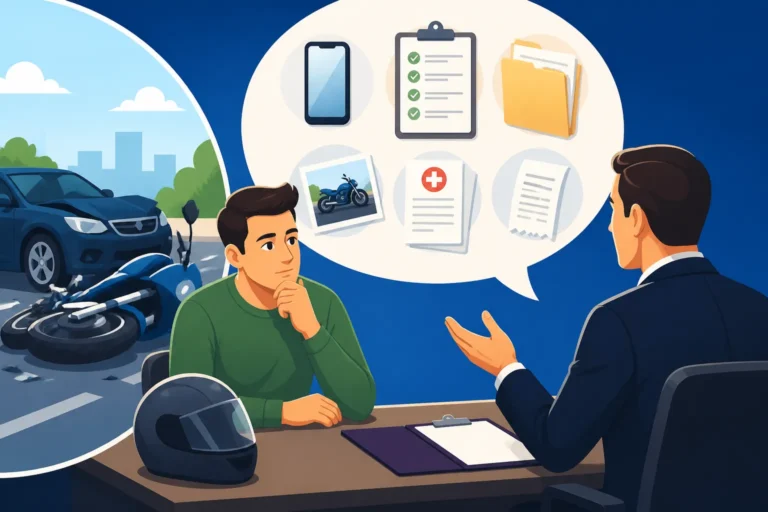
The foundation of any successful multi-defendant claim is an exhaustive investigation. Your lawyer won't just rely on the police report, which often only paints a preliminary picture and sometimes even contains errors or biases against riders. Instead, they will launch their own detailed inquiry. This typically involves revisiting the accident scene to collect photographic and video evidence, examining skid marks, debris fields, and traffic patterns. They’ll also gather witness statements, review surveillance footage from nearby businesses or traffic cameras, and obtain cell phone records to check for distracted driving.
When a road hazard is involved, they’ll secure maintenance records from municipal departments and consult with civil engineers to assess the defect. For product liability claims, they'll work with forensic experts to analyze the failed motorcycle part, determining if it had a manufacturing defect or was improperly installed. Every piece of evidence is crucial, as it helps to build a compelling narrative against each defendant, demonstrating their individual contributions to the crash. Detailed documentation of the scene is essential for Motorcycle Accident Evidence for Proving Fault.
Navigating Multiple Insurance Companies
Perhaps the most frustrating aspect of multi-defendant cases for an injured rider is dealing with multiple insurance adjusters. Each insurance company represents its own client and its own financial interests, which means they're usually trying to minimize payouts or, even worse, deflect blame entirely onto another party or, unfortunately, onto you. They might argue that another driver was solely at fault, or that the road condition was not their client’s responsibility, or that your injuries were pre-existing.
Your attorney acts as a crucial buffer in this often-contentious environment. They will handle all communications with every insurance company involved, preventing adjusters from twisting your words or pressuring you into unfavorable settlements. They understand the tactics insurers use to assign blame to riders and how to counter them effectively. They'll submit comprehensive demand letters to each insurer, detailing the evidence of their client's fault and the full extent of your damages, including medical expenses, lost wages, pain and suffering, and property damage. An experienced attorney knows How Insurance Companies Assign Blame to Riders and can fight back.
Legal Pleadings and Lawsuit Filing
In most multi-defendant cases, your attorney will likely file a single lawsuit against all responsible parties. This is often more efficient than filing separate lawsuits, as all claims can be litigated together in the same court. The initial legal documents, known as "pleadings," will outline the facts of the accident, identify each defendant, and state the legal basis for holding each party liable. This consolidated approach allows the court to assess the full picture and determine each party's share of fault.
Throughout the litigation process, your attorney will engage in discovery—exchanging information and evidence with all defendants. This can involve depositions, where witnesses and defendants are questioned under oath, and requests for documents and other forms of evidence. The goal is to gather even more information to solidify the case against each defendant and prepare for potential settlement negotiations or, if necessary, a trial. When seeking legal assistance for such intricate matters, resources like LegalMatch can connect you with attorneys well-versed in complex legal pleadings and multi-defendant lawsuits.
How Liability is Apportioned Among Multiple Parties
When multiple parties are at fault, determining how much each party is responsible for your injuries and damages is critical. This process, known as "apportioning liability," is governed by state laws and can significantly impact the amount of compensation you ultimately receive. It’s rarely a simple 50/50 split and often requires sophisticated legal arguments.
Understanding Comparative and Contributory Negligence
Every state has laws that dictate how shared fault impacts a personal injury claim. Broadly, these fall into two categories:
- Contributory Negligence: This is the harshest rule, followed by only a handful of states like Maryland, Virginia, Alabama, and North Carolina. If you are found even 1% at fault for your accident, you are completely barred from recovering any damages from other at-fault parties. This rule can be devastating for motorcycle riders, who often face unfair bias.
- Comparative Negligence: Most states follow some form of comparative negligence, which allows you to recover damages even if you were partially at fault. There are two main types:
- Pure Comparative Negligence: In states like California, Florida, and New York, you can recover damages even if you are mostly at fault (e.g., 90% responsible). Your compensation is simply reduced by your percentage of fault. So, if you suffered $100,000 in damages but were 20% at fault, you would still recover $80,000.
- Modified Comparative Negligence: This is the most common system, used in states like Texas, Ohio, and Pennsylvania. You can recover damages only if your fault is below a certain threshold, usually 50% or 51%. If you are found to be 50% or 51% or more at fault, you cannot recover anything. If your fault is below that threshold, your compensation is reduced by your percentage of fault. For example, if you're in an accident in Ohio and found 40% at fault for $100,000 in damages, you'd get $60,000. But if you were found 51% at fault, you'd get nothing.
These rules, especially Comparative Negligence in Motorcycle Accidents, are vital to understand, as the other defendants and their insurers will certainly try to maximize your percentage of fault to reduce their own liability.
Joint and Several Liability
Another critical legal concept in multi-defendant cases is "joint and several liability," which is recognized in many states. This doctrine is a huge advantage for accident victims. It means that if multiple parties are found at fault, you can collect the entire amount of your damages from any one of the at-fault parties, regardless of their individual percentage of fault. The burden then falls on the paying defendant to seek contributions from the other at-fault parties.
For example, if you have $100,000 in damages, and two defendants are found 70% and 30% at fault respectively, under joint and several liability, you could potentially collect the full $100,000 from the 70% at-fault party. This is particularly important if one defendant has deep pockets (e.g., a large corporation or a well-insured driver) while another is underinsured or uninsured. Without this doctrine, if an underinsured defendant was only 30% at fault, you might only recover 30% of your damages from them, leaving you in a financial lurch.
The Role of Expert Witnesses and Accident Reconstruction
To accurately apportion fault among multiple parties, especially when conflicting accounts exist, expert witnesses are invaluable. Accident reconstructionists can meticulously analyze crash scene data, vehicle damage, and other evidence to create a scientific model of how the accident occurred. They can determine vehicle speeds, points of impact, and critical events leading up to the crash, helping to assign precise percentages of fault to each driver or other contributing factor.
Medical experts can testify about the nature and severity of your injuries, connecting them directly to the impact forces and mechanisms of the crash, which helps refute claims that your injuries were pre-existing or less severe than you claim. Economic experts can project future lost wages and medical costs, solidifying the monetary value of your claim. These experts provide objective, scientific evidence that can sway judges and juries, ensuring a fair allocation of responsibility and a more accurate assessment of your Types of Damages in a Motorcycle Accident Claim.
Here's a quick overview of common defendants and their potential liabilities:
| Defendant Type | Common Cause of Action | Typical Defenses | Impact on Claim Complexity |
|---|---|---|---|
| Other Drivers | Negligence (e.g., distracted driving, failure to yield, speeding) | Blaming rider, other drivers, road conditions | High |
| Vehicle Owners | Negligent entrustment, vicarious liability | Driver acted outside permission, no negligence | Medium (adds layer of insurance) |
| Government Entities | Negligent road maintenance, faulty signage/signals | Lack of notice, sovereign immunity, rider negligence | High (strict procedural rules) |
| Motorcycle Manufacturers | Product defect (e.g., brakes, tires, frame) | Improper maintenance, misuse, unauthorized modifications | Very High (requires specialized experts) |
| Repair Shops | Negligent repairs, faulty installation of parts | Rider error, unrelated defect, proper procedures followed | High (requires technical investigation) |
| Commercial Employers | Vicarious liability for employee actions, negligent hiring/training | Employee acted outside scope of employment | Medium |
Benefits of Having a Lawyer When Multiple Defendants Are Involved
Trying to manage a motorcycle accident claim with multiple defendants on your own is like trying to fix a complex engine with no tools or experience – you're likely to make things worse. An experienced motorcycle accident lawyer provides indispensable benefits, turning a daunting process into a manageable one with the best possible outcome. Many riders ask, Do You Need a Motorcycle Accident Lawyer, and in multi-defendant cases, the answer is almost always yes.
Streamlining Communication and Negotiations
Imagine fielding calls from three different insurance adjusters, two lawyers representing other drivers, and perhaps a city official, all while trying to recover from serious injuries. Each party will ask for statements, documents, and try to get you to admit fault or minimize your injuries. It's a full-time job in itself, and it's designed to overwhelm you.
Your lawyer becomes your single point of contact, taking over all communications. They know how to speak to insurance adjusters and opposing counsel, ensuring your rights are protected and you don't inadvertently say anything that could harm your claim. They consolidate requests for information, coordinate scheduling, and manage the flow of documents. This allows you to focus solely on your physical recovery, knowing that the legal complexities are being handled by a professional. This streamlined approach makes navigating the claim significantly less stressful. For more details on this process, consider reading How Lawyers Deal with Insurance Companies.
Maximizing Your Compensation
The primary goal of every insurance company, especially when multiple parties are involved, is to pay as little as possible. They will try every trick in the book to reduce the value of your claim by downplaying your injuries, disputing fault, or arguing that someone else is more responsible. When multiple insurers are involved, they often engage in a "battle of the adjusters," each trying to push liability onto the others.
An attorney levels the playing field. They meticulously calculate the full extent of your damages, including current and future medical expenses, lost wages, diminished earning capacity, pain and suffering, emotional distress, and property damage. They then leverage their negotiation skills, backed by solid evidence and expert testimony, to demand fair compensation from all responsible parties. They can identify all potential sources of recovery, including stacked insurance policies, commercial liability, and government funds, ensuring no stone is left unturned. This comprehensive approach is key to How to Maximize Your Motorcycle Accident Settlement. When you're seeking to ensure you get the maximum compensation possible in such a complex claim, services like LegalMatch can help you find attorneys who are experts in this field.
Navigating Complex Legal Procedures
Multi-defendant litigation involves a host of intricate legal rules and procedures that are completely unfamiliar to most laypersons. There are specific rules for filing lawsuits, serving defendants, conducting discovery, filing motions, and adhering to strict court deadlines. A single misstep or missed deadline can jeopardize your entire case.
A skilled attorney is intimately familiar with these rules, ensuring that all legal requirements are met flawlessly. They know which legal arguments to make, how to challenge opposing counsel's tactics, and when to bring in expert witnesses. They will handle everything from drafting and filing legal documents to representing you in court, if the case proceeds to trial. This expertise is crucial for successfully maneuvering through the legal system and protecting your right to compensation. Understanding What a Motorcycle Accident Lawyer Does highlights just how vital their role is in these situations.
Disclaimer
Please note that this content is intended for informational purposes only and does not constitute legal advice. Motorcycle accident laws vary significantly by state, and the specifics of your case will dictate the applicable laws and potential outcomes. If you have been involved in a motorcycle accident, it is highly recommended that you consult with a qualified personal injury attorney in your jurisdiction to discuss your specific situation and legal options.