Motorcycle Accident Fault Laws in Illinois
Dealing with the aftermath of a motorcycle accident is already traumatic enough, but trying to navigate the complex world of insurance claims and legal fault can feel like a cruel second blow. Many riders in Illinois find themselves asking, "How exactly does the law decide who's to blame?" This guide will break down Illinois' specific fault laws, explain how blame is assigned in motorcycle crashes, and detail how shared fault can impact your ability to recover compensation, helping you understand your rights and the unique challenges you might face.
Understanding Illinois' Modified Comparative Negligence
Illinois operates under an "at-fault" insurance system, which means that the party primarily responsible for causing the accident is generally liable for the damages. However, it's not always a clear-cut case of one person being 100% at fault. In the world of motorcycle accidents, especially, blame can often feel like a moving target, with insurance companies frequently trying to shift some, or even all, of the responsibility onto the rider. That's where Illinois' specific rule of "modified comparative negligence" comes into play, and it's absolutely crucial for any rider to understand.
The 51% Rule and Its Implications
Illinois law, much like in a number of other states, follows a rule known as "modified comparative negligence" with a 51% bar. What this essentially means is that you, as the injured motorcyclist, can still recover compensation even if you were partly to blame for the accident. However, there's a significant catch: your own percentage of fault cannot exceed 50%. If a jury or insurance adjuster determines that you were 51% or more responsible for the crash, you are completely barred from recovering any damages from the other party. This rule is designed to prevent a plaintiff from recovering if they bear the majority of the blame, but it also means that even a slight shift in the fault percentage can dramatically alter, or even erase, your entire claim. It's a tough pill to swallow when you know you're hurt and facing mounting bills, but this is the reality of the legal landscape in Illinois. Understanding the difference between pure vs modified comparative negligence is vital for any rider.
How Comparative Negligence Reduces Your Payout
Let's talk about the practical side of this. If you are found to be partially at fault, your total compensation award will be reduced proportionally by your percentage of blame. For example, if your damages (medical bills, lost wages, pain and suffering) are calculated at $100,000, but you are found to be 20% at fault for the accident, your maximum recoverable amount will be reduced by 20%. This means you would only be able to recover $80,000. While $80,000 is still a substantial amount, it's significantly less than the total damages you incurred, and it highlights how critical it is to fight against any unfair assignment of fault. Insurance companies are acutely aware of this rule and will often attempt to push your fault percentage as high as possible, sometimes even just over the 50% mark, to avoid paying out entirely. This is why accurately assessing and proving fault in a motorcycle accident is so important.
How Fault is Determined in Illinois Motorcycle Crashes
Determining who is truly at fault in a motorcycle accident in Illinois is a comprehensive process that goes far beyond a simple "he said, she said" scenario. It involves a meticulous collection of evidence, a deep understanding of traffic laws, and often, the reconstruction of the accident itself. For riders, who are often unfairly stereotyped, every piece of evidence can make a critical difference in proving your case.
The Role of Police Reports and Traffic Laws
One of the first and most critical pieces of evidence is usually the police report. When officers respond to the scene of a crash, they document their observations, interview witnesses, and often issue citations. The information contained in a police report, including details about traffic violations, can significantly influence initial fault assessments. For instance, if the other driver was cited for running a red light or making an unsafe lane change, it strongly supports a finding of their fault.
However, it's important to remember that a police report is not the final word on fault. Officers are not judges or juries, and their reports can sometimes contain inaccuracies or be biased. For example, some officers might be quicker to assign blame to the motorcyclist due to inherent biases against riders, even if the evidence doesn't fully support it. If you believe the police report is inaccurate or assigns fault unfairly, it's possible to challenge it, but this often requires substantial additional evidence to bolster your argument. Always remember, when you're caught in the whirlwind immediately after a crash, knowing what to do immediately after a motorcycle accident can make all the difference, including how you interact with law enforcement.
Evidence, Witness Statements, and Accident Reconstruction
Beyond the police report, a multitude of other factors contribute to determining fault. This includes:
- Physical Evidence: Skid marks, vehicle damage, debris patterns, and the final resting positions of the vehicles all tell a story about the forces involved and the sequence of events.
- Witness Statements: Independent eyewitnesses can provide invaluable, unbiased accounts of what happened. Their perspective can often corroborate your story or contradict the other driver's version of events. This is why gathering witness contact information at the scene, if possible, is so crucial.
- Dashcam/Surveillance Footage: In today's world, dashcams are becoming increasingly common. If either vehicle involved, or even a nearby business, has surveillance footage, it can provide irrefutable evidence of who was at fault.
- Traffic Camera Footage: Many intersections in Illinois, especially in cities like Chicago, Peoria, or Springfield, have traffic cameras that might have captured the incident. This footage can be a game-changer.
- Cell Phone Records: In cases of suspected distracted driving, cell phone records can sometimes prove if a driver was texting or talking at the time of the crash.
- Accident Reconstruction: For more complex accidents, experts can use all available data to scientifically reconstruct the crash, providing a detailed analysis of speed, angles of impact, and other critical factors. This can be particularly useful in challenging an unfair fault assignment or proving intricate details of a crash, like a left-turn collision.
The collective weight of this evidence is what ultimately allows for a thorough and accurate determination of fault, rather than relying solely on assumptions or initial impressions.
Common Scenarios and Illinois Law
Certain accident scenarios tend to recur in motorcycle accident cases, and how Illinois law views them is important.
- Left-Turn Accidents: These are tragically common. A car making a left turn often fails to see an oncoming motorcycle, leading to a collision. In most of these cases, the driver making the left turn is deemed at fault for failing to yield the right-of-way.
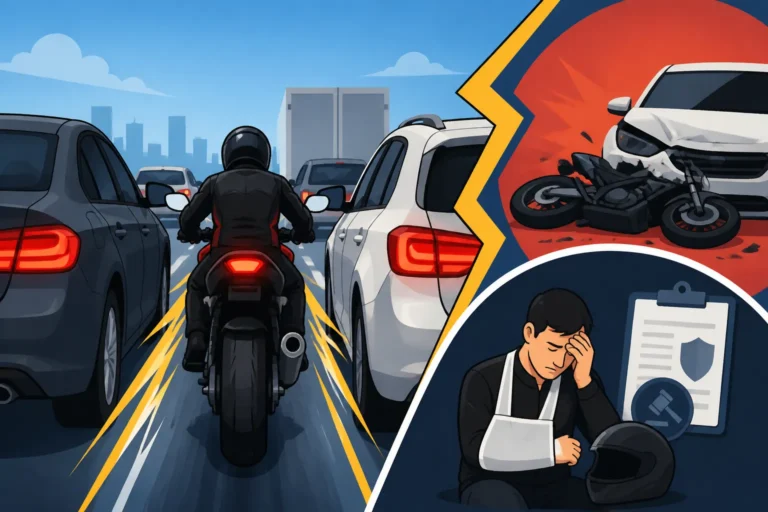
- Lane Splitting: While legal in California, lane splitting is generally not permitted in Illinois. If a motorcyclist is involved in an accident while lane splitting, they could be assigned a percentage of fault, even if another driver contributed to the crash. This is a common tactic insurance companies use to assign blame to riders.
- Distracted Driving: Drivers failing to see motorcycles is a lamentable and dangerous reality. When drivers are distracted by cell phones, passengers, or other internal/external factors, they often miss motorcycles. Proving this distraction can be challenging but is crucial for establishing fault against the driver.
- Road Hazards: Sometimes, the road itself is to blame. Potholes, gravel, uneven pavement, or construction debris can cause a rider to lose control. In such cases, the municipality or construction company responsible for maintaining the road could be held liable. However, proving government liability for road hazards can be a very complex undertaking.
Each scenario presents unique challenges in proving fault, and the specific details of the crash, coupled with Illinois' modified comparative negligence rules, will heavily influence the outcome.
The Impact of Shared Fault on Your Illinois Claim
The concept of shared fault is often where motorcycle accident claims become incredibly contentious. While Illinois allows for partial recovery, insurance companies and opposing legal teams will relentlessly try to maximize your assigned percentage of fault. This isn't just about reducing their payout; it's about potentially eliminating it entirely if they can push your fault over that 50% threshold.
How Your Percentage of Fault Directly Reduces Compensation
As we touched upon earlier, if you are found to be even 10% at fault, your total compensation is reduced by that 10%. If you're 40% at fault, your compensation drops by 40%. This isn't theoretical; it's a direct, dollar-for-dollar reduction that hits hard when you're already dealing with devastating injuries, medical bills, and lost income.
Consider a rider named David in suburban Chicago who suffered multiple fractures and road rash after a car abruptly changed lanes without signaling, colliding with his motorcycle. David's total damages, including medical expenses, lost wages, and pain and suffering, were assessed at $150,000. However, the insurance company argued that David was going slightly over the speed limit (estimated at 10 mph over) and should have had more time to react, assigning him 25% of the fault. Under Illinois' modified comparative negligence, David's $150,000 settlement would be reduced by 25%, meaning he would only receive $112,500. This example vividly illustrates how even a seemingly small percentage of fault can significantly impact your financial recovery.
Common Tactics to Assign Fault to Riders in Illinois
Insurance companies have a playbook when it comes to motorcycle accidents, and unfortunately, many of their strategies involve trying to pin blame on the rider. Here are some tactics you might encounter:
- The "I Didn't See the Motorcycle" Defense: This is perhaps the most common and frustrating defense. Drivers often claim they simply didn't see the motorcyclist, implying the rider was somehow invisible or should have done more to make themselves seen. This defense tries to shift responsibility onto the rider, suggesting a failure to operate safely, even when the driver was clearly negligent.
- Speeding or Reckless Driving Allegations: Even if a rider was not speeding, insurance companies may allege excessive speed or reckless behavior, playing into negative stereotypes about motorcyclists. This can be incredibly difficult to disprove without strong evidence like accident reconstruction or witness testimony.
- Lack of Proper Gear: While Illinois has a universal helmet law for all riders, meaning all motorcyclists must wear a helmet, insurers might still try to argue that a lack of other protective gear (like armored jackets or proper riding pants) contributed to the severity of injuries, even if it didn't cause the accident itself. This is a subtle but effective way to reduce the perceived value of your damages.
- Improper Lane Usage: Arguments about lane positioning, following distance, or even questions around lane splitting legality and fault by state, are often used to assign fault, even if the rider was operating safely and legally.
- Delayed Medical Treatment: If there's any gap between the accident and seeking medical attention, insurers might argue that your injuries weren't severe or were caused by something else, attempting to reduce your claim's value. This is why it's crucial to seek immediate medical attention after a crash.
It's a tough fight, but recognizing these tactics is the first step in countering them effectively. Knowing that insurers often employ rider bias in fault determination can help you prepare for what's to come.
Navigating the Legal Landscape and Protecting Your Rights
Given the complexities of Illinois' modified comparative negligence laws and the aggressive tactics often employed by insurance companies, protecting your rights after a motorcycle accident is paramount. You are not alone in this struggle, and there are concrete steps you can take to safeguard your claim.
Documenting the Scene and Your Injuries
Immediately following a motorcycle crash, if your injuries permit, documentation is key. Take photographs and videos of everything: the accident scene from multiple angles, vehicle damage, road conditions, traffic signs, and any visible injuries. Exchange information with the other driver and gather contact details from any witnesses. Also, seeking immediate medical attention is vital, not just for your health but also to establish a clear link between the accident and your injuries. Keep a detailed record of all medical appointments, treatments, and expenses. Your motorcycle accident evidence for proving fault starts from the moment the crash happens.
The Statute of Limitations in Illinois
Another critical factor in Illinois is the statute of limitations. This is a legal deadline by which you must file a personal injury lawsuit. In Illinois, generally, the statute of limitations for personal injury claims, including those arising from motorcycle accidents, is two years from the date of the accident. While two years might seem like a long time, it passes quickly when you're recovering from injuries, dealing with medical treatments, and trying to get your life back on track. Missing this deadline almost always means forfeiting your right to seek compensation, regardless of how strong your case might be. There are exceptions, of course, but it’s safest to assume the two-year rule applies to you. For a deeper dive into the specific deadlines, you might want to look into topics like The Statute of Limitations Explained.
Fighting Unfair Fault Assignment
The biggest frustration for many riders in Illinois is when they're unfairly blamed for an accident they didn't cause. Insurance adjusters, driven by profit, will often try to assign you a higher percentage of fault to reduce their payout. This is where the battle truly begins. You should never admit fault at the scene, as anything you say can and will be used against you.
To effectively fight back, you'll need robust evidence. This could include expert testimony from accident reconstructionists, detailed medical records proving the extent and cause of your injuries, and even compelling arguments based on the physics of the crash. Having a clear and comprehensive collection of evidence, coupled with a solid understanding of Illinois traffic laws, is your best defense against unfair fault assignments. Trying to fight these battles alone can be overwhelming, especially when you're physically and emotionally recovering.
When to Seek Legal Counsel
Given the complexity of Illinois' fault laws, the tactics employed by insurance companies, and the strict deadlines involved, many riders find themselves needing professional legal help. An experienced motorcycle accident attorney understands Illinois-specific laws and the nuances of accident reconstruction. They can:
- Investigate thoroughly: Gather evidence, interview witnesses, and work with experts to build a strong case.
- Negotiate with insurers: Protect you from lowball offers and aggressive tactics, ensuring your rights are upheld.
- Accurately assess damages: Calculate the full extent of your economic and non-economic damages, including future medical costs and lost earning capacity.
- Represent you in court: If a fair settlement cannot be reached, they can take your case to trial.
Trying to manage a serious injury claim against a large insurance company while focusing on your recovery is a monumental task. Having an advocate who knows the ins and outs of Illinois law, particularly concerning how comparative negligence affects your claim, can make a world of difference in securing the compensation you rightfully deserve.
| Fault Percentage Assigned to Rider | Impact on Compensation | Recoverable Damages Example ($100,000 total) | Legal Outcome |
|---|---|---|---|
| 0% | Full Recovery | $100,000 | Full |
| 10% | 10% Reduction | $90,000 | Partial |
| 25% | 25% Reduction | $75,000 | Partial |
| 49% | 49% Reduction | $51,000 | Partial |
| 50% | 50% Reduction | $50,000 | Partial |
| 51% or more | 100% Bar | $0 | No Recovery |
This table clearly illustrates the critical impact of Illinois' 51% modified comparative negligence rule on your potential compensation. Even one percentage point can turn a significant recovery into nothing.
Disclaimer
Please remember, this article provides general information and is not legal advice. Motorcycle accident laws are complex and vary by jurisdiction. For advice specific to your situation, you should consult with a qualified legal professional specializing in motorcycle accident claims in Illinois.