How Comparative Negligence Affects Settlements in Ohio
Riding a motorcycle in Ohio brings a unique sense of freedom, but it also means facing unique challenges, especially after an accident. One of the most confusing and frustrating aspects is trying to understand how fault plays into your ability to recover compensation for your injuries and damages. It's not always a clear-cut case of one person being 100% at fault, and often, both parties might share some responsibility. This guide aims to clear up the complexities of how comparative negligence in Ohio specifically impacts your motorcycle accident settlement, helping you navigate these tricky waters.
Understanding Ohio's Modified Comparative Negligence Rule
When you're involved in a motorcycle accident in Ohio, and injuries or damages occur, the legal system needs a way to assign responsibility. Unlike some states where one party is deemed entirely at fault, Ohio operates under a "modified comparative negligence" rule, specifically known as the "51% bar rule." This can be a game-changer for your claim, and frankly, it often leaves riders feeling unfairly targeted or confused about their rights.
What the 51% Bar Rule Means for Riders
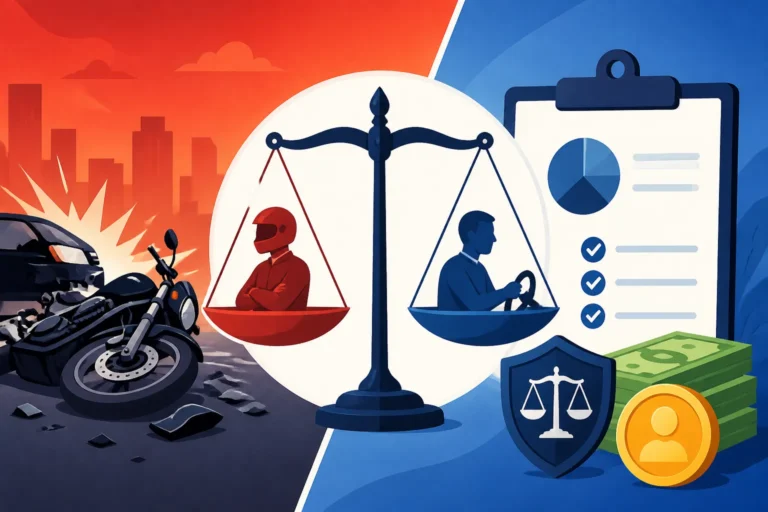
The core of Ohio's rule is straightforward, yet its implications are profound: you can still recover damages even if you were partially at fault for the motorcycle accident, as long as your fault is determined to be 50% or less. If your share of fault is found to be 51% or more, you are legally barred from recovering any damages from the other party.
Let's break that down. Imagine you're riding through Columbus, and a driver makes a sudden, unsafe lane change, causing a collision. However, let's say a jury or an insurance adjuster determines that you were speeding slightly, contributing 20% to the cause of the accident, while the other driver's unsafe maneuver contributed 80%. Under Ohio's 51% rule, you can still pursue compensation. However, your total recoverable damages will be reduced by your percentage of fault. So, if your total damages (medical bills, lost wages, pain and suffering, bike repair) were calculated at $100,000, that 20% fault means you'd only be able to recover $80,000. It's a significant reduction, but it's still far better than receiving nothing.
This rule is a sharp contrast to "pure comparative negligence" states where you could theoretically be 99% at fault and still recover 1% of your damages. Ohio draws a firm line at 51%, and understanding this threshold is absolutely critical for any rider involved in a crash. Many riders don't realize this until they're deep into the claim process, which can lead to immense frustration when an insurer tries to push their fault above that crucial 50% mark.
How Fault is Determined by Insurance Companies and Courts
Determining who is at fault in a motorcycle accident is rarely a simple task, and it often becomes a battle of narratives, especially when comparative negligence comes into play. Insurance companies, frankly, are always looking for ways to minimize their payout, and assigning a higher percentage of fault to the motorcycle rider is a common tactic. They often capitalize on pre-existing biases against motorcyclists.
Insurance adjusters will meticulously gather evidence, including police reports, witness statements, photographs of the scene, vehicle damage, and medical records. They'll also scrutinize traffic laws, accident reconstruction reports, and sometimes even social media posts. For example, if you were involved in a Left-Turn Motorcycle Accident, where a car turned in front of you, the driver might argue you were speeding or in their blind spot, even if the primary cause was their failure to yield. They’ll look for any shred of evidence that suggests you contributed to the crash. This process can feel intrusive and unfair, especially when you're dealing with injuries and the trauma of the accident itself.
Courts follow a similar, albeit more formalized, process. If a settlement cannot be reached, the case might go to trial, where a jury will hear all the evidence and arguments. It will then be up to the jury to assign a percentage of fault to each party involved. This is why gathering comprehensive Motorcycle Accident Evidence for Proving Fault from the outset is paramount. Every detail, from skid marks to weather conditions, can influence how fault is perceived and assigned.
Impact on Your Motorcycle Accident Settlement
The determination of comparative negligence in Ohio directly influences the actual payout you receive. It's not just about if you get compensated, but how much. This is where the rubber truly meets the road, and understanding the financial implications can help you set realistic expectations and strategize your claim.
Reducing Economic Damages
Economic damages are the tangible, quantifiable losses you suffer due to an accident. These include things like medical bills, lost wages, property damage to your motorcycle, and even future medical expenses or loss of earning capacity. These are the damages that are relatively easy to put a dollar figure on, though calculating future losses can get complex.
Let's revisit our earlier example. If your total economic damages—including that hospital stay in Cleveland, therapy sessions in Cincinnati, your broken Harley-Davidson Street Glide, and the income you missed from your job—total $50,000, and you're found 20% at fault, that $50,000 will be reduced by 20%. You'd then only be able to claim $40,000 for your economic losses. If your fault climbs to 51% or higher, you would get nothing for those very real and significant costs. This scenario is a stark reminder of why even a small percentage of fault can have a substantial financial consequence. It means that while the other driver’s insurance might cover a portion, you could be left footing a significant part of the bill for injuries and damages that weren't entirely your fault.
It's also important to remember that these calculations don't account for how much a settlement could be reduced if you weren't wearing a DOT-compliant helmet, even if it wasn't a direct cause of the collision, as insurers sometimes use the "helmet defense" to argue for reduced payouts for head injuries.
Affecting Non-Economic Damages
Beyond the bills and lost income, a motorcycle accident inflicts a heavy toll on your quality of life. Non-economic damages are meant to compensate you for these less tangible, yet very real, losses. This includes physical pain and suffering, emotional distress, loss of enjoyment of life, disfigurement, and even post-traumatic stress disorder (PTSD).
These damages are notoriously harder to quantify, often relying on formulas or multipliers applied to economic damages, as well as compelling evidence of your suffering. If you've been through a traumatic accident that left you with chronic pain, recurring nightmares, or unable to enjoy riding your bike again, these are legitimate losses. However, just like economic damages, your non-economic damages will be reduced by your percentage of comparative fault. If a jury awards you $50,000 for pain and suffering, and you are found 20% at fault, that award instantly drops to $40,000. The emotional and physical toll doesn't get reduced, but the financial recognition of it does.
Imagine you're a passionate rider who suddenly can't even stand the thought of getting on a bike after a severe accident, or you're dealing with debilitating back pain. The mental anguish and loss of a cherished hobby are profound. When an insurance company or court assigns even a minor percentage of fault to you, it feels like they're diminishing the very real impact the accident has had on your life. This is why having strong evidence, like an injury journal detailing your daily pain and emotional struggles, is crucial.
Real-World Settlement Scenarios in Ohio
To really drive home the point, let's look at some hypothetical scenarios based on Ohio's 51% comparative negligence rule. These examples illustrate how the same initial damage value can result in wildly different net settlements depending on the assigned fault.
Consider an accident where the total assessed damages (medical, lost wages, bike repair, pain and suffering) are $100,000.
| Rider's Percentage of Fault | Driver's Percentage of Fault | Recoverable Damages (after reduction) | Outcome |
|---|---|---|---|
| 0% | 100% | $100,000 | Full Recovery |
| 10% | 90% | $90,000 (10% reduction) | Partial Recovery |
| 25% | 75% | $75,000 (25% reduction) | Partial Recovery |
| 50% | 50% | $50,000 (50% reduction) | Partial Recovery |
| 51% | 49% | $0 | No Recovery (barred by law) |
| 75% | 25% | $0 | No Recovery (barred by law) |
As you can clearly see, crossing that 50% fault threshold is the most critical factor. Even if the other driver was also significantly negligent, if your actions are deemed to have contributed more than half to the accident, you walk away with nothing. This emphasizes why every percentage point matters when it comes to Shared Fault in Motorcycle Accidents.
Protecting Your Claim Against Comparative Negligence Arguments
Given Ohio's strict 51% bar rule, it’s not enough to simply prove the other driver was at fault; you must also diligently work to minimize any perceived fault on your part. Insurance adjusters are experts at finding ways to shift blame, and as a motorcycle rider, you often face an uphill battle due to common biases. You need to be proactive and strategic from day one.
Documenting the Scene and Your Injuries Thoroughly
The moments immediately following an accident are chaotic, but what you do then can significantly impact your ability to counter comparative negligence arguments later. Photos and videos of the accident scene from various angles are invaluable. Take pictures of your motorcycle's final resting place, the other vehicle, road conditions, traffic signs, skid marks, and any debris. Capture the general intersection or road layout. This helps show exactly what happened and can refute claims about your positioning or speed.
Beyond the scene, diligent documentation of your injuries and medical treatment is crucial. Seek immediate medical attention, even if you feel fine, as some injuries, like a Traumatic Brain Injury, may have delayed symptoms. Follow all doctor's orders, attend every therapy session, and keep a detailed record of your symptoms, pain levels, and how your injuries affect your daily life. An "injury journal" can be incredibly persuasive in showing the true extent of your suffering and countering arguments that your injuries aren't as severe as you claim. Any gaps in treatment or failure to follow medical advice can be used by the defense to suggest your injuries are not as severe or were worsened by your own negligence.
Remember, a police report can be a double-edged sword. While it provides official documentation, sometimes errors or biases creep in. If you believe the report unfairly assigns blame or misrepresents facts, you might need to understand How to Correct a Wrong Police Report.
Countering Rider Bias and Unfair Fault Assignments
Unfortunately, motorcyclists often contend with unfair biases. The phrase "I didn't see the motorcycle" is all too common, and insurers might subtly suggest that because you were on a motorcycle, you were inherently more at risk or riding aggressively. This is where a strong legal approach comes into play.
Your lawyer can work to actively counter these stereotypes by presenting evidence that paints a clear picture of your responsible riding. This might involve obtaining expert testimony from accident reconstructionists who can analyze the physics of the crash and definitively show how the other driver's actions were the primary cause. They can also highlight your adherence to traffic laws and responsible riding practices. For instance, if the other driver failed to yield while making a turn, your lawyer will emphasize their clear violation, regardless of minor contributing factors on your end.
Understanding How Insurers Use Rider Stereotypes Against You is the first step to fighting back. It’s about building a narrative based on facts, not assumptions. This might include presenting evidence that you were wearing appropriate gear, like a DOT-approved helmet, even if it’s not legally required for all riders your age in Ohio, as it demonstrates responsibility and concern for safety. This attention to detail in your defense can be the difference between recovering significant compensation and receiving nothing at all.
The Role of Legal Counsel in Ohio Comparative Negligence Cases
Navigating comparative negligence in Ohio on your own can feel overwhelming, especially when you're recovering from injuries. An experienced motorcycle accident attorney understands the nuances of Ohio's specific laws and how to effectively combat insurance company tactics. They know how to gather critical evidence, interview witnesses, and, if necessary, bring in experts to strengthen your case and challenge any attempts to unfairly assign you a high percentage of fault.
A skilled attorney will relentlessly investigate the crash, identify all potential parties at fault, and build a compelling case to minimize your comparative negligence. They will also handle all communications and negotiations with insurance companies, protecting you from saying anything that could inadvertently hurt your claim. In Ohio, where that 51% threshold looms large, having a legal advocate who specializes in motorcycle accidents can significantly impact How Comparative Negligence Reduces Your Payout and your ultimate ability to recover damages. They are your best defense against having your financial recovery unfairly reduced or completely denied due to comparative fault.
Disclaimer
Please note that this article is intended for informational purposes only and does not constitute legal advice. Motorcycle accident laws, including those pertaining to comparative negligence, can be complex and vary based on specific circumstances. It is crucial to consult with a qualified Ohio motorcycle accident attorney to discuss the specifics of your case and receive personalized legal guidance.