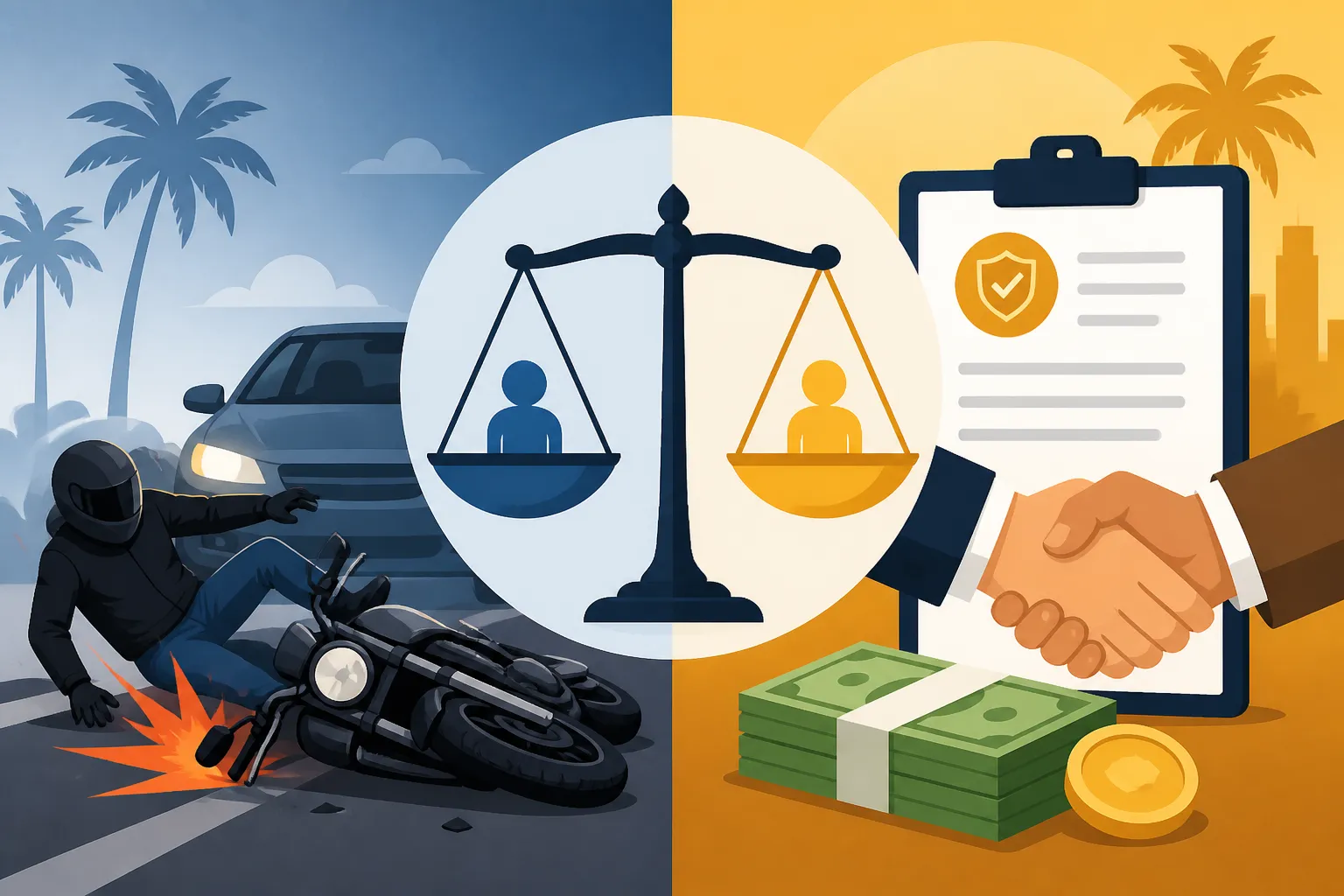
How Comparative Negligence Affects Settlements in Florida
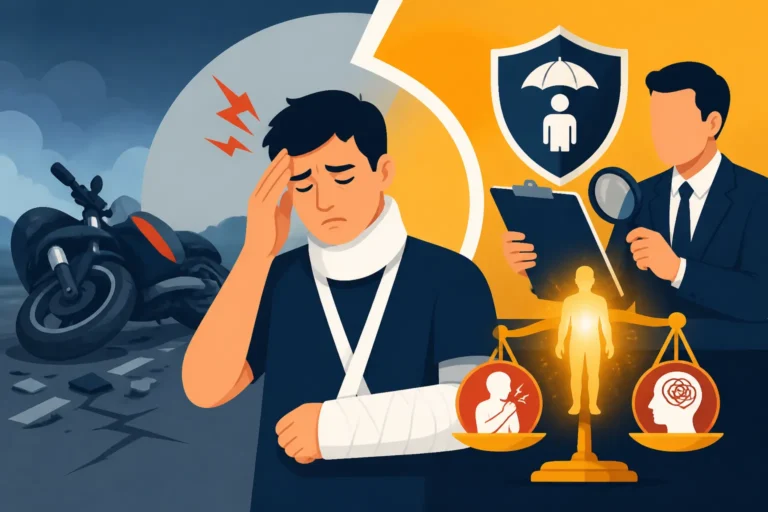
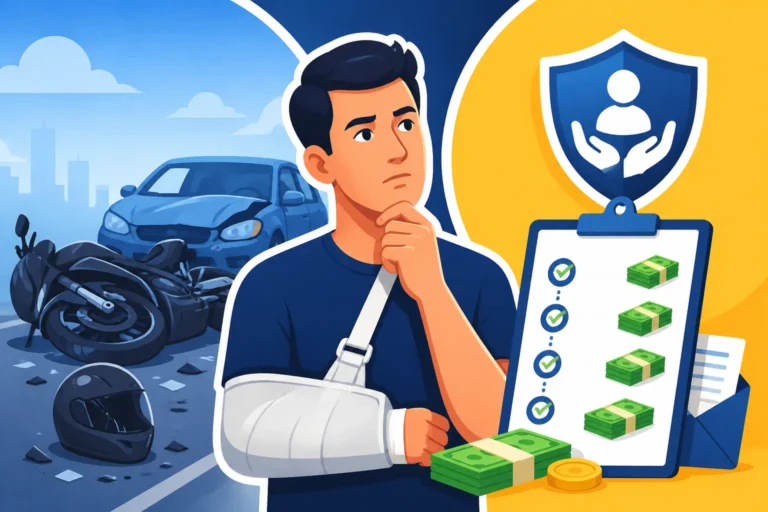
It's incredibly frustrating when you've been in a motorcycle accident and are dealing with serious injuries, only to have the insurance company try to pin some of the blame on you. Navigating the legal complexities of shared fault can feel overwhelming, especially when you're focused on recovery. This guide will walk you through how comparative negligence laws in Florida specifically impact your motorcycle accident settlement, helping you understand your rights and how to protect your claim.
Understanding Comparative Negligence in Florida
When you're involved in a motorcycle accident, one of the biggest questions that arises is "who is at fault?" In Florida, like many states, it's not always a black-and-white answer. The Sunshine State operates under a system known as pure comparative negligence. This means that even if you, as the motorcycle rider, are found partially responsible for the accident, you can still recover damages from the other party. However, your compensation will be reduced by your percentage of fault. This can be a huge relief for riders who might otherwise be completely barred from recovering anything.
What is Pure Comparative Negligence?
Pure comparative negligence is a legal doctrine that allows an injured party to recover damages even if they are largely at fault for the accident, with their compensation simply reduced proportionally. Let's say you're riding your motorcycle through Miami, and a car suddenly makes a U-turn in front of you without signaling. You swerve, but unfortunately, you clip their bumper and go down. The investigation might find that the car driver was 80% at fault for the illegal U-turn, but you were 20% at fault because you might have been slightly exceeding the speed limit or not maintaining sufficient distance.
Under Florida's pure comparative negligence system, if your total damages (medical bills, lost wages, pain and suffering) are calculated at $100,000, and you are found 20% at fault, your recoverable compensation would be reduced by 20%. So, instead of $100,000, you would receive $80,000. This system aims for a fair distribution of consequences based on each party's contribution to the crash. It's a critical difference from other states, which we'll discuss next.
How It Differs from Other Negligence Rules
It's important to recognize that not all states handle shared fault the same way. Florida's pure comparative negligence rule stands in contrast to other systems, most notably modified comparative negligence and contributory negligence.
In states with a modified comparative negligence rule (like Texas, for example), you can only recover damages if your percentage of fault is below a certain threshold, usually 50% or 51%. If you are found 50% or 51% or more at fault, you might recover nothing. This means if you're deemed 51% responsible for a crash, your claim is completely barred, regardless of how severe your injuries are. This can be a harsh reality for riders in those states. For a deeper dive into these differences, you might find our article on Pure vs Modified Comparative Negligence Explained helpful.
Then there's the even stricter contributory negligence rule, which is only followed in a handful of states. Under this old-school system, if you are found even 1% at fault for an accident, you are completely barred from recovering any damages. Imagine a minor infraction, like a tail light being out, completely preventing you from getting compensation after a severe collision where the other driver was clearly mostly to blame. It's a very unforgiving standard that Florida wisely avoids. Understanding these distinctions really highlights why Florida's approach, while reducing your payout, doesn't outright deny it based on partial fault.
How Your Degree of Fault Impacts Your Payout
The percentage of fault assigned to you directly correlates with how much money you can ultimately receive in your motorcycle accident settlement. This is where the insurance companies really come into play, as they will almost always try to assign some degree of fault to the motorcyclist to reduce their payout. It's an uphill battle sometimes, but knowing how the system works can empower you.
Calculating Damages with Shared Fault
The calculation is relatively straightforward: your total damages are determined, and then that amount is reduced by your established percentage of fault. Total damages aren't just your medical bills; they encompass a wide range of losses, including lost wages, property damage, and the often-significant pain and suffering you endure. Our guide on How Motorcycle Accident Settlements Are Calculated provides a more detailed breakdown of these components.
Let's consider a practical example. Imagine you suffered a severe broken leg and extensive road rash after being hit by a distracted driver near Orlando. Your total economic damages (medical bills, lost income, motorcycle repairs) amount to $75,000, and your non-economic damages (pain, suffering, emotional distress) are valued at $125,000, bringing your total to $200,000. If an investigation, perhaps with the help of an accident reconstruction expert, concludes that the other driver was 90% at fault for distracted driving, but you were 10% at fault for, say, slightly over-accelerating at the intersection, your $200,000 settlement would be reduced by 10%. This means you would receive $180,000. This reduction applies across all categories of damages.
The table below illustrates how different fault percentages can affect a hypothetical $100,000 total damage claim in Florida:
| Rider's Fault Percentage | Other Driver's Fault Percentage | Original Damages | Reduction Amount | Net Settlement Amount |
|---|---|---|---|---|
| 0% | 100% | $100,000 | $0 | $100,000 |
| 10% | 90% | $100,000 | $10,000 | $90,000 |
| 25% | 75% | $100,000 | $25,000 | $75,000 |
| 50% | 50% | $100,000 | $50,000 | $50,000 |
| 75% | 25% | $100,000 | $75,000 | $25,000 |
As you can see, every percentage point of fault assigned to you directly reduces your potential compensation. This is why disputing unfair fault assignments is so critical.
The "Helmet Defense" and Comparative Negligence
In Florida, the "helmet defense" is a specific way your actions can impact your settlement under comparative negligence rules, even if you didn't directly cause the accident. While Florida has a Motorcycle Helmet Laws by State that allows riders over 21 to ride without a helmet if they have adequate insurance coverage, choosing not to wear one can still impact your claim if you sustain a head injury.
The helmet defense argument, detailed in our post on The Helmet Defense Explained, suggests that had you been wearing a DOT-compliant helmet, your head injuries would have been less severe or avoided entirely. Insurance companies love to use this. They'll argue that even if their insured driver was 100% at fault for the collision, your head injury damages should be reduced because you "failed to mitigate" your injuries by not wearing a helmet. For example, if your total damages are $200,000, but $100,000 of that is for a traumatic brain injury, and the insurance company successfully argues you were 30% responsible for the severity of that specific injury due to not wearing a helmet, your recovery for that portion of your damages could be reduced.
It's a tricky area because not wearing a helmet doesn't make you at fault for the cause of the crash. However, it can certainly reduce the amount of compensation you receive for certain types of injuries. This is a prime example of how insurance companies assign blame to riders, even indirectly.
Common Scenarios Where Riders Share Fault
Unfortunately, there are many common situations where motorcycle riders might be assigned partial fault in a collision, even when the other driver initiated the dangerous situation. Recognizing these can help you be more vigilant on the road and better prepare for a potential claim.
- Speeding: Even if a car pulled out in front of you, if you were exceeding the posted speed limit, the insurance company might argue you had less time to react and therefore share some blame.
- Unsafe Lane Changes: If you were attempting a lane change at the same time a car merged into your lane, or if you were lane splitting where it wasn't legal or safe, you could be assigned partial fault. Our guide on Lane Splitting and Motorcycle Accident Liability delves into this complex topic.
- Following Too Closely: Rear-end collisions are often automatically assumed to be the fault of the trailing driver. While this isn't always true for motorcycles, an insurance adjuster will certainly try to argue you were tailgating.
- Failure to See the Other Vehicle: The classic "I didn't see the motorcycle" defense is rampant. However, if the accident reconstruction shows you could have seen the car entering your path and had time to react, you might be assigned some fault for failing to avoid the collision. This doesn't mean you're to blame, but it's a common tactic used by the defense.
- Illegal Maneuvers: Any traffic violation on your part, no matter how minor, can be used by the defense to argue shared fault. This includes running a yellow light that turned red, not yielding the right of way, or making an illegal turn.
These are just a few examples. The key takeaway is that insurance companies will scour every detail to find any reason to reduce their payout, and assigning partial fault to the rider is their go-to strategy.
Gathering Evidence to Minimize Your Fault
When comparative negligence is on the table, the evidence you collect becomes absolutely paramount. Every piece of information helps paint a clearer picture of what truly happened and can significantly reduce any fault unfairly attributed to you. It's all about proving the other driver's negligence while simultaneously disproving your own.
The Importance of Documentation at the Scene
After a motorcycle accident, the scene of the crash is a fleeting moment in time. What you document immediately can make or break your claim. The adrenaline makes it hard to think clearly, but try your best to gather as much as possible. Our article, What to Do After a Motorcycle Accident, offers a detailed checklist.
- Photos and Videos: Take pictures and videos from every angle imaginable. Get shots of your motorcycle, the other vehicle, road conditions, traffic signs, skid marks, debris, and any visible injuries. If the other driver claims you were speeding, but your bike is barely damaged and their car is totaled, that tells a story. Look for damage on both vehicles to help establish the point of impact and force.
- Witness Information: Eyewitnesses can be invaluable. Get their names, phone numbers, and email addresses. Their unbiased accounts can directly counter an insurance company's attempt to blame you. Ask them what they saw.
- Police Report: The official police report can be a double-edged sword, as discussed in How a Police Report Can Hurt Your Claim. While it offers an official account, sometimes police officers, lacking specific motorcycle accident training, might misinterpret events or be influenced by rider stereotypes. Nonetheless, it’s a crucial document and part of the official record. Make sure to note the reporting agency and report number.
- Exchange Information: Get the other driver's insurance information, driver's license number, and contact details. This is standard procedure but vital.
Thorough documentation allows your legal team to build a strong case and challenge any accusations of shared fault effectively.
Medical Records and Treatment History
Your medical records are the backbone of your injury claim. They establish the extent of your injuries, the necessary treatment, and the associated costs. When dealing with comparative negligence, a complete and consistent medical history is even more critical.
- Seek Immediate Medical Attention: Even if you feel fine after a crash, see a doctor. Adrenaline can mask pain, and some serious injuries, like concussions or internal bleeding, might not be immediately apparent. Gaps in medical treatment can be used by insurance companies to argue that your injuries weren't severe or weren't directly caused by the accident.
- Follow Doctor's Orders: Adhere to all prescribed treatments, therapies, and follow-up appointments. If you skip physical therapy sessions or don't take medication as directed, the defense might argue you worsened your own condition or prolonged your recovery, implicitly suggesting a form of self-negligence.
- Document Everything: Keep a journal of your pain levels, limitations, and how your injuries affect your daily life. This helps quantify your pain and suffering, which is a major component of your total damages. It also creates a chronological record of your struggles.
Clear and consistent medical documentation directly supports your claim for damages and helps refute any attempts by the other side to minimize the impact of the accident on your life.
Accident Reconstruction and Expert Testimony
Sometimes, an accident is so complex that simply looking at photos or a police report isn't enough to determine fault accurately. This is particularly true in disputes involving comparative negligence, where subtle details can shift fault percentages. In these situations, an accident reconstruction expert can be invaluable.
These professionals use scientific principles, physics, and advanced software to recreate the accident scene. They can analyze skid marks, vehicle damage, traffic camera footage, and even witness statements to determine vehicle speeds, angles of impact, and critical moments leading up to the crash. Their testimony can provide an objective, data-driven assessment of fault, which can be highly persuasive to an insurance company or a jury.
For instance, if the other driver claims you were speeding, but an accident reconstructionist can prove based on the impact dynamics that you were within the legal limit, it completely undermines the defense's claim of your comparative negligence. This kind of expert evidence is a powerful tool for Proving Fault in a Motorcycle Accident and minimizing any blame placed on you.
Negotiating Your Settlement with Comparative Negligence
Navigating settlement negotiations when comparative negligence is a factor can feel like a high-stakes poker game. Insurance companies are experts at using any perceived fault on your part to reduce their payout. This is where strategic thinking and experienced representation truly shine. For tips on maximizing your overall compensation, read our guide on How to Maximize Your Motorcycle Accident Settlement.
Dealing with Insurance Adjusters
Insurance adjusters are not on your side, no matter how friendly they seem. Their primary goal is to settle your claim for the lowest possible amount, and they are trained to find ways to assign fault to you. They will ask leading questions, try to get you to admit fault, or downplay your injuries.
- Be Careful What You Say: Never admit fault or make statements that could be interpreted as admitting fault, such as "I didn't see them" or "I should have been more careful." Stick to the facts.
- Do Not Accept the First Offer: The initial offer is almost always a lowball, especially when comparative negligence is a factor. They are testing the waters to see if you're desperate or unknowledgeable. Our article on How to Handle a Lowball Settlement Offer explains this in detail.
- Understand Their Tactics: Adjusters might try to delay the process, claim your injuries are pre-existing, or argue that your medical treatment was excessive. When comparative negligence is a concern, they will specifically focus on any alleged traffic violations or actions they can pin on you to reduce the claim. They might bring up common causes of motorcycle accidents and try to fit your situation into a narrative that blames you.
It's a continuous negotiation, and it's essential to present a strong, evidence-backed case to counter their tactics.
The Role of a Motorcycle Accident Attorney
This is perhaps the most critical component when comparative negligence is at play. Trying to fight an insurance company on your own, especially when they're actively trying to blame you, is an uphill battle that most people lose. A skilled motorcycle accident attorney is your advocate and expert guide through this complex process.
- Expert Knowledge: Attorneys specializing in motorcycle accidents understand Florida's comparative negligence laws inside and out. They know how insurance companies operate and how to counter their blame-shifting tactics.
- Evidence Collection and Analysis: Your lawyer will know exactly what evidence is needed to prove the other driver's fault and defend against accusations of your own negligence. They can enlist accident reconstructionists, obtain expert medical opinions, and gather traffic camera footage or black box data that you might not even know exists.
- Negotiation Power: An attorney brings significant leverage to the negotiating table. Insurance companies know that a lawyer isn't afraid to go to court if a fair settlement can't be reached. This often leads to more serious settlement offers. Our post on Do You Need a Motorcycle Accident Lawyer explains why this expertise is invaluable.
- Protecting Your Rights: They will ensure deadlines are met, paperwork is filed correctly, and your rights are protected throughout the entire process. They also understand how insurance companies assign blame to riders and can effectively challenge those assessments.
Ultimately, a good attorney can significantly increase your chances of recovering maximum compensation, even when comparative negligence is a factor.
Understanding Your Potential Settlement Range
The final settlement amount in a motorcycle accident claim involving comparative negligence is never an exact science. It depends on numerous factors, including the severity of your injuries, the total economic and non-economic damages, the clarity of fault, and, of course, the percentage of fault ultimately assigned to you.
Your attorney will help you understand a realistic range for your settlement. This involves:
- Detailed Damage Assessment: Calculating all current and future medical expenses, lost wages, property damage, and a fair value for your pain and suffering and emotional distress.
- Precedent and Case Law: Drawing on their experience with similar cases and understanding how juries in Florida have awarded damages in situations with shared fault.
- Negotiation Strategy: Developing a strategy to argue for a lower percentage of fault for you and a higher percentage for the other driver. This might involve discrediting witness testimony or presenting compelling expert analysis.
Even if you are assigned some fault, a skilled attorney can work to keep that percentage as low as possible, thereby maximizing your net payout. They will fight vigorously against an unfair fault assignment to ensure that Florida’s comparative negligence rules don’t unduly penalize you. Our guide on How Comparative Negligence Reduces Your Payout provides further details on the financial implications.
Disclaimer
Please remember that this article provides general information and insights into how comparative negligence affects motorcycle accident settlements in Florida. It is not legal advice. Every accident and claim is unique, and the information presented here may not apply to your specific situation. For personalized legal guidance tailored to your case, it is highly recommended to consult with a qualified motorcycle accident attorney in Florida.