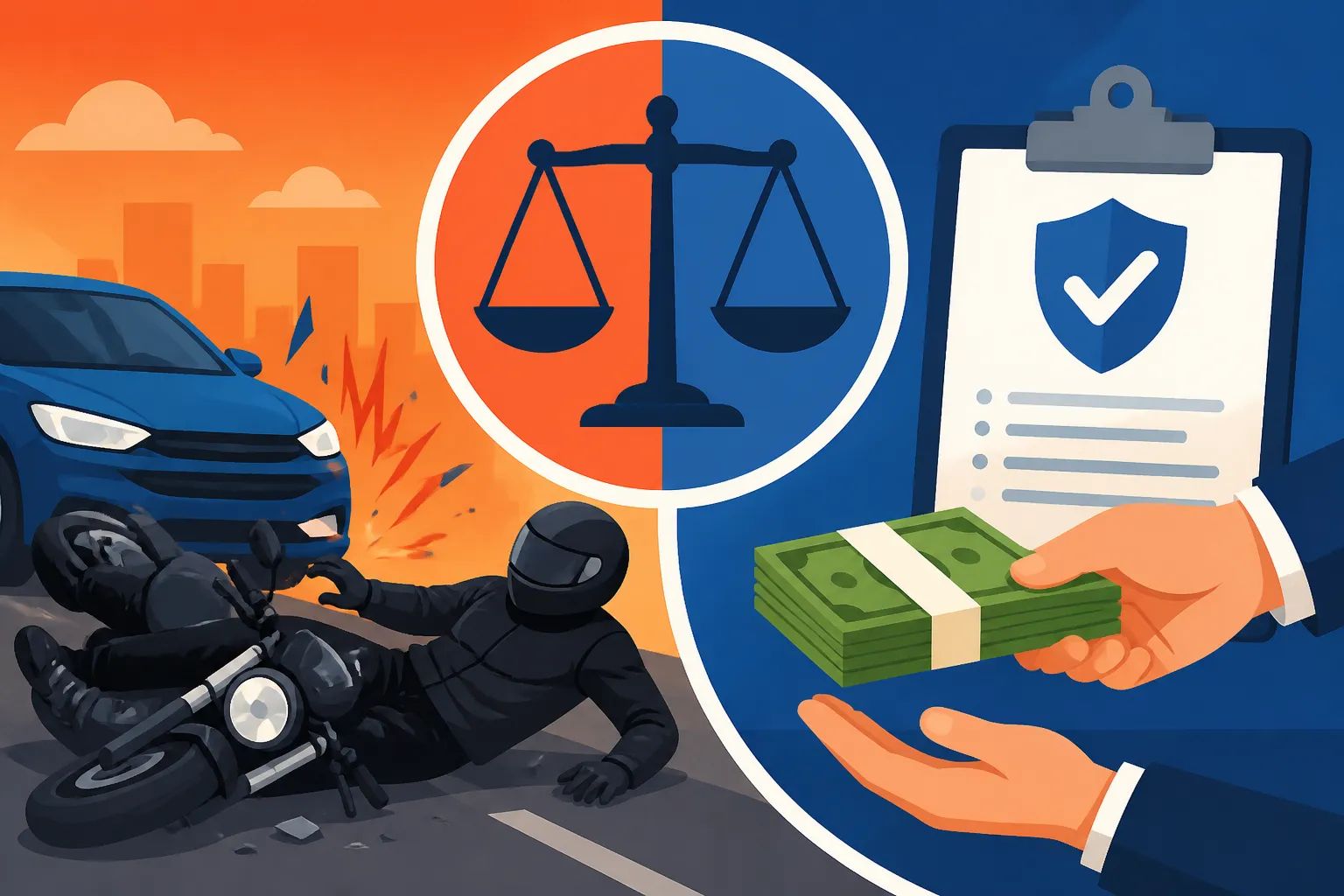
How Comparative Negligence Affects Settlements in Texas
Navigating the aftermath of a motorcycle accident in Texas can feel incredibly overwhelming, especially when you're grappling with injuries and mounting bills. One of the trickiest aspects is figuring out how the state's comparative negligence laws might affect your ability to recover damages. It's a system that can drastically reduce your settlement or even prevent you from getting any compensation at all, and it's essential for every rider to understand. This guide will meticulously break down how comparative negligence works in Texas and what it means for your motorcycle accident claim.
Understanding Comparative Negligence in Texas
Texas operates under a system known as "modified comparative negligence with a 51% bar rule." This legal concept can be a real headache for injured motorcyclists because it means that if you are found to be partly at fault for the accident, your compensation can be reduced, or even eliminated entirely. It’s not about who was most at fault, but rather if your share of the blame crosses a very specific threshold.
What is Modified Comparative Negligence?
In plain English, modified comparative negligence means that if you're deemed 51% or more responsible for the crash, you legally cannot recover any damages from the other party. Zero. Zilch. It doesn't matter how severe your injuries are or how much your medical bills stack up; if you hit that 51% mark, your claim is barred. However, if you are found to be 50% or less at fault, you can still recover compensation, but your total award will be reduced by your percentage of fault.
For instance, imagine you're involved in a collision in downtown Austin, and the jury determines your total damages (medical bills, lost wages, pain and suffering) amount to $100,000. If they also decide you were 20% at fault for the accident – perhaps you were slightly exceeding the speed limit, even if the other driver ran a red light – your $100,000 settlement would be reduced by 20%. This means you would only receive $80,000. It’s a direct calculation, and every percentage point of fault assigned to you chips away at your potential recovery. This system is crucial to grasp because it directly impacts your bottom line.
The Impact on Your Motorcycle Accident Claim
For motorcyclists, this specific rule carries even greater weight due to persistent stereotypes and biases. It’s an unfortunate reality that riders often face an uphill battle when it comes to fault determination. Insurers and even jurors can sometimes subconsciously (or consciously) assume the motorcyclist was engaging in risky behavior, even when evidence suggests otherwise. This phenomenon, sometimes referred to as 'Rider Bias in Fault Determination', can lead to a higher percentage of fault being assigned to the rider than might be truly warranted.
Because of this, even seemingly minor actions on your part can be scrutinized and used to assign a percentage of fault. If you weren't wearing a DOT-compliant helmet (even if the law in some states doesn't require it for all riders, Texas generally requires it for those under 21, or if you don't have certain insurance coverage), or if you were briefly speeding, or even if your bike's modifications are questioned, an insurance adjuster might seize on these details. These factors are often used by the defense to argue that you contributed to your injuries, potentially reducing your payout even if they don't impact the direct cause of the accident. Understanding How Comparative Negligence Reduces Your Payout is critical before you even begin negotiations.
How Fault is Determined in a Texas Motorcycle Accident
Determining who is at fault in a motorcycle accident in Texas is rarely straightforward. It involves a deep dive into the specifics of the crash, examining everything from witness statements to the precise angle of impact. Insurance companies, true to their nature, will often go to great lengths to minimize their payout, which frequently means trying to pin as much blame on the motorcyclist as possible. This is where a thorough investigation becomes your best defense.
Evidence Collection and Its Role
The foundation of any successful accident claim hinges on compelling evidence. Immediately after a motorcycle accident, even if you’re shaken and hurt, collecting as much information as possible is paramount. This includes taking copious photos and videos of the scene from various angles – not just your bike and the other vehicle, but also road conditions, traffic signs, skid marks, and any debris. Eyewitness accounts are golden; their unbiased perspective can often counteract biased assumptions about riders. The police report also plays a significant role in establishing initial fault, though it's not the final word. While police reports can sometimes How Police Reports Establish Fault, they can also sometimes How a Police Report Can Hurt Your Claim if they contain inaccuracies or premature conclusions.
Beyond the immediate scene, medical records become critical documentation of your injuries and their severity, directly correlating to your damages. Expert accident reconstructionists might be brought in to piece together what happened, analyzing vehicle speeds, trajectories, and points of impact. Dashcam footage or surveillance video from nearby businesses can be invaluable, offering an objective view of the moments leading up to and during the collision. All these pieces of evidence contribute to building a clear narrative that either supports your claim of the other driver's fault or helps to defend against allegations of your own negligence.
The "I Didn't See the Motorcycle" Defense
One of the most infuriating and unfortunately common defenses drivers use against motorcyclists is the ubiquitous, "I didn't see the motorcycle." This isn't just a casual statement; it's often a tactical maneuver by insurance companies to shift blame. It implies that because they "didn't see" you, you must have been invisible, speeding, or otherwise riding in a way that made you undetectable. This defense attempts to absolve the driver of their responsibility to be observant and operate their vehicle safely.
However, "I didn't see the motorcycle" doesn't automatically mean you're at fault. Drivers have a legal duty to maintain a proper lookout and operate their vehicles with due care, especially when sharing the road with vulnerable users like motorcyclists. If a driver fails to see you because they were distracted by their phone (a very common scenario in Motorcycle Accidents Caused by Distracted Driving), or simply not paying attention, that's negligence on their part. Your legal team can challenge this defense by presenting evidence of the other driver's actions (or inactions), proving that their inattention, not your riding, was the primary cause. This might include cell phone records, traffic camera footage, or even the driver's own statements at the scene.
Calculating Damages with Shared Fault in Texas
Once fault has been assigned, even if you’re less than 51% responsible, the next step involves calculating the total value of your damages and then applying the comparative negligence reduction. This is where the true financial impact of shared fault becomes clear, directly affecting the amount of money you’ll actually receive.
Economic vs. Non-Economic Damages Under Comparative Negligence
In a motorcycle accident claim, damages are generally split into two categories: economic and non-economic. Economic damages are quantifiable financial losses, like your past and future medical bills, lost wages from time off work, property damage to your bike, and any rehabilitation costs. These are often easier to calculate because there are receipts, invoices, and pay stubs to back them up. Non-economic damages, on the other hand, are more subjective. These include compensation for physical pain and suffering, emotional distress, disfigurement, loss of enjoyment of life, and loss of consortium. These are often assigned a monetary value through formulas or by a jury's discretion.
Under Texas's modified comparative negligence rule, both your economic and non-economic damages are subject to reduction based on your assigned percentage of fault. For example, if your total medical bills are $50,000, your lost wages are $10,000, and your pain and suffering are valued at $40,000, your total damages would be $100,000. If you are found 20% at fault, that $100,000 is immediately reduced to $80,000. This percentage applies across the board, affecting every single component of your claim, meaning less money in your pocket to cover the real costs you’ve incurred and will continue to incur. Learn more about Economic vs Non-Economic Damages Explained to understand the full scope.
Real-World Scenarios and Payout Examples
Let's illustrate how this plays out with a few hypothetical scenarios, assuming a total assessed damage value of $150,000 for a severe motorcycle accident in Houston, covering extensive medical treatment, significant lost income, and considerable pain and suffering.
- Scenario 1: You are found 10% at fault. Maybe you were momentarily distracted or drifted slightly in your lane just before the collision, even though the other driver was primarily negligent. Your total damages of $150,000 would be reduced by 10%, meaning you would receive $135,000.
- Scenario 2: You are found 30% at fault. Perhaps you were splitting lanes where it wasn't explicitly illegal but was deemed a contributing factor, or you didn't have your headlight on during dusk. The $150,000 would be reduced by 30%, resulting in a payout of $105,000. For more on lane splitting, consider reading Who Is at Fault in a Lane Splitting Motorcycle Accident.
- Scenario 3: You are found 50% at fault. This could happen if, for instance, a jury believes both you and the other driver contributed equally to an intersection accident – maybe they ran a stop sign, but you were also speeding significantly. In this case, your $150,000 would be reduced by 50%, leaving you with $75,000.
- Scenario 4: You are found 51% or more at fault. If the evidence strongly points to your negligence being the primary cause, such as a clear case of illegal lane changes or reckless driving, and you hit or exceed 51% fault, you would receive $0. This is the 51% bar rule in full effect, and it underscores the critical importance of fighting every percentage point of fault attributed to you.
Here's a table to visualize the impact:
| Total Damages Assessed | Your Percentage of Fault | Calculated Reduction | Net Payout to You |
|---|---|---|---|
| $150,000 | 0% | $0 | $150,000 |
| $150,000 | 10% | $15,000 | $135,000 |
| $150,000 | 25% | $37,500 | $112,500 |
| $150,000 | 50% | $75,000 | $75,000 |
| $150,000 | 51% | $150,000 | $0 |
This table clearly illustrates how devastating even a small percentage of fault can be to your final settlement amount.
Protecting Your Claim Against Shared Fault Allegations
Given Texas's modified comparative negligence laws, protecting your claim from allegations of shared fault isn't just important; it's absolutely crucial. Every action you take, or don't take, immediately following an accident can have significant ramifications for your ability to recover compensation.
Steps to Take Immediately After a Crash
The moments following a motorcycle crash are chaotic and often painful, but your actions during this critical time can significantly impact your future claim. Your first priority, always, is your safety and well-being. Move to a safe location if possible, and always seek medical attention, even if you feel fine. Adrenaline can mask serious injuries, and waiting to see a doctor can not only jeopardize your health but also allow insurance companies to argue that your injuries weren't severe or were unrelated to the accident.
Beyond medical care, documenting the scene is paramount. Take photos and videos of everything: your bike's damage, the other vehicle's damage, skid marks, road conditions, traffic signs, and any visible injuries. Exchange information with the other driver, but never admit fault or apologize. Any statement you make can be twisted and used against you later to assign you a higher percentage of fault. Get contact information from any witnesses, as their statements can be vital in countering biased claims. Finally, always call the police and ensure a report is filed. Even if they don't assign fault on the spot, the report creates an official record of the incident. This initial evidence gathering forms the bedrock of proving fault in a motorcycle accident. Read What to Do Immediately After a Motorcycle Accident for more detailed instructions.
The Role of Legal Counsel in Disputing Fault
When faced with the complexities of Texas comparative negligence laws and aggressive insurance adjusters trying to pin blame on you, having an experienced motorcycle accident lawyer on your side is invaluable. These legal professionals understand the nuances of state law and are adept at gathering the necessary evidence to counter fault allegations. They can work with accident reconstructionists, interview witnesses, and subpoena critical records (like cell phone data or traffic camera footage) that you might not be able to access on your own.
A skilled attorney will tirelessly investigate the Common Causes of Motorcycle Accidents, such as distracted driving or failure to yield, to build a strong case proving the other driver's negligence. They can challenge the "I didn't see the motorcycle" defense head-on, presenting arguments that highlight the other driver's legal duty to be observant. Furthermore, they are experts in negotiation, knowing how to leverage evidence to How to Negotiate a Motorcycle Accident Settlement for the maximum possible amount. If the insurance company unfairly assigns you a high percentage of fault, your lawyer can fight back, protecting your right to fair compensation. They understand the strategies insurers use to undervalue claims and are prepared to take your case to court if necessary, ensuring your voice is heard and your rights are protected.
Disclaimer
Please remember that this blog post provides general information and insights into motorcycle accident claims and comparative negligence laws in Texas. It is not intended as legal advice, and the specifics of your case may vary. For personalized legal guidance tailored to your unique situation, it is always recommended to consult with a qualified motorcycle accident attorney in Texas.