How Comparative Negligence Reduces Your Payout
It's an unfortunate truth that when you're involved in a motorcycle accident, even if another driver was clearly at fault, you might still find yourself being assigned a percentage of the blame. This can feel incredibly unfair, especially when you're dealing with painful injuries and mounting bills. The tricky part is that this assigned fault, known as comparative negligence, can directly reduce the amount of compensation you receive, leaving you with less than you deserve. This guide will help you understand how comparative negligence works, its potential impact on your settlement, and what steps you can take to protect your claim.
Understanding Comparative Negligence in Motorcycle Accidents
You've been in a crash, you're hurting, and you're trying to figure out what comes next. One of the biggest hurdles many riders face isn't just proving the other driver was negligent, but also fighting off attempts by insurance companies to pin some of the blame on them. This concept is at the heart of comparative negligence, and it's absolutely crucial to grasp if you want to understand how your potential payout might shrink.
What is Comparative Negligence?
At its core, comparative negligence is a legal principle that allows an injured party to recover damages even if they were partially at fault for an accident. It's a system designed to fairly apportion responsibility when multiple parties contribute to a crash. This is a stark contrast to an older, much harsher system called contributory negligence, which some states still follow (though very few for motorcycle accidents). Under contributory negligence, if you were found even 1% at fault, you would be completely barred from recovering any compensation. Imagine being T-boned by a distracted driver, but because you were technically going 5 mph over the limit, you get nothing. Brutal, right?
Thankfully, most states have moved to some form of comparative negligence. This means that if you're injured in a motorcycle accident, your recovery isn't automatically thrown out just because you made a minor error. Instead, the court or insurance adjuster will determine a percentage of fault for each party involved. For example, if you sustained $100,000 in damages but were found 20% at fault, your recoverable damages would be reduced by 20%, leaving you with $80,000. It's a more equitable system, but it still means your actions, however minor, can have a significant financial impact. The key is understanding that your percentage of fault directly impacts the amount of money you can potentially recover, making every percentage point a critical battleground in your claim.
How Different States Apply Comparative Negligence
The world of comparative negligence isn't a one-size-fits-all scenario. Different states have adopted different versions of this legal doctrine, and knowing which one applies where your accident occurred is paramount to understanding your potential recovery. Generally, there are two main types: "pure comparative negligence" and "modified comparative negligence."
In states with pure comparative negligence, like California, you can recover damages even if you are found to be mostly at fault. For instance, if you're deemed 90% at fault for a motorcycle accident that caused $100,000 in damages, you could still recover 10% of those damages, or $10,000. It's a system that truly allows for recovery no matter how high your percentage of fault, as long as it's not 100%. While this might seem surprisingly lenient, it aims to prevent complete financial ruin for a party who was mostly but not entirely to blame. Riders often wonder, "How Comparative Negligence Affects Settlements in California?" and the answer is usually a direct percentage reduction.
Then there's modified comparative negligence, which is far more common. This version comes in two flavors: the "50% rule" and the "51% rule."
-
The 50% Rule: In states like North Carolina and South Dakota (which actually use contributory negligence, but for illustrative purposes, if they were comparative, they might fit this rule), if you are found to be 50% or more at fault, you are barred from recovering any damages. If your fault is 49% or less, your damages are reduced proportionally. So, if you're 50% at fault, you get nothing. If you're 49% at fault, your $100,000 claim becomes $51,000. This system, also called "barred if 50% or greater," is designed to prevent a plaintiff from recovering if their fault equals or exceeds that of the other party. You can read more about How the 50% Fault Rule Works.
-
The 51% Rule: More commonly, states like Texas, Ohio, and New Jersey follow the "51% rule." Under this rule, you can still recover damages as long as your percentage of fault is 50% or less. If your fault is determined to be 51% or more, you are completely barred from recovery. So, if you're 50% at fault for $100,000 in damages, you could still recover $50,000. But if it's found you were 51% at fault, your claim becomes zero. This is often referred to as "barred if 51% or greater." Understanding How the 51% Fault Rule Works is vital, as it can be the difference between a significant settlement and nothing at all. Each state has its own specific statutes, and these nuances can dramatically alter your case's outcome.
Why Motorcycle Riders Are Often Targeted by This Defense
It's a frustrating reality that motorcycle riders often face an uphill battle when it comes to fault determination after an accident. There's an undeniable bias that exists, both consciously and unconsciously, within the public, law enforcement, and even among some insurance adjusters. This bias often leads to the assumption that the motorcyclist must have been doing something wrong, making them a prime target for comparative negligence defenses.
One of the most common refrains heard after a car-motorcycle collision is, "'I Didn't See the Motorcycle' Defense Explained." This isn't just a casual statement; it's a deeply ingrained societal issue where cars often fail to register motorcycles as significant vehicles on the road. This blind spot, whether literal or figurative, is often shifted to imply the motorcyclist was somehow "invisible" or behaving unpredictably, rather than acknowledging the car driver's failure to maintain a proper lookout. Insurance companies are very adept at leveraging this narrative to assign a percentage of fault to the rider, suggesting they weren't "conspicuous enough" or should have anticipated the car driver's mistake, even when legally they had the right of way. This is a classic tactic for How Insurance Companies Assign Blame to Riders.
Furthermore, general stereotypes about motorcyclists — that they are reckless, speed demons, or rule-benders – can unfairly influence how fault is perceived. Even if you were riding perfectly safely, an adjuster or jury might subconsciously lean towards assigning some blame to you simply because of the vehicle you were on. This phenomenon is what we often refer to as Rider Bias in Fault Determination. This bias can manifest in various ways, from questioning your speed without evidence to scrutinizing your lane positioning, all to chip away at your right to full compensation. It's a disheartening aspect of the claims process, but one that riders must be prepared to address head-on.
The Direct Impact on Your Settlement Payout
Let's get down to brass tacks: how does comparative negligence actually hit your wallet? It's not just a theoretical concept; it has a very real, very tangible effect on the amount of money you ultimately receive for your injuries, medical bills, lost wages, and pain and suffering.
How Your Percentage of Fault Reduces Damages
The most straightforward way comparative negligence affects your payout is through a direct, mathematical reduction of your total damages. Once a total value for all your losses (medical bills, lost income, pain and suffering, property damage, etc.) has been determined, your assigned percentage of fault is subtracted from that amount.
Consider this example:
Sarah was involved in a motorcycle accident. Her total damages, including medical expenses, lost wages, and pain and suffering, were calculated at $250,000.
-
Scenario 1: Pure Comparative Negligence (e.g., California)
- If Sarah was found 20% at fault, her payout would be reduced by 20%: $250,000 – (20% of $250,000) = $250,000 – $50,000 = $200,000.
- If Sarah was found 60% at fault, her payout would be reduced by 60%: $250,000 – (60% of $250,000) = $250,000 – $150,000 = $100,000. She still recovers something.
-
Scenario 2: Modified Comparative Negligence (51% Rule, e.g., Texas)
- If Sarah was found 20% at fault, her payout would be $200,000 (same as above).
- If Sarah was found 50% at fault, her payout would be reduced by 50%: $250,000 – (50% of $250,000) = $250,000 – $125,000 = $125,000. She still recovers.
- If Sarah was found 51% at fault, her payout would be $0. She recovers nothing because her fault exceeded the 50% threshold.
As you can see, even a small percentage of fault can lead to a significant financial hit. In states following the modified rules, crossing that 50% threshold can mean the difference between recovering hundreds of thousands of dollars and receiving absolutely nothing. This makes fighting every single percentage point of fault incredibly important. This direct calculation is a core component of How Motorcycle Accident Settlements Are Calculated and directly impacts What Affects Your Motorcycle Accident Payout.
Beyond the Math: Subjective Factors Influencing Fault Assignment
While the math of comparative negligence might seem straightforward once a percentage is assigned, the process of actually determining that percentage is anything but. It's not just about a police report; it's a complex interplay of evidence, witness testimony, legal arguments, and the subjective perceptions of insurance adjusters, and potentially, jurors.
Insurance adjusters, for instance, are trained to look for any shred of evidence that can shift fault away from their insured and onto you. They might highlight minor traffic infractions, your speed (even if it wasn't the primary cause of the accident), or even your lane positioning to argue for a higher percentage of your fault. Their goal is to reduce their company's liability, and comparative negligence is one of their most powerful tools. They're not looking to give you a fair shake; they're looking to save their company money.
If a case goes to trial, jurors, who may not be familiar with motorcycles or may harbor unconscious biases, will be tasked with assigning fault. A skilled attorney for the defense might play on these biases, subtly suggesting that riders are inherently more dangerous or take more risks. They might argue that you should have been more aware of the larger vehicles around you, even if the car driver clearly violated a traffic law. This is where solid evidence, expert testimony, and persuasive legal arguments become absolutely vital to counter these subjective narratives. Without a strong case, subjective factors can easily inflate your assigned fault, drastically cutting down your potential settlement.
The "Helmet Defense" and Comparative Negligence
Even if you were wearing a helmet, or especially if you weren't, the issue of motorcycle helmets can become a significant factor in comparative negligence, particularly when head injuries are part of your claim. This is known as the "helmet defense," and it's a tactic insurance companies love to employ.
States have varying motorcycle helmet laws. Some, like California, have universal helmet laws, requiring all riders to wear a DOT-compliant helmet. Others, like Florida, have partial helmet laws, requiring helmets only for riders under 21, or allowing adults to ride without one if they carry sufficient insurance. And a few, like Iowa and New Hampshire, have no helmet laws at all for adult riders. You can learn more about Motorcycle Helmet Laws by State.
Regardless of your state's specific law, if you were not wearing a helmet and sustained a head injury, the defense will almost certainly argue that your injuries would have been less severe, or perhaps even avoided entirely, had you been wearing one. Even in states where helmets aren't legally required for adults, the defense can still argue that your choice not to wear one constituted negligence that contributed to the severity of your injuries, thereby reducing your payout. This doesn't mean your fault contributed to the cause of the accident, but rather to the extent of the damages. For example, if your total damages were $300,000, but a significant portion of that was due to a head injury, and the defense successfully argues that not wearing a helmet contributed to 30% of that head injury's severity, your overall settlement could be reduced.
The challenge with The Helmet Defense Explained is that it requires a scientific and medical argument. Did the helmet, or lack thereof, actually make a difference in your specific injury? An accident reconstruction expert or medical professional might be needed to counter this argument, demonstrating that even with a helmet, the head injury would have occurred, or that the specific injury was unrelated to helmet use. Understanding How Helmet Use Affects Comparative Negligence is crucial, as this defense can shave off a substantial portion of your compensation, especially in cases involving traumatic brain injuries.
Strategies to Mitigate the Impact of Shared Fault
When facing a comparative negligence defense, it's easy to feel overwhelmed. The good news is that there are proactive steps you can take to fight back and protect your right to fair compensation. It's about building a strong case that minimizes any perceived fault on your part and maximizes the other driver's responsibility.
Gathering Strong Evidence to Dispute Fault
The moment an accident happens, your priority is safety and medical attention. But as soon as it's practical, gathering comprehensive evidence is your strongest defense against comparative negligence claims. Don't wait, and don't assume the police report will tell the whole story.
-
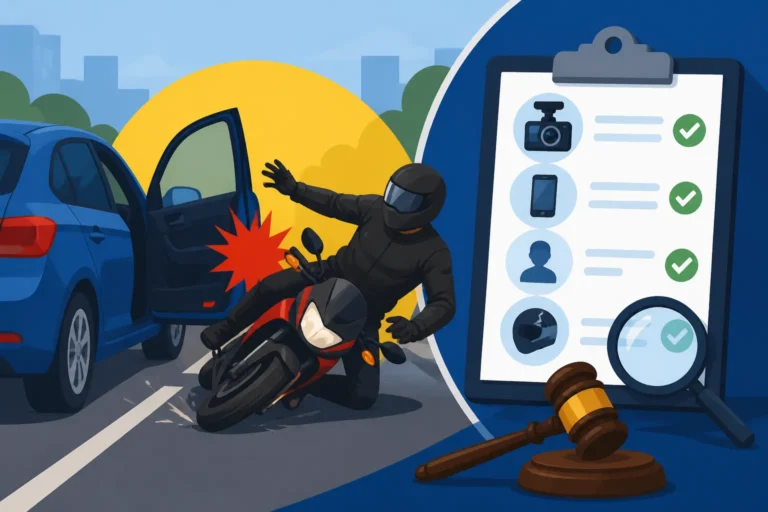
Detailed Photos and Videos: Take pictures and videos from multiple angles. Capture the position of the vehicles, road conditions, traffic signs, skid marks, debris, and any visible injuries. The more visual evidence, the better. This includes damage to your gear, which can sometimes provide clues about the impact. Check out Photos to Take to Prove Motorcycle Fault for a complete checklist.
-
Witness Statements: Eyewitnesses can be invaluable, especially if they saw the other driver's actions or inaction. Get their contact information immediately. Even if they didn't see the entire sequence, their perspective on specific elements (like your speed, the other driver's distraction, or traffic signals) can be critical. How Witnesses Affect Motorcycle Fault cannot be overstated.
-
Police Report: While not always perfect, a police report will often include an initial assessment of fault and details about the accident scene. However, understand that a police report can sometimes hurt your claim if it unfairly assigns blame to you. Know How Police Reports Establish Fault and how to address discrepancies.
-
Dashcam or Helmet Cam Footage: If you have a dashcam on your motorcycle or a helmet cam, this footage can be absolute gold. It provides an objective, undeniable account of the moments leading up to and during the crash. This direct evidence can shut down many comparative negligence arguments. How Dashcam Footage Proves Fault is a powerful tool in your arsenal.
-
Medical Records: Your medical records are crucial not only for documenting your injuries but also for establishing the timeline of events and the severity of your pain and suffering.
-
Traffic Laws: Understand the specific traffic laws in your state and locality. If the other driver violated a specific law (e.g., failure to yield, distracted driving, illegal lane change), that's strong evidence against their attempt to shift blame.
The more detailed and varied your evidence, the stronger your position will be to counter any claims that you were partly responsible for the crash or the severity of your injuries. Remember, you're building a narrative that proves your limited or non-existent fault, and evidence is the bedrock of that narrative.
The Role of Legal Representation in Challenging Fault
Navigating a motorcycle accident claim, especially when comparative negligence is a factor, is incredibly complex. This is precisely why hiring an experienced motorcycle accident attorney is not just recommended, but often essential. An attorney brings a wealth of knowledge and resources that are critical in fighting unfair fault assignments.
First, an attorney understands the nuances of How Fault Is Determined in Motorcycle Accidents in your specific state, including whether it's a pure or modified comparative negligence state. They can analyze the evidence to build a compelling case, anticipate the defense's arguments, and strategically counter any attempts to blame you. They know how to effectively present your evidence, including accident reconstruction reports, expert witness testimony, and medical records, to demonstrate the other driver's full liability.
Furthermore, a lawyer acts as a shield between you and the insurance companies. Insurance adjusters are notorious for using tactics to elicit statements from injured parties that can be twisted and used against them. An attorney handles all communications with the insurance companies, ensuring that you don't inadvertently say something that could be used to increase your assigned percentage of fault. They also have the negotiation skills and experience to push back against lowball offers and unreasonable fault assignments, significantly increasing your chances of a fair settlement. They understand the patterns and biases of insurance carriers and know how to challenge them effectively. For instance, if an adjuster tries to use the 'I Didn't See the Motorcycle' defense, your attorney will be prepared to dismantle it.
Understanding Your State's Specific Laws
It's been said before, but it bears repeating: the laws governing comparative negligence vary significantly from state to state, and understanding the specific statutes in the jurisdiction where your accident occurred is paramount. What flies in California might completely bar your claim in another state.
For example, if your accident happened in Pennsylvania, which is a modified comparative negligence state with a 51% rule, being found 50% at fault means you still recover half your damages. However, if that same accident happened in Maryland, which follows a contributory negligence rule, being 1% at fault means you recover nothing. These distinctions are not minor; they are deal-breakers.
Your attorney will be well-versed in the specific motorcycle accident fault laws for your state, whether it's Motorcycle Accident Fault Laws in Florida, Motorcycle Accident Fault Laws in Texas, or any other state. This local expertise allows them to apply the correct legal framework to your case, advise you on realistic outcomes, and develop a strategy tailored to maximize your recovery within those specific legal confines. They will know the precedents, the local judges, and the typical jury pools, all of which influence how fault is ultimately decided. This local legal insight is a cornerstone of a successful claim.
Real-World Scenarios of Comparative Negligence
Understanding comparative negligence through examples can help illustrate how quickly fault can become a complex, shared issue in the eyes of the law and insurance companies. These scenarios often lead to heated disputes over who is ultimately responsible.
Speeding and a Driver Turning Left
This is a classic and incredibly common scenario for motorcycle accidents, and it often becomes a battleground for comparative negligence. Imagine you're riding your motorcycle, perhaps enjoying a brisk ride on a clear day. A car approaches from the opposite direction and suddenly makes a left turn directly in front of you, violating your right of way. The collision is inevitable. In many such cases, the car driver is clearly at fault for a Left-Turn Motorcycle Accidents Explained.
However, the defense will almost immediately look for ways to assign you partial blame. If you were even slightly over the speed limit, or if the police report indicates a higher-than-posted speed, the car driver's insurance company will argue that your speed contributed to the accident or the severity of the impact. They might contend that if you had been going the speed limit, you would have had more time to react, or the collision would have been less severe. This doesn't mean the left-turning driver isn't primarily at fault, but your speed, even if minor, could be used to assign you 10%, 20%, or even 30% of the fault, directly reducing your payout. It's a frustrating but common outcome where initial fault is clear, but shared responsibility is still argued.
Lane Splitting and Unsafe Lane Changes
Lane splitting, while legal in some states (like California), is another hot topic that frequently involves comparative negligence arguments, especially when it results in an accident. If you're Lane Splitting and Motorcycle Accident Liability in a state where it's legal, and a car unexpectedly changes lanes into you, the car driver is likely at fault for an Motorcycle Accidents Caused by Unsafe Lane Changes.
However, even in states where lane splitting is legal, there are usually specific conditions and limits (e.g., speed differentials, types of roads). If you were lane splitting above the recommended speed differential, or in conditions deemed unsafe by law enforcement, the defense will argue that your lane splitting contributed to the collision. They might say you were "riding recklessly" or "created an unexpected hazard." Even if the car driver failed to check their mirrors, your actions might be assigned a percentage of fault, reducing your compensation. The defense might argue that even if lane splitting is legal, it carries an inherent risk, and you, as the rider, should bear some responsibility for choosing to engage in that maneuver under the given circumstances. This can turn a seemingly clear case of an unsafe lane change into a shared fault dispute.
Road Hazards and Rider Awareness
Not all motorcycle accidents involve another vehicle; sometimes, the road itself is the culprit. Potholes, gravel, uneven pavement, or debris can cause a rider to lose control and crash. In these cases, liability might fall on a government entity responsible for road maintenance or a construction company. However, comparative negligence can still come into play.
The defense, whether it's a city or a contractor, might argue that you, as the rider, should have seen and avoided the hazard. They might question your speed, your following distance, or your general awareness of road conditions. For instance, if you hit a large pothole at night on a poorly lit road, you might argue government liability for the Motorcycle Accidents Caused by Road Hazards. But the defense could counter that you were riding too fast for the conditions, or that a "reasonably prudent rider" would have spotted the hazard, even in low light, and taken evasive action. While the city's negligence in maintaining the road might be clear, your alleged failure to react adequately could be used to assign you a percentage of fault, impacting your recovery for injuries and damages. This means even when no other driver is involved, your actions are still under scrutiny.
Navigating the Comparative Negligence Landscape
Understanding how comparative negligence can reduce your payout is half the battle. The other half is taking proactive steps and preparing for the fight. It's rarely simple, and insurance companies are never on your side.
Don't Assume Complete Blamelessness
It's natural to feel like the victim after an accident, especially when another driver caused the initial impact. However, assuming you are 100% blameless without a thorough investigation can be a costly mistake. Insurance companies will dissect every detail, looking for any way to shift some liability onto you. They will scrutinize your speed, lane positioning, reaction time, whether you were wearing appropriate gear, and even the legality of any modifications to your motorcycle. What you believe is completely irrelevant could be used to argue some percentage of fault. This is why it’s imperative to never admit fault at the scene, even if you feel you contributed in some way. Let the facts and evidence speak for themselves after a proper investigation. Every statement you make can be used to assign blame.
Be Prepared for Negotiation and Litigation
Comparative negligence almost always means you're in for a negotiation. The first offer from the insurance company will likely reflect their highest possible assessment of your fault. Your attorney will then meticulously review the evidence to present a counter-argument, aiming to reduce or eliminate your assigned fault. This back-and-forth can be lengthy and frustrating.
If negotiations fail to reach a fair settlement, your case might proceed to litigation. This means presenting your case to a judge or jury, who will ultimately decide the percentage of fault for each party. This is where the subjective factors we discussed earlier become highly influential. A skilled attorney knows how to present evidence and testimony in a way that resonates with a jury, challenging common biases against motorcyclists and highlighting the other party's negligence. Without strong legal representation, going up against an insurance company's legal team in court is an extremely daunting task, and one that often ends with a much lower payout for the unrepresented rider.
Prioritize Medical Treatment and Documentation
Regardless of fault, your health is the most important thing. Seek immediate medical attention after an accident, even if you feel fine. Many serious injuries, especially those affecting the spine or brain, have delayed symptoms. Consistent medical treatment and thorough documentation of your injuries, pain, and recovery process are crucial. This includes keeping a pain journal, noting how your injuries affect your daily life, and attending all follow-up appointments.
Insurance companies often use gaps in medical treatment or a lack of documentation to argue that your injuries aren't as severe as you claim, or that they were caused by something other than the accident. This can indirectly affect comparative negligence arguments by undermining the total value of your claim. If your damages are perceived as smaller, the impact of any assigned fault becomes proportionally greater, further reducing your net payout. So, while medical treatment doesn't directly prove fault, it protects the value of the damages component of your claim, which then ensures that any comparative negligence reduction is applied to the highest possible base amount.
Comparative negligence is a significant obstacle for many injured motorcyclists, but it is not an insurmountable one. By understanding its mechanics, preparing with strong evidence, and having experienced legal counsel by your side, you can significantly mitigate its impact and fight for the full compensation you deserve.
Disclaimer
The information provided in this guide is intended for general informational purposes only and does not constitute legal advice. Motorcycle accident laws, including those related to comparative negligence, vary by state and are complex. It is crucial to consult with a qualified motorcycle accident attorney to discuss the specifics of your case and the laws in your jurisdiction.