How Helmet Use Affects Comparative Negligence
Riding a motorcycle comes with an undeniable sense of freedom, but it also carries unique risks. When an accident happens, and you're dealing with injuries, property damage, and mounting medical bills, the last thing you want is for someone to point a finger at you. Many riders worry about how their helmet use, or lack thereof, might affect their claim, especially when terms like "comparative negligence" get thrown around. This comprehensive guide will break down exactly how helmet use impacts shared fault in a motorcycle accident claim, helping you understand your rights and potential recovery.
Understanding Comparative Negligence in Motorcycle Accidents
The concept of comparative negligence is a cornerstone of personal injury law in many states, and it's something every rider needs to grasp, especially after an accident. In plain language, it's a legal doctrine designed to assign a percentage of fault to each party involved in an accident. Instead of a simple "one person is 100% at fault" scenario, it acknowledges that sometimes, multiple parties contribute to a crash.
When you're involved in a motorcycle accident, the at-fault driver's insurance company will almost always try to find ways to reduce their liability. One of their primary tactics is to argue that you, the rider, were at least partially responsible for the crash or your injuries. If they succeed, your compensation can be reduced proportionally to your assigned percentage of fault. This can be incredibly frustrating because it feels like you're being penalized for simply existing on two wheels. However, understanding this system is the first step in protecting your claim. You can learn more about how fault is typically assigned by checking out our guide on How Fault Is Determined in Motorcycle Accidents.
Pure Comparative Negligence
Some states operate under a "pure comparative negligence" system. In these jurisdictions, you can recover damages even if you are mostly at fault for the accident. Your compensation is simply reduced by your percentage of fault. For example, if a jury finds you 80% at fault for an accident, but your total damages are $100,000, you could still recover $20,000. It's not a perfect system, and it still feels unfair to many riders, but it does mean that being partially at fault doesn't necessarily bar you from any recovery. States like California and Florida utilize this system, which means that even if a jury believes you share a significant portion of the blame, you won't be completely shut out of a settlement.
Imagine a scenario in Los Angeles where a car driver makes an illegal U-turn, causing you to swerve and lay down your bike. While the driver is clearly negligent, let's say a witness testifies that you were going slightly over the speed limit. Under pure comparative negligence, a jury might assign the car driver 85% fault and you 15% fault. If your total damages (medical bills, lost wages, pain and suffering) are calculated at $200,000, your final settlement would be reduced by 15%, leaving you with $170,000. The key takeaway here is that some recovery is almost always possible, even if you are deemed to have played a role in the incident itself.
Modified Comparative Negligence
More commonly, states follow a "modified comparative negligence" rule. This system has a threshold for fault, meaning if you are found to be at fault beyond a certain percentage, you might be barred from recovering any damages at all. There are two main variations: the "50% bar rule" and the "51% bar rule."
Under the 50% bar rule, if you are found to be 50% or more at fault, you cannot recover any damages. This rule is often seen in states like North Carolina. This is a tough pill to swallow because it means that even if another driver was equally negligent, your claim could be entirely dismissed. For riders, this can feel incredibly punitive, especially given the inherent biases that sometimes exist against motorcyclists. It places immense pressure on proving that the other driver was primarily responsible.
The 51% bar rule is a bit more forgiving. In states like Texas, if you are 51% or more at fault, you are barred from recovery. If you are found to be 50% or less at fault, you can still recover, with your damages reduced by your percentage of fault. This small difference can have a massive impact on your ability to secure compensation after an accident. For instance, if you're riding through Austin and a car merges into your lane without looking, causing a crash, and a jury finds you 50% at fault for, say, slightly inadequate braking, you could still recover half of your damages. But if they find you 51% at fault, you get nothing. The stakes are incredibly high in these situations, making every piece of evidence and every argument critical.
The Helmet Defense: How It Connects to Comparative Negligence
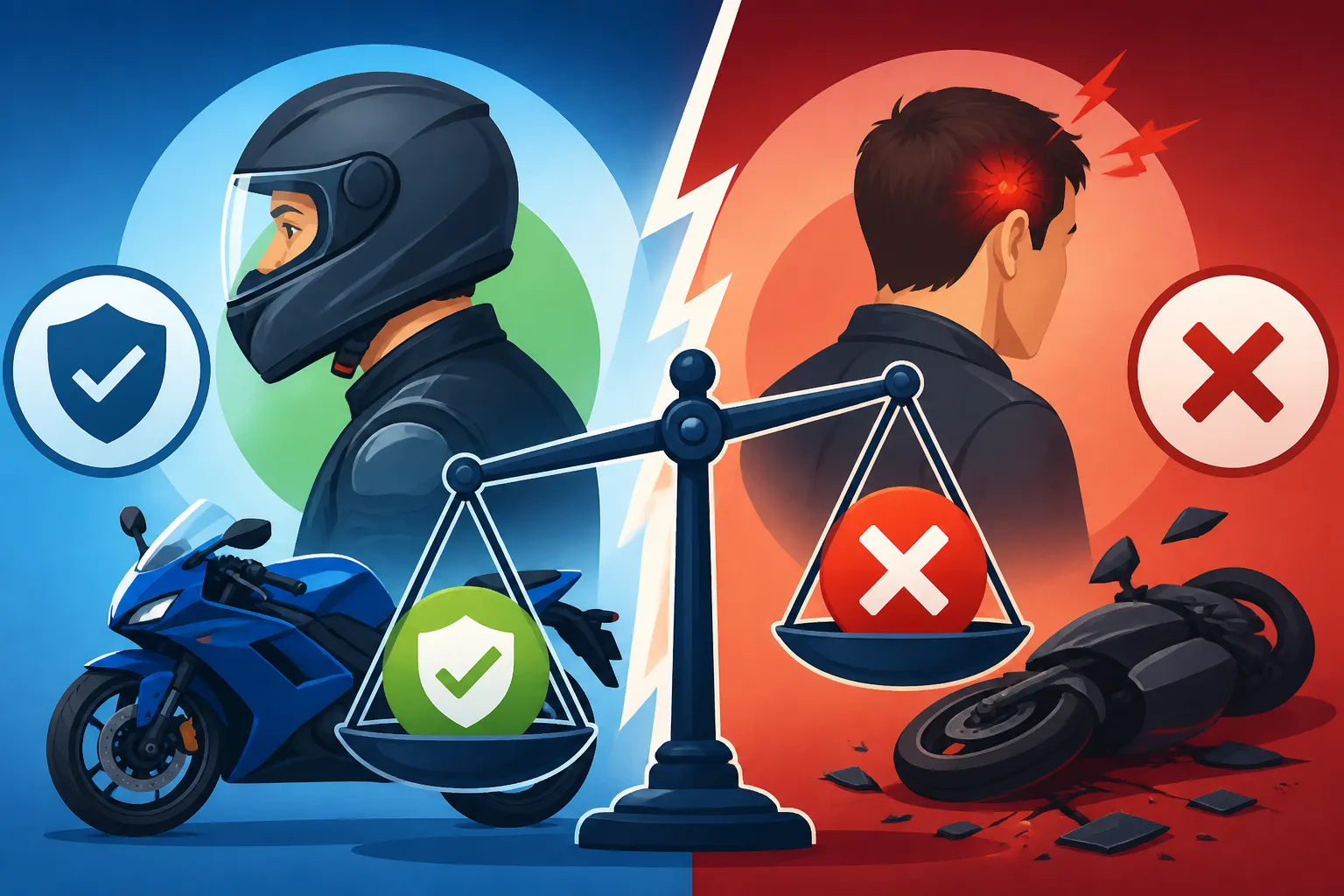
Now that we understand comparative negligence, let's talk about the "helmet defense." This is a common tactic used by insurance companies and defense attorneys to argue that even if their client was at fault for the accident, your injuries (especially head injuries) were worse than they would have been if you had been wearing a helmet. Essentially, they're trying to shift a portion of the responsibility for your damages onto you, even if they can't shift responsibility for the cause of the accident. This often falls under the umbrella of "comparative negligence" or "failure to mitigate damages."
It's a frustrating argument because it implies that your choice about personal safety gear somehow absolves a negligent driver of their full responsibility. However, the legal system often looks at what steps an injured party could have taken to reduce the severity of their injuries. When a state has specific helmet laws, this defense becomes even more potent. This defense is outlined further in our article, The Helmet Defense Explained.
Legal Basis of the Helmet Defense
The legal basis for the helmet defense varies by state. In states with universal helmet laws, where all riders are legally required to wear a helmet (like California), not wearing one can be a significant hurdle for your claim. The defense will argue that your non-compliance with the law contributed directly to the severity of your head injuries. They don't have to prove that not wearing a helmet caused the accident, only that it worsened your injuries. This can lead to a reduction in your compensation for medical bills related to head trauma, lost wages due to TBI, and pain and suffering from these specific injuries.
Even in states with partial helmet laws (e.g., riders under 21 or those without sufficient insurance coverage in Florida), if you fall into the category that is required to wear a helmet and you don't, the defense can still use this argument against you. The argument centers on the idea of "failure to mitigate damages." The law generally expects injured parties to take reasonable steps to minimize their losses. If wearing a helmet is considered a reasonable and legally mandated step, then failing to do so can be held against you. This doesn't mean you can't recover anything, but it can certainly chip away at the value of your claim, particularly for head-related injuries.
Impact on Head Injury Claims
The most direct impact of the helmet defense is on claims involving head injuries. Traumatic Brain Injuries (TBIs), concussions, skull fractures, and other head trauma can result in astronomical medical bills, long-term rehabilitation, and a lifetime of diminished capacity. If you weren't wearing a helmet, or if you were wearing a non-DOT-compliant novelty helmet, the defense will argue that these injuries could have been avoided or significantly lessened.
For example, if you suffer a severe TBI in a crash where you weren't wearing a helmet in a universal helmet law state like California, the defense might argue that 30-50% of the costs associated with your TBI (e.g., $500,000 in medical bills and lost earnings) should be attributed to your own negligence in not wearing a helmet. This means that even if the other driver was 100% at fault for causing the collision, your overall compensation could be reduced by that amount because you "failed to mitigate" the head injury. This is a powerful weapon in their arsenal and can drastically reduce the payout for some of the most devastating injuries. It’s why understanding How Helmet Laws Affect Your Accident Claim is so critical for riders.
State Helmet Laws and Their Influence on Comparative Negligence
Understanding the specific helmet laws in your state is paramount, as these laws directly influence how the helmet defense is applied and how comparative negligence might affect your motorcycle accident claim. There's a significant difference between states with universal helmet laws, partial laws, and those with no laws for adult riders.
Universal Helmet Law States
In states with universal helmet laws, such as California, Georgia, Oregon, and Washington, every motorcycle rider and passenger, regardless of age or experience, is legally required to wear a DOT-compliant helmet. When an accident occurs in these states and the rider was not wearing a helmet, the helmet defense is often highly effective for the opposing side.
The defense can argue that the rider violated a clear safety statute, and this violation directly contributed to the severity of their head injuries. Even if the other driver was entirely at fault for causing the collision, the jury may assign a percentage of fault for the injury severity to the helmet-less rider under the principles of comparative negligence. This means that a portion of the damages related to head injuries might be unrecoverable. For example, if you suffer a serious concussion in Seattle, Washington, and weren't wearing a helmet, the jury might decide that 20% of your medical bills and pain and suffering from that concussion are your responsibility, even if the car driver ran a red light. This creates a difficult situation where the at-fault driver isn't fully held accountable for the catastrophic outcomes. Many states have specific rules about Motorcycle Helmet Laws by State, so it's always worth checking your local regulations.
Partial Helmet Law States
Most states fall into the "partial helmet law" category. These states typically require helmets for riders under a certain age (often 18 or 21) or for riders who do not carry a specific amount of insurance coverage (like in Florida or Texas). For adult riders over the specified age who meet insurance requirements, wearing a helmet may be optional.
In these states, the helmet defense becomes more nuanced. If an adult rider who is not legally required to wear a helmet chooses not to, the defense cannot argue that they violated a specific law. However, they can still argue "failure to mitigate damages" – meaning the rider failed to take reasonable steps to prevent further injury. The argument then shifts from a violation of law to a question of general prudence and safety. It’s a harder sell for the defense, but still possible. For instance, in Florida, if you're over 21, carry $10,000 in medical payment coverage, and choose not to wear a helmet, you're compliant with the law. However, if you suffer a serious head injury in Miami, the defense could still try to argue that a prudent person would wear a helmet, and thus your injury could have been less severe. While not as strong as a legal violation, it can still influence a jury, especially in cases with severe head trauma.
No Helmet Law States
Currently, there are very few states, like New Hampshire, that have no statewide helmet law for adult riders. In these rare jurisdictions, the helmet defense based on legal non-compliance is almost entirely removed. It’s difficult for a defense attorney to argue that you broke a law when no such law exists.
However, even in states with no mandatory helmet laws, the defense can still attempt to use the "failure to mitigate damages" argument. They might bring in expert witnesses to testify about the proven safety benefits of helmets and argue that any reasonable rider would choose to wear one. The success of this argument often depends on the specifics of the case, the severity of the injuries, and the persuasive power of the attorneys involved. While challenging, the defense will still try to present evidence suggesting that the rider's non-use of a helmet contributed to their injuries, even if it wasn't illegal.
Types of Injuries and How Helmet Use Impacts Their Claim Value
Beyond the broad legal doctrines, the practical impact of helmet use on your claim often boils down to the specific injuries you sustain. Motorcycle accidents often result in devastating injuries, but head injuries are particularly vulnerable to the helmet defense.
Head and Brain Injuries
Head and brain injuries, ranging from concussions to severe Traumatic Brain Injuries (TBIs), are undeniably the most affected by helmet use. If you were wearing a DOT-compliant helmet at the time of the crash and still suffered a head injury, it actually strengthens your claim for full compensation. It demonstrates that you took all reasonable precautions, and despite that, the other driver's negligence still led to significant harm. The helmet itself, even if damaged, can serve as crucial evidence of the impact forces involved and your efforts to protect yourself.
However, if you weren't wearing a helmet, or were wearing a novelty helmet not approved by DOT, any head injury claim becomes a major battleground. The defense will argue that your failure to wear appropriate head protection directly led to or exacerbated injuries like skull fractures, concussions, or even devastating TBIs. This can lead to a significant reduction in the value of your pain and suffering, medical expenses, and lost wages directly attributable to your head injuries. For example, if you sustain a severe TBI with millions in projected lifetime care costs, and you weren't wearing a helmet, the defense might argue that a substantial portion of those costs should not be covered by their insured, leveraging comparative negligence to reduce the payout for these incredibly serious damages. For more information on head injuries, you can check out our article on Motorcycle Accident Traumatic Brain Injuries.
Non-Head Injuries
It's a common misconception that if you weren't wearing a helmet, it will negatively impact all your injury claims. This isn't necessarily true. For injuries unrelated to your head – think road rash, broken bones in your arms or legs, spinal cord injuries (not directly caused by head impact), or internal organ damage – the helmet defense is generally much weaker, if applicable at all.
The core argument of the helmet defense is that wearing a helmet mitigates head injuries. It has no bearing on whether you would have suffered a broken femur or severe road rash on your arms. Therefore, compensation for these types of non-head injuries should, in theory, remain unaffected by your helmet use. The defense might still try to use your helmet non-use to paint you as a reckless rider to a jury, hoping to illicit bias, but this is a much harder argument to win regarding specific non-head injury damages. Your claim for Motorcycle Broken Bones: Claims and Compensation or Motorcycle Road Rash: Claims and Compensation would likely be assessed based on the direct cause of those injuries, not your headwear.
How Policy Limits Affect Your Payout
Even with strong arguments against the helmet defense, the overall value of your claim can be capped by insurance policy limits. If the at-fault driver only carries the minimum liability coverage (which is often shockingly low, like $25,000 for bodily injury per person in some states), your potential payout can be severely limited, regardless of the severity of your injuries or the strength of your case against comparative negligence arguments.
This is where your own Underinsured Motorist (UIM) coverage becomes crucial. If your damages exceed the at-fault driver's policy limits, your UIM coverage can step in to cover the remaining costs, up to your own policy limits. This is a vital layer of protection for motorcyclists, who are unfortunately often involved in accidents with underinsured drivers. If the helmet defense has successfully reduced a portion of your claim, hitting these policy limits becomes even more likely, forcing you to rely on your own insurance or seek other avenues for recovery. Understanding How Insurance Policy Limits Affect Your Payout is essential for every rider.
Strategies to Counter the Helmet Defense
Facing the helmet defense can feel overwhelming, but there are concrete strategies you can employ to minimize its impact on your motorcycle accident claim. It's not an automatic win for the defense, and a skilled approach can often mitigate its effects.
Proving DOT Compliance and Proper Use
If you were wearing a helmet, the first and most critical step is to prove that it was DOT-compliant and properly worn. A DOT-approved helmet meets specific safety standards designed to protect your head. This means showing that your helmet had the appropriate DOT sticker on the back, was purchased from a reputable dealer (like a Cycle Gear store), and was worn correctly (strapped securely, not loose).
Gathering evidence is key here. Keep the damaged helmet; it’s a crucial piece of physical evidence that demonstrates you took precautions. Take photos of the helmet immediately after the accident, especially showing the DOT sticker and any impact points. Receipts of purchase can also help prove it was a legitimate, compliant helmet. If the defense tries to argue your head injury was due to improper helmet use, your ability to show a fully secured, compliant helmet makes their argument much weaker. It demonstrates that you took reasonable steps to protect yourself, and despite that, the force of the collision caused injury, which squarely places the blame back on the negligent driver. This proactive documentation is vital for How to Prove You Wore a Helmet.
Demonstrating Causation: Linking Injuries to the Crash, Not Helmet Non-Use
A fundamental counter-argument to the helmet defense is to challenge the causation link. The defense has the burden of proving that your lack of a helmet caused or exacerbated your head injury. Your legal team can argue that even if you weren't wearing a helmet, the impact was so severe that you would have sustained a head injury regardless, or that your injuries are primarily from other forces (e.g., direct impact to the body, whiplash, rotational forces).
Expert witnesses, such as accident reconstructionists or medical professionals, can be invaluable here. An accident reconstructionist might testify about the physics of the crash and the forces involved, demonstrating that the impact was simply too powerful for any helmet to entirely prevent injury. A neurosurgeon or neurologist could testify that your specific head injury (e.g., a diffuse axonal injury) is often caused by rotational forces that even a helmet might not entirely prevent. They can distinguish between injuries that are preventable by a helmet versus those that occur despite helmet use due to extreme forces. The goal is to show that the primary cause of your damages was the other driver's negligence, not your headwear.
Challenging the "Failure to Mitigate" Argument
Even in states with partial or no helmet laws, where the defense pivots to "failure to mitigate damages," you can challenge this. Your argument can be that wearing a helmet was not legally required for you, and therefore, choosing not to wear one was not an unreasonable failure to mitigate. This is often more successful in states where adults have an explicit legal choice regarding helmet use.
Furthermore, you can argue that you did take other reasonable steps to ensure your safety. Perhaps you were wearing a full complement of other safety gear – a robust riding jacket, armored pants, gloves, and sturdy boots. Mentioning your commitment to safety, perhaps even purchasing gear from reputable retailers like Cycle Gear, can demonstrate that you're a responsible rider, not a reckless one. This helps to combat the negative stereotypes often applied to motorcyclists and can shift a jury's perception. The defense's argument relies on painting you as irresponsible; showing other safety measures you took can chip away at that perception.
The Role of DOT-Compliant Helmets and Safety Gear
The discussion around helmet use and comparative negligence inevitably leads to the critical importance of wearing not just any helmet, but a DOT-compliant one, and indeed, a full suite of safety gear. This isn't just about personal safety; it's about protecting your legal claim.
What is a DOT-Compliant Helmet?
A DOT-compliant helmet is one that meets the Federal Motor Vehicle Safety Standard (FMVSS) 218. This standard sets minimum performance requirements for helmets to protect against head injuries in a crash. When you see a DOT sticker on the back of a helmet, it signifies that the manufacturer certifies it meets these standards. These helmets are designed to withstand certain impact forces, distribute energy, and prevent skull penetration.
Choosing a helmet that has only a novelty sticker or no certification whatsoever is a gamble, both for your safety and your legal standing. Novelty helmets offer minimal protection and are easily crushed in a crash, providing little to no real-world safety benefit. If you are involved in an accident while wearing a novelty helmet, the defense will treat it much like not wearing a helmet at all, significantly strengthening their comparative negligence arguments regarding your head injuries. Always ensure your helmet is a genuine DOT-approved product, preferably a full-face helmet for maximum protection, readily available at motorcycle gear shops like Cycle Gear. Learn more about What Is a DOT-Compliant Helmet.
How Full Safety Gear Strengthens Your Claim
While helmets specifically address head injuries, wearing full safety gear – including a sturdy motorcycle jacket with armor, armored pants, gloves, and protective boots – plays a crucial role in overall injury mitigation and, by extension, can strengthen your claim against comparative negligence arguments.
Even if you weren't wearing a helmet in a state where it's not legally required for you, demonstrating that you were wearing other substantial protective gear helps counter the narrative that you were reckless or negligent in protecting yourself. For example, if you're wearing armored motorcycle pants and still suffer a broken leg, the defense can't argue you would have been fine without them; you clearly took steps to protect that area. This comprehensive approach to safety showcases your responsible attitude as a rider, which can be influential to a jury. It helps them see you as someone who values safety, even if one specific piece of gear (a helmet, in some cases) was not worn. Furthermore, the damage to your protective gear itself, like scrapes on your jacket or scuffed boots, can serve as physical evidence of the accident's impact and the force you endured, thereby supporting your injury claims.
| Helmet Use Status | Legal Requirement (Example State) | Potential Impact on Comparative Negligence | Type of Injuries Most Affected | Evidence to Counter |
|---|---|---|---|---|
| DOT-Compliant Helmet Worn | Universal (CA), Partial (FL), None (NH) | Minimal/None – shows due diligence. | None negatively affected; supports all claims. | Photos of damaged helmet, purchase receipts. |
| No Helmet Worn | Universal (CA) | Significant reduction in head injury compensation likely due to legal violation. | Head, Brain Injuries (TBI, concussion, skull fx). | Argue severity regardless of helmet, other protective gear worn. |
| No Helmet Worn | Partial (FL for 21+), None (NH) | Moderate reduction in head injury compensation possible due to "failure to mitigate." | Head, Brain Injuries (TBI, concussion, skull fx). | Argue no legal requirement, other safety gear, minimal impact on non-head injuries. |
| Novelty Helmet Worn | All States | Significant reduction in head injury compensation, treated similarly to no helmet. | Head, Brain Injuries (TBI, concussion, skull fx). | Argue intent to protect, but acknowledge inadequate protection. |
The Broader Implications of Comparative Negligence and Helmet Use
The legal landscape surrounding motorcycle accidents, comparative negligence, and helmet use is complex and often feels stacked against riders. Beyond the immediate impact on your settlement, there are broader implications that every motorcyclist should consider. These factors can influence public perception, insurance company tactics, and even the emotional toll of a claim.
Rider Bias in Fault Determination
Unfortunately, a pervasive issue in motorcycle accident claims is "rider bias." This refers to the preconceived notions or stereotypes that insurance adjusters, juries, and sometimes even law enforcement, might hold against motorcyclists. There's often an underlying assumption that riders are inherently reckless, speed excessively, or weave through traffic dangerously. When a rider is involved in an accident and wasn't wearing a helmet, this bias can be significantly amplified.
The defense attorney will exploit this bias, attempting to paint the helmet-less rider as someone who doesn't care about their safety, and therefore, implicitly, might also be negligent in other aspects of riding. This can subtly influence how fault for the accident itself is perceived, even if there's no direct link between helmet use and the cause of the collision. Overcoming this requires a strong counter-narrative, often by presenting evidence of responsible riding, proper licensing, and adherence to other traffic laws. This bias makes it even more critical to understand issues like Rider Bias in Fault Determination.
The Importance of Legal Representation
Given the complexities of comparative negligence, the helmet defense, and potential rider bias, attempting to navigate a motorcycle accident claim on your own can be a daunting and ultimately detrimental endeavor. Insurance companies are skilled negotiators whose primary goal is to minimize their payouts. They have vast resources and will leverage every possible argument, including your helmet use, to reduce your compensation.
A knowledgeable motorcycle accident attorney understands these tactics and knows how to effectively counter them. They can gather evidence, interview witnesses, consult with experts, and build a compelling case that focuses on the other driver's negligence while defending against any attempts to shift blame onto you. They can also provide context for helmet laws in your specific state and challenge the applicability or impact of the helmet defense on your particular injuries. Their expertise can significantly increase your chances of a fair settlement, even when comparative negligence and helmet use are factors. You should definitely consider When to Hire a Motorcycle Accident Lawyer.
Long-Term Effects on Insurance Rates
Beyond the immediate accident claim, how fault is assigned, especially concerning comparative negligence and helmet use, can have long-term repercussions on your motorcycle insurance rates. While an accident itself will likely cause your premiums to rise, if you are found to be significantly at fault, or if the helmet defense successfully reduces your claim, it could be interpreted as a higher risk profile by your insurance carrier.
Even if you recover damages, a finding of shared fault might lead to higher premiums in the future, as insurers view you as a greater liability. This underscores the financial importance of fighting diligently against unfair fault assignments and ensuring that the true cause of the accident and the severity of injuries are accurately attributed. This long-term financial impact is another reason why it's crucial to address these issues thoroughly during the claim process.
Disclaimer
Please remember that this article provides general information and insights into how helmet use affects comparative negligence in motorcycle accident claims. It is not legal advice. Laws regarding motorcycle accidents, comparative negligence, and helmet requirements vary significantly by state and can be complex. After a motorcycle accident, it is always recommended to consult with a qualified personal injury attorney in your jurisdiction to discuss the specific details of your case and understand your legal rights and options.