How Helmet Laws Affect Your Accident Claim
Riding a motorcycle offers unparalleled freedom, but it also comes with unique risks, especially when an accident occurs. One of the most frustrating aspects for riders after a crash is dealing with insurance companies and their attempts to diminish your claim, often by scrutinizing whether or not you were wearing a helmet, even if you were wearing one or if local laws didn't strictly require it. This comprehensive guide will peel back the layers of how helmet laws, or the lack thereof, can significantly impact your motorcycle accident claim, helping you understand the complexities and protect your rights.
The Shifting Sands of Motorcycle Helmet Laws Across the US
It's easy to assume helmet laws are uniform across the nation, but the reality is a patchwork of regulations that can be incredibly confusing. What's legal in one state might be a fineable offense, or worse, a liability hurdle in another. Understanding these distinctions is the first crucial step in grasping how your accident claim might be affected.
Universal Helmet Laws: No Exceptions, Just Protection
In some states, like California and Washington, the rule is crystal clear: if you're on a motorcycle, you must wear a helmet. These are known as universal helmet laws, and they apply to all riders, regardless of age or insurance status. The intention behind these laws is simple: to minimize head injuries and fatalities. From a claims perspective, if you're involved in a crash in a state with a universal helmet law and weren't wearing one, it can create a significant challenge. Insurers will almost certainly use this against you, arguing that your injuries would have been less severe had you complied with the law. This doesn't automatically negate your claim, but it certainly gives them ammunition to reduce your payout. It’s also important to remember that not all helmets are created equal; always make sure your helmet is DOT-compliant, a requirement in all states with helmet laws.
For example, if you're cruising down the Pacific Coast Highway in California, a state with a Motorcycle Helmet Law in California, and you get into an accident without a helmet, even if the other driver was clearly at fault, their insurance company will point directly to your non-compliance. They'll try to argue that your traumatic brain injury, for instance, was worsened by your failure to wear a helmet, attempting to reduce their liability. It's a tough pill to swallow, especially when you're already in pain, but it's a tactic insurers frequently employ.
Partial Helmet Laws: Age and Insurance as Deciding Factors
Many states operate under partial helmet laws, which introduce more nuanced requirements. In these states, often riders under a certain age (commonly 18 or 21) are required to wear helmets, while older riders might be exempt if they meet specific criteria, such as carrying a certain amount of medical or motorcycle insurance. Florida, for instance, requires riders under 21 to wear a helmet, and riders 21 and older can ride without one if they have an insurance policy providing at least $10,000 in medical benefits.
This is where things can get particularly complicated for a motorcycle accident claim. Imagine you're an adult rider in Florida, have the required insurance, and choose not to wear a helmet. If you're involved in a crash and suffer a head injury, the other driver's insurance company cannot typically argue that you were violating a helmet law to reduce your claim. However, they can still try to use the "helmet defense" by arguing that your injuries would have been less severe had you chosen to wear a helmet, irrespective of the law. This is a common tactic, and it highlights how even legal non-use can be weaponized against you.
The Few and Far Between: States with No Helmet Laws
Believe it or not, a handful of states have no helmet laws whatsoever for adult riders. States like Illinois, Iowa, and New Hampshire, for example, do not mandate helmet use for adults. While this offers riders maximum freedom, it doesn't entirely protect you from the "helmet defense" in the event of an accident. If you crash in one of these states without a helmet, the opposing insurance company can still argue that, regardless of legality, your decision not to wear a helmet contributed to the severity of your injuries.
In such scenarios, proving that your injuries were solely caused by the other driver's negligence becomes even more critical. You might think, "Well, it's legal here, so they can't say anything!" But insurers are notoriously skilled at finding ways to minimize payouts. They might bring in medical experts to testify about the protective benefits of helmets, even if the law didn't require one. This is why understanding The Helmet Defense Explained is crucial, regardless of your state's specific regulations.
Understanding the "Helmet Defense" and How Insurers Use It
The "helmet defense" is a frustrating reality for many motorcycle accident victims. It's a legal strategy employed by opposing parties, typically insurance companies, to argue that a rider's injuries, particularly head injuries, would have been less severe (or even avoided) if they had been wearing a helmet, or a DOT-compliant helmet, at the time of the crash. This defense aims to reduce the amount of compensation the injured rider can receive.
The Core Argument: Avoiding or Minimizing Payouts
At its heart, the helmet defense is about minimizing the insurance company's financial responsibility. They're not necessarily trying to say you caused the accident, but rather that your damages were exacerbated by your own actions. For instance, if you sustain a severe traumatic brain injury in a crash where the other driver ran a red light, the insurance company might readily admit their client was at fault for the collision itself. However, they will then pivot to argue that your decision not to wear a helmet, or to wear a non-DOT-compliant novelty helmet, was a contributing factor to the severity of your specific head injuries.
They'll present this as a failure on your part to mitigate your own damages, even if wearing a helmet isn't legally required for you in that state. This argument suggests that a reasonable and prudent person would wear a helmet for safety, regardless of the law. They're trying to shift a portion of the responsibility for your medical bills, lost wages, and pain and suffering from their policyholder to you. This is a common and often effective tactic used to reduce How Not Wearing a Helmet Affects Your Settlement.
How Insurance Companies Assign Blame to Riders Based on Helmets
Insurance companies are masters at scrutinizing every detail to find reasons to reduce payouts. When it comes to helmets, they'll often conduct their own investigations, looking for evidence of non-use or improper use. This might involve reviewing police reports, witness statements, medical records, and even photos from the accident scene. If the police report notes "no helmet worn" or if witnesses confirm it, that information becomes a key piece of their defense.
They often leverage pre-existing biases against motorcyclists, portraying them as reckless or irresponsible, particularly if they weren't wearing a helmet. This stereotype, unfortunately, is deeply ingrained in some adjusters' minds. For example, a claims adjuster from Progressive or GEICO might highlight how a rider's lack of a helmet aligns with a perceived risk-taking behavior, subtly suggesting the rider is partially to blame for their own injury outcome. This psychological angle is part of How Insurance Companies Assign Blame to Riders more generally, and it's particularly potent with the helmet defense.
The Burden of Proof: Did the Helmet Really Matter?
Crucially, the burden of proof for the helmet defense usually falls on the party asserting it – meaning the insurance company or the defendant. They must demonstrate a direct causal link between the lack of a helmet and the specific head injuries sustained. This isn't always straightforward. For instance, if a rider suffers a broken leg but no head injury, the argument that not wearing a helmet worsened their leg injury falls flat. The defense must prove that had a helmet been worn, the head injury would have been less severe or would not have occurred at all.
This often involves expert testimony from accident reconstructionists and medical professionals who can analyze the impact forces, the nature of the head injury, and the protective capabilities of various helmets. If the injury was, for example, a neck injury resulting from whiplash, a helmet might not have prevented or lessened that specific injury. Challenging this causal link is a key strategy in countering the helmet defense, as it attempts to show that Does Not Wearing a Helmet Affect a Claim in Florida or other states only if there's a direct connection to the injury.
The Direct Impact on Your Damages: From Medical Bills to Pain and Suffering
The consequences of the helmet defense, if successful, can be devastating to your overall claim value. It directly attacks the very damages you are seeking to recover, reducing the compensation intended to cover your medical care, lost income, and emotional toll.
Head Injuries and Brain Trauma: The Most Contested Claims
When it comes to head injuries, the impact of the helmet defense is most profound. Traumatic Brain Injuries (TBIs), from concussions to severe brain damage, are among the most serious and expensive injuries a motorcyclist can sustain. These injuries often require extensive, long-term medical care, rehabilitation, and can lead to permanent disability or cognitive impairments. If the insurance company successfully argues that your lack of a helmet contributed to your TBI, your compensation for these catastrophic injuries can be significantly reduced.
This reduction could impact all aspects of your claim related to the head injury: past and future medical expenses, lost wages due to cognitive impairment, and even future earning capacity. The stakes are incredibly high. For instance, if an accident reconstruction expert testifies that a DOT-compliant helmet would have absorbed a significant portion of the impact force, potentially preventing or mitigating the TBI, a jury might assign a percentage of fault or contribution to your own injuries, thereby reducing your overall award. You need to understand how Motorcycle Accident Traumatic Brain Injuries are valued and contested.
Non-Head Injuries and Property Damage: Still at Risk?
It's important to differentiate. While the helmet defense primarily targets head injuries, its influence can sometimes subtly extend to other parts of your claim. For instance, if an insurer successfully paints you as a "reckless" rider for not wearing a helmet, it might indirectly influence how a jury views your overall credibility or responsibility, potentially leading to a slight reduction in damages for other injuries, even if illogical. However, strictly speaking, not wearing a helmet has no direct bearing on damages for a broken arm, road rash, or property damage to your bike.
For example, if you weren't wearing a helmet and suffered a fractured pelvis and extensive road rash, the helmet defense wouldn't typically apply to those specific injuries. The insurance company would struggle to argue that a helmet would have prevented a broken pelvis. However, they might still try to use the narrative of your perceived "negligence" to devalue other aspects of your case, or leverage How Insurers Use Rider Stereotypes Against You to influence general sentiment. It's a tricky line they walk, but they'll try. This is why thorough documentation of all your injuries, regardless of their location, is critical.
Emotional Distress and Quality of Life: Beyond the Physical
Beyond the tangible costs of medical bills and lost wages, motorcycle accidents often inflict deep emotional scars. Post-Traumatic Stress Disorder (PTSD), anxiety, depression, and a general loss of enjoyment of life are common non-economic damages. These are often subjective and harder to quantify, but they represent a significant portion of many accident settlements. When the helmet defense is raised, it can impact these claims too.
If a jury or adjuster believes that your failure to wear a helmet contributed to your head injury, they might also believe that the ensuing emotional distress and impact on your quality of life are partially your own fault. This can lead to a reduction in the compensation you receive for pain and suffering. The argument goes that a "reasonable" person would have taken precautions, and therefore, some of the emotional toll could have been avoided. This underscores why every aspect of your case, including non-economic damages like emotional distress, can be influenced by how the helmet defense plays out.
Navigating Comparative Negligence and Shared Fault with Helmet Laws
The concept of "comparative negligence" or "shared fault" is a cornerstone of personal injury law in most states, determining how compensation is awarded when more than one party is responsible for an accident. When the helmet defense is successfully employed, it intertwines directly with these negligence rules, potentially leading to a significant reduction in your settlement.
Pure Comparative Negligence: Every Percentage Counts
In states that follow "pure comparative negligence" rules, like California, even if you are found to be 99% at fault for your injuries (for example, due to not wearing a helmet), you can still recover damages for the 1% of fault attributed to the other party. The total amount of your damages is simply reduced by your percentage of fault. So, if you suffered $100,000 in damages and were found 20% at fault for your head injury due to not wearing a helmet, you would only receive $80,000.
This might seem fair on the surface, but it's where the helmet defense can be particularly insidious. The insurance company doesn't have to prove you caused the accident, only that your actions (or inactions) contributed to the severity of your injuries. This percentage can be fiercely debated, and even a small percentage of fault assigned to you can lead to a substantial reduction in your overall payout, especially if your injuries are catastrophic. Understanding your state's specific rules on Comparative Negligence in Motorcycle Accidents is critical here.
Modified Comparative Negligence: The 50% or 51% Rule
Most states, including Texas, Florida, and Pennsylvania, adhere to a "modified comparative negligence" standard. Under this rule, you can only recover damages if your percentage of fault is less than a certain threshold – typically 50% or 51%. If your fault meets or exceeds that threshold, you are completely barred from recovering any compensation. This is often referred to as the "50% bar rule" or "51% bar rule."
Consider a scenario in a 51% bar rule state: an intoxicated driver pulls out in front of you, causing a severe crash. You weren't wearing a helmet and sustained a serious TBI. If the jury determines the drunk driver was 60% at fault for the accident, but your failure to wear a helmet made you 40% responsible for the severity of your head injury, you could still potentially recover 60% of your damages. However, if the jury, influenced by the helmet defense, finds you 50% or 51% responsible for the severity of your injury, you could lose your entire claim for those specific damages. The margin is incredibly thin, and this is why How Comparative Fault Reduces Your Payout is a vital aspect of motorcycle claims.
Contributory Negligence: A Harsh Reality for Some Riders
While rare, a few states, like Virginia, still follow the antiquated "pure contributory negligence" rule. In these states, if you are found to be even 1% at fault for an accident or the severity of your injuries, you are completely barred from recovering any damages whatsoever. This is an extremely harsh standard for accident victims.
In a contributory negligence state, the helmet defense becomes an even more powerful weapon for insurance companies. If they can successfully argue that your failure to wear a helmet contributed at all to the severity of your head injury, your entire claim for that injury, and potentially your entire case, could be dismissed. Even if the other driver was grossly negligent, your legal non-compliance or perceived imprudence regarding a helmet could leave you with nothing. This emphasizes the vital role of meticulous evidence collection and legal expertise in these jurisdictions to avoid States Where 1% Fault Bars Recovery.
Proving Helmet Use and Countering Insurer Tactics
When an insurer raises the helmet defense, whether validly or as a scare tactic, proving that you were wearing a helmet, or successfully arguing against the defense's merits, becomes paramount. This requires proactive steps from the moment of the accident and strategic legal action thereafter.
Documenting Helmet Use: Police Reports, Witnesses, and Photos
The most direct way to counter the helmet defense is to prove you were indeed wearing a DOT-compliant helmet. This starts immediately after the crash. Your top priority is seeking medical attention, but if you're able, or a loved one is, these steps are crucial:
- Police Report: Ensure the responding officer's report accurately reflects whether you were wearing a helmet. If it's noted you weren't wearing one, but you were, try to correct the report or provide evidence to the officer. The police report is often the first piece of evidence an insurer looks at, and a mistake here can be hard to overcome later.
- Witness Statements: Did anyone see you wearing your helmet? Independent witnesses can corroborate your account. Their statements, especially if recorded early on, are invaluable.
- Accident Scene Photos: Capture photos of your helmet, especially if it's damaged. A damaged helmet is powerful evidence not only that you were wearing it but also of the impact forces involved. Show the helmet's condition, the DOT sticker, and its location relative to you or your motorcycle. Many riders wear quality helmets from brands like Shoei, Arai, or HJC, which are clearly DOT-approved and often show clear signs of impact.
- Medical Records: Your initial medical records might note whether you were wearing a helmet upon arrival at the hospital. These observations can also be used as evidence.
Collecting this kind of evidence can be crucial for How to Prove You Wore a Helmet and demonstrating that you took appropriate safety measures.
The Role of Medical Experts and Accident Reconstruction
Even if you weren't wearing a helmet, or if the insurer is trying to claim your helmet was faulty, medical experts and accident reconstructionists play a vital role in countering the helmet defense. An accident reconstruction expert can analyze the dynamics of the crash, the impact points, and the forces involved to determine if a helmet would have truly altered the outcome of your injuries. They can provide a detailed report explaining what happened and how.
Similarly, a medical expert can review your specific head injuries and medical records to determine if those injuries could have been prevented or significantly mitigated by a helmet. In many cases, injuries like diffuse axonal injury (DAI) or brainstem injuries are rotational in nature, and even the best helmet might not fully prevent them. Their testimony can challenge the causal link the insurer attempts to establish. They might also testify that your injuries were consistent with the specific impact, regardless of helmet use, or that the force was so immense that even a helmet might not have prevented the injury. This can be key to How to Counter the Helmet Defense.
Why You Should Never Admit Fault at the Scene
One of the most critical pieces of advice after any accident is to never admit fault, even partially, at the scene. This includes saying things like, "I should have been more careful," or "I guess I wasn't wearing my helmet tightly enough." These seemingly innocent statements can be used against you by insurance companies to bolster their arguments, including the helmet defense. Stick to the facts: exchange information, call the police, and seek medical attention.
Remember, the scene of an accident is chaotic and emotionally charged. You might not fully understand what happened, and you certainly don't know the full extent of your injuries or the other driver's actions. Admitting fault, or even suggesting it, can severely compromise your ability to pursue a full and fair claim later. Let your legal team and the evidence speak for itself. It’s always best practice to avoid assumptions or admissions about liability.
Beyond Helmets: How All Your Riding Gear Impacts Your Claim
While helmets are often the focus of legal scrutiny, the rest of your riding gear plays an equally crucial role in protecting you and can have a significant, albeit different, impact on your motorcycle accident claim. Insurance companies will look at your overall gear, not just your helmet, when assessing injury severity.
Jackets, Pants, and Boots: Protecting Against Road Rash and Fractures
When you go down on a motorcycle, the asphalt acts like sandpaper, stripping away skin and muscle. This is where high-quality riding jackets, pants, and boots become lifesavers. Gear made from abrasion-resistant materials like leather or reinforced textiles (e.g., Cordura) with CE-rated armor in impact zones (shoulders, elbows, knees, hips) can prevent devastating road rash, broken bones, and deep tissue damage.
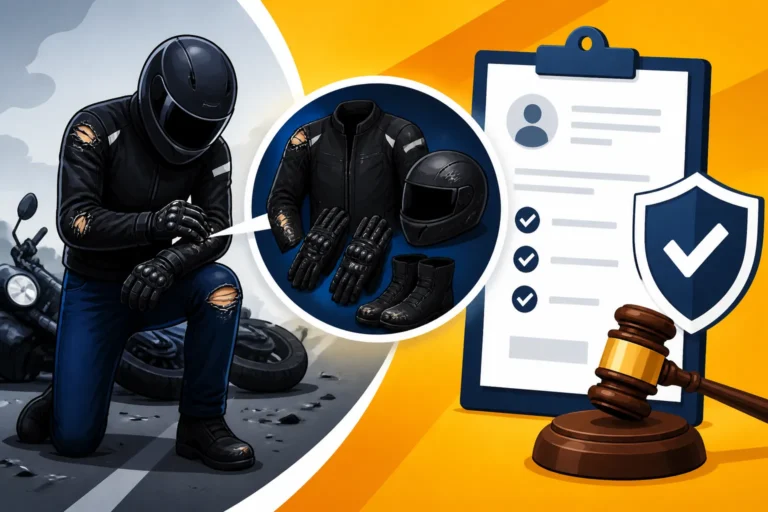
If you were wearing proper gear, and still sustained injuries like severe road rash, compound fractures, or internal injuries, your gear itself becomes powerful evidence. Damaged gear shows the force of the impact and how it likely prevented even worse injuries. For example, if your sturdy leather jacket from a reputable brand like Alpinestars or Dainese is shredded, it clearly illustrates the force it absorbed, mitigating what could have been far more gruesome injuries. This can help you argue against claims that you were somehow negligent in protecting yourself. Wearing appropriate gear is part of Motorcycle Safety Gear and Legal Protection.
Eye Protection and Gloves: Small Details, Big Impact
It's easy to overlook smaller pieces of gear, but eye protection and gloves are vital for safety and can also play a role in your claim. Proper eye protection, whether it's a helmet visor or dedicated goggles, prevents debris, insects, or even wind from impairing your vision, which could contribute to an accident. In a crash, eye protection shields your eyes from direct impact or flying fragments.
Gloves, often overlooked until a crash happens, protect your hands – a natural instinct is to put your hands out to break a fall. High-quality motorcycle gloves, particularly those with reinforced knuckles and palm sliders, can prevent severe road rash, broken fingers, and nerve damage. If you sustained hand injuries and weren't wearing gloves, an insurer might argue that these injuries could have been lessened. Conversely, if your gloves are torn or damaged, they serve as further evidence of the crash's severity and your proactive safety measures. You can find excellent gear at stores like Cycle Gear, ensuring you're protected from head to toe.
How Gear Damage Supports Your Claim
The condition of your riding gear post-accident can be a compelling piece of evidence. Take photos of your helmet, jacket, pants, gloves, and boots immediately after the crash, even if they seem minor. If your gear is torn, scuffed, or otherwise damaged, it visually demonstrates the forces involved in the accident. This isn't just about showing that you were wearing the gear; it's about illustrating the severity of the impact.
For instance, if your helmet shows a deep gouge or crack, it's undeniable proof that your head hit the ground hard, and the helmet did its job by absorbing that impact, likely preventing a more severe injury. This tangible evidence can help counteract arguments that your injuries are exaggerated or that the crash wasn't that severe. It can also help establish a higher value for your non-economic damages, like pain and suffering, by clearly showing the intensity of the trauma you experienced. This is precisely How Gear Damage Supports Your Claim.
State-Specific Nuances: A Look at Regional Helmet Law Implications
Given the varied landscape of helmet laws across the United States, it’s critical for riders to understand the specific regulations in their state of residence or any state they plan to ride through. These localized rules directly influence how helmet use (or non-use) is treated in an accident claim.
California's Universal Law and Claim Impact
California has a universal helmet law, meaning all riders and passengers, regardless of age, must wear a DOT-compliant helmet. There are no exceptions for age or insurance coverage. This strict adherence to helmet use is reflected in how accident claims are handled. If a rider in California is involved in a crash and was not wearing a helmet, their case immediately faces a significant hurdle.
Even if the other driver was entirely at fault, the insurance company will almost certainly invoke the "helmet defense." They'll argue that any head injuries sustained could have been prevented or substantially mitigated had the rider complied with the law. California follows a pure comparative negligence standard, so while not wearing a helmet won't bar your claim entirely, it will likely lead to a percentage reduction in damages attributable to your head injuries. For instance, if you have $200,000 in damages and are found 30% responsible for your head injury due to not wearing a helmet, your head injury specific damages could be reduced by $60,000. This makes proving compliance, or effectively countering the defense, even more critical in the Golden State. It's not just about getting a ticket; it's about your entire recovery process.
Florida's Partial Law and Its Insurance Considerations
Florida operates under a partial helmet law. Riders under 21 must wear a helmet, while riders 21 and older can legally ride without one if they carry at least $10,000 in medical benefits coverage. This distinction has profound implications for a claim. If an adult rider meets the insurance requirement and chooses not to wear a helmet, they are technically riding legally.
However, "legal" doesn't mean "immune from the helmet defense." Insurance companies in Florida can still argue that, despite the legality, the rider's choice not to wear a helmet contributed to the severity of their head injuries. Florida uses a modified comparative negligence rule (the 51% bar rule). This means if the jury finds the rider to be 51% or more at fault for their injuries due to not wearing a helmet, they could be completely barred from recovering damages for those injuries. The nuances of How Florida's Helmet Law Works emphasize the need for expert legal guidance to navigate such claims effectively.
Texas: Finding the Balance Between Freedom and Safety
Texas also has a partial helmet law, similar to Florida's. Riders under 21 are required to wear a helmet. Riders 21 and older can ride without a helmet if they have completed a motorcycle safety course or carry at least $10,000 in medical insurance coverage. This provision allows adult riders a choice, but like Florida, this choice can still be leveraged by insurers.
Texas also follows a modified comparative negligence rule, with a 51% bar. This means if the insurance company can convince a jury that your decision not to wear a helmet contributed 51% or more to the severity of your head injury, you would receive nothing for those damages. The state's balance between rider freedom and safety means riders must be extra vigilant about understanding the potential impact on their claims. If you're riding in Texas without a helmet, even if legally, you should be prepared for the insurer to bring up How Texas Helmet Law and Insurance Work and attempt to reduce your settlement.
When to Consult a Motorcycle Accident Attorney
Dealing with the aftermath of a motorcycle accident is overwhelming, especially when you're injured and facing an insurance company determined to minimize your claim. The complexities of helmet laws and the "helmet defense" make legal representation not just helpful, but often essential.
Complexities of the Helmet Defense
The helmet defense is not a simple "yes or no" question; it's a sophisticated legal argument that requires specialized knowledge to counteract. If the insurance company is using your helmet (or lack thereof) against you, it immediately adds layers of complexity to your case. They might hire their own accident reconstruction experts and medical professionals to support their claims that your injuries were exacerbated by your helmet choices.
An experienced motorcycle accident attorney understands these tactics. They know how to challenge the causal link between helmet use and injury severity, how to scrutinize expert testimony, and how to present counter-evidence. They can argue that even with a helmet, certain injuries were inevitable, or that the other driver's negligence was the overwhelming cause of your suffering. Without legal representation, you might find yourself outmatched and overwhelmed by the insurance company's resources and strategies, potentially leaving significant money on the table.
Maximizing Your Settlement
Beyond just fighting the helmet defense, an attorney's primary goal is to ensure you receive the maximum possible settlement for all your damages. This includes not just your immediate medical bills and lost wages, but also future medical costs, loss of earning capacity, pain and suffering, emotional distress, and property damage. An attorney knows how to accurately value these damages, which can be significantly higher than what an insurance company's initial offer might suggest.
They can gather all necessary evidence, including medical records, expert opinions, and witness statements, to build a strong case. They handle all communication and negotiations with insurance adjusters, protecting you from making statements that could harm your claim. Furthermore, if a fair settlement cannot be reached, they are prepared to take your case to court. An attorney experienced in motorcycle claims understands the subtle and overt biases that sometimes exist against riders and can strategically navigate these challenges to protect your rights and help you recover financially and physically. This expertise is vital for How to Maximize Your Motorcycle Accident Settlement and navigating the entire process successfully.
Disclaimer
This article provides general information about motorcycle helmet laws and their potential impact on accident claims and should not be considered legal advice. Motorcycle accident laws, including those pertaining to helmets and comparative negligence, vary significantly by state and are subject to change. The information presented here is for educational purposes only. If you have been involved in a motorcycle accident, it is strongly recommended that you consult with a qualified attorney in your jurisdiction to discuss your specific situation and understand your legal rights and options.