Motorcycle Accidents Caused by Road Hazards
Riding a motorcycle offers unparalleled freedom, but it also comes with unique challenges, not least of which are the ever-present dangers lurking on our roads. Potholes, loose gravel, unexpected debris – these aren't just minor inconveniences for riders; they can be the direct cause of catastrophic motorcycle accidents. This comprehensive guide will delve into how these road hazards contribute to crashes, who might be held responsible, and how you can navigate the complex aftermath if you're unfortunately involved in such an incident.
Understanding the Unique Vulnerabilities of Motorcyclists to Road Hazards
For those of us on two wheels, the road isn't just a surface to travel on; it's a dynamic, often unpredictable environment. What might be a slight bump for a car driver can send a motorcyclist skidding or even airborne. Our interaction with the road is far more intimate and, consequently, far more susceptible to its imperfections. The margin for error is significantly smaller, making every ripple, crack, or patch of loose material a potential hazard of the highest order.
Why Road Hazards Pose a Greater Threat to Riders
Imagine cruising along, enjoying a perfect day, when suddenly you hit a pothole that seemed to appear out of nowhere. In a car, you might feel a jarring thud, perhaps a flat tire, or even some suspension damage. Annoying, certainly, but generally not life-threatening. For a motorcyclist, however, that same pothole can cause the front wheel to tuck, leading to an immediate loss of control, a high-side, or a low-side crash. Our contact patch with the road is small, and our stability relies on momentum and balance. Anything that disrupts this delicate equilibrium, from a rogue pebble to a significant dip, can have disproportionately severe consequences. The lack of an enclosed cabin also means riders are directly exposed to the impact and subsequent fall, leading to far more serious injuries than those typically sustained in car accidents.
Think about a common scenario: you’re leaning into a curve, your bike beautifully balanced, and suddenly your tires hit a patch of sand or gravel left behind by a construction vehicle. The bike loses traction almost instantly. There's no heavy chassis to absorb the shock, no airbags to deploy, and no seatbelt to hold you in place. It's just you, the bike, and the unforgiving pavement. This inherent instability means that even seemingly minor road imperfections demand constant vigilance and can turn a pleasant ride into a nightmare in a split second.
Common Misconceptions About Rider Skill and Road Conditions
It's a frustratingly common refrain we hear after a motorcycle accident involving a road hazard: "The rider should have been more careful" or "They must have been riding too fast for the conditions." While rider skill and awareness are absolutely crucial for safety, this mindset often unfairly shifts blame away from the negligence that created the hazard in the first place. No matter how experienced a rider is, or how meticulously they scan the road ahead, some hazards are simply unavoidable or impossible to anticipate until it's too late.
Consider a patch of black ice on a shaded turn, or a fresh oil spill just over a blind crest. These aren't scenarios where "more skill" would necessarily prevent a crash; they're scenarios where dangerous road conditions were present due to lack of maintenance, proper signage, or timely cleanup. We riders are often unfairly stereotyped as reckless, making it harder to prove that the road condition, not our riding, was the primary cause of an incident. This bias can significantly impact who is at fault in a motorcycle accident claim, making it vital to gather robust evidence to counter such assumptions.
Identifying the Most Dangerous Road Hazards for Motorcyclists
Road hazards come in many forms, each presenting its own unique challenge and danger to motorcycle riders. It’s not just the obvious giant potholes; sometimes, the most insidious hazards are those that are subtle or unexpected. Knowing what to look for and understanding their impact is the first step in both prevention and, unfortunately, in building a strong accident claim.
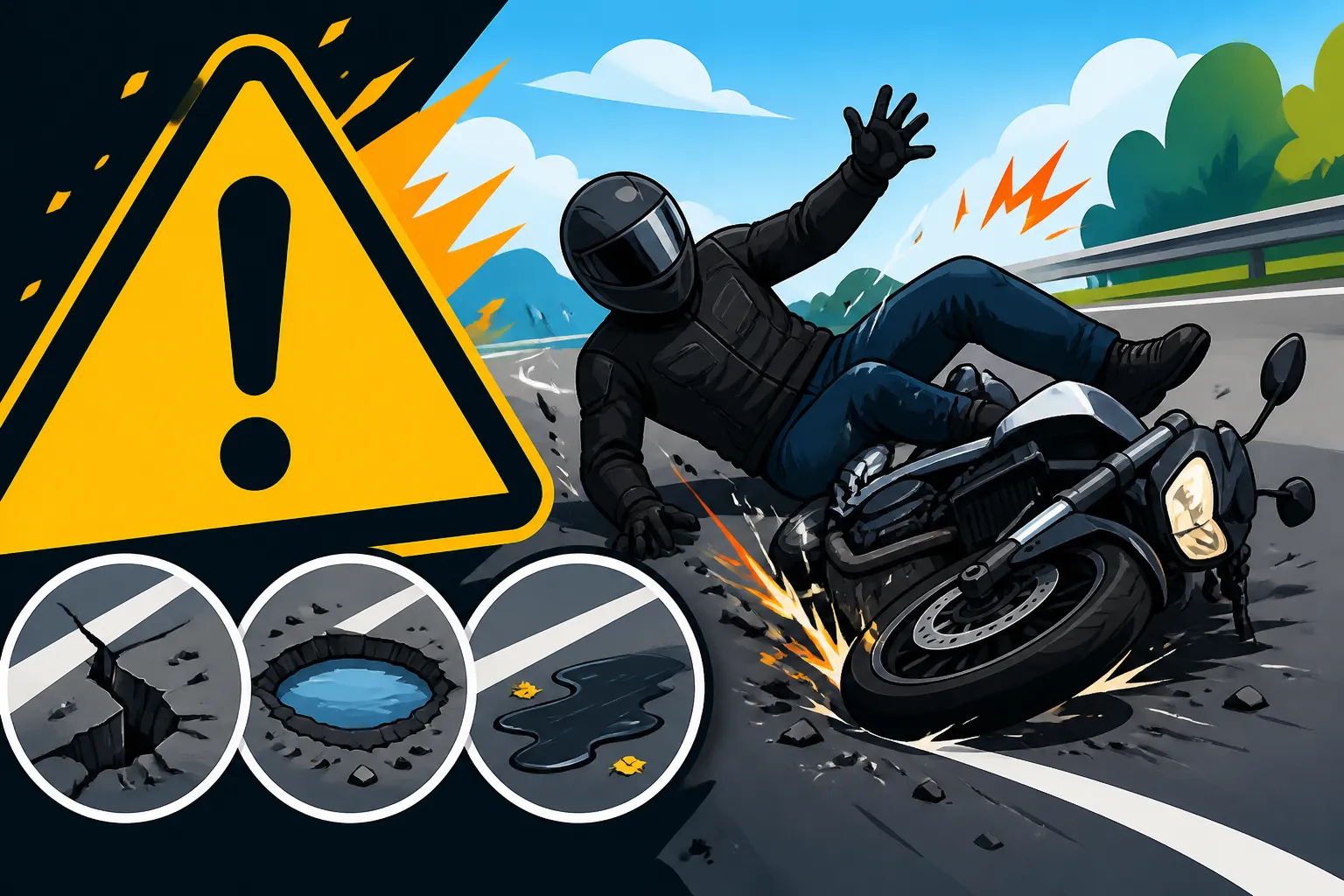
Potholes, Cracks, and Uneven Pavement
These are perhaps the most universally recognized road hazards, and for good reason. Potholes are formed when water seeps into cracks in the road, freezes, expands, and then thaws, causing the pavement to break apart. What starts as a small imperfection can quickly become a wheel-eating chasm. For a motorcycle, hitting a pothole, especially at speed, can cause severe jolts, throw the handlebars off-center, or even pinch the tire and cause a blowout. The impact can damage rims, tires, suspension components, and even the bike's frame.
Similarly, extensive cracks, especially those running parallel to the direction of travel, can be extremely dangerous. A motorcycle tire can get caught in a deep crack, causing the bike to veer unpredictably. Uneven pavement, such as significant height differences between lanes, raised manhole covers, or sudden dips and bumps, can destabilize a bike, especially when leaning into a turn or attempting to change lanes. In cities like Los Angeles or Chicago, where road maintenance can be a constant battle, these hazards are a daily reality for riders. A sudden change in road elevation, even just an inch or two, can mimic the effect of hitting a curb for a motorcycle, leading to a loss of balance and control that’s incredibly difficult to recover from at speed.
Gravel, Sand, and Debris
Loose materials on the road are a rider's worst enemy, as they drastically reduce tire traction. Gravel, sand, dirt, or even spilled soil from construction trucks can turn a perfectly good road into a treacherous surface, especially when encountered mid-turn. This is often an issue in rural areas where dirt roads meet paved ones, or in urban areas near construction sites. Even a small patch can cause the tires to slide out, leading to a low-side crash where the bike falls onto its side.
Beyond loose aggregates, debris is another significant threat. This can range from small items like discarded plastic bottles or hubcaps to larger, more dangerous objects such as fallen tree branches, blown-out truck tire treads, construction materials, or even discarded furniture. Imagine hitting a piece of metal rebar or a chunk of concrete at highway speeds; the consequences can be truly horrific. These objects can damage tires, snag suspension components, or even be propelled upwards, striking the rider. Many accidents occur when a driver ahead swerves to avoid debris, and the motorcyclist, having less room to maneuver or less visibility of the object, hits it directly.
Spills and Slick Surfaces
Liquid spills are particularly perilous because they often appear suddenly and are difficult to see, especially at night or in specific lighting conditions. Oil, transmission fluid, diesel fuel, or antifreeze leaks from other vehicles can create incredibly slick patches on the road. Rain can make these spills even more treacherous, spreading them across a wider area and making them nearly invisible until a tire slips. Fresh asphalt sealant, wet leaves, or even large puddles after a rain shower can also create extremely slick conditions that challenge a motorcycle's limited traction.
These surfaces offer very little friction, and attempting to brake, accelerate, or turn on them can easily cause a loss of control. The suddenness with which a motorcycle can lose grip on a slick surface leaves riders with virtually no time to react, often leading to immediate and violent crashes. The aftermath of a crash due to a fluid spill can be particularly frustrating, as the source of the spill might be long gone, complicating the process of proving fault.
Obstacles, Malfunctioning Infrastructure, and Construction Zones
Beyond the natural wear and tear of roads, other man-made hazards can present severe risks. Unmarked or poorly lit construction zones are notorious accident sites, with temporary barriers, open trenches, uneven plates, or misplaced cones posing direct obstacles. Utility work, for instance, often leaves behind uneven metal plates that can become slick when wet or shift under the weight of a motorcycle. Malfunctioning traffic signals or missing stop signs can lead to intersection accidents, where the hazard isn't physical but a breakdown in traffic control.
Think about a faded lane marker that makes it impossible to discern where one lane ends and another begins, especially in adverse weather, or a broken street light that plunges a complex intersection into darkness. These infrastructural failures can contribute to confusion and misjudgment, leading to accidents. In some cases, third-party contractors, like those installing fiber optic cables or repairing water mains, might leave excavations poorly covered or marked, creating massive pitfalls for unsuspecting riders. When you consider the myriad of Common Causes of Motorcycle Accidents, these infrastructure-related issues stand out due to their preventable nature.
Establishing Fault in Road Hazard Motorcycle Accidents
Determining fault in a motorcycle accident caused by a road hazard can be significantly more complex than a typical vehicle-on-vehicle collision. It often involves identifying a negligent party other than another driver, such as a government entity or a private contractor. This process requires a thorough investigation and a deep understanding of liability laws.
Proving Negligence by the Responsible Party
To successfully pursue a claim, you must demonstrate that a specific entity was negligent in maintaining the roadway or controlling a work zone, and that this negligence directly led to your accident and injuries. This means proving four key elements:
- Duty: The responsible party had a legal duty to maintain the road in a safe condition. This is usually self-evident for government agencies responsible for public roads.
- Breach: The responsible party breached that duty by failing to repair a known hazard, failing to properly warn of a hazard, or creating a new hazard through their actions (or inactions).
- Causation: The breach of duty was a direct cause of your motorcycle accident and injuries. This is where detailed evidence of the hazard itself and how it impacted your riding is critical.
- Damages: You suffered actual damages as a result of the accident, such as medical bills, lost wages, and pain and suffering.
For example, if you hit a massive pothole on a state highway in Pennsylvania that has been reported multiple times to the Department of Transportation (PennDOT) but never repaired, you might argue they breached their duty of care. If a construction company leaves loose gravel on a public street after working and fails to sweep it up or post warning signs, and you crash as a result, they may be found negligent. This can be a challenging legal battle, but it is entirely possible to prove negligence in a motorcycle accident.
The Role of Government Entities and Private Contractors
Often, the responsible party for a road hazard is a government entity – be it a municipal, county, or state department of transportation. Pursuing a claim against a government entity, however, comes with its own set of hurdles. These agencies often have sovereign immunity laws that protect them from lawsuits, or they have specific, much shorter statutes of limitations and strict notice requirements that must be followed. For instance, in many states, you might only have 60 to 180 days to file an official notice of claim with the government agency, significantly less than the typical two- or three-year statute of limitations for personal injury claims against private individuals.
Private contractors, on the other hand, are typically subject to standard personal injury laws. If a company like Acme Construction is performing work on a street and leaves dangerous conditions behind – an improperly covered trench, inadequate lighting, or debris – they can be held liable. The challenge here is identifying the specific contractor and gathering evidence of their direct responsibility. This might involve obtaining permits, construction plans, or even eyewitness accounts from local businesses or residents. Understanding Government Liability for Road Hazards is crucial in these scenarios, as the rules of engagement are distinctly different.
Shared Fault and Comparative Negligence Considerations
Even if a road hazard was clearly a contributing factor to your accident, insurance companies and defense attorneys will almost always try to argue that you, as the motorcyclist, were at least partially at fault. They might contend that you were riding too fast, weren't paying enough attention, or failed to take evasive action that a "reasonable" rider would have. This is where the concept of Comparative Negligence in Motorcycle Accidents comes into play.
Most states follow some form of comparative negligence, which means your compensation can be reduced by the percentage of fault assigned to you. For example, if a jury determines your total damages are $100,000, but you were 20% at fault for riding slightly too fast for the conditions, your award would be reduced to $80,000. Some states, like California, follow "pure comparative negligence," allowing recovery even if you are mostly at fault. Others, like Texas, follow a "modified comparative negligence" rule (specifically the 51% bar rule), which means if you are found 51% or more at fault, you cannot recover any damages. This is why it's incredibly important to challenge any unfair allegations of shared fault in motorcycle accidents, as they can significantly reduce your payout.
Gathering Evidence After a Road Hazard Accident
The moments immediately following a motorcycle accident are chaotic and stressful, but they are also crucial for gathering evidence that will support your claim. Unlike a collision with another vehicle where the other driver's insurance information is primary, a road hazard accident demands meticulous documentation of the environment itself. This evidence is your bedrock for establishing fault and proving your damages.
Documenting the Scene and the Hazard
If you are physically able to do so, and it is safe, the very first thing you should do after ensuring your immediate safety is to document the accident scene comprehensively. This means taking abundant photographs and videos. Don't just focus on your damaged motorcycle; photograph the specific road hazard from multiple angles and distances. Show its size, depth, location, and any surrounding conditions. Use objects for scale, like a shoe or a wallet, next to a pothole or debris field. Capture relevant landmarks, street signs, and traffic control devices to clearly establish the precise location.
In addition to photos, a video recording can be immensely powerful. Narrate what you are seeing, pointing out the hazard, how it relates to your bike, and the overall road conditions. Note the time of day, weather, and visibility. Were there any warning signs (or lack thereof)? Was the hazard obscured by shadows, overgrown vegetation, or poor lighting? Remember, conditions can change rapidly. A puddle could dry up, debris might be cleared, or a pothole could be temporarily filled. Having immediate, timestamped evidence is indispensable when proving fault in a motorcycle accident. This meticulous approach to documenting the scene is one of the most critical First Steps to Protect Your Motorcycle Claim.
Collecting Witness Statements and Police Reports
Eyewitnesses can provide invaluable, objective accounts of what happened and, importantly, corroborate the existence and nature of the road hazard. If anyone stopped to help or observed the accident, get their contact information – names, phone numbers, and email addresses. Ask them what they saw and if they have any information about the road hazard itself, such as whether it had been there for a long time or if others had nearly crashed because of it. Their testimony can lend significant weight to your claim, especially if it's your word against a government agency.
While a police report typically focuses on traffic violations and driver fault, it's still a critical piece of evidence. The responding officer might have noted the road hazard in their report, or at least described the conditions that led to the crash. Even if they don't explicitly assign blame to the hazard, their objective description of the scene can be crucial. If the report doesn't accurately reflect the presence of the hazard, you may need to learn how to correct a wrong police report. Always request a copy of the official police report as soon as it's available.
Medical Records and Expert Testimony
Your injuries are a central component of your claim, and thorough medical documentation is paramount. Even if you feel okay after a crash, always seek immediate medical attention. Adrenaline can mask pain, and some serious injuries, like internal bleeding or a traumatic brain injury, may not manifest symptoms for hours or even days. Comprehensive medical records will detail your injuries, the course of treatment, prognoses, and any long-term impacts. These records directly link your injuries to the accident, quantify your medical expenses, and provide the basis for pain and suffering damages. Gathering Motorcycle Accident Evidence for Proving Fault extends beyond the crash scene itself to your personal recovery journey.
In complex road hazard cases, expert testimony may be necessary. An accident reconstruction expert can analyze the scene, vehicle damage, and your account to explain exactly how the road hazard caused the crash. A civil engineer or road maintenance expert might be called upon to testify about maintenance standards, whether the hazard violated those standards, and the feasibility of repair or warning. Furthermore, medical experts can provide detailed opinions on the extent of your injuries and their long-term effects, which is crucial for calculating Average Motorcycle Accident Settlement Amounts.
Navigating the Claim Process After a Road Hazard Crash
The period following a motorcycle accident involving a road hazard can feel overwhelming. Beyond the physical recovery, you're faced with a bureaucratic maze of insurance companies, government agencies, and legal procedures. Knowing what to expect and how to approach each step is vital to protecting your rights and maximizing your potential compensation.
Reporting the Accident and Initial Steps
Once you've sought medical attention and documented the scene, reporting the accident is your next immediate step. If the police were called, a report would have been generated. You'll also need to notify your own insurance company, even if the fault lies elsewhere. This is especially important for activating any Personal Injury Protection (PIP) or medical payments coverage you might have, which can help cover immediate medical expenses regardless of fault. Remember, when speaking with your insurer or any other party, stick to the facts and avoid speculating or admitting fault. For detailed guidance on your initial actions, refer to What to Do After a Motorcycle Accident.
If you suspect a government entity or private contractor is responsible for the road hazard, the clock starts ticking immediately. Research the specific notice of claim requirements for the government agency involved (city, county, or state Department of Transportation) in your jurisdiction. These requirements are often very strict regarding deadlines and the exact information that must be included. Missing these deadlines can permanently bar your claim, regardless of its merits. It’s highly advisable to consult with an attorney specializing in motorcycle accidents as early as possible to ensure these critical steps are handled correctly.
Dealing with Insurance Companies and Their Tactics
Dealing with insurance companies, whether yours or the at-fault party's, can be one of the most frustrating aspects of the post-accident process. Insurers, particularly those representing a government agency or large construction company, are primarily concerned with minimizing their payout. They may employ various tactics to achieve this: offering a lowball settlement early on before you fully understand your injuries, delaying the process, or trying to shift blame to you, the rider. They might ask for recorded statements, which you should generally avoid providing without legal counsel, as these can be used against you later.
They might also dispute the severity of your injuries, argue that a pre-existing condition is to blame, or question the link between the road hazard and your accident. It's not uncommon for them to suggest that you should have seen the hazard and avoided it. This is where an experienced attorney can be invaluable, serving as your advocate and handling all communications with insurers. They understand the nuances of How Insurance Companies Assign Blame to Riders and can effectively counter these tactics, ensuring your rights are protected and that you receive fair consideration.
Understanding Potential Compensation and Damages
If your claim is successful, you could be entitled to compensation for a wide range of damages resulting from the road hazard accident. These typically fall into two categories: economic and non-economic damages.
- Economic Damages: These are quantifiable financial losses. They include current and future medical expenses (hospital stays, surgeries, physical therapy, medication, adaptive equipment), lost wages (income you've lost due to inability to work), loss of future earning capacity (if your injuries prevent you from returning to your previous job or earning potential), and property damage (repair or replacement of your motorcycle and gear).
- Non-Economic Damages: These are more subjective but no less real. They include pain and suffering (physical pain, emotional distress, discomfort), mental anguish, loss of enjoyment of life (inability to participate in hobbies or activities you once loved), and disfigurement or scarring. In some egregious cases, punitive damages might be awarded if the responsible party's actions were particularly reckless or malicious, though this is rare in road hazard cases.
The total value of your claim will depend heavily on the severity of your injuries, the extent of your financial losses, and the impact the accident has had on your life. For a deeper dive into the financial aspects, explore Types of Damages in a Motorcycle Accident Claim. It's crucial to meticulously track all expenses and document every aspect of your recovery to ensure all damages are accounted for.
Here's a simplified table illustrating common damages:
| Type of Damage | Examples | How It's Calculated |
|---|---|---|
| Medical Expenses | ER visits, surgeries, rehab, medications, ongoing care | Actual bills, estimates from medical professionals for future care |
| Lost Wages | Income missed due to injury and recovery | Pay stubs, tax returns, employment records |
| Loss of Earning Capacity | Diminished ability to earn in the future | Expert testimony from economists or vocational specialists |
| Property Damage | Motorcycle repair/replacement, damaged gear (helmet, jacket) | Repair estimates, fair market value for replacement |
| Pain and Suffering | Physical pain, emotional distress, mental anguish | Often a multiplier of economic damages, or per diem method |
| Loss of Enjoyment of Life | Inability to partake in hobbies, social activities | Personal testimony, journals, expert psychological evaluations |
| Disfigurement/Scarring | Permanent physical changes due to injuries | Medical evidence, photographic evidence, personal impact |
Preventing Road Hazard Accidents and Staying Safe
While we can't control every pothole or piece of debris, adopting proactive strategies can significantly reduce your risk of encountering problems and improve your ability to react safely when they do arise. For us riders, safety isn't just about defensive driving; it's about anticipating the road's next trick.
Defensive Riding Strategies
The core of preventing road hazard accidents lies in defensive riding. This means cultivating a heightened state of awareness at all times.
- Scan Ahead: Continuously scan the road surface far ahead of you, not just the vehicle in front. Look for changes in pavement texture, shadows that might conceal hazards, fresh water, or dark patches that could indicate oil spills. The faster you spot a hazard, the more time you have to react.
- Maintain Proper Following Distance: Give yourself ample space between your motorcycle and the vehicle ahead. This increases your field of vision and provides more time to react to hazards that the car might kick up or swerve to avoid. A safe following distance on a motorcycle is even more critical than in a car.
- Adjust Speed to Conditions: Always ride at a speed appropriate for the road conditions, not just the posted limit. If the road looks rough, wet, or unfamiliar, slow down. This gives your tires more grip and you more time to maneuver. If you find yourself in a situation where you might be partly at fault for speeding, know that How Speeding Affects Motorcycle Accident Fault can be a complex issue in a claim.
- Proper Lane Positioning: Choose your lane position wisely. Sometimes riding slightly to the left or right within your lane can help you avoid common hazards that accumulate in the center (like oil drips) or near the shoulder (like debris). However, always ensure your position allows you to be seen by other drivers.
- Smooth Inputs: When you encounter a hazard, avoid sudden braking, acceleration, or steering. Smooth, controlled inputs are critical to maintaining stability. If you must swerve, do so gently and progressively. If you must brake, use both front and rear brakes smoothly.
No matter how skilled you are, hazards will always exist. Your best defense is a proactive offense: anticipating what the road might throw at you and being prepared to react calmly and effectively.
Reporting Hazards to Authorities
This is where we, as riders, can make a tangible difference not only for our own safety but for the entire riding community. If you encounter a significant road hazard – a dangerous pothole, a persistent oil slick, a large amount of debris, or a malfunctioning traffic light – report it to the appropriate authorities immediately.
- Who to Contact: For state highways, contact your state’s Department of Transportation (e.g., Caltrans in California, TxDOT in Texas, FDOT in Florida). For city streets, contact your local public works department or 311 service. Many cities now have online portals or apps where you can easily report hazards with photos and location data. For critical immediate dangers, such as a large object in a live lane of traffic, call non-emergency police dispatch (or 911 if it poses an immediate severe risk of another accident).
- What Information to Provide: Be specific. Provide the exact location (street name, cross streets, nearest address, mile marker on a highway), a clear description of the hazard, its size, and how long you think it’s been there. If you took photos, offer to share them.
- Why It Matters: Reporting hazards not only helps prevent future accidents but can also be important if you or someone else later has an accident at that location. Your report creates a record that the responsible entity was aware (or should have been aware) of the hazard, which can be crucial in proving negligence. This can often be the first step in establishing How Police Reports Establish Fault in a broader sense, even if the report isn't about your specific accident. Being an active participant in road safety benefits everyone.
Disclaimer
Please note that this article is intended for informational purposes only and does not constitute legal advice. Motorcycle accident claims, especially those involving road hazards and government entities, are highly complex and jurisdiction-specific. It is always recommended to consult with a qualified personal injury attorney in your state for advice tailored to your specific situation.