How Fault Affects Your Settlement
You've been in a motorcycle accident, and now you're not just dealing with injuries and bike damage, but also the gnawing worry about how your settlement will pan out, especially if there's any question about who was to blame. It’s a frustrating reality that the path to recovery often feels like an uphill battle, especially when you feel the scales of justice might be tipped against riders. This guide is here to shed light on how fault is determined in motorcycle accidents and, more importantly, how that determination directly impacts the compensation you can expect to receive.
Understanding the Concept of Fault in Motorcycle Accidents
When you’re involved in a motorcycle accident, one of the first and most critical questions that arises is "Who's at fault?" It’s more than just a matter of pointing fingers; it’s a legal designation that profoundly influences whether you can recover compensation for your injuries, medical bills, lost wages, and property damage. For motorcyclists, this question often comes with a built-in bias, making the process even more challenging.
The Initial Blame Game
It’s an unfortunate truth that in many vehicular accidents involving motorcycles, there's an almost immediate tendency for others – drivers, witnesses, and especially insurance adjusters – to assume the motorcyclist must have been doing something wrong. This "blame the biker" mentality is a pervasive frustration many riders encounter. Even when a car driver clearly committed a critical error, such as turning left in front of a motorcycle or failing to yield, the narrative can quickly shift to questioning the rider's speed, visibility, or maneuvers. This initial blame game can set a negative tone for your entire claim from the outset.
The reality is that Common Causes of Motorcycle Accidents are often rooted in drivers failing to see motorcyclists, making it crucial to understand how fault is determined and how to counter these biases. From the moment the police arrive at the scene, their observations and initial reports begin to paint a picture of fault. This is why accurately documenting the scene and not admitting fault, even if you’re shaken, is absolutely critical.
Legal Definitions of Negligence
In the eyes of the law, "fault" is often synonymous with "negligence." Negligence essentially means that someone failed to act with the level of care that a reasonably prudent person would have exercised under similar circumstances, and this failure directly caused harm. For instance, a car driver who is texting and swerves into your lane is likely negligent because a reasonable driver would be focused on the road. Similarly, if a motorcyclist was speeding excessively or performed an unsafe lane change, they could be deemed negligent.
The specifics of negligence can get quite intricate, but the core idea revolves around duty of care, breach of that duty, causation, and damages. Every driver on the road has a duty of care to operate their vehicle safely and follow traffic laws. When that duty is breached, leading to an accident and subsequent injuries or damages, the breaching party is usually considered negligent and, therefore, at fault. Understanding these legal definitions is the first step in asserting your rights and challenging unfair blame.
Why Fault Matters for Your Wallet
The determination of fault isn't just an abstract legal concept; it's the bedrock of your financial recovery after a motorcycle accident. In most states, if you are found to be 100% at fault, you generally cannot recover damages from another driver's insurance. Conversely, if the other driver is 100% at fault, their insurance should cover your economic and non-economic damages. However, the situation often isn't so black and white.
When fault is shared, things get complicated, and that's where the various rules of comparative negligence come into play, directly affecting the amount of compensation you can ultimately receive. The greater your percentage of fault, the less money you will be able to recover. This is why every piece of evidence, every witness statement, and every detail you gather about How Fault Is Determined in Motorcycle Accidents can literally translate into thousands of dollars, or even the ability to recover anything at all.
Comparative Negligence: The Core Principle Affecting Your Payout
Navigating the aftermath of a motorcycle accident is tough enough without grappling with complex legal doctrines. However, if you're wondering how fault affects your settlement, understanding comparative negligence is absolutely essential. This legal framework dictates how damages are apportioned when more than one party shares some degree of blame for an accident. It's the mechanism that can reduce your payout based on your own contribution to the crash.
Pure Comparative Negligence Explained
In states that follow "pure comparative negligence" rules, you can recover damages even if you are found to be largely at fault for the accident, though your compensation will be reduced by your percentage of fault. For example, if you’re involved in a crash in a state like California, Florida, or New York, and a jury determines you were 80% at fault but sustained $100,000 in damages, you could still recover $20,000 (20% of your total damages).
This system is generally seen as more forgiving for accident victims, ensuring that even if you made a mistake, you're not entirely barred from recovering for the damages caused by another negligent party. While it still means your settlement will be significantly lower if you hold a high percentage of fault, it offers a crucial lifeline that isn't available in other states. It’s a pragmatic approach that recognizes that accidents often have multiple contributing factors.
Modified Comparative Negligence Rules
Most states operate under some form of "modified comparative negligence." This system is a hybrid approach that allows for recovery when shared fault exists, but with a critical threshold. If your fault exceeds a certain percentage, you might be completely barred from recovering any damages. There are two main variations: the 50% Bar Rule and the 51% Bar Rule.
The 50% Bar Rule
Under the 50% Bar Rule, sometimes referred to as the "equal to or greater than" rule, you can recover damages as long as your percentage of fault is not greater than the defendant's fault. This means if you are found to be 50% at fault, you can still recover 50% of your damages. However, if your fault is determined to be 51% or higher, you recover nothing. States like Ohio, Illinois, Montana, New Jersey, and Pennsylvania adhere to this rule. This can be a harsh cutoff, especially for motorcyclists who are often unfairly assigned higher percentages of blame by insurance companies or juries due to existing biases.
The 51% Bar Rule
The 51% Bar Rule, often called the "not as great as" rule, is slightly more lenient. In these states, you can recover damages as long as your percentage of fault is not greater than the combined fault of all other defendants. This means if you are 50% at fault, you can recover 50% of your damages. But if you are 51% or more at fault, you are barred from recovery. This rule is followed in states such as Georgia, Texas, Wisconsin, and Arizona. The difference between 50% and 51% might seem small, but it's the difference between receiving substantial compensation and receiving nothing at all. This highlights the critical importance of proving the other driver's negligence and minimizing your own perceived fault.
Contributory Negligence: The Harsh Reality
While pure and modified comparative negligence offer some pathway to recovery even with shared fault, "contributory negligence" is the most unforgiving system. Only a handful of jurisdictions still follow this rule, including North Carolina, Virginia, Maryland, Alabama, and Washington D.C. In these places, if you are found to be even 1% at fault for the accident, you are completely barred from recovering any damages whatsoever from the other party.
Imagine a scenario where a car driver blows through a stop sign and T-bones your motorcycle, but it's later argued that you were traveling 5 mph over the speed limit. In a contributory negligence state, if a court finds you even marginally responsible for the accident due to that minor speeding violation, your entire claim could be dismissed. This draconian rule places an immense burden on the injured party to be entirely blameless, which is often an impossible standard in the chaos of a real-world collision. For riders in these states, establishing sole fault of the other party is paramount, making the need for skilled legal representation even more critical. Understanding Contributory vs Comparative Negligence Explained can help you grasp the stakes involved in your state.
How Fault is Established and Proven
Proving who is at fault in a motorcycle accident is rarely straightforward, especially when dealing with the inherent biases against riders. It requires a meticulous collection of evidence and a strategic presentation of facts to overcome assumptions and establish the truth. Insurance companies are not on your side; their goal is to minimize payouts, which often means trying to shift as much blame as possible onto the motorcyclist.
The Role of Evidence in Proving Fault
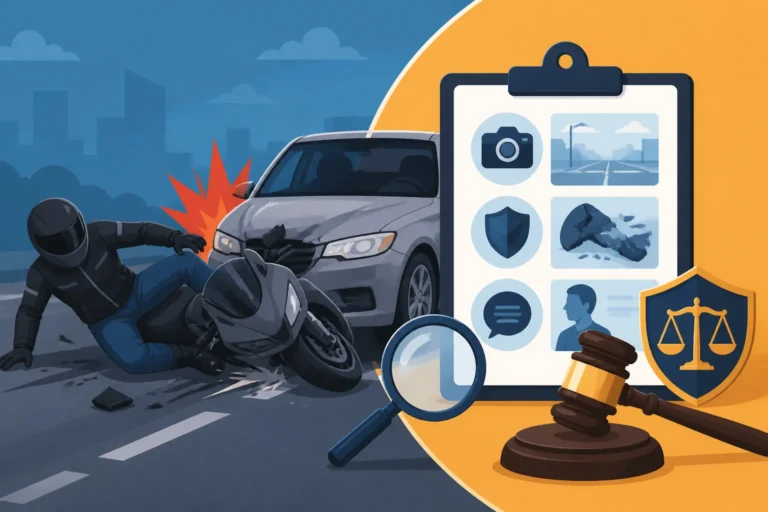
Evidence is the backbone of any motorcycle accident claim. Without solid evidence, your version of events can easily be dismissed or challenged. The types of evidence that are crucial for proving fault include:
- Police Reports: While not always definitive, a police report provides an official account of the accident, including diagrams, witness statements, and initial fault determinations. A detailed report can be invaluable, but it's important to know How Police Reports Establish Fault and how to correct a wrong one if needed.
- Photographs and Videos: Pictures taken at the scene of the accident are incredibly powerful. They can document vehicle positions, road conditions, damage, injuries, traffic signs, and any debris. Dashcam footage, if available, can offer an objective, real-time view of what transpired, often becoming irrefutable proof.
- Witness Statements: Independent witnesses can corroborate your account of the accident. Their unbiased perspective can carry significant weight, especially when it contradicts the other driver's story or helps counter anti-rider bias. Learn more about How Witnesses Affect Motorcycle Fault and why securing their contact information is crucial.
- Traffic Laws and Violations: Proving that the other driver violated a specific traffic law, like running a red light or failing to yield, directly supports a claim of negligence. This can often be tied back to specific causes like Motorcycle Accidents Caused by Left-Turn Collisions or Motorcycle Accidents Caused by Failure To Yield.
- Accident Reconstruction: For complex accidents, experts can recreate the crash dynamics using physics, vehicle data, and scene evidence. This scientific analysis can definitively establish impact points, speeds, and lines of sight, often dismantling speculative arguments about fault.
Every piece of evidence contributes to building a compelling case that clearly outlines who was responsible for the collision. The more comprehensive your evidence, the stronger your position will be when negotiating a settlement.
Insurance Company Tactics in Assigning Blame
Insurance companies are formidable opponents. They employ various tactics to assign blame, often unfairly, to motorcyclists. One common tactic is capitalizing on "rider bias." This refers to the preconceived notions many people, including insurance adjusters and potential jurors, have about motorcyclists being reckless or irresponsible. This bias can manifest in claims being undervalued or outright denied, even when the evidence clearly favors the rider.
Another frequently heard defense is "I didn't see the motorcycle." While drivers may genuinely fail to notice a motorcycle, this is rarely a valid excuse for negligence. Drivers have a responsibility to be vigilant and look for all traffic, including motorcycles. Insurance companies, however, might use this defense to suggest the motorcyclist was somehow "invisible" or not making themselves seen, subtly shifting blame. They might also scrutinize your actions, looking for any minor infraction – perhaps you were slightly over the speed limit, or your headlight wasn't bright enough – to assign partial fault. It's critical to understand How Insurance Companies Assign Blame to Riders and be prepared to counter these arguments effectively.
When Multiple Parties Share Fault
Not all accidents are simple "one driver vs. one rider" scenarios. Sometimes, fault can be shared between the motorcyclist and the car driver, or even involve third parties. For example, a pothole might have contributed to the accident, potentially bringing in Government Liability for Road Hazards. Or, a defective part on your motorcycle, like a brake failure, could point to Manufacturer Liability for Defective Parts.
When fault is shared, the legal concept of comparative or contributory negligence (as discussed earlier) becomes paramount. If a portion of the blame falls on you, your total damages will be reduced by your percentage of fault in most states. It’s a complex dance where each party's contribution to the accident needs to be carefully assessed and weighted. This is where having an experienced advocate who understands how to dissect multi-party liability and prove the varying degrees of fault can make a world of difference in your final settlement.
| State Type & Rule | Example States | Impact on Your Settlement |
|---|---|---|
| Pure Comparative | California, Florida, New York, Missouri | You can recover damages even if 99% at fault, but your compensation is reduced by your fault percentage. |
| Modified Comparative (50% Bar) | Ohio, Illinois, Montana, New Jersey, Pennsylvania | You can recover if 50% or less at fault. If 51% or more, you get nothing. |
| Modified Comparative (51% Bar) | Georgia, Texas, Wisconsin, Arizona | You can recover if 50% or less at fault. If 51% or more, you get nothing. |
| Contributory Negligence | North Carolina, Virginia, Maryland, Alabama, D.C. | If you are 1% or more at fault, you recover nothing. |
Impact of Fault on Your Settlement Components
Understanding how fault is determined is only half the battle; the other half is knowing how that determination directly translates into the monetary value of your settlement. Every component of your claim, from the staggering medical bills to the intangible pain and suffering, is scrutinized through the lens of fault. If you are assigned any percentage of blame, it will inevitably chip away at the total compensation you can receive.
Economic Damages and Fault Reduction
Economic damages are the quantifiable financial losses you've incurred due to the accident. These include things like medical expenses, lost wages, and property damage. Even these "hard costs" are not immune to the effects of shared fault.
- Medical Bills: From emergency room visits and surgeries to physical therapy and ongoing medication, medical costs can skyrocket after a serious motorcycle accident. If you are found to be 20% at fault in a pure comparative negligence state, for example, your medical bill reimbursement would be reduced by 20%. So, if you had $50,000 in medical bills, you would only recover $40,000. This reduction can be particularly devastating if you have mounting bills and are already facing financial strain.
- Lost Wages and Future Earning Capacity: Being unable to work after an accident can mean a significant loss of income. This includes wages lost immediately after the crash, as well as potential future earnings if your injuries result in long-term disability or a reduced capacity to work. Just like medical bills, these losses are proportionally reduced by your assigned fault percentage. If you anticipated losing $30,000 in wages due to recovery, and you were 30% at fault, you'd only see $21,000 of that reimbursed.
- Property Damage: The cost to repair or replace your damaged motorcycle, helmet, and other gear is also an economic damage. If your bike was totaled and valued at $15,000, and you were found 25% at fault, you would only receive $11,250 for your property. This can leave you scrambling to cover the remaining costs out of pocket, adding insult to injury.
It's critical to document all of these expenses thoroughly, as detailed in Types of Damages in a Motorcycle Accident Claim, to present the strongest possible case for full reimbursement.
Non-Economic Damages and the Fault Factor
Non-economic damages are often the largest component of a motorcycle accident settlement and cover the subjective, non-financial losses you've endured. These include pain and suffering, emotional distress, loss of enjoyment of life, and disfigurement. While harder to quantify, they are profoundly impacted by the severity of your injuries and, crucially, by your percentage of fault.
- Pain and Suffering: This compensates you for the physical pain and discomfort you experience as a direct result of your injuries. This can range from the acute pain immediately after the crash to chronic pain that may last for years. If a jury determines your pain and suffering is worth $100,000, but you're deemed 40% at fault, that figure will be slashed to $60,000.
- Emotional Distress and Mental Anguish: Many riders experience significant psychological trauma after a crash, including anxiety, depression, or even PTSD. These emotional damages are a real consequence of severe accidents. Like other non-economic damages, the amount you can recover for mental anguish will be directly reduced by your assigned fault.
- Loss of Enjoyment of Life: If your injuries prevent you from participating in hobbies, sports, or daily activities you once enjoyed, you can claim damages for this loss. Imagine no longer being able to ride your motorcycle, hike, or even play with your kids without pain. This significant impact on your quality of life is considered in your settlement, but again, your fault percentage will proportionally decrease any award.
Because these damages are subjective, insurance companies often try to minimize them, and any assigned fault gives them more ammunition to do so. This is especially true given the propensity for Rider Bias in Fault Determination.
Property Damage Claims and Fault
Beyond your physical injuries, the damage to your motorcycle and riding gear can be substantial. For many riders, their motorcycle is more than just transportation; it's a passion, a lifestyle. Seeing it mangled after an accident is heartbreaking, and the financial burden of repair or replacement is a major concern.
In a fault-based system, your ability to recover for property damage is tied directly to the fault assessment. If the other driver is 100% at fault, their insurance should cover the full cost of repairs or the fair market value of your totaled bike, along with any damaged gear like helmets and jackets. However, if you are found to be partially at fault, your recovery for property damage will also be reduced by that same percentage. This means you could be left to pay a portion of your repair costs or replacement value out of pocket. For instance, if you had a custom Harley-Davidson valued at $25,000 and were found 20% at fault, you would only recover $20,000 from the other driver's insurer, leaving you with a $5,000 deficit. This financial hit, on top of everything else, can be incredibly frustrating.
Strategies for Mitigating the Impact of Shared Fault
When you’re a motorcyclist involved in a crash, it often feels like you’re starting behind the eight ball when it comes to fault. The stereotypes and biases can make it an uphill battle to prove the other driver’s negligence. However, there are proactive steps you can take both at the scene and throughout your claim process to significantly mitigate the impact of any shared fault and protect your potential settlement.
Gathering Comprehensive Evidence at the Scene
The moments immediately following an accident are chaotic, but they are also crucial for collecting evidence that can shape the outcome of your claim. What you do right after the crash can either bolster your case or leave you vulnerable to unfair fault assignments.
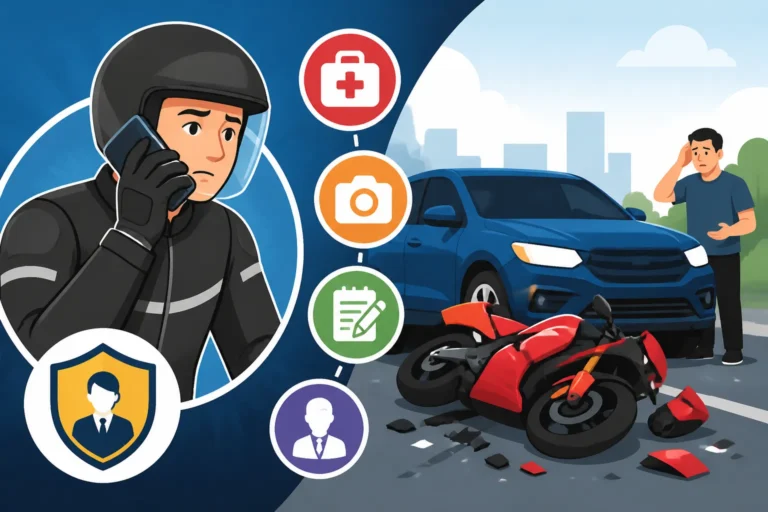
- Document Everything Visually: Use your phone to take extensive photos and videos of the accident scene. Capture the positions of all vehicles, damage to both your motorcycle and the other vehicle, road conditions (skid marks, debris, potholes), traffic signals, and any relevant signs. Get wide shots, close-ups, and multiple angles. Don't forget photos of your injuries, your damaged helmet, and other riding gear. This visual evidence can be powerful in countering narratives that attempt to blame you. Learn more about Photos to Take to Prove Motorcycle Fault.
- Collect Contact Information: Get the other driver's name, insurance information, license plate number, and phone number. Equally important is gathering contact information from any witnesses. Independent witnesses can be vital in confirming your version of events and refuting the other driver's claims or insurance company tactics.
- Do Not Admit Fault: Even if you feel shaken or partly responsible, never apologize or admit fault at the scene. Statements made in the immediate aftermath can be used against you later. Stick to the facts when speaking with police, but avoid speculating or accepting blame. For more guidance on this, see What to Do Immediately After a Motorcycle Accident and Why You Should Never Admit Fault at the Scene.
By being prepared and diligent in these initial steps, you lay a strong foundation for your claim and arm yourself against unfair blame.
Seeking Prompt Medical Attention
Your health is, of course, the top priority after any accident. But beyond your well-being, seeking immediate medical attention plays a critical role in documenting your injuries and, by extension, proving the extent of the damages you've suffered due to the other driver's negligence.
- Establish a Clear Link to the Accident: Visiting a doctor or emergency room right after the crash creates an official record that your injuries were a direct result of the incident. This helps prevent insurance companies from arguing that your injuries are pre-existing or unrelated to the accident, a common tactic to reduce payouts.
- Consistent Medical Care: Follow all your doctor's recommendations for treatment, including follow-up appointments, physical therapy, and specialist visits. Gaps in treatment can be exploited by insurance adjusters to suggest your injuries weren't as severe as claimed or that you weren't diligent in your recovery. Consistent medical records provide irrefutable evidence of your pain, treatment, and progress.
- Documentation of Severity: Your medical records will detail your diagnoses, symptoms, pain levels, and any limitations caused by your injuries. This documentation is crucial for calculating both economic damages (like future medical costs) and non-economic damages (like pain and suffering). The more thoroughly your injuries are documented, the harder it is for insurers to dispute their severity or impact on your life.
Your commitment to your health directly reinforces the validity of your injury claims, making it harder for insurance companies to reduce your settlement based on arguments about fault or injury severity.
The Value of Legal Representation
Facing off against an insurance company after a motorcycle accident can feel like an impossible task, especially when they're trying to pin blame on you. This is precisely why hiring a knowledgeable motorcycle accident attorney is not just helpful, but often essential.
- Countering Rider Bias: Experienced attorneys understand the pervasive Rider Bias in Fault Determination and know how to present evidence in a way that overcomes these stereotypes. They can highlight the other driver's specific acts of negligence, such as distracted driving or failure to yield, ensuring the focus remains on the true cause of the accident.
- Expert Investigation: Lawyers have the resources to conduct thorough investigations. This might involve hiring accident reconstruction specialists, interviewing witnesses, subpoenaing traffic camera footage, and analyzing phone records to prove distracted driving. This deep dive into the specifics of the crash can uncover crucial evidence that you might not be able to obtain on your own, helping to prove Who Is at Fault in a Motorcycle Accident.
- Negotiating with Insurers: Insurance adjusters are trained negotiators whose primary goal is to settle claims for the lowest possible amount. An attorney understands their tactics and can effectively negotiate on your behalf, challenging unfair fault assignments and demanding a fair settlement that reflects the full extent of your damages. They know how to accurately calculate Average Motorcycle Accident Settlement Amounts and fight for what you deserve.
- Navigating Complex Laws: Accident laws, especially those concerning comparative negligence, vary by state and can be incredibly complex. A lawyer can explain how the specific laws in your state, like Motorcycle Accident Fault Laws in California or Motorcycle Accident Fault Laws in Texas, apply to your case and strategize the best course of action. This expertise is invaluable when preparing a demand letter, responding to lowball offers, or, if necessary, taking your case to court.
Ultimately, an attorney acts as your advocate, protecting your rights and fighting to ensure that your percentage of fault, if any, is minimized, and your compensation is maximized. For more on this, consider reading Do You Need a Motorcycle Accident Lawyer and How a Lawyer Increases Your Settlement.
Disclaimer
Please remember that the information provided in this article is intended for general informational purposes only and does not constitute legal advice. Motorcycle accident laws are complex and vary significantly by state. It is crucial to consult with a qualified legal professional for advice tailored to your specific situation and jurisdiction.