Government Liability for Road Hazards
Riding a motorcycle connects you to the road in a way no car ever can. You feel every ripple, every texture, and every imperfection. This intimate connection, while exhilarating, also means that dangerous road hazards can turn a thrilling ride into a nightmare in a split second. When you're picking yourself up from the pavement, surrounded by bent chrome and the sting of road rash, it’s only natural to wonder who is truly responsible for the conditions that led to your crash. This guide is here to help you navigate the often-confusing landscape of government liability when dangerous roads cause a motorcycle accident.
The Treacherous Truth About Road Hazards for Riders
Motorcyclists face a unique set of challenges on the road. What might be a minor bump or swerve for a car can be a life-altering event for a rider. Our smaller contact patch, two wheels, and exposed nature mean we're far more vulnerable to road conditions that others might barely notice. It's a frustrating reality that the very infrastructure we rely on for our commutes and adventures can, at times, become our biggest threat.
Common Road Conditions That Catch Riders Off Guard
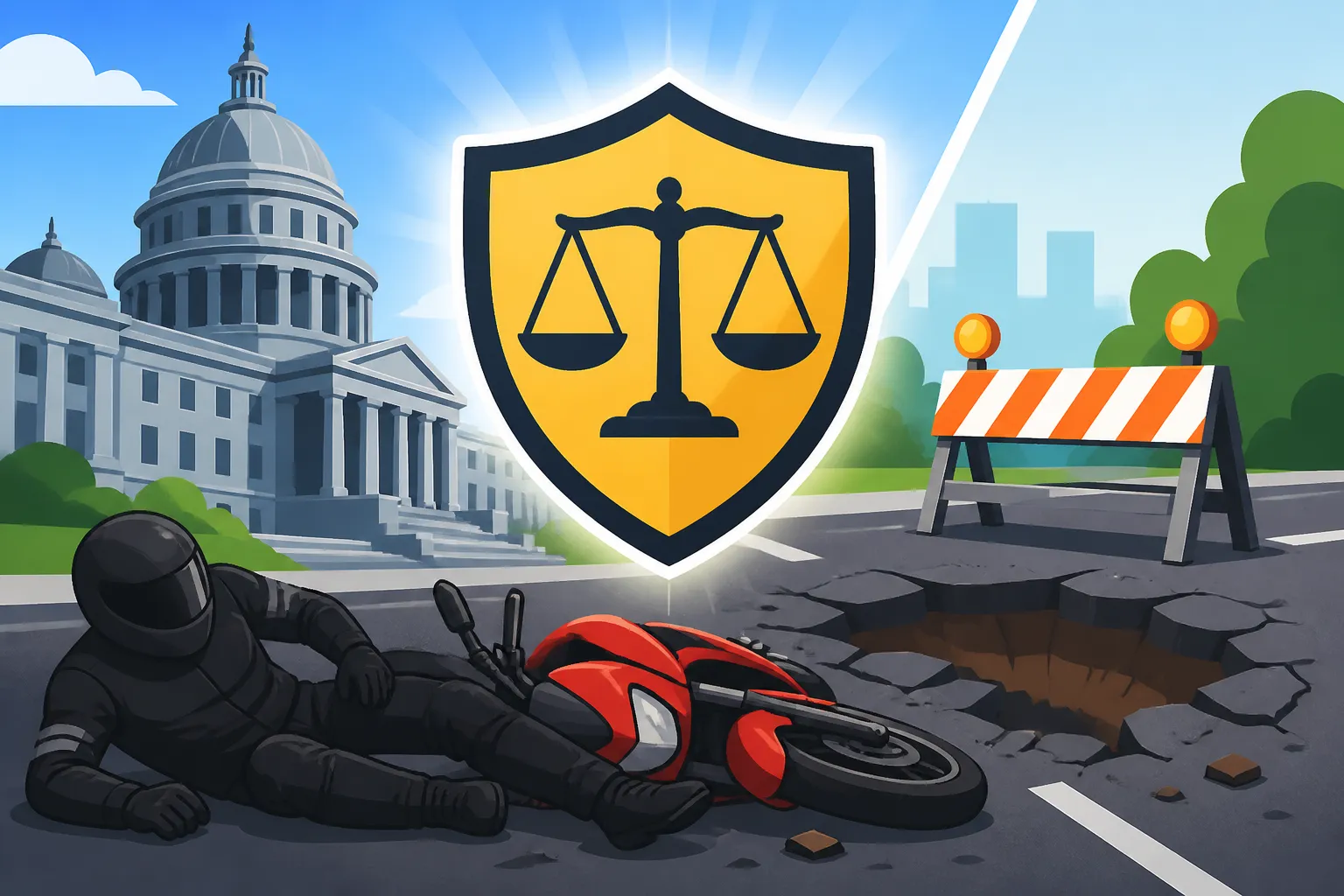
Think about your daily commute or that favorite winding back road. How many times have you encountered something that made you clench up, even for a moment? For motorcyclists, these aren't just minor annoyances; they're potential catastrophe triggers. Potholes are perhaps the most notorious culprit, ranging from small, tire-grabbing divots to crater-sized chasms capable of swallowing a wheel. Hitting one unexpectedly can cause a loss of control, a bent rim, or worse, a complete washout.
Beyond potholes, uneven pavement, often found at construction sites or where utility work has been done, can throw a motorcycle off its line. Cracks that spiderweb across the asphalt, especially if they are deep or wide, can also destabilize a bike. Then there's the bane of every rider's existence: unexpected loose gravel or sand, especially on turns or newly paved sections. A sudden patch of gravel can instantly reduce traction, sending a rider sliding. Oil slicks, standing water, and even unexpected debris like fallen tree branches or construction materials can also lead to devastating accidents. We also have to contend with malfunctioning traffic signals, inadequate street lighting at night, or missing road signs that fail to warn of upcoming dangers like sharp curves or changes in road surface. All these elements demand constant vigilance, a level of focus that is often taken for granted by other road users.
Why Road Hazards Hit Motorcyclists Harder
It’s no secret that motorcyclists are inherently more vulnerable than occupants of other vehicles. We don't have a metal cage surrounding us, airbags deploying, or seatbelts to hold us in place. When a road hazard causes a crash, the rider bears the full brunt of the impact. The injuries sustained are often severe and catastrophic. We're talking about extensive road rash that can require skin grafts, broken bones that shatter on impact, internal injuries, and, tragically, traumatic brain injuries or spinal cord damage, even with proper gear.
The physics of a motorcycle further compound the danger. Our bikes rely on balance, and any abrupt disruption to that balance – like hitting a hidden obstacle – can quickly lead to a fall. Our narrow profile means hazards are harder to see and react to in time, particularly if they are obscured by shadows, glare, or other vehicles. And let’s not forget the phenomenon of "target fixation," where a rider's eyes lock onto a hazard, inadvertently steering the bike directly into it. While a car might absorb a bump or even drive over some debris with minimal consequence, a motorcycle often cannot. For a deeper understanding of these risks, you might want to read our guide on How Road Defects Cause Motorcycle Crashes.
Pinpointing Responsibility: Which Government Entity is at Fault?
Identifying the responsible party for a road hazard isn't always straightforward. It's rarely a single, monolithic "government." Instead, it could be a federal, state, county, or even a local municipal entity, each with its own jurisdiction and specific rules regarding road maintenance and liability. This can feel like a bureaucratic labyrinth, but understanding who owns and maintains the road is the critical first step in pursuing a claim.
Federal, State, County, or City? Untangling the Jurisdiction
The first question to ask after a road hazard accident is, "Whose road was it?" The answer dictates which government entity you'll be dealing with. Generally speaking:
- Federal Government: While the federal government largely funds highway projects, most major interstates and federal highways are maintained by individual state departments of transportation. It's rare to sue the federal government directly for a road hazard, but it can happen in cases involving federal lands or specific federal projects.
- State Government: State Departments of Transportation (DOTs) are typically responsible for maintaining state highways, turnpikes, and often major interstates within their borders. For example, in California, you'd deal with Caltrans; in Texas, it's TxDOT; and in Florida, it's the Florida Department of Transportation. These agencies are massive and have extensive protocols for road inspection and repair.
- County Government: Counties are usually responsible for roads that connect different cities within their borders, as well as rural roads that aren't designated as state or federal highways. The specific department within the county would vary, but it's often a Public Works Department or Highway Department.
- City or Municipal Government: City public works departments are generally responsible for maintaining local streets, alleys, sidewalks, and traffic signals within city limits. If your accident happened on Main Street in downtown Denver or on a residential street in Phoenix, the city would likely be the responsible party.
Knowing which entity has jurisdiction is paramount because each has its own unique claims process, strict deadlines, and specific legal immunities. Trying to file a claim against the wrong entity is a guaranteed way to waste valuable time and potentially miss critical deadlines. For more detail on this specific issue, check out our guide on Who Is at Fault in a Road Hazards Motorcycle Accident.
The Role of Private Contractors and Utility Companies
Sometimes, the hazard isn't directly a government oversight but rather the fault of a third-party entity operating on public roads. This adds another layer of complexity but can also open up additional avenues for compensation. For instance, a private construction company hired by the city to repave a section of road might leave behind debris or an improperly secured construction zone, leading to an accident. In such cases, the contractor could be directly liable for their negligence.
Similarly, utility companies – gas, electric, water, or telecommunications – often perform work on roads and sidewalks. If they poorly backfill a trench, leave behind uneven asphalt, or fail to properly mark a work zone, they could be held responsible for any accidents resulting from their negligence. Imagine a situation where a crew from a local utility company like PG&E in California or Con Edison in New York leaves a significant patch of loose gravel after digging up a street to fix a pipe. If a motorcyclist crashes due to this hazard, the utility company, not necessarily the city, might bear the primary responsibility. This introduces elements of Third-Party Liability in Motorcycle Accidents, making the investigation even more detailed.
The Uphill Battle of Proving Government Negligence
Suing a government entity isn't like filing a claim against another driver's insurance company. Governments are generally protected by what's called "sovereign immunity," meaning they can't be sued unless they've explicitly waived that right. Even when they have, they often operate under different rules and a much higher burden of proof for the claimant. This means you can't just point to a pothole and expect a check; you have to demonstrate that the government was truly negligent in its duties.
The "Notice" Requirement: What the Government Knew or Should Have Known
One of the biggest hurdles in proving government liability is the "notice" requirement. You must demonstrate that the government entity responsible for the road had actual or constructive notice of the dangerous condition before your accident occurred, and then failed to remedy it within a reasonable amount of time.
- Actual Notice: This means the government literally knew about the hazard. Perhaps a citizen called 311 to report it, a city inspector documented it, or a maintenance crew was scheduled to fix it. If you can find a record of a complaint or a work order for that specific hazard prior to your crash, you're in a strong position.
- Constructive Notice: This is trickier to prove. It means the hazard existed for such a length of time, or was so conspicuous, that the government should have known about it through reasonable inspection and maintenance practices. For instance, a giant, visible pothole that has been growing for months on a heavily traveled road in Chicago, Illinois, might be considered constructive notice, even if no one formally reported it.
The challenge here lies in obtaining the government's internal records – maintenance logs, inspection reports, citizen complaint databases – which they are often reluctant to provide without legal pressure. It's a critical piece of the puzzle in Motorcycle Accident Evidence for Proving Fault. Without proving notice, even the most egregious road hazard won't lead to a successful claim against the government.
Designing for Danger: Flaws in Planning and Construction
While the notice requirement often focuses on maintenance, sometimes the hazard is inherent in the road's design or construction. This can include:
- Poor Road Design: Roads built with inadequate banking on curves, improper drainage leading to constant pooling water or ice, or sightline obstructions at intersections. These are often complex cases, as governments can sometimes claim "discretionary immunity" for planning and design decisions, arguing that these were policy choices made by engineers and planners.
- Faulty Construction: Errors in how the road was built, such as using substandard materials, improper paving techniques leading to rapid deterioration, or failure to adhere to engineering specifications. This might involve looking at contractor liability in addition to or instead of the government.
Proving a design defect requires extensive expert testimony, often from civil engineers and accident reconstructionists, who can demonstrate that the design itself was unreasonably dangerous and directly caused or contributed to your accident. This is a much higher bar than simply proving a maintenance failure. When considering How Fault Is Determined in Motorcycle Accidents, these design and construction flaws present a unique challenge that requires specialized expertise.
Navigating the Complex Government Claims Process
If you've been injured due to a road hazard, the clock starts ticking immediately, and the rules of engagement are different than a standard car-on-motorcycle collision. Governments have very specific and often unforgiving procedures for filing claims against them, designed to protect public funds and streamline legal challenges. Missing a single step can mean the end of your ability to recover compensation, no matter how severe your injuries.
Strict Deadlines and Specific Procedures: The Statute of Limitations for Government Claims
This is perhaps the most crucial point: government claims have significantly shorter deadlines than typical personal injury lawsuits. While you might have two or three years to file a lawsuit against a private individual or company in many states, claims against a government entity often must be filed within a mere six months to one year from the date of the accident. These deadlines are non-negotiable and are often referred to as "statutes of limitations" or "notice of claim" periods.
For example, in California, a claim against a state or local government entity for personal injury generally must be filed within six months. In New York, it's often 90 days for a notice of claim. These are not minor details; they are absolute barriers. If you fail to file your "Notice of Claim" within this specified window, you will almost certainly lose your right to sue, regardless of the merits of your case. This is why immediate action is critical. Our guide on The Statute of Limitations Explained covers these timelines in more detail, but always remember to check the specific laws for your state and locality when dealing with government entities.
Gathering the Right Evidence for Your Claim
To have any hope of success against a government entity, you need meticulously documented evidence. This isn't just about what happened; it's about proving every aspect of the claim: the existence of the hazard, the government's knowledge of it, the causation of your injuries, and the extent of your damages.
Here's what you need to focus on:
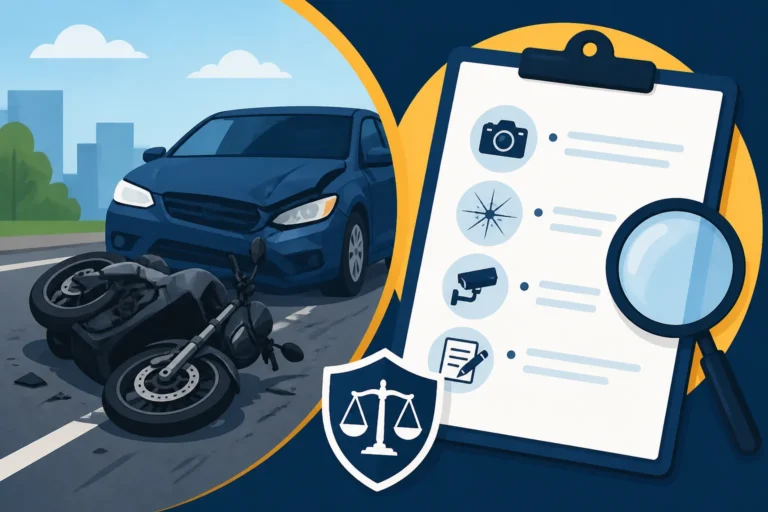
- Photos and Videos: Immediately after the crash, if you are able, take comprehensive, date-stamped photos and videos of the road hazard from multiple angles and distances. Include close-ups of the defect, as well as wider shots showing its location relative to landmarks, street signs, and traffic. Document any warning signs (or lack thereof). Also, photograph your damaged motorcycle, your injuries, and any damaged gear. Our guide on Photos to Take to Prove Motorcycle Fault offers excellent advice here.
- Witness Statements: Obtain contact information from anyone who saw the accident or who frequently travels that road and might have noticed the hazard before. Their testimony can be invaluable in establishing the hazard's existence and the government's constructive notice.
- Police Report: A detailed police report can document the conditions at the scene, including descriptions of the road hazard, if the officer observes it.
- Medical Records: Comprehensive documentation of all your injuries, treatments, diagnoses, and prognoses is essential. This proves the extent of your damages.
- Maintenance Logs and Inspection Reports: Your attorney can request these through public information requests or discovery. These documents are crucial for proving the government's actual or constructive notice of the hazard.
- Expert Testimony: In complex cases, you might need an accident reconstruction expert to explain how the hazard caused your crash, or a civil engineer to testify about road design flaws or maintenance standards.
Thorough documentation is the bedrock of any successful motorcycle accident claim, but it's particularly vital when you're up against the immense resources of a government entity. For more details on what to collect, read How to Document the Scene to Prove Fault.
Here's a quick look at the typical responsibilities and challenges when dealing with different government levels:
| Government Entity | Typical Road Jurisdiction | Example Road Types | General Claims Filing Window | Key Challenge in Claims |
|---|---|---|---|---|
| Federal | National parks, some federal routes | Blue Ridge Parkway | Varies, often 2 years | Sovereign Immunity, High Bar for Proof |
| State | State highways, major interstates | I-95, US-101 | Often 6 months – 1 year | Strict Notice Requirement, Extensive Bureaucracy |
| County | Rural roads, connecting routes | County Road 52 | Often 6 months – 1 year | Varying Local Laws, Limited Resources |
| City | Local streets, municipal roads | Main Street | Often 6 months – 1 year | Strict Notice Requirement, Potential for Comparative Fault |
Note: Claims filing windows are highly dependent on the specific state and local laws. Always consult legal counsel promptly to confirm applicable deadlines.
Common Defenses and How to Counter Them
When you bring a claim against a government entity, prepare for a rigorous defense. They have legal teams dedicated to protecting public funds and will employ various strategies to deny or minimize your claim. Understanding these common defenses is crucial for effectively countering them.
Governmental Immunity and Discretionary Functions
As mentioned earlier, sovereign immunity is the government's shield. They generally cannot be sued unless they have expressly waived this immunity, typically through specific statutes. Even where immunity is waived, there are often exceptions, particularly for "discretionary functions." This defense argues that the government cannot be held liable for decisions made at a policy or planning level.
For instance, if a city decided to prioritize funding for street lighting in one neighborhood over another, and your accident occurred in the dimly lit area, they might argue that the allocation of funds was a discretionary policy decision. However, if they decided to install streetlights and then failed to properly maintain them, or a reported streetlight outage was ignored, that falls into a "ministerial" (duty-bound) function, for which immunity might not apply. The line between discretionary and ministerial can be blurry and is often a point of contention in these cases. Overcoming governmental immunity often requires an attorney with a deep understanding of administrative law and the specific nuances of your state's Tort Claims Act.
Arguing Comparative Negligence and Rider Bias
Even if you successfully prove the government's negligence and overcome immunity defenses, they will almost certainly try to argue that you, the motorcyclist, were at least partially at fault for the accident. This is where the unfair "rider bias" often comes into play. Insurance adjusters and government lawyers are notorious for leveraging stereotypes against motorcyclists, implying that riders are inherently reckless, speed, or don't pay attention. They might claim you were going too fast for the conditions, weren't watching the road, or could have avoided the hazard.
This is a critical defense because many states follow some form of Comparative Negligence in Motorcycle Accidents. If you are found to be partly at fault, your potential compensation will be reduced by your percentage of fault. In some states, like North Carolina, if you are found even 1% at fault, you might be barred from any recovery (contributory negligence). In modified comparative negligence states (like Texas or Ohio), you might be barred if you are 50% or 51% at fault. This defense often highlights the importance of thorough documentation, witness testimony that supports your safe riding practices, and potentially accident reconstruction to prove that the hazard was unavoidable. Understanding Shared Fault in Motorcycle Accidents is vital when confronting these allegations.
Seeking Justice: The Importance of Legal Counsel
The complexities of motorcycle accident claims involving road hazards, particularly when a government entity is involved, cannot be overstated. From navigating jurisdictional mazes to battling against sovereign immunity and strict deadlines, it's a fight few riders should attempt alone.
Why an Attorney is Essential for Government Claims
Hiring an experienced motorcycle accident attorney isn't just a good idea; it's often a necessity when dealing with government liability. Here's why:
- Navigating Bureaucracy: Government agencies are vast and complex. An attorney knows the specific departments, filing requirements, and internal processes that laypeople often find impenetrable. They know who to contact, what forms to file, and the precise language required for a successful claim.
- Understanding Immunity Laws: These laws are highly specific to each state and often change. An attorney specializing in government liability will understand the nuances of sovereign immunity and discretionary function defenses, knowing how to challenge them effectively in your jurisdiction, whether it's in Florida or Washington state.
- Meeting Strict Deadlines: The unforgiving "Notice of Claim" deadlines are a trap for the unwary. An attorney ensures all paperwork is filed correctly and on time, preserving your right to seek compensation.
- Access to Resources: Lawyers have access to expert witnesses – such as accident reconstructionists, civil engineers, and medical professionals – who can provide crucial testimony to prove negligence and the extent of your injuries. They also know how to obtain governmental records that are not easily accessible to the public.
- Leveling the Playing Field: You'll be going up against sophisticated government legal departments. An attorney provides you with the legal expertise and advocacy needed to stand a chance.
Trying to handle a government claim yourself is almost always a losing battle. You might be asking, Do You Need a Motorcycle Accident Lawyer? In these specific types of claims, the answer is a resounding yes.
What a Motorcycle Accident Lawyer Does in These Cases
A dedicated motorcycle accident lawyer specializing in road hazard claims will undertake a comprehensive process to build your case and fight for your rights:
- Thorough Investigation: They will meticulously investigate the accident scene, gather all available evidence, including photos, videos, witness statements, and police reports. They'll also actively seek out maintenance records, inspection logs, and citizen complaints from the relevant government entity to establish notice.
- Proper Notice of Claim Filing: They will prepare and file the precise "Notice of Claim" required by your state and local government, ensuring all strict deadlines and procedural requirements are met. This step is critical and unforgiving.
- Evidence Collection and Analysis: Beyond initial evidence, they will work to secure expert opinions, such as from accident reconstruction specialists who can explain how the road defect directly led to your crash, or engineers who can highlight design flaws.
- Negotiation with Government Adjusters: They will handle all communications and negotiations with the government's legal representatives or insurance adjusters. These negotiations are often complex, as government entities are reluctant to pay out.
- Litigation and Trial: If a fair settlement cannot be reached, your attorney will be prepared to take your case to court, arguing against governmental immunity and presenting your case to a judge or jury.
In short, a lawyer becomes your advocate, investigator, and legal strategist, allowing you to focus on your recovery. The sooner you engage one, the better your chances of a successful outcome. Considering When to Hire a Motorcycle Accident Lawyer is paramount, especially in these types of cases.
Disclaimer
The information provided in this guide is for general informational purposes only and does not constitute legal advice. Motorcycle accident laws, including those concerning government liability and statutes of limitations, vary significantly by state and local jurisdiction. You should consult with a qualified attorney to discuss the specific facts and circumstances of your individual case.