Fault in a Hit-and-Run Motorcycle Accident
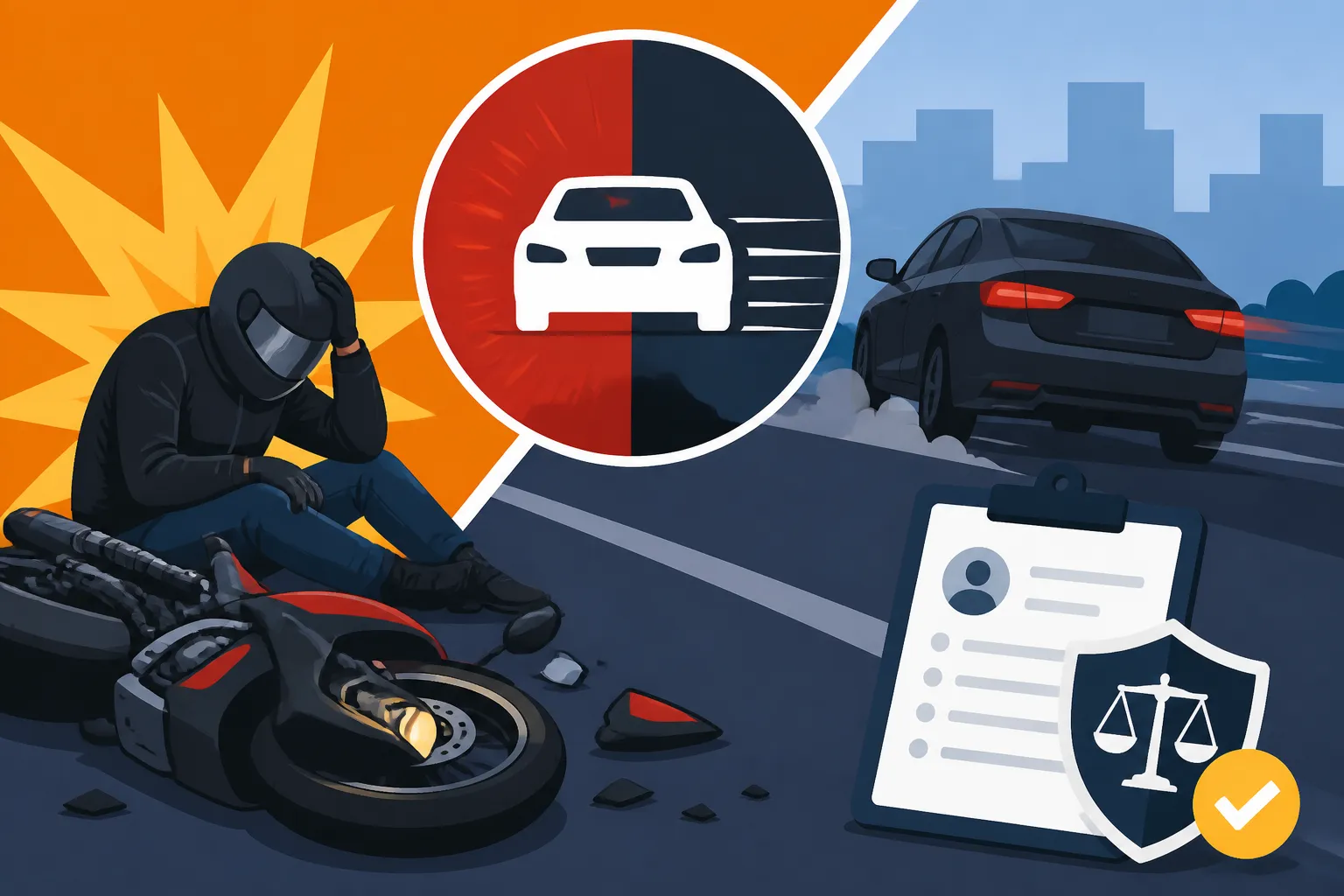
Experiencing a motorcycle accident is jarring, frightening, and often painful, but when the other driver flees the scene, it adds a whole new layer of frustration, anxiety, and a profound sense of injustice. You're left injured, your bike is damaged, and the person responsible for this chaos is nowhere to be found. This guide is here to walk you through the unique challenges of proving fault in a hit-and-run motorcycle accident and how to navigate the complicated path toward recovery.
Understanding the Immediate Aftermath of a Hit-and-Run
When you're involved in a hit-and-run, the immediate moments after the crash can feel chaotic and overwhelming. Your adrenaline is pumping, you might be in pain, and the sheer shock of the situation can make clear thinking difficult. It's crucial, however, to prioritize certain steps to protect yourself and your potential claim, even when the at-fault party has vanished.
Prioritizing Safety and Seeking Medical Attention
Your safety and well-being are paramount. Even if you feel okay, the impact of a motorcycle accident can cause hidden injuries that only manifest hours or days later. This is particularly true for things like head trauma or internal bleeding. The very first thing you need to do, if you are able, is to get yourself and your motorcycle out of immediate danger, off the road, and to a safe spot.
Once you’re in a secure location, don't delay in seeking medical attention. Call 911 or have someone call for you, even if you just feel bruised. Paramedics can assess your condition, and if necessary, transport you to the nearest emergency room. Establishing a clear medical record from the moment of the accident is absolutely vital. If you delay treatment, insurance companies often try to argue that your injuries weren't caused by the crash, or that they weren't as severe as you claim. It's a common tactic to try and reduce payouts, and it's a frustrating hurdle many riders face. Even seemingly minor issues like road rash can become infected or lead to complications if not properly treated.
Securing the Scene and Gathering Initial Details
After ensuring your safety and getting medical help, your next priority is to gather as much information as possible from the accident scene. This might seem impossible when the other driver is gone, but every tiny detail can become a crucial piece of the puzzle later. Start by contacting law enforcement. You need a police report, and they will begin the investigation into the hit-and-run. Make sure to tell them it was a hit-and-run and provide any description of the fleeing vehicle and driver you can recall.
While you wait for the police, if you're physically able and it's safe to do so, try to remember and note down everything you can. What color was the vehicle? What make or model? Did you see any part of the license plate – even just a few numbers or letters? What direction did it drive off in? Were there any distinguishing features, like bumper stickers, damage, or unique rims? Take photos and videos of the accident scene, your injuries, your damaged motorcycle, and any surrounding elements. Look for nearby businesses or homes that might have security cameras. Ask any witnesses present if they saw anything. Even if they didn't get a clear look at the fleeing vehicle, their testimony about the accident itself can be invaluable for proving that the collision was not your fault. For more on this, check out our guide on how to document the scene to prove fault.
The Unique Challenges of Proving Fault in a Hit-and-Run
Proving fault in a standard motorcycle accident can be tough enough, but a hit-and-run elevates the difficulty significantly. The simple truth is, without the other driver present, you're starting from a significant disadvantage.
The Burden of Proof Without the Other Driver Present
In a typical accident claim, you're trying to prove that the other driver's negligence caused the collision. Their insurance company then assesses that evidence, potentially offers a settlement, or you go through a legal process. In a hit-and-run, the primary challenge isn't just proving their negligence in causing the crash (though that's part of it), but first, identifying who "they" are. The burden falls squarely on you, and often on law enforcement, to find the fleeing driver. Until that driver is found, their insurance information isn't available, and you're essentially dealing with an "uninsured" party.
This is where the "rider bias" often comes into play. Even when you're the victim of a hit-and-run, some insurance adjusters might still try to scrutinize your actions, looking for ways to diminish your claim. They might imply you were somehow at fault for the crash itself, or that your injuries aren't as severe as you claim without the other driver's account to corroborate the incident. This can be incredibly frustrating and emotionally draining, adding insult to injury when you're already dealing with the trauma of the accident. It’s a common frustration that many riders experience when dealing with the aftermath of a crash, and something we delve into more in our article on how insurance companies assign blame to riders.
Common Scenarios and Why Drivers Flee
Drivers flee accident scenes for a variety of unsettling, yet unfortunately common, reasons. Understanding these can sometimes help in predicting what information might be available or how a police investigation might proceed.
One prevalent reason is intoxication. A driver who is under the influence of alcohol or drugs knows that remaining at the scene will lead to an arrest and severe penalties. Fleeing gives them time to sober up and potentially avoid those charges, however unethical and illegal it may be. Another common scenario involves drivers who are uninsured or underinsured, fearing the financial repercussions of an accident they caused. They might not have a valid license, or perhaps they have an outstanding warrant for arrest. Sometimes, it's simply panic and a misguided belief that they can escape responsibility.
Regardless of the reason, the impact on you as the injured motorcyclist is the same: you're left to pick up the pieces alone. It's an unfair situation, and it requires a methodical approach to ensure you don't shoulder all the financial and emotional burdens.
Crucial Evidence for Identifying the At-Fault Driver
While the immediate aftermath of a hit-and-run might feel like a dead end, there are specific types of evidence that can be instrumental in identifying the at-fault driver and proving their negligence. Don't underestimate the power of thorough investigation.
Leveraging Witness Accounts and Surveillance Footage
Witnesses can be the eyes and ears you couldn't be in the chaos of a crash. Even if they didn't catch a full license plate, they might remember details about the vehicle, the driver, or the direction of travel that can be incredibly helpful to law enforcement. A good witness might recall a distinct vehicle color, a partial license plate, or even a specific detail like a spoiler, a dent, or a unique window decal. Their statements can also help establish the circumstances of the crash itself, reinforcing that the other driver was clearly at fault.
Beyond eyewitnesses, modern technology offers a powerful tool: surveillance footage. Dashcams in other vehicles, traffic cameras operated by the city or state, and security cameras on nearby businesses or residential properties can all be potential goldmines of evidence. After a crash, you should immediately ask any businesses in the vicinity if they have outdoor cameras. Many businesses, like convenience stores, gas stations, or even apartment complexes, have cameras that record activity on public streets. Police can often subpoena this footage, but the sooner it's requested, the better, as many systems overwrite old data within a few days or weeks. This footage can often capture the fleeing vehicle's license plate, a clear image of the vehicle, or even the moment of impact. This kind of objective evidence, as detailed in our article on how dashcam footage proves fault, can be irrefutable.
The Role of Physical Evidence and Police Investigations
Even if the other driver flees, they often leave behind traces. The impact of the collision can leave paint transfers, fragments of headlights or taillights, or pieces of their vehicle's bodywork at the scene. These seemingly small pieces of debris can be analyzed by forensic experts to identify the make, model, and even the specific year of the offending vehicle. Police investigators are trained to look for this kind of physical evidence. When they arrive at the scene, they will cordon off the area, collect any debris, and document tire marks or other physical indicators of the crash.
The police report itself is a crucial document. It officially records the details of the accident, the initial findings of the officers, and any witness statements they gathered. A comprehensive police report will establish the fact that a hit-and-run occurred and often include descriptions of the fleeing vehicle if available. The more details you can provide to the responding officers, the more thorough and helpful their report will be. This report will be a cornerstone of your insurance claim and any subsequent legal action. Learn more about how police reports establish fault in our detailed guide.
In some cases, police departments in larger cities like Los Angeles or Chicago have dedicated hit-and-run investigation units that specifically pursue these types of cases. They have resources to track down leads, cross-reference vehicle descriptions with DMV records, and even put out public appeals for information. Staying in communication with the investigating officer can be helpful, as they might uncover new leads.
Navigating Insurance Claims After a Hit-and-Run
Once the shock of the accident settles, the reality of repair costs, medical bills, and lost wages can quickly set in. Dealing with insurance companies after a hit-and-run is a distinct challenge because the at-fault driver's insurance information is missing. This is where your own insurance policy becomes critical.
Understanding Your Uninsured Motorist Coverage
This is perhaps the single most important aspect of dealing with a hit-and-run motorcycle accident. If the at-fault driver is never identified, your best, and often only, recourse for recovering damages for your injuries and potentially your bike's damage, is through your own uninsured motorist (UM) or underinsured motorist (UIM) coverage. Many states require or offer UM/UIM coverage for bodily injury, and often property damage, specifically for situations where the other driver is uninsured or, critically, untraceable in a hit-and-run.
UM coverage typically kicks in to pay for your medical expenses, lost wages, and pain and suffering up to your policy limits, just as if the at-fault driver's insurance had paid. Without this coverage, if the driver is never found, you could be left footing the bill for everything out of pocket, which for serious motorcycle accident injuries, can be financially devastating. It's a lifesaver for riders. Always review your policy carefully or speak with your insurance agent to understand what your UM/UIM coverage entails. If you're unsure about your coverage, contact your provider right away.
Dealing with Your Own Insurance Company
While your UM/UIM coverage is designed to protect you, dealing with your own insurance company isn't always a walk in the park. Even though they are your insurer, they are still a business that aims to minimize payouts. They might investigate the accident vigorously, looking for reasons to reduce the amount they have to pay, or even deny the claim if they can find fault with your actions. This can feel like a betrayal, especially when you're the victim of a hit-and-run.
You'll need to report the accident promptly, usually within a day or two, according to your policy's terms. Provide them with the police report number and all the details and evidence you've gathered. Be prepared for them to ask detailed questions about the accident, your injuries, and your recovery process. They will likely want access to your medical records, and they may even request an independent medical examination (IME) by a doctor they choose.
It’s crucial to be honest but cautious. Remember, anything you say can potentially be used to reduce your claim. It’s not uncommon for adjusters to try to downplay the severity of your injuries or suggest that you were somehow partially to blame. For tips on how to handle these situations, you might find our article on how to fight an unfair fault assignment helpful.
Here’s a table outlining key differences in handling a regular vs. hit-and-run claim:
| Aspect | Regular Motorcycle Accident Claim | Hit-and-Run Motorcycle Accident Claim |
|---|---|---|
| At-Fault Driver | Known, contact/insurance info exchanged | Unknown, fled the scene |
| Primary Insurance Payer | At-fault driver's liability insurance | Your own Uninsured Motorist (UM) coverage |
| Fault Determination | Based on evidence, witness statements, police report | Primarily based on your evidence & police report; often more challenging to prove liability definitively without other party's account |
| Evidence Focus | Proving other driver's negligence & damages | 1. Identifying fleeing driver, then proving their negligence & damages |
| 2. Proving eligibility for UM/UIM benefits (e.g., confirming it was a "hit-and-run" and not a single-vehicle accident) | ||
| Investigation Lead | Insurance adjusters for both sides, possibly lawyers | Police investigation (crucial), then your own insurer/lawyer |
| Settlement Timeline | Can vary, depends on injury severity & negotiation | Often longer due to identification challenges; if driver found, similar to regular claim |
Legal Avenues and When to Seek Professional Help
After a hit-and-run, the path to recovery and justice can be incredibly complex. While your own insurance might cover some of your damages, they won't necessarily fight for every penny you deserve, nor will they necessarily pressure law enforcement to find the other driver. This is where legal guidance becomes invaluable.
The Importance of the Police Report
We've touched on this already, but it bears repeating: the police report is absolutely essential. For your UM/UIM coverage to kick in for a hit-and-run, your insurance company will almost certainly require an official police report. It serves as concrete proof that the accident occurred and that the other driver fled. Without it, your insurer might deny that a hit-and-run even happened, treating it as a single-vehicle accident where you'd only be covered if you had collision coverage on your own policy (and typically no coverage for medical bills or pain and suffering if you were seen as "at fault").
It's vital that the report accurately reflects what happened. If you notice any factual errors in the report, such as an incorrect description of the accident or your injuries, you should immediately contact the police department to request a correction. An accurate report strengthens your case and helps prevent your insurance company from trying to minimize your claim later on.
When a Lawyer Can Make All the Difference
You might be wondering, "Do I really need a lawyer for a hit-and-run?" The answer, almost unequivocally, is yes. A motorcycle accident lawyer specializing in these types of cases can be your strongest advocate. They understand the nuances of hit-and-run laws and the tactics insurance companies use.
Here’s what a skilled lawyer can do:
- Lead the Investigation: While the police investigate for criminal charges, your lawyer will investigate to build a civil case. This includes reviewing the police report, speaking to witnesses, tracking down surveillance footage, analyzing physical evidence, and even hiring accident reconstruction experts if necessary. They know what evidence disproves rider fault and how to gather it effectively.
- Navigate Complex Insurance Claims: Your attorney will handle all communication with your insurance company, ensuring you don't inadvertently say something that could jeopardize your claim. They will meticulously document your damages, including medical expenses, lost wages, and pain and suffering, and present a compelling case to maximize your settlement. They can help you understand the average motorcycle accident settlement amounts for injuries like yours.
- Identify Liable Parties: In some cases, even if the primary at-fault driver isn't found, other parties might be held responsible. For instance, if a road hazard caused or contributed to the accident, the government entity responsible for road maintenance could be liable. A lawyer can explore all potential avenues for recovery.
- Negotiate for Fair Compensation: Insurance companies are often more willing to negotiate fairly when dealing with an attorney. Lawyers know how to value your case accurately and won't back down from lowball offers. They understand what affects your motorcycle accident payout and will fight to ensure you receive just compensation.
- Peace of Mind: Perhaps most importantly, having an experienced attorney allows you to focus on your recovery without the added stress of legal and insurance battles. You've been through enough.
Facing a hit-and-run motorcycle accident is a lonely and frustrating experience, but you don't have to go through it alone. Seeking immediate medical attention, diligently gathering evidence, understanding your insurance coverage, and retaining a knowledgeable attorney are critical steps toward achieving justice and getting your life back on track.
Disclaimer
The information provided in this article is for general informational purposes only and does not constitute legal advice. Motorcycle accident laws vary significantly by jurisdiction. It is crucial to consult with a qualified attorney in your state for advice regarding your specific situation.