Motorcycle Accident Fault Laws in South Carolina
Getting into a motorcycle accident is one of the most terrifying experiences a rider can face. Beyond the immediate shock and physical pain, the stress of understanding who's to blame and what that means for your future and your ability to get the care you need can feel overwhelming. Dealing with insurance companies who often have preconceived notions about motorcyclists only adds to the frustration. This guide is here to demystify motorcycle accident fault laws in South Carolina, helping you understand your rights and the legal landscape so you can navigate the aftermath with a clearer head.
South Carolina's Approach to Accident Fault: Modified Comparative Negligence
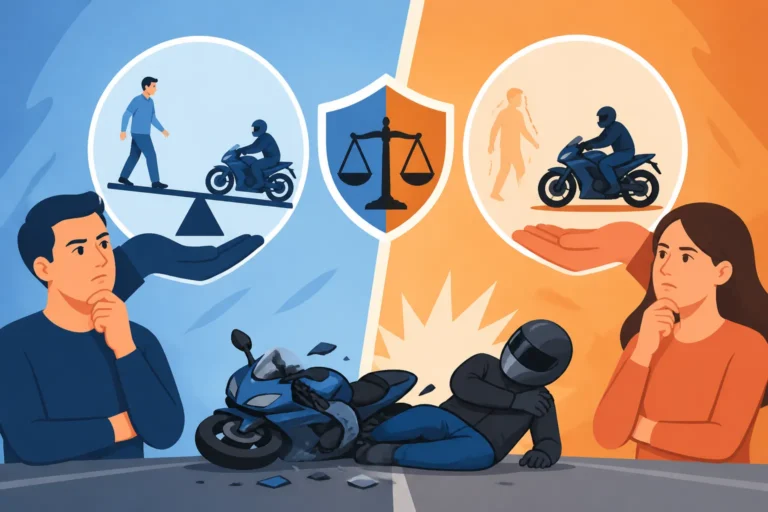
When a motorcycle accident happens in South Carolina, the question of fault isn't always a straightforward "who hit whom" situation. Our state operates under a principle called "modified comparative negligence." What this means is that even if you, as the rider, contributed in some way to the accident, you might still be able to recover damages for your injuries and losses, as long as your share of the blame isn't too high. This system is designed to provide a fairer outcome than older, harsher fault rules.
How the 51% Rule Works in Practice
The "51% Rule" is the heart of South Carolina's modified comparative negligence law. Here’s the gist: you can recover damages from the other driver unless you are found to be 51% or more at fault for the accident. If your fault is determined to be 50% or less, you can still seek compensation, but the amount you receive will be reduced proportionally to your percentage of fault.
Imagine a scenario: You're riding along I-26 near Charleston, and a driver in an SUV suddenly merges into your lane without looking, causing a collision. However, let's say it's later determined that you were slightly speeding, contributing 10% to the accident. Under South Carolina law, if your total damages (medical bills, lost wages, pain and suffering, etc.) are $100,000, your recovery would be reduced by 10%, meaning you could still collect $90,000. But if a jury decided you were 55% at fault because you were lane splitting aggressively, for instance, you would recover nothing. This highlights why understanding how fault is determined in motorcycle accidents is so crucial.
When Your Own Actions Can Reduce Your Recovery
It’s a tough pill to swallow, but sometimes, a rider's own actions can unfortunately contribute to an accident, or at least be perceived that way by insurance adjusters or a jury. Things like speeding, riding too close to another vehicle (tailgating), or even not wearing appropriate safety gear can come into play. For instance, if you weren't wearing a DOT-compliant helmet and sustained a head injury, even if the other driver was primarily at fault, an insurance company might argue that your injury would have been less severe had you been properly geared up. This is often referred to as "the helmet defense" and can impact your settlement.
Another common example is if you were engaging in a behavior like lane splitting, which, while legal in California under specific conditions, is not explicitly permitted in South Carolina and could be viewed as a contributing factor to an accident. The defense might argue that your actions contributed to the incident, even if the other driver was clearly negligent. This is why being aware of your own riding habits and the law is so vital, not just for safety, but for protecting your legal claim. Understanding when a rider is partially at fault can make a significant difference in the outcome.
Key Factors in Determining Fault for Motorcycle Accidents in South Carolina
Determining fault after a motorcycle accident in South Carolina is a complex process that involves gathering and analyzing a wide array of evidence. It's rarely as simple as one party saying "they hit me" and the other saying "no, you hit me." Police, insurance companies, and potentially courts will look at multiple factors to build a clear picture of what happened and assign percentages of fault.
The Role of the Police Report and Accident Scene Evidence
Immediately after an accident, the police report is often the first official document outlining the initial assessment of fault. While not always the final word, it carries significant weight. Officers arriving at the scene will investigate, take statements, and document critical details such as vehicle positions, road conditions, debris fields, and any traffic violations. This information is compiled into a formal report, usually available a few days after the incident. For instance, if a driver failed to yield while turning left, the police report might note this and assign a contributing factor.
Beyond the police report, the physical evidence at the scene is paramount. Skid marks, paint transfers between vehicles, the final resting positions of the motorcycle and other vehicles, and any damage to surrounding property can all tell a story. Gathering this motorcycle accident evidence for proving fault quickly is crucial. Photos and videos taken immediately after the crash by you, witnesses, or emergency responders can be invaluable. Even small details, like the type of road hazards present, can influence how fault is ultimately assigned.
Witness Statements and Expert Reconstruction
Eyewitness accounts can be incredibly powerful in establishing fault, especially when details are disputed. Someone who saw the entire sequence of events unfold, particularly an impartial third party, can provide an objective perspective that can be difficult for insurance companies to dismiss. Always try to get contact information for any witnesses at the scene.
Sometimes, though, the accident scene is so chaotic, or the details are so complex, that standard evidence isn't enough. This is where accident reconstruction experts come in. These specialists can meticulously analyze physical evidence, vehicle damage, and even witness statements to recreate the accident using scientific principles. They can determine speeds, angles of impact, and sequences of events, which can be critical in situations where fault is heavily disputed. For example, if there's a disagreement on who ran a red light at a busy intersection in Columbia, an expert might use surveillance footage, vehicle damage patterns, and road markings to prove exactly how the collision occurred. This type of detailed analysis can be especially important in cases involving Motorcycle Accident Liability: A Complete Guide.
How Traffic Laws and Violations Impact Fault
Traffic laws are the rulebook of the road, and violations of these laws often play a direct role in determining fault. In South Carolina, if a driver violates a traffic law and that violation directly causes or contributes to an accident, they will almost certainly be found at least partially, if not entirely, at fault. For example, if a car driver makes an illegal U-turn on Highway 17 in Myrtle Beach and collides with your motorcycle, their violation of traffic law is a clear indicator of their negligence.
Here's a table illustrating how common traffic violations can influence fault determination in South Carolina:
| Traffic Violation (Driver) | Impact on Fault | Example Scenario |
|---|---|---|
| Failure to Yield | High likelihood of fault for driver | Driver fails to yield to an oncoming motorcycle while turning left, causing a Left-Turn Motorcycle Accidents Explained. |
| Distracted Driving | High likelihood of fault for driver | Driver texting and rear-ends a motorcycle stopped at a red light in Greenville. |
| Speeding | Increases driver's fault, can also increase rider's fault | Driver speeds and loses control, hitting a motorcycle. If the rider was also speeding, fault may be shared. |
| Unsafe Lane Change | High likelihood of fault for driver | Driver merges without checking blind spot, cutting off and colliding with a motorcycle. |
| Driving Under the Influence (DUI) | Near 100% fault for driver (and potential punitive damages) | Impaired driver veers into a motorcycle's lane, causing a crash. |
| Improper Lane Usage | Increases driver's fault | Driver drifts into motorcycle's lane, forcing rider off the road. |
Understanding how police reports establish fault and how traffic violations affect fault is crucial for any motorcycle accident claim in South Carolina.
The Impact of Fault on Your Motorcycle Accident Claim
When you're dealing with the aftermath of a motorcycle accident, the question of fault isn't just a matter of principle; it directly dictates how much compensation you can expect to receive. This is the practical application of South Carolina's modified comparative negligence rule we discussed earlier. It impacts everything from negotiations with insurance adjusters to what a jury might award if your case goes to trial.
Calculating Damages with Shared Fault
Let's revisit the concept of shared fault and how it directly affects your financial recovery. As a reminder, if you are found 50% or less at fault, you can still recover damages, but that amount will be reduced by your percentage of blame. If you are found 51% or more at fault, you generally recover nothing.
Consider a rider named Sarah who was involved in a collision with a distracted driver in Charleston. Sarah suffered $150,000 in damages, including extensive medical bills for her broken leg, lost wages, and pain and suffering. The insurance company for the distracted driver attempts to assign 20% fault to Sarah, arguing she could have reacted faster. If this 20% fault holds up, her $150,000 settlement would be reduced by 20% ($30,000), leaving her with $120,000. This is How Comparative Negligence Reduces Your Payout in real-world scenarios.
This reduction applies to all categories of damages – economic damages like medical expenses and lost income, and non-economic damages like pain, suffering, and emotional distress. It underscores why accurately determining fault and minimizing your perceived contribution to the accident is so vital for maximizing your settlement.
Protecting Your Claim When Fault is Disputed
It's an unfortunate reality that insurance companies, especially those representing the at-fault driver, will often try to shift some or all of the blame onto the motorcyclist. This is a common tactic, sometimes stemming from inherent biases against riders or simply a desire to minimize their payout. They might argue you were speeding, not visible enough, or even imply you were "asking for it" by riding a motorcycle. This is where How Insurers Use Rider Stereotypes Against You becomes a real issue.
When fault is disputed in a motorcycle crash, protecting your claim becomes your top priority. Here are some actionable steps you can take:
- Document Everything: From the moment the accident happens, document everything. Take photos and videos of the accident scene, vehicle damage, your injuries, and any road hazards. Keep a detailed log of all medical treatments, appointments, and how your injuries affect your daily life.
- Seek Medical Attention Immediately: Even if you feel okay, get checked out by a doctor. Some serious injuries, like internal injuries or a traumatic brain injury, might not show symptoms right away. Gaps in medical treatment can be used by insurance companies to argue your injuries aren't severe or weren't caused by the accident.
- Do NOT Admit Fault: Never, ever admit fault at the scene of an accident, even if you think you might have made a mistake. You're shaken up, potentially injured, and not in a position to make legal determinations. Let the investigation play out.
- Limit Communication with Insurers: Beyond providing your basic contact and insurance information, be very careful what you say to the other driver's insurance company. They are not on your side and will look for anything to use against you. It's often best to let a legal professional handle these communications.
- Gather Witness Information: If there were witnesses, get their names and contact information. Their objective accounts can be crucial.
- Consult with an Attorney: This is perhaps the most critical step. An experienced motorcycle accident attorney understands South Carolina's fault laws, how insurance companies operate, and how to gather and present evidence to prove the other driver's fault and protect your rights. They can help counter unfair fault assignments and fight for the compensation you deserve. This is especially true given the complexities of Shared Fault in Motorcycle Accidents.
By being proactive and informed, you significantly improve your chances of a fair outcome when fault is on the table.
Common Scenarios and South Carolina Specifics
Motorcycle accidents often occur under specific circumstances, and how South Carolina law views these scenarios can significantly impact fault. As riders, we know certain situations are inherently more dangerous, and the law sometimes recognizes this, placing a higher burden on other drivers. However, it's also important to understand where the law might hold riders accountable for their actions.
Left-Turn Accidents and Driver Responsibility
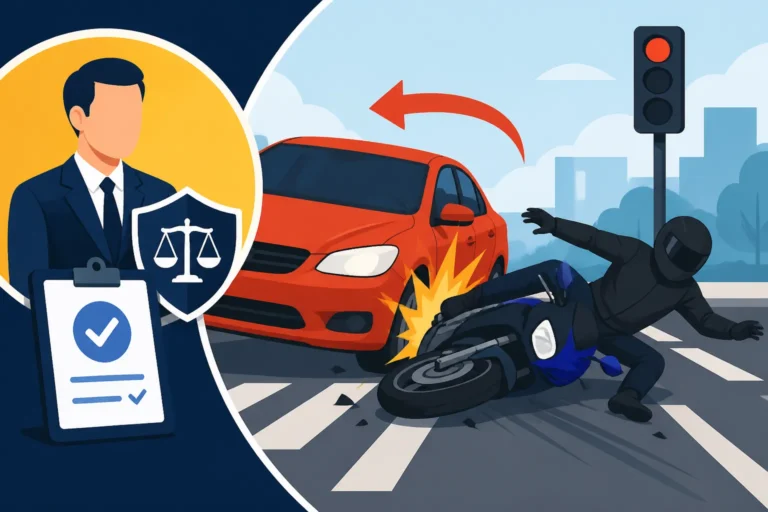
The dreaded left-turn accident. It's a scenario that every motorcyclist fears, and tragically, it's one of the most common causes of serious motorcycle collisions. In South Carolina, much like elsewhere, the driver making a left turn generally has a duty to yield the right-of-way to oncoming traffic, including motorcycles. When a driver fails to do so and turns directly into the path of a motorcycle, they are almost always found at fault.
Think about riding down King Street in Charleston. A car traveling in the opposite direction attempts to make a left turn into a side street but misjudges your speed or simply doesn't see you. They pull out, and you have no time to react. In this situation, the car driver's failure to yield is a clear violation of traffic law and is considered the primary cause of the accident. Their defense might be "I didn't see the motorcycle," but in South Carolina, this is generally not a valid excuse to avoid liability if they violated your right-of-way. This principle is explored further in Motorcycle Accidents Caused by Left-Turn Collisions.
However, there can be rare exceptions where a motorcyclist might share some fault. If the motorcyclist was excessively speeding, riding without a headlight at night, or performing an illegal maneuver, an argument could be made that their actions contributed to the collision. These nuances highlight why every accident is unique and requires a thorough investigation.
Lane Splitting and its Legal Status in South Carolina
Lane splitting is a hot topic among riders, and its legality varies wildly from state to state. For those unfamiliar, lane splitting involves a motorcyclist riding between lanes of slow or stopped traffic. While some states like California allow it under specific conditions, South Carolina currently does not have a law explicitly permitting or prohibiting lane splitting.
This lack of explicit law creates a gray area. If you're involved in an accident while lane splitting in South Carolina, an insurance company or a jury could potentially interpret it as an unsafe maneuver or a contributing factor to the accident, even if another driver was clearly negligent. They might argue you were riding unsafely or failed to exercise reasonable care, attempting to assign you some percentage of fault under comparative negligence. This is a crucial distinction to grasp, as Lane Splitting and Motorcycle Accident Liability can be complicated.
It's a tricky situation for riders in South Carolina. While it's not illegal, it could be used against you in a fault determination. The safest course of action, from a legal and personal safety standpoint, is to avoid lane splitting in South Carolina.
Road Hazards and Government Liability
Sometimes, an accident isn't caused by another driver, but by dangerous conditions on the road itself. Potholes, crumbling pavement, unexpected gravel or debris, or malfunctioning traffic signals can all lead to a serious motorcycle crash. When this happens, the question shifts from "who is at fault?" to "who is responsible for maintaining the road?"
In South Carolina, the government entity responsible for maintaining that particular road (whether it's the state, county, or a municipality like the City of Greenville or Spartanburg County) could be held liable. This is known as Government Liability for Road Hazards. However, suing a government entity comes with its own set of challenges and specific rules, often including strict deadlines for filing a notice of claim and limitations on the amount of damages you can recover.
For instance, if you hit a massive pothole on a state highway near Columbia that caused you to lose control, you might have a claim against the South Carolina Department of Transportation (SCDOT). You would need to prove that the SCDOT knew or should have known about the hazard and failed to fix it within a reasonable time, and that this failure directly caused your accident. This requires meticulous documentation, including photos of the hazard, the accident scene, and proof of when the hazard was reported (if known). These types of cases can be complex and often require the expertise of a legal professional to navigate.
Disclaimer
Please remember that this information is for educational purposes only and is not a substitute for professional legal advice. Every motorcycle accident case is unique, and the laws surrounding fault and liability can be complex. If you have been involved in a motorcycle accident in South Carolina, it is strongly recommended that you consult with an experienced motorcycle accident attorney to discuss your specific situation and understand your legal options.