When a Rider Is Partially at Fault
It’s a truly gut-wrenching feeling when you’ve been in a motorcycle accident, and amidst the pain and chaos, a nagging thought creeps in: "What if I wasn't entirely blameless?" Many riders fear that even a minor misstep on their part will completely derail their ability to recover damages, leaving them with mounting medical bills and a totaled bike. This guide will walk you through the complex reality of shared fault in motorcycle accidents, explaining how different laws can impact your claim and what steps you can take to protect yourself even when you bear some responsibility.
Understanding Shared Fault in Motorcycle Accidents
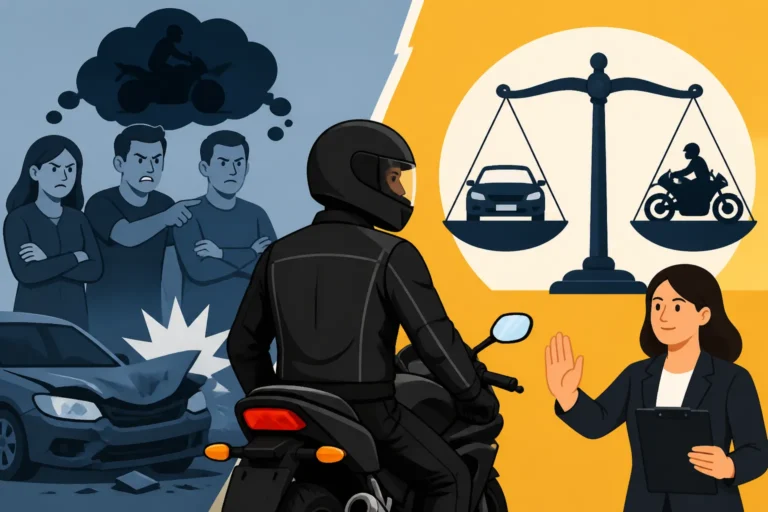
Being involved in a motorcycle accident is stressful enough without the added worry of being partially at fault. The legal system recognizes that accidents are rarely black and white, and often, multiple parties contribute to the incident. When we talk about a rider being partially at fault, it means that while another driver may have been primarily negligent, the motorcyclist also engaged in some action (or inaction) that contributed to the crash. This concept is incredibly important because it dictates how much compensation, if any, you can receive for your injuries and damages.
What "Partially at Fault" Really Means
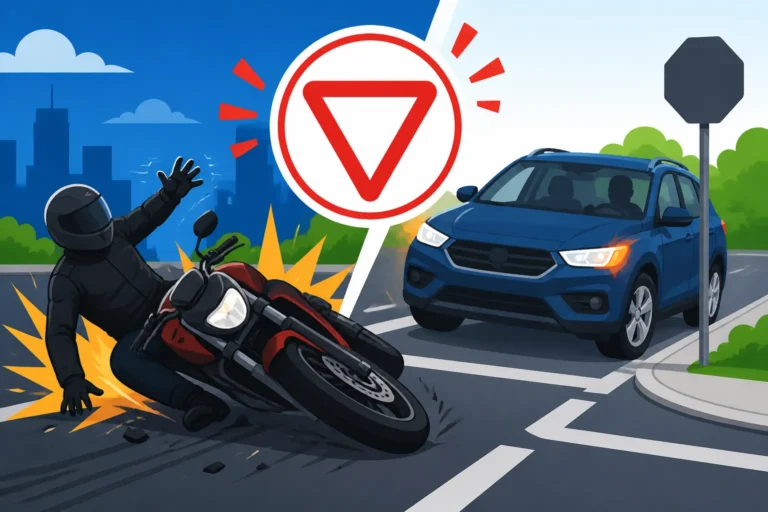
When the term "partially at fault" is used, it refers to the legal doctrine of shared liability. In essence, it acknowledges that the chain of events leading to an accident often has more than one link, and sometimes, those links involve actions from both sides. For example, a car driver might have run a stop sign, but you, as the motorcyclist, might have been traveling slightly over the speed limit. Both actions contributed to the collision. It's not about assigning all blame to one party, but rather determining the percentage of responsibility each party holds. This percentage is crucial because it directly influences your ability to recover damages. Insurance companies and courts spend a significant amount of time and resources trying to pinpoint this exact percentage, often leading to contentious disputes.
How Fault Is Determined Legally
Determining fault in a motorcycle accident involves a thorough investigation into all contributing factors. This isn't just a casual assessment; it's a deep dive into traffic laws, witness statements, accident reconstruction, and even driver behavior. The police report is often the first step, providing an initial assessment, but it’s not always the final word, especially if the officer didn't witness the event or was biased against the motorcyclist. Insurance adjusters will scrutinize every detail, looking for any evidence that could shift some blame onto the rider, as this allows them to reduce their payout. Understanding the process of how fault is determined in motorcycle accidents is vital for protecting your claim. They will look at things like traffic violations, adherence to road signs, speed, road conditions, and even weather to build a comprehensive picture. For a detailed exploration, you can refer to our guide on Who Is at Fault in a Motorcycle Accident.
Exploring Comparative and Contributory Negligence Laws
The specific laws governing shared fault vary significantly from state to state, and understanding these differences is paramount for any rider involved in a crash. These legal doctrines, broadly categorized as comparative negligence and contributory negligence, directly impact whether you can recover damages and how much you ultimately receive. It’s not just legal jargon; it’s the framework that determines your financial future after an accident.
Contributory Negligence: A Harsh Reality
In a handful of states, known as contributory negligence states, the law is incredibly strict. If you are found to be even 1% at fault for an accident, you are completely barred from recovering any damages from the other party. Imagine a scenario where a car driver makes an illegal U-turn right in front of you, causing a collision, but you were found to have a burned-out headlight. Even if the U-turn was the primary cause, that faulty headlight could make you 1% at fault, and under contributory negligence, you would receive nothing. This draconian rule exists in very few states, such as Alabama, Maryland, North Carolina, and Virginia, along with Washington D.C. It’s a truly unforgiving system that often leaves injured riders in dire financial straits, highlighting the immense importance of adhering to all traffic laws and maintaining your bike.
Pure Comparative Negligence: A More Forgiving System
Many states operate under pure comparative negligence rules. Under this system, you can recover damages even if you are found to be mostly at fault for an accident. Your compensation is simply reduced by your percentage of fault. For example, if a jury determines your total damages are $100,000, but you were 40% at fault for the crash, you would still be able to recover $60,000. States like California, Florida, and New York follow pure comparative negligence. This system aims for a more equitable distribution of responsibility and allows injured parties to receive some compensation for their losses, even if they played a significant role in causing the accident. It acknowledges that fault is often shared and that individuals should not be entirely shut out of recovery simply because they bear some responsibility. You can learn more about this by reading our article on Pure vs Modified Comparative Negligence.
Modified Comparative Negligence: The Most Common Approach
The most common system used across the United States is modified comparative negligence, which strikes a middle ground between the two extremes. Within this system, there are two main variations: the 50% rule and the 51% rule.
- 50% Rule: In states following the 50% rule (like Colorado, North Dakota, and Wisconsin), you can recover damages as long as your fault is not greater than the other party's fault. This means if you are 50% at fault or less, you can still recover. However, if you are found to be 51% or more at fault, you are barred from recovery. So, if your damages are $100,000 and you are found 50% at fault, you could get $50,000. But if you were 51% at fault, you'd get nothing.
- 51% Rule: Under the 51% rule (used in states like Arizona, Illinois, and Texas), you can recover damages as long as your fault is not equal to or greater than the other party's fault. This means you can be up to 50% at fault and still recover, but if you are 51% or more at fault, you cannot. This distinction is subtle but crucial; if you're 50% at fault in a 51% rule state, you still recover.
These modified rules are designed to prevent individuals who are primarily responsible for an accident from recovering substantial damages while still offering a path to compensation for those who bear some, but not primary, responsibility. The specific threshold can make a significant difference in the outcome of your claim.
Here’s a simplified table illustrating how fault percentages might impact a hypothetical $100,000 settlement under different rules:
| State Type | Rider's Fault | Other Party's Fault | Recoverable Damages (out of $100,000) | Notes |
|---|---|---|---|---|
| Contributory Negligence | 1% | 99% | $0 | Any fault bars recovery. |
| Pure Comparative Negligence | 70% | 30% | $30,000 | Recoverable, reduced by fault. |
| Modified Comparative (50% Rule) | 50% | 50% | $50,000 | Recoverable if fault <= 50%. |
| Modified Comparative (50% Rule) | 51% | 49% | $0 | Barred if fault > 50%. |
| Modified Comparative (51% Rule) | 50% | 50% | $50,000 | Recoverable if fault < 51%. |
| Modified Comparative (51% Rule) | 51% | 49% | $0 | Barred if fault >= 51%. |
This table clearly shows the drastic differences these legal frameworks can have on your potential recovery. Knowing which rule applies in your state is the first critical step in understanding your position after a crash. You can also explore Contributory vs Comparative Negligence Explained for further understanding.
Common Scenarios Where Riders Bear Partial Fault
It's easy to picture the other driver as entirely to blame in an accident. After all, that's often the case when a car "doesn't see" a motorcycle. However, the reality is that sometimes, even experienced riders can make mistakes or be caught in situations where their actions contribute, however slightly, to a collision. Recognizing these common scenarios can help you understand how partial fault might be assigned and how to best prepare your defense.
Speeding or Reckless Riding
Even if another driver clearly violated a traffic law, your speed can become a factor. For instance, if a car makes an illegal left turn in front of you, but you were traveling significantly above the posted speed limit, an insurance adjuster or jury might decide that your excessive speed contributed to the severity of the collision, or even prevented you from avoiding it entirely. This doesn't mean the car driver is off the hook, but it could mean you share a percentage of the fault. The argument would be that had you been traveling at a safe and legal speed, you might have had more time to react, or the impact might have been less severe. Similarly, actions like weaving through traffic (even if not strictly lane splitting) or exhibiting aggressive riding behaviors can be interpreted as reckless, leading to an assignment of partial fault.
Lane Splitting Accidents
Lane splitting, while legal in some states like California, often comes with its own set of rules and nuances. If you were lane splitting in a state where it's illegal, or if you were performing it unsafely (e.g., at excessive speed, or in heavy traffic conditions not conducive to safe splitting), and an accident occurs, you could easily be assigned a percentage of fault. Even in states where it's legal, an insurer might argue that your specific execution of lane splitting was negligent. For example, if you were splitting lanes at 20 mph faster than the surrounding traffic, and a car unexpectedly merges into your lane, you might be deemed partially responsible for failing to perform the maneuver safely. This is a complex area, and understanding Lane Splitting and Motorcycle Accident Liability is crucial.
Not Wearing a Helmet or Proper Gear
While not wearing a helmet or appropriate gear doesn't cause an accident, it can absolutely affect the severity of your injuries and, consequently, your compensation. In many states, especially those with partial helmet laws or the "helmet defense," insurance companies can argue that your failure to wear a helmet exacerbated your head injuries, even if the other driver was completely at fault for the collision itself. This doesn't mean you caused the crash, but it can significantly reduce the amount you receive for medical expenses related to head trauma. Similarly, inadequate gear like thin jackets instead of abrasion-resistant materials can lead to more severe road rash and other injuries, which insurers may use to argue that you contributed to the extent of your damages. Our article on How Helmet Laws Affect Your Accident Claim delves deeper into this often-controversial topic.
Ignoring Road Conditions or Hazards
Riders have a responsibility to ride defensively and to react appropriately to road conditions. If an accident occurs due to a pothole or debris on the road, but it's found that you were riding too fast for the conditions, or simply not paying adequate attention to the road ahead, you might bear some partial fault. For instance, if you hit a large patch of gravel on a winding road and lose control, but there were warning signs about loose gravel that you ignored, an argument could be made that you contributed to your own accident. Similarly, riding aggressively in heavy rain or icy conditions, or failing to maintain proper tire pressure, could also lead to an assignment of partial fault if those factors are deemed to have played a role in the crash. Even though governments can be liable for dangerous roads, your own negligence can still factor in. You can read more about this in our discussion on Motorcycle Accidents Caused by Road Hazards.
How Partial Fault Impacts Your Accident Claim and Settlement
Discovering you might be partially at fault can be disheartening, but it doesn't automatically mean your claim is worthless. The reality is that shared fault can significantly alter the trajectory and outcome of your case. It’s a critical factor that directly influences how much you can recover, the strategies employed by insurance companies, and the complexity of your negotiations.
Reduced Compensation for Damages
The most direct and immediate impact of partial fault is a reduction in the compensation you can receive. As discussed with comparative and contributory negligence, your total settlement or award will be reduced by your percentage of fault. If you're in a pure comparative negligence state and a jury awards you $200,000 for medical bills, lost wages, and pain and suffering, but finds you 25% at fault, your payout would be reduced to $150,000. In modified comparative negligence states, that same 25% fault would also reduce your payout by that amount, provided you don't cross the 50% or 51% threshold. This reduction applies to all categories of damages, including economic damages (medical bills, lost income, property damage) and non-economic damages (pain and suffering, emotional distress). Understanding How Comparative Negligence Reduces Your Payout is essential for setting realistic expectations.
Insurance Company Tactics and Denials
Insurance companies are profit-driven entities, and assigning partial fault to a motorcyclist is a common tactic they use to minimize their payouts. They often exploit rider stereotypes, suggesting that all motorcyclists are inherently reckless or prone to speeding, regardless of the actual circumstances of the accident. Their adjusters will meticulously comb through evidence – police reports, witness statements, even your social media – looking for any shred of information that can shift blame onto you. They might even outright deny your claim initially, hoping you'll give up, especially if they believe they can assign a high percentage of fault to you. They may send out lowball offers or try to get you to admit fault at the scene. This is why it's so important to be careful what you say and to document everything.
Increased Complexity and Length of the Claim Process
When fault is shared, the claims process becomes inherently more complex and typically takes longer to resolve. Instead of a straightforward negotiation where one party is clearly at fault, shared fault scenarios involve a more detailed investigation, often with back-and-forth arguments about fault percentages. This can lead to delays in reaching a settlement, as both sides will present evidence and arguments to support their respective positions on who is primarily responsible. If a settlement cannot be reached, the case might even proceed to litigation, which further prolongs the process and adds to the stress. This prolonged negotiation is a common frustration for riders just trying to get their lives back on track. For a general overview of the process, you might find our guide on Motorcycle Accident Settlement Process Explained helpful.
Strategies for Riders Facing Partial Fault Allegations
It’s easy to feel defeated when you know you might be partially to blame, but don't give up hope. There are concrete steps you can take to protect your claim and ensure you still receive fair compensation, even when facing allegations of shared fault. It requires diligence, careful documentation, and often, professional guidance.
Gathering Comprehensive Evidence
Even if you believe you made a mistake, gathering as much evidence as possible is crucial. This includes photos and videos of the accident scene from multiple angles, showing road conditions, traffic signs, vehicle damage, and any visible injuries. Document witness contact information, obtain the police report, and seek immediate medical attention, no matter how minor your injuries seem. Your medical records will be vital in proving the extent of your damages. If the other driver admitted fault at the scene, try to get it on record. Evidence like dashcam footage, if available, can be incredibly powerful in showing the sequence of events and counteracting claims of your own negligence. Thorough documentation helps in Proving Fault in a Motorcycle Accident for any party involved.
Consulting with Legal Professionals
This is perhaps the most important step. A seasoned motorcycle accident attorney understands the nuances of shared fault laws in your state and can strategize effectively to minimize your assigned fault. They can counter insurance company tactics, gather additional evidence, negotiate on your behalf, and, if necessary, prepare your case for trial. An attorney can also help you understand the true value of your claim, including all your damages, so you don't accept a lowball offer. They know how to challenge unfair fault assignments and protect you from biased investigations. Even if you think you're partly at fault, never speak to the other party's insurance company without consulting your own legal counsel first. A good lawyer will be invaluable in guiding you through How to Negotiate a Motorcycle Accident Settlement.
Presenting a Strong Case for Reduced Fault
Your legal team will work to present a compelling argument that minimizes your percentage of fault. This might involve:
- Highlighting the other driver's primary negligence: Emphasizing how the other driver's actions were the primary cause of the accident. For instance, even if you were speeding slightly, if the other driver ran a red light, their action is a far greater violation and cause.
- Demonstrating your defensive riding: Showing that despite a minor error, you took all reasonable steps to avoid the collision.
- Using accident reconstruction experts: These professionals can analyze the physics of the crash to accurately determine impact forces, speeds, and trajectories, often providing objective data that supports a lower fault percentage for you.
- Challenging the "helmet defense": If you weren't wearing a helmet and sustained head injuries, your attorney can argue that the helmet wouldn't have prevented the particular injury, or that the other driver's negligence was still the sole cause of the collision itself.
By proactively taking these steps, you significantly increase your chances of a more favorable outcome, even when shared fault is on the table. It's about building the strongest possible case, irrespective of initial perceptions of blame.
The Importance of a Motorcycle Accident Attorney in Shared Fault Cases
Navigating a motorcycle accident claim is challenging enough, but when partial fault is a factor, the complexity escalates dramatically. This is precisely where the expertise of a dedicated motorcycle accident attorney becomes not just beneficial, but often critical. They act as your shield and sword, protecting your rights and fighting for the compensation you deserve against shrewd insurance companies.
Expert Interpretation of State-Specific Laws
As we’ve discussed, the laws regarding shared fault vary widely from state to state, encompassing contributory negligence, pure comparative negligence, and modified comparative negligence with its 50% and 51% rules. A skilled motorcycle accident attorney is intimately familiar with the specific laws in your jurisdiction. They can accurately assess how your assigned percentage of fault will impact your potential recovery, providing a realistic expectation of your case's value. Without this expertise, you might inadvertently make decisions that severely jeopardize your claim, such as accepting an unfair settlement offer or missing critical deadlines. Understanding the nuances of, for example, Motorcycle Accident Fault Laws in California versus Motorcycle Accident Fault Laws in Texas can be the difference between a significant payout and nothing at all.
Countering Insurance Company Bias
It's an unfortunate truth that motorcyclists often face a biased perception from the general public and, more importantly, from insurance adjusters. There's a persistent stereotype that riders are inherently reckless, leading insurers to automatically assign a higher degree of fault to them, regardless of the actual evidence. An attorney experienced in motorcycle accidents knows how to combat this bias head-on. They will aggressively challenge unfair fault assignments, present evidence that refutes these stereotypes, and ensure that your case is evaluated based on facts, not prejudice. They understand How Insurance Companies Assign Blame to Riders and can effectively dismantle their tactics.
Maximizing Your Settlement or Award
Even with partial fault, your attorney's goal is to maximize your compensation. They will meticulously calculate all your damages, including current and future medical expenses, lost wages, property damage, and pain and suffering. They will then build a robust case to argue for a lower percentage of fault on your part and a higher percentage for the other driver. This involves gathering expert testimonies, accident reconstruction reports, and detailed medical prognoses. They will negotiate aggressively with insurance companies, leveraging their legal knowledge and experience to secure the best possible settlement. Should negotiations fail, they are prepared to take your case to trial to fight for a fair jury award. For a broader understanding of compensation, you can refer to Motorcycle Accident Liability: A Complete Guide.
Ultimately, while being partially at fault can complicate a motorcycle accident claim, it doesn't have to be a dead end. With the right legal representation and a clear understanding of the laws at play, you can still fight for and secure the compensation you need to recover and rebuild your life.
Disclaimer
The information provided in this guide is for general informational purposes only and does not constitute legal advice. Motorcycle accident laws are complex and vary by jurisdiction. You should consult with a qualified attorney for advice regarding your specific situation.