Motorcycle Accident Fault Laws in New York
Riding a motorcycle in New York offers an unparalleled sense of freedom, but it also comes with unique risks, and unfortunately, accidents happen. When they do, one of the most stressful parts, beyond dealing with injuries and bike damage, is figuring out who is actually to blame and how that impacts your recovery. Many riders feel a deep frustration that they're often unfairly perceived as reckless, even when another driver is clearly at fault. This comprehensive guide will meticulously break down New York's motorcycle accident fault laws, detailing exactly how fault is determined, what evidence you'll need, and how it directly affects your ability to get the compensation you deserve.
Understanding New York's Fault System for Motorcycle Accidents
When a motorcycle accident occurs in the Empire State, understanding the legal framework governing fault is absolutely critical. New York operates under a specific set of rules that can significantly impact your claim, especially concerning shared responsibility. It's not as straightforward as a simple "you're 100% at fault" or "they're 100% at fault" situation.
Pure Comparative Negligence in the Empire State
New York adheres to what's known as a "pure comparative negligence" system. This means that even if you, as the motorcyclist, were found to be partially at fault for the accident, you are still entitled to recover damages from the other party. However, there's a catch, and it's a big one: your recoverable damages will be reduced by the percentage of fault assigned to you. For instance, if a court or an insurance adjuster determines that you were 25% responsible for the crash and your total damages (medical bills, lost wages, pain and suffering, etc.) amounted to $100,000, you would only be able to collect $75,000.
This system is quite different from "contributory negligence" states, where even 1% fault on your part could completely bar you from recovering any compensation at all. New York's approach aims for a fairer distribution of liability, acknowledging that accidents often aren't black and white, and multiple parties might contribute to the collision. It's designed to ensure that each party bears the financial burden proportional to their blameworthiness, which can be a relief for riders who know they might have made a small error but weren't solely responsible for a catastrophic crash.
How Shared Fault Impacts Your Claim
The concept of shared fault is where things can get really tricky. Imagine you're riding through Brooklyn, and a car suddenly merges into your lane without signaling, causing a collision. However, let's say an investigation reveals you were also going slightly over the speed limit. In a pure comparative negligence state like New York, both your speeding and the other driver's unsafe lane change would be considered. An insurance adjuster or jury might assign 80% fault to the driver for the unsafe merge and 20% to you for speeding.
This proportional reduction can feel disheartening, especially when the other driver's actions were the primary cause of the incident. It means that every piece of evidence, every witness statement, and every detail of the accident scene can influence that percentage. Insurance companies are experts at trying to shift blame, even a small percentage, onto the motorcyclist because it directly reduces their payout. This is why understanding How Comparative Negligence Reduces Your Payout is so vital and why having strong evidence to minimize your assigned fault is paramount. Even if you're certain the other driver caused the crash, expect them to look for any detail to pin some blame on you.
Common Scenarios and Fault Determination in New York
Motorcycle accidents often follow certain patterns, and New York's laws and precedents address these specific scenarios when determining fault. The nuances of traffic laws combined with the inherent vulnerability of motorcyclists create unique challenges in assigning blame.
Left-Turn Collisions and the 'Look Twice' Mandate
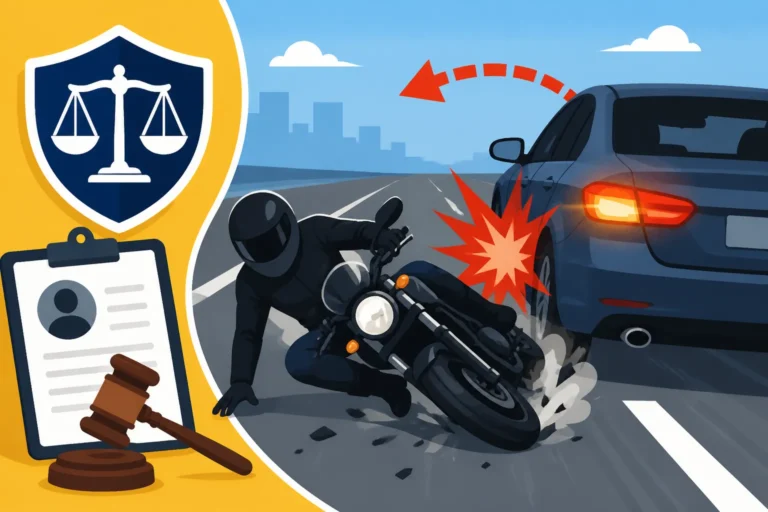
One of the most common and devastating types of motorcycle accidents in New York involves a car making a left turn in front of an oncoming motorcycle. Riders frequently lament the "I didn't see the motorcycle" defense, which, while common, doesn't absolve the turning driver of responsibility. New York Vehicle and Traffic Law Section 1141 dictates that a driver turning left must yield the right-of-way to any vehicle approaching from the opposite direction that is so close as to constitute an immediate hazard.
In most Motorcycle Accidents Caused by Left-Turn Collisions scenarios, the turning driver is found to be primarily at fault because they failed to properly observe and yield. However, even in these cases, an insurance company might try to argue that the motorcyclist was speeding, riding without headlights, or obscured in some way, attempting to assign a percentage of fault to the rider under pure comparative negligence. It's a frustrating reality that motorcyclists often bear the burden of proving their visibility and adherence to traffic laws, even when another driver clearly violated a fundamental rule of the road.
Lane Splitting Legality and Its Nuances
Lane splitting, the act of a motorcycle riding between lanes of slow or stopped traffic, is a contentious issue. In New York, lane splitting is generally illegal. New York Vehicle and Traffic Law Section 1122 specifically states that a vehicle shall not be driven in such a manner as to impede or block the normal and reasonable movement of traffic, and it restricts sharing lanes. This means that if you're involved in an accident while lane splitting, even if another driver makes a careless maneuver, your actions could be used to assign a significant percentage of fault to you.
While illegal, the impact of lane splitting on fault is not always 100% against the rider. For example, if you were lane splitting at a very low speed and a driver intentionally swerved into you, the driver might still bear primary fault. However, if a driver simply didn't see you because you were in an unexpected position between lanes, it becomes a much harder battle. Understanding Lane Splitting and Motorcycle Accident Liability is crucial, as the legal landscape here is complex, and the mere act of lane splitting can become a potent weapon for the defense to reduce their liability.
Distracted Driving and Its Grave Consequences
Distracted driving is a pervasive and incredibly dangerous problem on New York roads, and it's a frequent cause of motorcycle accidents. Whether it's texting, talking on the phone, eating, or fiddling with a GPS, these distractions divert a driver's attention from the road and, critically, from looking for motorcycles. New York has strict laws against using handheld electronic devices while driving, with penalties ranging from points on a license to significant fines.
Proving that another driver was distracted can be a game-changer in fault determination. If you can establish through witness statements, cell phone records, or even dashcam footage that the other driver was not paying attention, it strengthens your argument that they bear primary fault. This is especially true for Motorcycle Accidents Caused by Distracted Driving. However, collecting this evidence can be challenging, as distracted drivers rarely admit their negligence. This often requires thorough investigation and, sometimes, legal intervention to obtain necessary records. Without solid proof, it often comes down to conflicting testimonies, making the burden of proof even heavier on the injured rider.
Evidence Needed to Prove Fault in New York
After the initial shock and the immediate need for medical attention, the scramble to gather evidence begins. In the chaotic aftermath of a motorcycle accident in New York, what you do or don't do at the scene and in the days that follow can make or break your ability to prove fault and recover damages.
The Crucial Role of Police Reports and Citations
The police report is often the first official document detailing the accident, and it carries significant weight. When law enforcement arrives at the scene of a motorcycle crash in New York, they will investigate, interview witnesses, document the scene, and often issue citations. A citation issued to the other driver for a traffic violation – such as failure to yield, running a red light, or an unsafe lane change – serves as strong, though not always conclusive, evidence of their fault. Conversely, a citation issued to you could be detrimental to your claim.
It's important to remember that a police report is not the final word on fault, especially in civil court, but it forms a critical foundation. It documents key details like the date, time, location, vehicles involved, and often includes the officer's initial assessment of how the accident occurred. While officers are not always accident reconstruction experts, their observations and any citations issued can heavily influence how insurance companies view liability. If you believe the police report contains inaccuracies, it's possible to seek an amendment, though this can be difficult. Learning How Police Reports Establish Fault and how to potentially correct an unfair report is valuable for any rider.
Gathering Witness Statements and Other Documentation
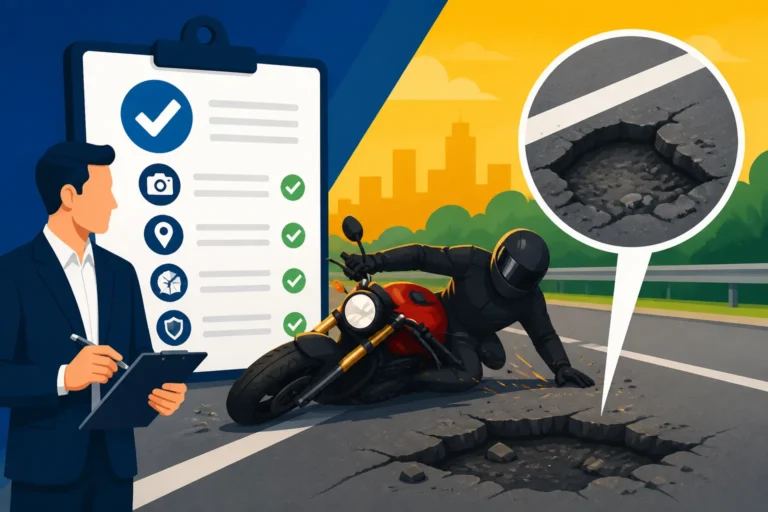
Beyond the police report, collecting comprehensive documentation is paramount. If you're able, or a trusted person can do so, immediately after the accident, take as many photos and videos as possible. This includes damage to all vehicles, skid marks, road conditions, traffic signs, debris, and the surrounding area. Digital timestamps and geotags on phone photos can be incredibly powerful.
Witness statements are also invaluable. Eyewitnesses can corroborate your account and often provide an objective perspective that can counteract biased claims from the other driver. Get their names, contact information, and a brief description of what they saw. If available, dashcam footage from your bike or nearby vehicles, or even surveillance video from businesses along the road, can provide undeniable proof of what happened. These pieces of evidence provide the tangible details that reconstruct the crash and help establish Motorcycle Accident Evidence for Proving Fault. Don't underestimate the power of seemingly small details; a clear photo of where your bike landed or a witness who saw the other driver on their phone can dramatically sway a fault determination.
Medical Records and Expert Testimony
While not directly related to how the accident happened, your medical records are critical for proving the damages resulting from the other party's fault. Immediate and consistent medical attention after a motorcycle accident in New York demonstrates the severity of your injuries and creates a clear timeline linking the crash to your physical harm. Gaps in treatment can be exploited by insurance companies to argue that your injuries weren't serious or weren't caused by the accident.
In complex cases, or when fault is heavily disputed, expert testimony may be necessary. An accident reconstruction expert, for instance, can analyze physical evidence like skid marks, vehicle damage, and crash dynamics to scientifically determine speed, points of impact, and who was at fault. Medical experts can also testify about the extent of your injuries, their prognosis, and the long-term impact on your life, directly bolstering your claim for damages. These professionals bring an objective, scientific lens to the situation, often cutting through conflicting narratives and presenting a clear picture to adjusters or a jury.
Navigating the Insurance Landscape and Settlement Impacts
The aftermath of a motorcycle accident isn't just about physical recovery; it's also a battle with insurance companies. Understanding how New York's insurance system interacts with fault determination for motorcycle claims is crucial for securing a fair settlement.
No-Fault vs. At-Fault Insurance Principles
This is a really important distinction for New York motorcyclists. While New York is generally known as a "no-fault" state for car accidents, this system does not typically apply to motorcycles for personal injuries. Under New York's no-fault law (Personal Injury Protection or PIP), car drivers and passengers can get medical expenses and lost wages paid by their own insurance regardless of who caused the accident.
However, motorcycles are excluded from this no-fault coverage for bodily injury. This means that if you're injured in a motorcycle accident in New York, you generally cannot claim PIP benefits from your own policy or the at-fault driver's policy. Instead, your personal injury claim operates under a traditional "at-fault" or "tort" system. This emphasizes why proving fault against the other driver is so incredibly important for motorcyclists; it's the primary path to recovering compensation for your medical bills, lost wages, and pain and suffering from their insurance company. Without clear fault, your options for recovery are severely limited, typically to your own health insurance and potentially uninsured/underinsured motorist (UM/UIM) coverage if you have it.
How Fault Directly Influences Your Settlement Value
As discussed, New York's pure comparative negligence rule means that your assigned percentage of fault directly reduces your potential settlement. If you're found 30% at fault, your $100,000 claim becomes a $70,000 payout. This makes the battle over fault percentages a high-stakes game. Insurance companies will aggressively try to push as much blame as possible onto the motorcyclist, knowing that every percentage point saved is money out of their pocket.
Your settlement value is calculated based on various damages, including economic damages (medical expenses, lost wages, property damage) and non-economic damages (pain and suffering, emotional distress). When fault is established, these damages are tallied, and then the reduction based on comparative negligence is applied. This means that even if you have substantial medical bills and significant pain, if a high percentage of fault is attributed to you, your final net payout could be significantly diminished. This underlines why maximizing your efforts to prove the other driver's fault and minimize your own is not just about principle, but about financial necessity. Understanding How Fault Affects Your Settlement is fundamental to preparing your claim.
The "Helmet Defense" in New York
New York has a universal helmet law, meaning all motorcycle riders and passengers must wear a DOT-compliant helmet. New York Vehicle and Traffic Law Section 381(6) is clear on this requirement. While riding without a helmet is a traffic violation, its impact on your injury claim can be complex.
In some states, not wearing a helmet can be used by the defense (often referred to as the "helmet defense") to argue that your injuries, particularly head injuries, would have been less severe had you been wearing a helmet, thereby reducing their liability. In New York, this defense can certainly be raised. The defense would need to prove two things: first, that you weren't wearing a proper helmet (or any helmet), and second, that your injuries were worsened by this failure. It's not enough to simply say you weren't wearing one; they must establish a causal link to your injuries. For example, if you suffer a broken leg, the lack of a helmet would generally not be a relevant defense. However, if you sustained a traumatic brain injury, the defense would almost certainly invoke it to try and reduce their payout. Even if you were not at fault for the accident itself, your non-compliance with the helmet law could introduce a factor of comparative negligence regarding the severity of your injuries, ultimately affecting How Not Wearing a Helmet Affects Your Settlement. This is why adhering to Motorcycle Helmet Laws by State is always the safest bet, both for your physical well-being and your legal standing.
Here's a quick overview of how New York's fault system typically works:
| Aspect | Description | Impact on Rider |
|---|---|---|
| Fault System | Pure Comparative Negligence | You can recover damages even if partially at fault, but your compensation is reduced by your assigned percentage of fault. |
| No-Fault Insurance (PIP) | Generally does NOT apply to motorcycles for bodily injury claims. | Motorcyclists must prove the other party's fault to recover for medical expenses, lost wages, and pain & suffering. |
| Helmet Law | Universal – all riders and passengers must wear a DOT-compliant helmet. | Not wearing a helmet can be used as a "helmet defense" to argue that your head injuries were exacerbated, potentially reducing your compensation for those specific injuries, even if not at fault for the crash. |
| Lane Splitting | Generally illegal. | Engaging in lane splitting at the time of an accident can be used to assign a percentage of fault to the rider. |
| Burden of Proof | The injured motorcyclist (plaintiff) generally bears the burden of proving the other driver's negligence and the extent of their own damages. | You must gather strong evidence to establish the other driver's fault and link your injuries and losses directly to the accident. |
What to Do After a Motorcycle Accident in New York
The moments and days following a motorcycle accident can be overwhelming. While your health and safety are always paramount, knowing the correct steps to take can significantly protect your rights and improve your ability to prove fault under New York law.
Secure the Scene and Seek Medical Attention
Your first priority after any accident is your safety and health. Move to a safe location if you can, and immediately call 911 to report the accident. Even if you feel okay, it’s critical to accept medical attention from paramedics at the scene. Adrenaline can mask pain, and some serious injuries, like a Motorcycle Traumatic Brain Injury, may not show immediate symptoms. Getting checked out by medical professionals ensures your well-being and creates an immediate record of your injuries. This initial medical documentation is incredibly important in linking your injuries directly to the crash.
While waiting for emergency services, if it's safe to do so, try to secure the scene. Turn on your hazards. If you have a camera or smartphone, take photos of the accident scene from various angles before vehicles are moved, including road conditions, traffic signs, skid marks, and any debris. These visual records can be invaluable in reconstructing the accident and demonstrating fault. Remember, every detail helps paint a clear picture for investigators and insurance adjusters down the line.
Gather Information and Avoid Admitting Fault
After ensuring safety and seeking medical help, the next crucial step is to gather as much information as possible from the other driver(s) and any witnesses. Collect names, contact information, insurance details, and vehicle license plate numbers. If witnesses are present, kindly ask for their contact information and a brief statement of what they saw. This is particularly important for motorcyclists, as Rider Bias in Fault Determination, unfortunately, still exists, and objective witness accounts can counteract unfair assumptions.
It's absolutely critical to remember this: never admit fault, apologize, or make any statements that could be interpreted as admitting responsibility at the scene of the accident. Even a simple "I'm so sorry, are you okay?" can be twisted by insurance companies later. Stick to the facts. When speaking with police, provide accurate details but avoid speculation or taking blame. Your statements can be used against you, especially under New York’s pure comparative negligence system, where any admission could significantly reduce your recoverable damages.
Preserve Evidence and Consult Legal Counsel
Once you've left the accident scene, the work isn't over. Preserve all damaged gear – your helmet, jacket, pants, and boots – as they can serve as powerful physical evidence of the impact and your injuries. If your helmet is damaged, keep it; its condition can show the force of impact, supporting your claim for head injuries. Similarly, photographs of road rash or bruising over time can vividly document your suffering.
Given the complexities of New York’s pure comparative negligence laws and the common biases against motorcyclists, consulting with an attorney experienced in motorcycle accident claims is highly recommended as soon as possible. They can help you understand your rights, navigate the insurance claims process, and ensure all critical evidence is preserved and properly presented. An experienced lawyer knows how to fight back against insurance companies attempting to shift blame, and they can help you get the full compensation you deserve. They understand the intricacies of Motorcycle Accident Fault Laws in New York and can provide invaluable guidance from the very beginning.
Disclaimer
Please remember that this article provides general information and is not intended as legal advice. Laws can change, and every accident case is unique. For personalized advice regarding your specific situation, it is always recommended to consult with a qualified legal professional in New York.