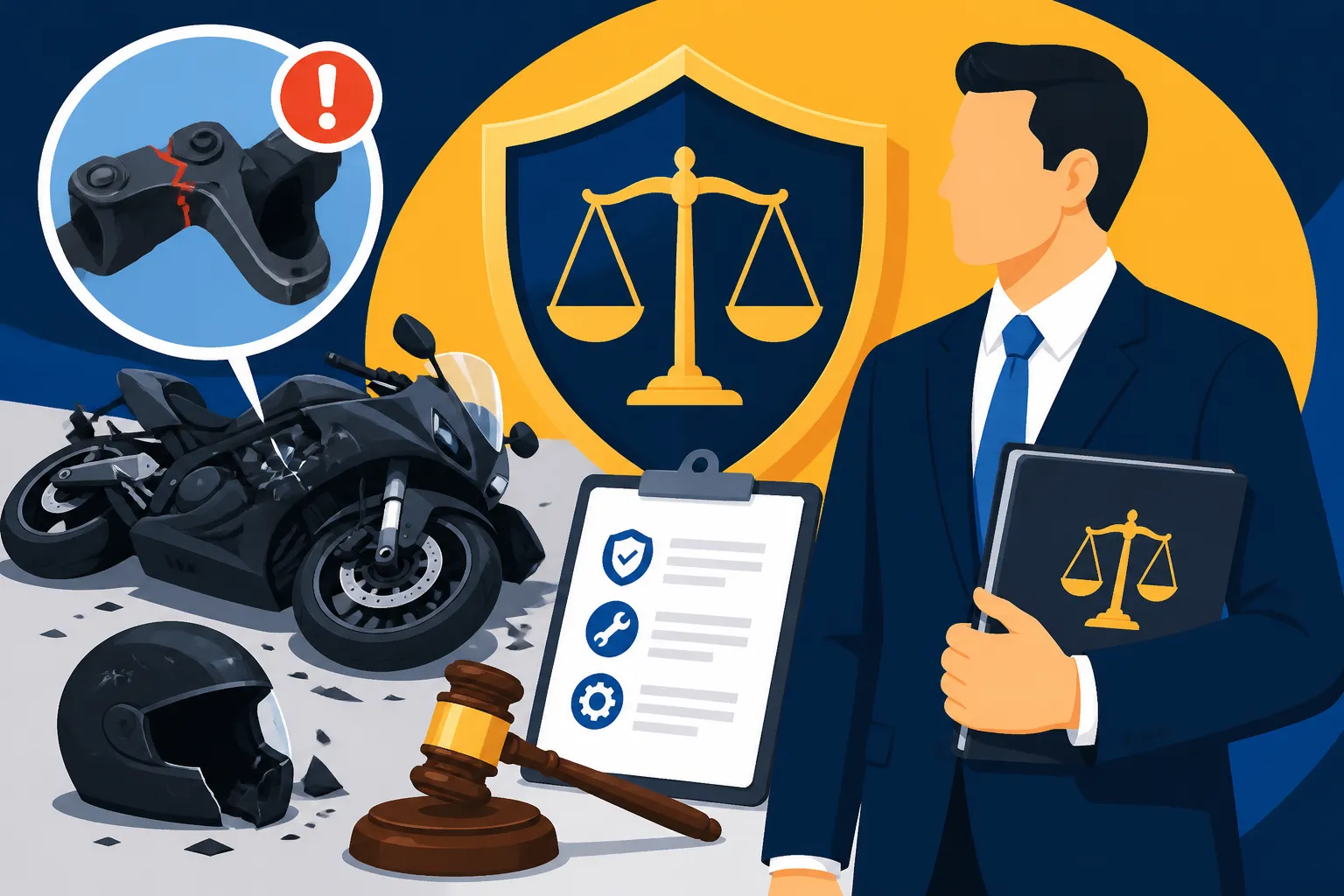
How Lawyers Handle Product Liability Motorcycle Claims
Imagine you've been riding your motorcycle for years, meticulously maintaining it, always riding defensively, and then, out of nowhere, something goes wrong that's entirely beyond your control. You crash, not because of another driver's negligence or your own mistake, but because a crucial component on your bike failed. This frustrating and often devastating scenario is the heart of a product liability motorcycle claim, and navigating its complexities requires a deep understanding of the law. This guide will help you understand how legal professionals handle such claims, from identifying the defect to seeking the justice you deserve. If you suspect a faulty component was to blame, finding guidance, perhaps through resources like LegalMatch, can illuminate your path forward.
Understanding Product Liability in Motorcycle Accidents
When a motorcycle accident occurs due to a defect in the bike itself, or in its protective gear, it falls under the realm of product liability law. This isn't your typical "car hit bike" scenario where you're trying to prove another driver ran a red light or failed to yield. Instead, you're looking at a situation where the product — be it the motorcycle, its tires, brakes, or even your helmet — was inherently unsafe or improperly manufactured.
The core idea here is holding manufacturers, distributors, or retailers responsible for putting a dangerous product into the hands of consumers. It's a different beast from proving fault in a typical two-vehicle accident, as it shifts the focus from human error on the road to corporate responsibility for product safety. This can feel like an uphill battle against large corporations with deep pockets, but it's a fight that can be won with the right approach and legal support.
The Three Types of Product Defects
Product liability claims generally hinge on proving one of three types of defects, each with its own nuances and challenges in evidence collection and legal argument. Understanding these distinctions is crucial for building a strong case.
Manufacturing Defects
A manufacturing defect occurs when a product departs from its intended design, even though the design itself was safe. Think of it like this: the blueprint for the motorcycle's braking system was perfectly fine, but during assembly, a batch of brake calipers was made with substandard material or wasn't properly installed. This means that while most of the bikes off the assembly line might be safe, yours had a specific flaw due to an error in the manufacturing process.
Proving a manufacturing defect often requires showing that the specific item you purchased was an anomaly and deviated from the manufacturer's own specifications. For example, if your front tire suddenly delaminated and caused a crash, and experts later determine it was due to improper bonding during production, that would be a manufacturing defect. This is distinct from cases involving Manufacturer Liability for Defective Parts more generally, as it focuses on an error in individual production rather than the overall design.
Design Defects
Unlike a manufacturing defect, a design defect means the product was inherently dangerous as it was designed, even if it was manufactured perfectly according to those plans. In other words, every single unit produced with that design carries the same risk. A classic example might be a motorcycle frame design that has a critical stress point making it prone to cracking under normal riding conditions, or a fuel tank placement that consistently ruptures in low-speed impacts, posing an undue fire hazard.
To prove a design defect, you generally need to demonstrate that there was a safer, economically feasible alternative design available at the time the product was manufactured, and that the manufacturer failed to adopt it. This is a much broader challenge than a manufacturing defect, as it questions the fundamental engineering decisions of the company. It requires expert testimony on engineering principles and industry standards, showcasing that the original design was unreasonably dangerous.
Warning Defects Failure to Warn
Sometimes a product isn't defective in its design or manufacturing but becomes dangerous because it lacks adequate warnings or instructions for its safe use. This is often referred to as a "failure to warn" or "marketing defect." For example, if a specific motorcycle model has a known tendency to wobble at high speeds under certain load conditions, but the manufacturer fails to include a clear warning about this hazard in the owner's manual or on the bike itself, and an accident occurs as a result, that could be a warning defect.
This also extends to protective gear. Imagine a helmet that meets basic safety standards but isn't designed for extreme impacts, and the manufacturer doesn't adequately warn consumers about its limitations, potentially misleading them into believing it offers universal protection. For those looking for more comprehensive information on helmet standards, the guide on DOT Helmet Requirements Explained offers valuable insights. To succeed in such a claim, you must show that the lack of warning made the product unreasonably dangerous and that if a proper warning had been provided, the accident would have been avoided.
Common Defective Motorcycle Parts Leading to Accidents
Motorcycles, by their very nature, involve a complex interplay of mechanical and electrical systems. A failure in any one of these critical components can have catastrophic consequences for the rider. Identifying which parts are most commonly implicated in product liability claims can help you understand where to focus your attention if you suspect a defect caused your accident.
Riders are particularly vulnerable to component failure due to the lack of surrounding protection that cars offer. While many Common Causes of Motorcycle Accidents involve other vehicles or rider error, it's vital not to overlook the potential for mechanical failure.
Critical Systems Prone to Failure
Certain systems on a motorcycle are inherently more critical for safety and control. When these components fail due to a defect, the results can be immediate and severe.
Braking Systems
The braking system is paramount for rider control. Defects in this area can lead to a complete loss of stopping power or unpredictable braking behavior. Common issues include faulty ABS (Anti-lock Braking System) units, which can fail to engage or, worse, engage inappropriately, leading to skidding. Caliper defects, where the mechanism that squeezes the brake pads onto the rotor malfunctions, can cause uneven braking or a total failure to apply pressure. Master cylinder issues, such as internal leaks or faulty seals, can reduce hydraulic pressure, making the brake lever or pedal feel "spongy" and ineffective. A sudden brake failure at speed, especially in traffic, is almost always catastrophic.
Tires
Motorcycle tires are the sole point of contact with the road, and their integrity is non-negotiable. Tire defects can range from tread separation, where the tread layer detaches from the tire carcass, to catastrophic blowouts caused by manufacturing inconsistencies like weak sidewalls or improperly cured rubber. Even subtle issues like uneven tire wear due to internal structural defects can lead to instability and loss of control, particularly when cornering or at higher speeds. When a tire fails, the rider has little to no ability to recover, often leading to severe injuries like road rash or broken bones, as discussed in detail in guides about Road Rash Injuries and Claims.
Steering and Suspension
These systems dictate how your motorcycle handles and responds to road conditions. Defects here can manifest as a terrifying lack of control. Fork failures, whether due to faulty materials or improper assembly, can lead to the front wheel collapsing or behaving unpredictably. Unexplained wobbles or speed oscillations can sometimes be traced back to a design flaw in the frame geometry or a defect in the suspension components like shock absorbers. Issues with the steering head bearings, if improperly manufactured or installed, can cause stiffness or looseness in the steering, making the bike difficult to maneuver and prone to crashing.
Other Components to Consider
While braking, tires, and steering are often the first suspects, other components can also lead to product liability claims if they fail.
Fuel and Electrical Systems
Defects in the fuel system, such as faulty fuel lines, pumps, or injectors, can lead to fuel leaks, which pose a serious fire hazard, especially during a crash. An engine that suddenly loses power due to a fuel delivery issue can leave a rider stranded or vulnerable in traffic. Similarly, electrical system defects, like faulty wiring harnesses or defective ignition components, can cause sudden power loss, instrument panel malfunctions, or even prevent the headlights or turn signals from working, increasing the risk of an accident due to reduced visibility.
Frames and Structural Components
The motorcycle frame is its backbone. Defects in its construction, such as poor welding, substandard materials, or design flaws that lead to metal fatigue, can result in the frame cracking or breaking during operation. This is a catastrophic failure that can cause the motorcycle to disintegrate at speed. Similarly, issues with swingarms, wheels, or other structural components can compromise the bike's integrity and lead to a total loss of control. These types of failures often result in the most severe accidents due to the sudden and violent nature of the breakdown.
The Complex Process of Proving a Product Liability Claim
Taking on a major manufacturer or distributor after a motorcycle accident is an intimidating prospect, and rightfully so. These companies are well-versed in defending themselves and have extensive legal teams. Proving a product liability claim is significantly more complex than a typical personal injury case, demanding specialized knowledge, extensive resources, and a meticulous approach to evidence. This isn't just about showing that an accident happened; it's about proving why it happened due to a defect, and that defect was the responsibility of someone other than yourself or another driver.
For those uncertain about the best path forward, exploring options through a platform like LegalMatch could connect you with experienced legal professionals who understand the nuances of product liability.
Gathering Critical Evidence
The success of a product liability claim hinges almost entirely on the quality and specificity of the evidence you can present. This goes beyond the basic steps you'd take after any crash.
Preserving the Evidence
This is arguably the most crucial step. After an accident potentially caused by a defective part, your absolute priority (after seeking medical attention, of course) must be to preserve the motorcycle and any suspected faulty components exactly as they are. Do not allow repairs to be made, and do not dispose of the bike or any parts. This physical evidence is the linchpin of your case. Insurers, manufacturers, and legal teams will want to inspect the actual components. If the part is repaired or discarded, proving the defect becomes exponentially harder, if not impossible. Take detailed photos and videos of the damage, the overall scene, and especially any suspected defective parts. This critical step aligns with the advice in Motorcycle Accident Evidence for Proving Fault.
Expert Analysis
Unlike a standard accident where police reports and witness statements might suffice, product liability cases demand expert testimony. You'll likely need to engage accident reconstructionists to determine the sequence of events and the role of the product failure. Mechanical engineers and materials scientists will be vital to examine the defective part, perform stress tests, and provide expert opinions on the nature of the defect (manufacturing, design, or warning). These experts can articulate how the defect caused the failure and why it was unreasonably dangerous. This is a highly specialized field, and finding the right expert is as important as finding the right lawyer. Guidance on When to Hire an Accident Reconstruction Expert can be particularly helpful here.
Documentation and Records
Beyond the physical evidence, a mountain of documentation supports a product liability claim. This includes all your medical records detailing the full extent of your injuries and ongoing treatment. Comprehensive documentation of injuries for a claim is essential, as highlighted in guides like How to Document Injuries for a Claim. Any maintenance records for your motorcycle can show that you regularly serviced the bike and that the defect wasn't due to neglect. Police reports, witness statements, and photographs from the scene are still important for establishing the context of the accident. Furthermore, your legal team will seek internal documents from the manufacturer, design specifications, testing data, and any records of similar incidents or recalls involving the same product or component.
Legal Theories and Challenges
Product liability law often operates under a different set of rules than negligence-based personal injury claims. While this can sometimes make it easier to prove a case, manufacturers are well-prepared to challenge these claims.
Strict Liability
Many states operate under a doctrine of "strict liability" for product defects. This is a significant advantage for the plaintiff. Under strict liability, you generally don't have to prove that the manufacturer was negligent or careless in designing or making the product. Instead, you only need to prove three things:
- The product was defective.
- The defect existed when the product left the manufacturer's control.
- The defect caused your injuries.
This removes the often-difficult burden of proving a company's intent or lack of care, focusing solely on the product itself. However, proving those three elements, especially the existence and causation of the defect, can still be incredibly challenging.
Breach of Warranty
Another legal theory sometimes used in product liability claims is "breach of warranty." This occurs when a product fails to live up to the promises made about its quality or performance. There are two main types:
- Express Warranty: A specific promise made by the manufacturer, such as a written guarantee that a part will last for a certain number of miles.
- Implied Warranty: Unspoken assurances that a product is fit for its ordinary purpose (e.g., that brakes will stop a motorcycle) and is of merchantable quality.
If the defective part breaches one of these warranties and causes your accident, you may have a claim. This is often an easier claim to prove if an explicit warranty exists, but can be limited to the cost of the product itself unless it directly caused injury.
Manufacturer Defenses
Manufacturers have a playbook of defenses they'll use to try and shift blame or negate liability. One common defense is that the hazard was "open and obvious," meaning any reasonable consumer should have recognized the danger. They might also argue "misuse of product," claiming you used the motorcycle or component in a way it wasn't intended, or that your modifications to the bike contributed to the failure. Additionally, they may try to argue that the product was altered after leaving their control, or that your own negligence (e.g., speeding, improper maintenance) was the true cause of the accident, a concept that often comes up in discussions about Comparative Negligence in Motorcycle Accidents.
Navigating the Legal Landscape and Seeking Justice
The journey through a product liability claim can be lengthy and emotionally draining. It involves intricate legal maneuvers, significant investigation, and often a protracted battle with well-funded corporate legal teams. This is precisely why having a dedicated and experienced legal advocate in your corner is not just recommended, but often essential.
The Role of a Specialized Attorney
When facing a product liability case, it's crucial to understand that not all personal injury lawyers have the specific expertise required. These cases demand a lawyer who deeply understands engineering principles, federal safety regulations (like those from the National Highway Traffic Safety Administration), and the unique procedural aspects of litigation against large manufacturers.
A specialized attorney will have the resources to fund expensive expert investigations, which can cost tens of thousands of dollars, without requiring upfront payment from you. They know how to conduct discovery, compelling manufacturers to turn over internal documents, design specifications, and complaint histories that can reveal patterns of defects. Moreover, they understand how to counter the aggressive defenses mounted by corporate legal teams, ensuring your rights are protected. Finding the right legal professional, perhaps through a service like LegalMatch, is often the first vital step in securing such expertise. For a broader understanding of what to look for, exploring guides on How to Find the Best Motorcycle Accident Attorney can be very insightful.
Potential Outcomes and Compensation
If your product liability claim is successful, either through a settlement or a court verdict, you can seek compensation for various damages you've incurred.
Economic Damages
These are the quantifiable financial losses directly resulting from your accident and injuries. They include the enormous costs of medical treatment, from emergency room visits and surgeries to physical therapy and long-term care. If you've missed work due to your injuries, you can claim lost wages, and if your injuries prevent you from returning to your previous profession or working at all, you can seek compensation for loss of earning capacity. The damage to your motorcycle itself and any other personal property destroyed in the crash also falls under economic damages. Your attorney will meticulously track all these costs to ensure every penny is accounted for, playing a key role in How to Maximize Your Motorcycle Accident Settlement.
Non-Economic Damages
Beyond the bills, an accident caused by a defective product can inflict deep, non-financial suffering. These are known as non-economic damages and compensate you for the pain and suffering you endured during and after the accident. This can include physical pain, emotional distress, mental anguish, loss of enjoyment of life (e.g., if you can no longer ride your bike or participate in hobbies), and even disfigurement or scarring. Calculating these damages can be complex and subjective, but a skilled attorney understands how to present this aspect of your suffering compellingly, as detailed in articles like Pain and Suffering in Motorcycle Settlements.
Punitive Damages
In rare cases, if it can be proven that the manufacturer acted with extreme negligence, recklessness, or malicious intent—such as knowingly selling a defective product despite clear safety warnings—a court might award punitive damages. These damages are not intended to compensate you for your losses but rather to punish the manufacturer for their egregious conduct and deter similar behavior in the future. Proving the level of culpability required for punitive damages is a high legal bar, but when achieved, it sends a powerful message.
Settlement Negotiations and Trial
Most product liability cases, like other personal injury claims, ultimately resolve through settlement negotiations rather than going to trial. Manufacturers often prefer to settle to avoid the negative publicity, high costs, and unpredictable outcomes of a jury trial. However, if a fair settlement cannot be reached, your attorney must be prepared to take your case to court. The prospect of a trial can often pressure manufacturers to offer a more reasonable settlement. The decision to pursue a Motorcycle Accident Settlement vs Trial is a critical one, and your attorney will guide you through the pros and cons of each path.
| Defect Type | Description | Who is Liable? | Key Evidence Needed | Typical Legal Theory |
|---|---|---|---|---|
| Manufacturing | Individual product deviates from intended design due to production error. | Manufacturer, sometimes distributor/retailer. | The specific defective part, expert analysis comparing it to design specs, production batch records. | Strict Liability |
| Design | Product is inherently dangerous due to its fundamental design. | Manufacturer. | Expert testimony on design flaws, alternative safer designs, accident data for similar products. | Strict Liability |
| Failure to Warn | Product lacks adequate warnings or instructions, making it unreasonably unsafe. | Manufacturer, sometimes distributor/retailer. | Product labeling, owner's manual, proof of knowledge of risk, expert opinion on warning inadequacy. | Strict Liability |
Product liability claims are undoubtedly challenging, but they are a crucial avenue for justice when a motorcycle accident stems from corporate irresponsibility rather than driver error. By understanding the types of defects, the rigorous evidence required, and the vital role of a specialized attorney, you can better prepare for the fight ahead. Platforms like LegalMatch can be invaluable in connecting you with attorneys who specialize in this niche, ensuring you have the best possible advocate to pursue your claim and hold negligent manufacturers accountable.
Disclaimer
Please remember that this information is intended for general guidance and informational purposes only, and does not constitute legal advice. Motorcycle accident claims, particularly those involving product liability, are highly complex and vary significantly based on individual circumstances, state laws, and specific product details. It is crucial to consult with a qualified motorcycle accident attorney who specializes in product liability in your jurisdiction to discuss the specifics of your case and receive personalized legal advice. Do not take action or refrain from acting based on the information provided here without professional legal counsel.