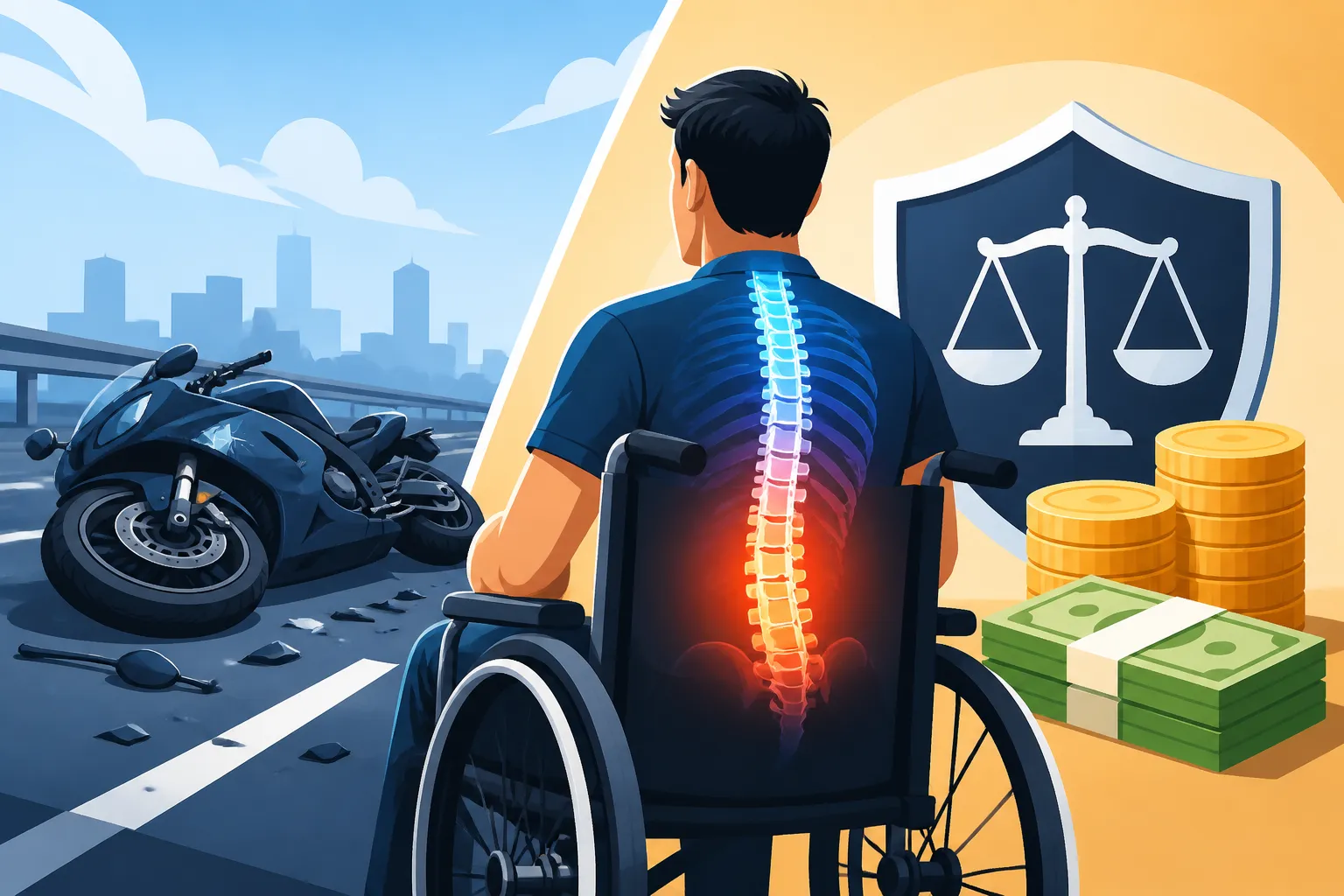
Average Settlement for a Motorcycle Spinal Cord Injury
A motorcycle accident can be a life-altering event, but few injuries carry the devastating and permanent weight of a spinal cord injury. The financial burden alone, let alone the physical and emotional toll, can feel insurmountable, leaving victims wondering how they will ever manage. This comprehensive guide aims to demystify the complexities surrounding the average settlement for a motorcycle spinal cord injury, helping you understand what goes into these crucial calculations and how to navigate the challenging path toward fair compensation.
Understanding the Severity of Spinal Cord Injuries in Motorcycle Accidents
Motorcycle accidents are notorious for causing severe injuries, and spinal cord injuries (SCI) are unfortunately among the most catastrophic. Unlike a broken arm or leg that might heal relatively quickly, a spinal cord injury often means a permanent change in physical function, sensation, and even daily life. It’s not just about immediate pain; it's about a complete re-evaluation of one's future.
Types and Classifications of Spinal Cord Injuries
Spinal cord injuries are incredibly complex, and their classification plays a massive role in understanding the long-term prognosis and, subsequently, the potential settlement value. It's not a one-size-fits-all diagnosis. What happened to your spinal cord during the impact, and where along its length the damage occurred, will dictate everything from sensation to mobility.
First, doctors classify SCIs as either complete or incomplete. A complete SCI means there's a total loss of motor function and sensation below the injury level on both sides of the body. This is often the most severe outcome. An incomplete SCI, on the other hand, means there's still some function or sensation below the injury level, even if minimal. This distinction is vital because even a tiny bit of preserved function can make a huge difference in rehabilitation potential and quality of life. Think of a rider who can still move a toe versus one who cannot feel or move anything below the waist.
Beyond complete or incomplete, the location of the injury on the spinal cord is paramount. Injuries in the cervical (neck) region, designated C1-C8, are generally the most serious, potentially leading to quadriplegia (paralysis of all four limbs and torso), impacting breathing, and requiring extensive care. Thoracic (mid-back, T1-T12) injuries often result in paraplegia (paralysis affecting the lower half of the body). Lumbar (lower back, L1-L5) and sacral (S1-S5) injuries typically affect the hips, legs, and bladder/bowel function. The higher the injury on the spinal cord, the more widespread and severe the functional loss tends to be. Medical professionals use the ASIA (American Spinal Injury Association) Impairment Scale to provide a standardized measure of the severity and level of the injury, ranging from A (complete) to E (normal), which is critical for documentation in a claim.
Immediate and Long-Term Medical Needs
When a rider suffers a spinal cord injury, the immediate aftermath is a whirlwind of emergency medical care. We're talking about ambulance rides, emergency room stabilization, diagnostic imaging like MRIs and CT scans, and often, immediate surgical intervention to stabilize the spine, decompress nerves, and prevent further damage. This initial phase alone can rack up hundreds of thousands of dollars in medical bills in a shockingly short amount of time. Hospitals, specialized neurosurgeons, and intensive care units are all involved in saving lives and mitigating further harm.
But the journey doesn't end when the immediate crisis passes. Far from it. A spinal cord injury requires extensive, ongoing rehabilitation, which can last months or even years. This includes physical therapy to regain strength and mobility, occupational therapy to relearn daily tasks, and speech therapy if breathing or vocal cords are affected. Many victims require assistive devices, such as wheelchairs – whether manual or motorized – braces, or even specialized vehicles. Home modifications, like widening doorways, installing ramps, or adapting bathrooms, become necessities to allow for independent living. These are not minor expenses; they are significant, lifelong financial commitments that will need to be accounted for in any settlement.
Moreover, the long-term care needs for someone with an SCI are staggering. Many individuals require round-the-clock nursing care or skilled assistance with basic personal care tasks. There's also the constant monitoring for secondary complications like pressure sores, bladder infections, respiratory issues, and chronic pain management. These are the kinds of Long-Term Effects of Motorcycle Injuries that insurance companies often try to minimize, but they represent a true, ongoing financial burden that demands substantial compensation. It’s a holistic change that requires a lifetime of medical attention and adaptive support.
The Life-Altering Impact Beyond Physical Pain
While the physical pain and medical costs are undeniable, the true devastation of a spinal cord injury extends far beyond what a doctor can measure or a bill can tally. This is where the emotional and psychological impact comes into sharp focus, often overlooked by those who haven't experienced it. Losing the ability to walk, use your hands, or even breathe independently is a profound shock that rips away a person's former life and identity.
Imagine a rider, once vibrant and active, suddenly confined to a wheelchair, unable to participate in hobbies, work, or even simple daily activities they once took for granted. The loss of independence is a crushing blow, leading to deep psychological distress, including depression, anxiety, and post-traumatic stress disorder (PTSD). Relationships with family and friends can become strained under the immense pressure, and the sense of loss can be overwhelming. Victims often experience a deep sense of grief for the life they've lost, a mourning process that can be lifelong.
This profound impact on quality of life, emotional well-being, and social interaction forms a significant part of "non-economic damages" in a claim. It’s about the inability to enjoy family outings, to pursue a cherished career, to engage in intimate relationships, or even just to wake up without constant pain or the need for assistance. These Catastrophic Motorcycle Injuries fundamentally alter existence, and any fair settlement must reflect this immense, immeasurable loss. It's not just about paying bills; it's about acknowledging a shattered life and providing the resources needed to build a new one.
Key Factors Influencing Spinal Cord Injury Settlements
Understanding the average settlement for a motorcycle spinal cord injury requires a deep dive into the specific factors that shape these complex figures. There's no magic number, unfortunately, because every case is unique, much like every rider's journey. What we can do is break down the core components that influence how much compensation you might receive, separating the concrete costs from the intangible losses.
Economic Damages: The Tangible Costs
When it comes to calculating a settlement for a spinal cord injury, economic damages are the easiest to quantify, though their sheer scale can be daunting. These are the "receipts" of your injury – the direct, verifiable financial losses you’ve incurred or will incur as a result of the accident. The medical expenses alone are staggering for a spinal cord injury, encompassing everything from emergency transportation and multiple surgeries to extensive hospital stays, specialized medication, and ongoing physical and occupational therapy.
Beyond initial treatment, there are the long-term medical costs, which are often the largest component. This includes future surgeries, regular doctor visits with specialists (neurologists, orthopedists, pain management specialists), nursing care, adaptive equipment like custom wheelchairs, shower chairs, or even complex home automation systems. Then there are lost wages. If you're a rider who relied on your physical abilities for work, a spinal cord injury could mean you can no longer perform your job. This includes both past lost wages from time off work during recovery and, critically, your Loss of Earning Capacity for the rest of your working life. If you can no longer earn what you did before, that lost future income must be calculated and included. Finally, home and vehicle modifications – ramps, widened doorways, accessible bathrooms, modified vans – are essential for daily living and represent substantial, measurable costs that must be covered.
Non-Economic Damages: The Intangible Losses
While economic damages are about calculable costs, non-economic damages aim to compensate for the immeasurable losses that a spinal cord injury inflicts. These are often harder to put a dollar figure on, but they are absolutely critical to a fair settlement. The most prominent non-economic damage is pain and suffering. This isn't just the physical agony of the injury itself, which can be intense and chronic, but also the discomfort of recovery, rehabilitation, and living with permanent limitations. Imagine the constant nagging pain, the stiffness, the nerve damage that never truly goes away.
Beyond physical pain, there's the profound emotional distress. A spinal cord injury often leads to severe anxiety, depression, fear, and frustration. The psychological impact can be as debilitating as the physical. Then we have loss of consortium, which addresses the negative impact on marital or family relationships, affecting intimacy, companionship, and the ability to participate in family activities. Many riders experience a significant loss of enjoyment of life – the inability to pursue hobbies, sports, travel, or even simple pleasures like walking on the beach or riding their motorcycle again. These are the things that make life meaningful, and when they are taken away or severely limited, that loss deserves substantial compensation. For a deeper understanding of these less tangible losses, explore our article on Types of Damages in a Motorcycle Accident Claim.
Liability and Comparative Negligence
Who is at fault in a motorcycle accident is perhaps the single most crucial factor influencing your settlement, especially with severe injuries like a spinal cord injury. Even if your damages are astronomical, if the other driver isn't found liable, or if you share a significant portion of the blame, your compensation can be drastically reduced or even eliminated. This is where the legal concept of comparative negligence comes into play, a system used in most states to apportion fault.
For example, in California, a pure comparative negligence state, if you're found 20% at fault for the accident (perhaps you were speeding, even if the other driver made an illegal left turn), your total damages would be reduced by 20%. So, if your total damages were $5 million, you would only receive $4 million. In states with modified comparative negligence, like Texas or Ohio, if you are found 51% or more at fault, you might recover nothing at all. This makes proving the other driver's fault absolutely paramount. You can learn more about how fault is determined in motorcycle accidents to protect your claim.
Insurance companies, especially with motorcycle accidents, are notorious for trying to shift blame to the rider. They might argue you were speeding, riding recklessly, or even that you weren't wearing appropriate gear. A common tactic is "The Helmet Defense Explained", where insurers argue that not wearing a helmet, even if not legally required for all riders in some states, contributed to your head or neck injury, thus reducing their liability. Even if you were wearing a helmet, they might claim it wasn't DOT-approved or that your riding somehow contributed to the crash. Every piece of evidence, from police reports to witness statements and accident reconstruction, becomes vital in establishing liability and minimizing any fault assigned to you.
Navigating Insurance and Legal Hurdles for Your Claim
Securing a fair settlement for a motorcycle spinal cord injury is never a simple process. It involves a daunting battle with insurance companies and, often, a complex legal journey. Understanding these hurdles is the first step in preparing yourself for what lies ahead.
The Role of Insurance Policy Limits
Here's a cold, hard truth that many accident victims discover too late: even if your spinal cord injury damages are in the millions, your actual payout might be capped by the at-fault driver's insurance policy limits. Most drivers carry the state minimum liability insurance, which, in many states, is shockingly low – sometimes as little as $25,000 to $50,000 for bodily injury per person. While this might cover a minor fender bender, it's woefully inadequate for a catastrophic injury like a spinal cord injury, where medical costs alone can quickly exceed seven figures. Our guide on How Insurance Policy Limits Affect Your Payout delves deeper into this often-frustrating reality.
When your damages far exceed the at-fault driver's coverage, you have a few options, though none are easy. First, your own uninsured/underinsured motorist (UM/UIM) coverage can be a lifesaver. If you have robust UM/UIM, it steps in to cover the gap between the at-fault driver's insufficient policy and your total damages. This is why having strong personal coverage is absolutely crucial for riders. Second, you might pursue a personal asset claim against the at-fault driver if they have significant assets. However, many drivers with minimum insurance don't have substantial personal wealth, making this a challenging path. Lastly, if there are multiple liable parties – for instance, a defective road condition, a manufacturer defect, or another vehicle involved – you may be able to draw from multiple insurance policies to cover your extensive damages.
Dealing with policy limits requires careful strategy. Insurance companies are not going to volunteer to pay more than they absolutely have to. They will offer the policy limit, often quickly, hoping you’ll accept and sign away your rights, even if it's a fraction of what you truly need. This is why understanding the full scope of your damages, projecting future costs, and having experienced legal counsel is paramount. They can help you determine the total value of your claim, identify all potential sources of recovery, and negotiate effectively, even in the face of restrictive policy limits.
The Complexities of Negotiation and Litigation
Once you've wrapped your head around the extent of your injuries and the potential insurance coverage, the real battle begins: negotiating with insurance adjusters. These individuals are highly trained to minimize payouts. They might question the severity of your injuries, suggest your medical treatment was excessive, or try to pin some degree of fault on you. For a spinal cord injury claim, which often involves astronomical sums, they will scrutinize every detail and use every tactic to reduce the amount they have to pay. They might even make a lowball settlement offer early on, hoping you're desperate and accept before fully understanding the long-term implications of your injury.
Should negotiations fail to yield a fair offer, your case may move into litigation, meaning you file a lawsuit. This is a significant step that opens up the discovery process, where both sides exchange information, take depositions (sworn testimonies), and gather further evidence. Litigation is a long and arduous journey, often lasting several years, and it can be emotionally taxing. During this phase, there might be opportunities for mediation, where a neutral third party helps both sides try to reach a settlement agreement. However, if no agreement is reached, the case could proceed to trial, where a judge or jury will ultimately decide liability and the amount of damages.
The decision to go to trial is not made lightly, especially in a case involving a spinal cord injury. While a jury might award a substantial verdict, there's always an element of uncertainty. Trials are expensive, time-consuming, and carry risks. However, sometimes going to trial is the only way to compel an insurance company to pay a fair amount, particularly when they refuse to acknowledge the full extent of your damages or liability. This entire process highlights why having a seasoned legal team is not just helpful, but often essential, to successfully navigate the intricate dance of negotiation and, if necessary, the courtroom.
Why Expert Witnesses Are Crucial
In a motorcycle spinal cord injury claim, the sheer complexity of the medical prognosis and financial implications necessitates the use of expert witnesses. These are not just nice-to-haves; they are often the backbone of a successful case, providing objective, authoritative testimony that insurance companies and juries simply cannot ignore.
First and foremost, medical experts are critical. This includes neurosurgeons, orthopedic specialists, rehabilitation doctors, and life care planners. A neurosurgeon can testify about the precise nature of your spinal cord injury, the surgeries performed, and the medical necessity of all treatments. A rehabilitation doctor can explain the extensive therapy required and its long-term outlook. Most importantly, a life care planner is an expert who meticulously projects all your future medical needs – from medications and equipment to ongoing therapies and personal care assistance – over your entire life expectancy. Their detailed report provides a concrete, dollar-figure breakdown of your future economic damages, which is invaluable in a spinal cord injury case.
Beyond medical professionals, other experts are often employed. A vocational expert can assess how your injury has impacted your ability to work and your earning potential. They can provide a clear picture of your lost wages and loss of earning capacity, translating your limitations into a calculable financial loss. An accident reconstruction expert may be brought in to analyze the crash scene, vehicle damage, and other data to definitively establish how the accident occurred and who was at fault, especially when fault is disputed. Their testimony can be crucial in countering insurance company attempts to shift blame, for example, if they claim you were speeding or riding recklessly. These experts lend credibility and weight to your claim, transforming abstract concepts of injury and loss into undeniable facts supported by professional analysis.
Estimating Your Spinal Cord Injury Settlement Value
It's natural to wonder, "What is my case worth?" especially when facing such devastating injuries. While there's no online calculator that can accurately spit out a figure for a motorcycle spinal cord injury settlement, we can explore the factors that create the range and highlight the importance of expert guidance.
Average Settlement Ranges and Why They Vary So Widely
If you’re searching for an "average settlement for a motorcycle spinal cord injury," you'll find numbers ranging from hundreds of thousands to several million dollars, or even tens of millions in the most catastrophic cases. This vast disparity isn't a lack of information; it's a reflection of the profound variability in spinal cord injuries themselves, and the context of each accident. A "minor" incomplete SCI with significant recovery will naturally yield a far smaller settlement than a complete SCI resulting in quadriplegia, lifelong care, and total loss of earning capacity.
The "average" figure is less useful than understanding the factors that push a settlement to the higher or lower end of the spectrum. These include:
- Severity of Injury: Complete versus incomplete, the level of injury (e.g., C1 vs. L5), and the extent of permanent paralysis or functional impairment.
- Age of the Victim: A younger victim with a long life expectancy will have far greater lifetime medical and lost earning capacity damages.
- Pre-Injury Income and Career: A highly paid professional will have a greater loss of earning capacity than someone with a lower income or who was already retired.
- Location: As we’ll discuss, state laws can impact final payouts.
- Clarity of Fault: A clear-cut case where the other driver is 100% at fault will yield a higher settlement than a case with shared fault.
- Insurance Coverage: The amount of available insurance coverage is a hard cap on many settlements.
Therefore, an "average" can be misleading. A case involving a young professional who sustained a C4 complete SCI, resulting in permanent quadriplegia, requiring round-the-clock medical care, and losing a multi-million-dollar future earning capacity, could settle for $10 million or more. In contrast, an older individual with an incomplete L5 injury resulting in partial paralysis who can return to some work might see a settlement in the high six figures or low millions.
State-Specific Laws and Their Impact
The state where your motorcycle accident occurred can significantly influence the final settlement value of a spinal cord injury claim. This is primarily due to variations in comparative negligence laws and sometimes, caps on damages.
Let’s consider states like California, which follows a "pure comparative negligence" rule. This means that even if you're found 90% at fault for the accident, you can still recover 10% of your damages. While a 90% fault finding would drastically reduce your settlement, you wouldn't be entirely barred from recovery. So, if your total damages were $5 million, and you were 10% at fault, you’d still receive $4.5 million. Our article, Comparative Negligence in Motorcycle Accidents, can provide more specific details.
Now, contrast this with states like Texas or Ohio, which adhere to "modified comparative negligence" (often the 51% rule). In these states, if you are found 51% or more at fault for the accident, you are legally barred from recovering any compensation. This is a stark difference and can completely derail a claim, regardless of the severity of your injuries. Furthermore, some states may have caps on non-economic damages (like pain and suffering) in personal injury cases, though these often face legal challenges and may not apply to catastrophic injuries like SCI in all jurisdictions. It's crucial to understand your state's specific laws, as they form the legal framework for your claim. This is why local legal expertise is so vital – a lawyer practicing in your state will be intimately familiar with these nuances.
Factor Description Impact on Settlement
Type of SCI (ASCE classification) Description & Functional Impact General Settlement Range (USD) Considerations
A Complete SCI $500,000 – $5,000,000+ Factors heavily influenced by extent of paralysis, age, earning potential, and jurisdiction.
B Incomplete SCI (Sensory Only) $300,000 – $2,000,000+ Recovery potential is key; functional limitations remain significant for some.
C Incomplete SCI (Motor Preserved, Non-Functional) $700,000 – $3,500,000+ Ability to move but not effectively use muscles for daily tasks leads to extensive needs.
D Incomplete SCI (Motor Preserved, Functional) $1,000,000 – $5,000,000+ Better prognosis but still likely lifelong deficits and adaptive needs.
E Normal (No SCI) N/A This classification implies no lasting functional impairment from a spinal injury.
Note: These ranges are highly generalized and for informational purposes only. Actual settlement amounts depend on numerous unique factors, including state laws, specific circumstances of the accident, available insurance, and the skills of legal representation.
The Critical Role of Legal Representation
Given the astronomical costs and life-altering nature of a motorcycle spinal cord injury, trying to navigate the settlement process alone is like trying to climb Mount Everest in flip-flops. Insurance companies have vast resources, experienced adjusters, and legal teams whose sole purpose is to pay out as little as possible. You need someone on your side who understands the complexities, speaks their language, and fights for your best interests.
This is where a dedicated motorcycle accident lawyer becomes indispensable. They know how to accurately calculate the full scope of your damages, including future medical costs, lost earning capacity, and the immense value of your pain and suffering. They understand the nuances of proving fault and countering the common "rider bias" that insurance companies often employ. They can identify all potential sources of recovery, including complex UM/UIM claims or claims against multiple at-fault parties. Most importantly, they can deal with the relentless tactics of insurance adjusters, allowing you to focus on your recovery.
The truth is, hiring an experienced attorney often leads to a significantly higher settlement than you would achieve on your own, even after their fees. They know how to negotiate, when to stand firm, and when to prepare for trial. They understand the Statute of Limitations Explained for filing a lawsuit and ensure all deadlines are met. Think of it this way: your attorney is your champion, leveling the playing field against powerful insurance corporations. For serious injuries like a spinal cord injury, asking "Do You Need a Motorcycle Accident Lawyer?" often has a resounding "Yes" as the answer. They are your best chance at securing the comprehensive compensation you desperately need for a lifetime of care and adjustment.
Disclaimer
Please remember that the information provided in this article is for general informational purposes only and does not constitute legal advice. Every motorcycle accident claim is unique, and the potential settlement value depends heavily on the specific facts, applicable laws in your state, and the severity of your injuries. You should always consult with a qualified legal professional to discuss your individual situation and get advice tailored to your needs.