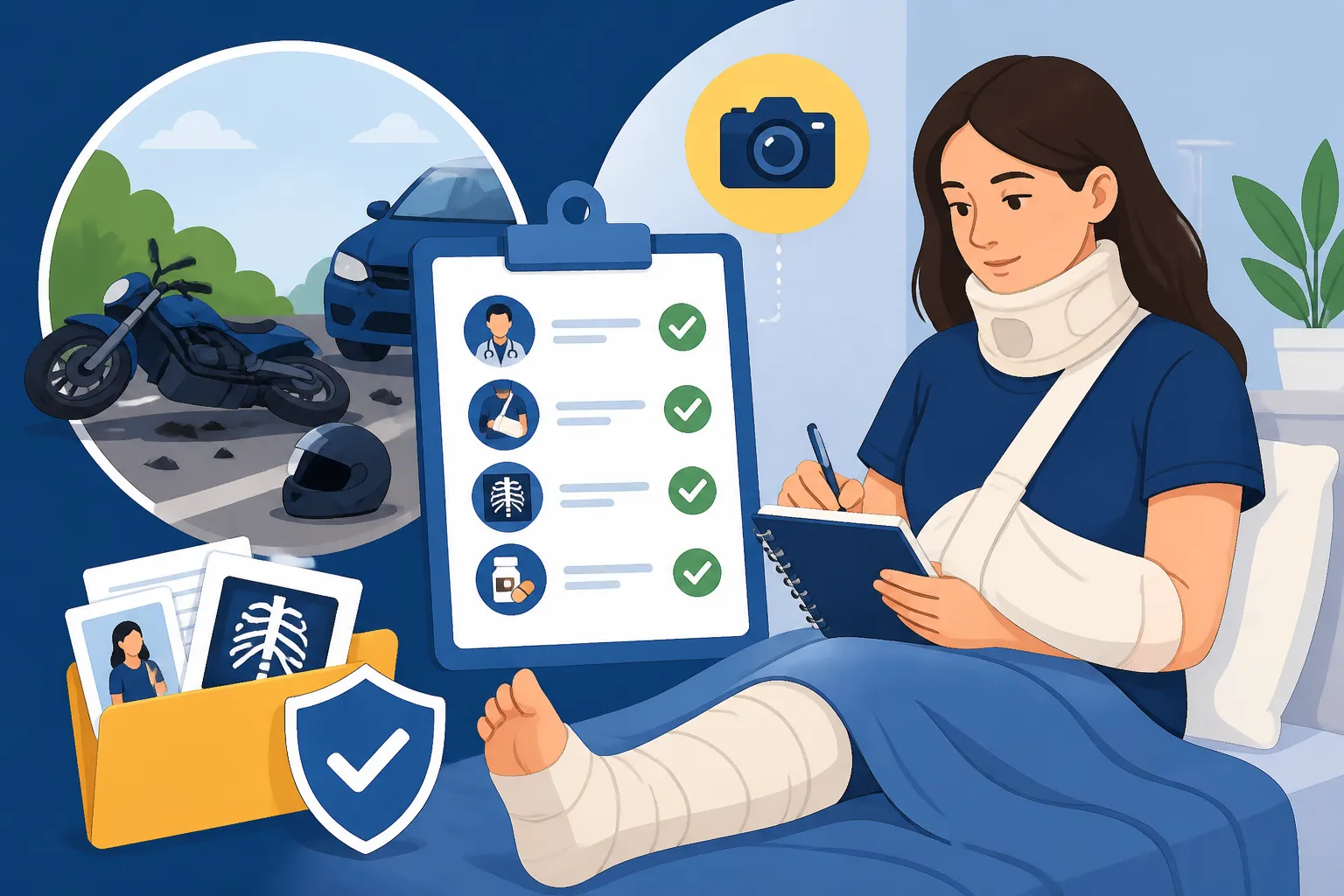
How to Document Your Recovery
Getting into a motorcycle accident is a nightmare scenario. Beyond the immediate shock and the physical pain, many riders face a frustrating battle with insurance companies who often try to downplay their injuries and minimize their claim. This guide is all about empowering you to meticulously document every step of your recovery, providing a clear, undeniable record that protects your rights and ensures you get the compensation you deserve for your physical and emotional toll.
Why Meticulous Documentation Matters for Your Motorcycle Accident Claim
When you're reeling from a motorcycle accident, the last thing you want to think about is paperwork. You're focused on healing, managing pain, and just getting through each day. However, it's precisely in these critical early stages and throughout your recovery that diligent documentation becomes your most powerful tool. Without a thorough record, you're leaving yourself vulnerable to an insurance system that is inherently designed to challenge your claims and reduce their payouts.
Countering Insurance Company Skepticism
Let's be brutally honest: insurance companies often view motorcycle accident victims with a degree of skepticism, sometimes unfairly attributing blame or exaggerating pre-existing conditions. They might suggest your injuries aren't as severe as you claim, or that your recovery is progressing faster than it actually is. They look for any inconsistencies, any gaps in your medical treatment, or any signs that you might be exaggerating your pain. This isn't personal; it's just how the system works. They are in the business of minimizing payouts, and a lack of solid evidence plays right into their hands.
Imagine this scenario: you're months into your recovery from a fractured tibia and significant road rash. You've had good days and bad days, but you didn't always write down the specific challenges of the bad days. When the adjuster reviews your file, they see a series of physical therapy appointments but no detailed notes from you about how agonizing it was to simply climb stairs after each session, or how the persistent throbbing kept you awake at night. This absence of personal detail allows them to paint a picture of a smoother, less painful recovery than you actually experienced. By documenting your recovery with precision, you create an undeniable narrative that directly refutes their attempts to minimize your suffering and financial losses. This documentation becomes the bedrock of proving fault and the extent of your damages, laying the groundwork for a stronger claim.
Establishing the Full Extent of Your Damages
Motorcycle accidents often result in severe, long-lasting injuries that go far beyond a simple cut or bruise. We're talking about things like debilitating Motorcycle Traumatic Brain Injury Claims and Compensation, complex fractures requiring multiple surgeries, or extensive Motorcycle Road Rash Treatment and Long-Term Impact. These injuries don't just heal overnight; they require ongoing medical care, rehabilitation, and can lead to permanent disability or chronic pain. The full scope of your damages isn't just about the initial emergency room visit; it encompasses every doctor's appointment, every physical therapy session, every prescription, every lost day of work, and every moment of pain and emotional distress.
Think about the long-term impact. If you sustained a spinal cord injury, your future might involve not just immediate surgeries but also years of physical therapy, adaptive equipment, home modifications, and potentially loss of earning capacity. Without documenting every single one of these elements, from the smallest co-pay to the projections for future medical expenses, you risk significantly undervaluing your claim. Thorough documentation allows your legal team to meticulously calculate not just your current economic damages (like medical bills and lost wages) but also your non-economic damages, such as pain and suffering, emotional distress, and loss of enjoyment of life. This comprehensive record is crucial for understanding How Motorcycle Accident Settlements Are Calculated and ensuring you don't leave money on the table that you desperately need for your healing journey.
Essential Medical Documentation to Track Your Recovery
Your medical records are the backbone of your motorcycle accident claim. They provide objective evidence of your injuries, the treatment you've received, and how your body is responding. But merely relying on hospitals and clinics to send records isn't enough. You need to be actively involved in tracking and compiling this information to ensure nothing is missed and to create a clear timeline of your healing process.
Doctor's Visits, Treatments, and Prescriptions
Every single interaction with a healthcare professional after your accident needs to be meticulously recorded. This includes your initial emergency room visit, follow-up appointments with your primary care physician, specialists like orthopedists or neurologists, physical therapy sessions, chiropractor visits, and even consultations with mental health professionals if you're experiencing anxiety or PTSD. For each visit, make sure to record the date, the name of the provider, the purpose of the visit, and any diagnoses, recommendations, or treatments received. Keep all appointment cards, discharge papers, and bills.
It's equally important to keep track of all prescribed medications. This means noting the name of the medication, the prescribing doctor, the dosage, the pharmacy, and the cost. This isn't just about tracking expenses; it's about demonstrating the ongoing nature of your pain management or rehabilitation. If you stop taking a medication because of side effects or if it wasn't effective, document that too. Insurance companies will scrutinize gaps in treatment or adherence to medical advice. If you miss an appointment, document why (e.g., "Too much pain to travel," "Unable to arrange transportation"). This proactive approach helps to counter any accusations that you weren't diligent in seeking or following treatment, which can be a common tactic used in The Helmet Defense Explained or other attempts to shift blame.
Tracking Pain Levels and Functional Limitations
While medical records provide objective data, your personal experience of pain and functional limitation is equally vital. This is where your subjective daily notes become invaluable. Doctors often ask you to rate your pain on a scale of 1 to 10 during appointments, but that's just a snapshot. What was your pain level at 3 AM when you couldn't sleep? What was it when you tried to lift a gallon of milk? These details matter. Start a dedicated "pain journal" where you record your pain levels multiple times a day.
Beyond numerical ratings, describe the type of pain (sharp, throbbing, dull ache, burning) and where it's located. Critically, document how this pain affects your daily activities. Did you struggle to get dressed? Could you not bend down to tie your shoes? Did you miss out on a family event because you couldn't sit comfortably? These entries vividly illustrate the real-world impact of your injuries. For example, if you typically enjoy riding your motorcycle on scenic routes through the Blue Ridge Mountains on weekends, but now find yourself unable to even sit for more than 30 minutes, this needs to be recorded. This kind of detailed personal account helps to prove Pain and Suffering Damages Explained and can significantly influence your overall settlement amount.
| Type of Medical Documentation | What to Track | Why It's Important |
|---|---|---|
| Doctor's Appointments | Dates, provider names, diagnoses, treatment plans, referrals, copies of all notes. | Objective proof of injuries and prescribed care. |
| Prescriptions & OTC Meds | Drug name, dosage, prescribing doctor, pharmacy, costs, side effects, effectiveness. | Demonstrates ongoing pain management/treatment. |
| Physical/Occupational Therapy | Dates, exercises, therapist notes, progress reports, challenges faced during sessions. | Shows commitment to recovery and functional limitations. |
| Imaging Results | X-rays, MRIs, CT scans, interpretations. | Visual evidence of internal injuries. |
| Hospital Bills & Medical Invoices | Itemized statements for all services, medications, and equipment. | Calculates economic damages, proves expenses. |
| Pain & Symptom Journal | Daily entries on pain levels (1-10), type of pain, location, aggravating factors, impact on daily activities, emotional state. | Personalizes suffering, tracks non-economic damages. |
Beyond Medical: Documenting Daily Life Impacts
While medical records are paramount, your recovery isn't just about what happens in a doctor's office. It's about how your injuries profoundly disrupt your daily life, your work, your hobbies, and your relationships. Capturing these less tangible, yet equally impactful, aspects of your recovery is crucial for a comprehensive claim.
The Power of a Recovery Journal
A dedicated recovery journal, separate from your medical notes, can be one of your most powerful tools. This is where you detail the non-medical impacts of your injuries. Think of it as a diary of your struggle and progress. Each day, or as often as you can, jot down observations about how your injuries are affecting your life. Are you unable to work? Document your Lost Wages in a Motorcycle Claim. Are you struggling with everyday tasks that used to be simple? Note it down.
For example, if you typically enjoyed spending your Saturday mornings wrenching on your Harley-Davidson or going for a long ride out to the coast, but now you can't even stand in the garage for more than a few minutes without severe back pain, that's a significant loss. Write about how this affects your mood, your sense of identity, and your ability to connect with your passions. Did you miss your child's soccer game because you couldn't sit on the bleachers? Did you have to cancel plans with friends because you were too exhausted or in too much pain? These details paint a vivid picture for an adjuster or a jury about the real, human cost of your accident. This personal narrative is vital for demonstrating your loss of enjoyment of life and emotional distress, both of which are key components of your overall compensation.
Visual Evidence: Photos and Videos of Your Progress (or Lack Thereof)
We live in a visual world, and photos and videos can be incredibly compelling evidence. Beyond just documenting the accident scene, continue to capture visual evidence throughout your recovery. This isn't just for the initial days, but for weeks and months afterward. Take pictures of your injuries as they heal (or don't heal as expected). Show the progression of road rash, bruising, swelling, surgical scars, or any assistive devices you need, like crutches, braces, or even a modified vehicle.
Consider taking short videos. Can you no longer walk without a limp? Film it. Are you struggling with physical therapy exercises that were once easy? Record your efforts. If you need assistance with basic tasks like getting dressed, cooking, or personal hygiene, a brief, respectful video can powerfully convey the extent of your limitations. For example, if you have a significant leg injury, a video of you attempting to navigate a flight of stairs or struggling to get into your car provides undeniable proof of your functional impairment. These visuals can contradict an insurance company's claim that your injuries are minor or that you're "faking it." Remember, a picture truly is worth a thousand words when it comes to illustrating pain and physical challenges. Make sure these photos and videos are timestamped and clearly depict the injury or limitation. They serve as critical evidence for How Photos of Injuries Help Your Claim and overall injury claims.
Organizing Your Documentation for Your Claim
Gathering all this information is one thing; organizing it effectively is another. A disorganized pile of papers and digital files won't do you much good when it comes time to build your claim. A systematic approach ensures that you or your legal team can easily access and present the evidence needed to support your case.
Creating a Centralized System
The best approach is to create a dedicated system for all your accident-related documentation. This could be a physical binder with clearly labeled sections, a digital folder on your computer, or a combination of both. Whichever method you choose, consistency is key.
For a physical system, get a sturdy binder with dividers for categories like:
- Accident Report & Initial Info: Police report, insurance information, witness contact details.
- Medical Records: Chronological order of doctor's visits, hospital stays, diagnostic tests, and treatment plans.
- Medical Bills: All invoices, statements, and receipts, cross-referenced with records.
- Prescriptions: List of medications, pharmacies, and costs.
- Lost Wages: Pay stubs, employment records, letters from your employer regarding missed work.
- Recovery Journal: Your daily notes on pain, limitations, and emotional impact.
- Photos & Videos: A printout log of where digital files are stored, with key descriptions and dates.
- Correspondence: All letters, emails, and notes from phone calls with insurance adjusters, medical providers, and your legal team.
For a digital system, create a main folder titled "Motorcycle Accident Claim – [Your Name]" and then subfolders for each of the categories listed above. Use consistent naming conventions for files (e.g., "2023-10-26_ER_Visit_Report.pdf," "2023-11-15_PhysicalTherapy_Invoice.pdf"). Regularly back up your digital files to a cloud service or external hard drive. This centralization makes it much easier to share specific documents when asked and to ensure a complete record.
Collaborating with Your Legal Team
If you've decided to work with an attorney, and for a serious motorcycle accident, it's almost always a good idea to consider When to Hire a Motorcycle Accident Lawyer, your organized documentation will be a huge asset to them. They'll appreciate having a clear, comprehensive record from day one, rather than having to chase down scattered pieces of information. Your legal team, experts in What a Motorcycle Accident Lawyer Does, will use this documentation to build a robust case, proving both liability and the full scope of your damages.
Be prepared to share all your notes, journals, photos, and records with your attorney. They will review everything, identify any missing pieces, and often request additional records directly from providers. They understand how medical records and other evidence work together. They'll also advise you on what not to say or do, particularly when interacting with insurance companies, as insurance adjusters are trained to get information that can be used against you. Maintaining open and honest communication with your legal team, and providing them with your thorough documentation, is essential for How to Maximize Your Motorcycle Accident Settlement and navigating the complexities of your claim.
Remember, the goal isn't just to collect documents; it's to create an irrefutable story of your accident and its impact on your life, ensuring you receive fair compensation for everything you've endured.
Disclaimer
Please remember that this article provides general information and is not legal advice. Every motorcycle accident claim is unique, and the laws governing personal injury claims vary by state. It is highly recommended to consult with a qualified legal professional specializing in motorcycle accidents to discuss the specifics of your situation and understand your rights and options.