Economic Damages Explained
When you've been in a motorcycle accident, the immediate aftermath is often a whirlwind of pain, confusion, and fear. Beyond the physical injuries, the financial burden can quickly become overwhelming, piling up medical bills and making it impossible to work. Understanding how to claim all the money you've lost is crucial, and that's exactly what "economic damages" are designed to cover. This guide will walk you through what these damages entail, how they're calculated, and why documenting every single expense is vital to your recovery.
Understanding Economic Damages in Motorcycle Accident Claims
Riding a motorcycle comes with an inherent understanding of risk, but that doesn't mean you should bear the financial brunt when someone else's negligence causes an accident. Economic damages are a cornerstone of any personal injury claim, especially after a motorcycle crash, because they represent the concrete, verifiable financial losses you've endured. It's not just about getting back on your feet; it's about reclaiming the money that was unjustly taken from your pocket.
What Exactly Are Economic Damages?
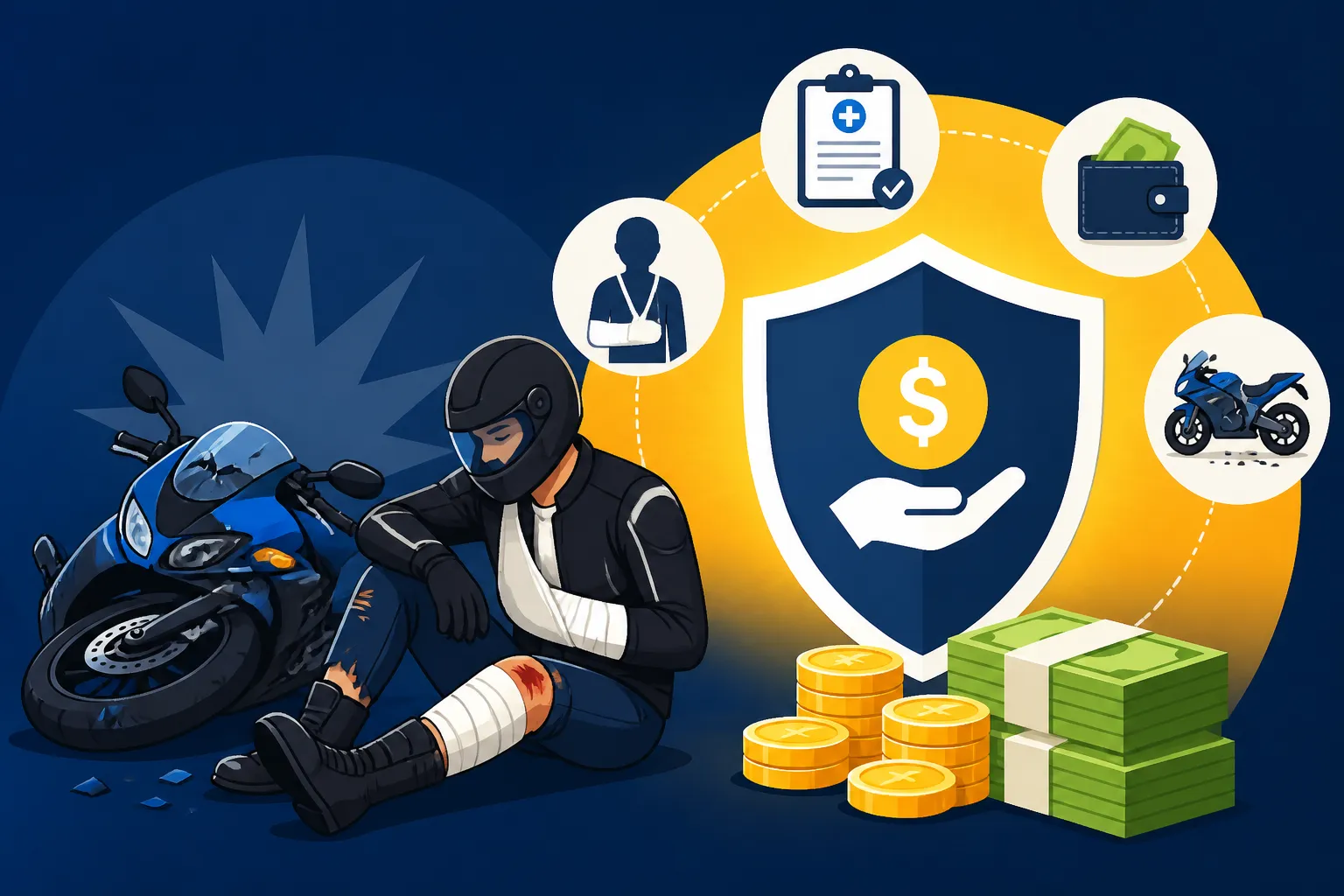
At its heart, economic damages refer to the measurable financial losses that can be precisely quantified with receipts, bills, invoices, and wage statements. Think of them as the "out-of-pocket" expenses and income losses directly attributable to your motorcycle accident. Unlike the more subjective "pain and suffering," these are objective costs that can be tallied up. When you're trying to piece your life back together, having a clear understanding of these tangible losses is incredibly empowering, as it forms the bedrock of what you're owed.
For instance, if you had a crash on I-95 near Miami and ended up in the emergency room at Jackson Memorial, every bill from that hospital stay, every prescription from the pharmacy, and every dollar you couldn't earn because you were recovering would fall under economic damages. These are the real-world consequences that directly impact your bank account, from the moment of impact to years down the road if your injuries are severe.
The Importance of Documentation
I cannot stress this enough: documentation is your best friend when pursuing an injury claim. Imagine trying to explain to an insurance adjuster or a jury that you spent thousands on physical therapy without a single bill to prove it. It's a losing battle. From the very first moment after your accident, every piece of paper, every email, every text message related to your injuries and their financial impact needs to be meticulously kept. This isn't just busywork; it's building the undeniable foundation of your claim.
This means holding onto everything from the tow truck receipt for your damaged bike to your medical co-pay statements, proof of income from your employer, and even detailed mileage logs for trips to doctor's appointments. The more complete and organized your records are, the stronger your case for recovering these vital economic damages will be. It provides clear, undeniable evidence of the financial hardships you've faced, leaving little room for the opposing party to dispute your legitimate losses.
Common Categories of Economic Damages
When you're reeling from a motorcycle accident, it can feel like a tidal wave of expenses. The good news is that most of these can be categorized and claimed as economic damages. It’s essential to understand each type, not just to track your current losses but to anticipate future ones too. This comprehensive approach ensures you don't leave any money on the table that you rightfully deserve.
Medical Expenses and Healthcare Costs
This is often the largest component of economic damages in a motorcycle accident claim, and for good reason. Motorcycle accidents frequently result in severe injuries, leading to extensive medical treatment. It starts with the immediate, emergency care you receive at the scene or in the ambulance. Then comes the hospital stay, which, even for a short period, can rack up staggering bills. Think about those crucial first few days: X-rays, MRI scans, consultations with various specialists like orthopedic surgeons or neurologists. All of these contribute to your medical expenses.
But it doesn't stop there. Once you're out of the acute phase, you'll likely face a long road to recovery involving physical therapy, occupational therapy, and potentially psychological counseling to cope with the trauma. Prescriptions for pain management and other medications are ongoing costs. If your injuries are particularly severe, you might require future surgeries, specialized equipment like wheelchairs or crutches, or even long-term care at a rehabilitation facility. Each of these costs, present and future, falls under this critical category. Remember that you may also be entitled to compensation for things like How Medical Bills Affect Your Settlement, which can significantly impact your recovery.
Lost Wages and Earning Capacity
A motorcycle accident often means you can't work, at least for a while. This direct loss of income is a major source of financial stress for many riders. Lost wages cover the income you would have earned from the time of the accident until you are able to return to your job. This includes your regular salary or hourly wages, bonuses, commissions, and even missed overtime opportunities. If you're a gig worker or self-employed, like a freelance graphic designer in Austin or a delivery rider in New York City, documenting these losses can be a bit more complex, often requiring tax returns, invoices, and financial statements to prove your average earnings.
Beyond immediate lost wages, a more significant and long-term concern for many accident victims is the loss of earning capacity. This refers to the reduction in your ability to earn income in the future due to permanent injuries or disabilities caused by the accident. For example, if a construction worker in Chicago can no longer perform heavy lifting after a spinal injury, their earning potential for the rest of their career has been significantly diminished. How Lost Wages Are Calculated involves not just your current salary but also projected career trajectory, promotions, and retirement benefits you might miss out on. This aspect requires expert analysis to project your future financial losses accurately.
Property Damage and Related Costs
While your personal injuries are paramount, the damage to your motorcycle and other personal belongings also represents a clear economic loss. If your prized Harley-Davidson was totaled in the accident, you're entitled to its fair market value. If it can be repaired, the cost of those repairs, including parts and labor, would be claimed. Don't forget any custom modifications or expensive accessories you had on your bike; these also contribute to the value.
But the property damage category isn't limited to just your motorcycle. What about your riding gear? A high-quality helmet, like a Shoei or Arai, can cost hundreds of dollars, and it's designed to absorb impact, meaning it's often damaged beyond repair in a crash. Your leather jacket, riding pants, boots, and gloves also provide crucial protection and are often torn or scuffed up. All of these items need to be replaced, and those costs are legitimate economic damages. Furthermore, if you needed a rental vehicle or other alternative transportation while your bike was being assessed or repaired, those expenses can also be included. Documenting How Property Damage Are Calculated in a Motorcycle Claim involves getting repair estimates or appraisals for your bike and itemizing all damaged gear.
Accounting for Future Economic Losses
One of the trickiest parts of a motorcycle accident claim is looking into the crystal ball of your future. Your injuries might not heal completely overnight, or ever, and that means ongoing expenses and lost income for years to come. This forward-looking aspect of economic damages is absolutely crucial, as it ensures you're not left with insurmountable bills long after your settlement. It requires foresight and often the input of specialized professionals.
Estimating Long-Term Medical Needs
Serious motorcycle injuries, such as a traumatic brain injury or a severe spinal cord injury, often necessitate lifelong medical care. Estimating these long-term medical needs is incredibly complex and requires the expertise of medical professionals and what are called "life care planners." These experts will review your medical records, assess your current condition, and project what kind of medical treatment, medications, therapies, and assistive devices you'll need for the rest of your life. This could include future surgeries, ongoing physical rehabilitation, specialized home health care, durable medical equipment, and even modifications to your home to accommodate a disability, such as widening doorways or installing ramps.
The challenge here lies in accurately predicting costs that are decades away, factoring in inflation and the evolving nature of medical technology. A life care plan isn't just a guess; it's a meticulously researched document that outlines every single anticipated medical cost. For example, if you sustained a spinal cord injury in a crash in Southern California, your life care plan might detail the costs of future physical therapy sessions at institutions like Rancho Los Amigos National Rehabilitation Center, specialized medications, and even the eventual replacement of wheelchairs or other mobility aids. This detailed projection is critical for ensuring that How Future Medical Costs Are Estimated accurately and that your settlement fully accounts for these monumental expenses.
Projecting Lost Future Earning Capacity
Just as medical costs can extend into the future, so too can your inability to earn a living at your previous capacity. Projecting lost future earning capacity requires the expertise of vocational specialists and forensic economists. A vocational expert will assess your pre-accident job skills, education, work history, and potential career path, then compare that with your post-accident abilities and limitations. They'll determine if you can return to your old job, if you need retraining for a different field, or if you're permanently unable to work at all.
Once the vocational expert has identified your reduced earning potential, a forensic economist steps in. They take that information, along with your age, life expectancy, inflation rates, and typical salary increases for your profession, to calculate the total monetary value of your lost future income. This isn't just about missing a few paychecks; it's about the decades of income, benefits, and retirement contributions you might forfeit. If a motorcycle crash in rural Pennsylvania left you unable to continue your career as a truck driver, the economist would calculate the difference between what you would have earned and what you can now earn over your working life, then discount that to a present-day lump sum.
The Impact of Permanent Disability
When a motorcycle accident results in a permanent disability, the scope of economic damages expands significantly. A permanent disability means your body or mind will never fully recover, leading to long-term challenges that generate ongoing financial needs. This could be anything from the need for a prosthetic limb after an amputation to chronic pain that limits your ability to perform daily tasks, or a traumatic brain injury that impairs cognitive function.
The financial impact of permanent disability includes not only the future medical care and lost earning capacity we've discussed but also a host of other expenses designed to help you live as independently and comfortably as possible. This includes adaptive equipment, such as specialized vehicles or home modifications to make your living space accessible. It also covers the cost of personal care attendants or in-home support if you need assistance with daily activities. These expenses are about ensuring a reasonable quality of life despite your injury and are a major component of a comprehensive claim, ensuring your long-term needs are met.
How Economic Damages Are Calculated and Proven
Proving economic damages isn't just about tallying up bills; it's a strategic process that requires meticulous attention to detail and, often, the backing of expert testimony. Insurance companies are notorious for trying to minimize payouts, and without concrete proof, your claims can easily be undervalued or dismissed. This is where your diligent record-keeping and a strong legal strategy come into play.
Gathering and Organizing Evidence
The bedrock of proving economic damages is the evidence you collect. It's a continuous process that begins immediately after the accident and continues throughout your recovery. You'll need every single medical bill from every provider – emergency room, ambulance, specialist visits, physical therapy, chiropractic care, prescriptions. Don't forget any out-of-pocket medical expenses, like over-the-counter pain relievers or medical devices you purchased. For lost wages, gather pay stubs, W-2s, tax returns, and letters from your employer detailing your missed workdays and lost income. If you're self-employed, profit and loss statements, bank records, and client invoices are crucial.
Property damage requires repair estimates or appraisals for your motorcycle, receipts for any damaged gear (helmet, jacket, boots), and documentation of rental vehicle costs. Keep a detailed log of all related expenses, including mileage to medical appointments, parking fees, and public transport costs. Photos of your damaged motorcycle and injuries are also incredibly persuasive. Think of it like building a financial story, where every piece of paper is a chapter. The more thorough you are, the harder it is for anyone to dispute your actual losses. This documentation is key to successfully navigate Proving Fault in a Motorcycle Accident and securing the compensation you deserve.
Working with Experts to Quantify Losses
For more complex claims, particularly those involving significant future losses or permanent disability, your personal documentation, while essential, won't be enough. This is where a team of experts becomes invaluable. As mentioned, medical experts can provide detailed prognoses and outline future treatment needs, while life care planners will itemize the exact costs of that long-term care. Vocational rehabilitation experts can assess your ability to return to work, and forensic economists can calculate the present value of your lost future earning capacity, considering factors like inflation and growth rates.
These experts provide unbiased, professional opinions that carry significant weight in negotiations with insurance companies or, if necessary, in court. Their reports and testimony transform your projected losses from speculative estimates into well-researched, scientifically sound figures. For example, if you suffered a severe neck injury in an accident near San Diego, an orthopedic specialist might testify about the permanence of your pain and limited mobility, directly supporting the need for ongoing physical therapy and potentially future surgical intervention, all quantified by a life care planner. This expert backing is a powerful tool against insurers who might try to minimize your suffering or financial hardship.
Presenting Your Economic Damages
Once all the evidence is gathered and the expert reports are in hand, the next step is to formally present your economic damages to the at-fault party's insurance company. This usually begins with a comprehensive demand letter, which outlines the accident, the injuries sustained, and a detailed breakdown of all your economic damages (and non-economic damages). This letter includes all supporting documentation: medical bills, wage loss statements, expert reports, and property damage estimates.
The goal is to clearly and compellingly demonstrate the full extent of your financial losses, leaving no ambiguity. This presentation isn't just about listing numbers; it's about telling your story with undeniable facts, showing how the accident has impacted every aspect of your financial life. During negotiations, you or your legal representative will refer back to these documented damages repeatedly, fighting for every dollar you're owed. A well-prepared and thoroughly documented presentation makes it incredibly difficult for the insurance company to deny the legitimacy of your economic losses.
Navigating Insurance Companies and Economic Damages
Dealing with insurance companies after a motorcycle accident can be one of the most frustrating parts of the entire process. Their primary goal is often to minimize payouts, and they have sophisticated tactics to do so. Understanding their perspective and limitations, like policy limits, is key to effectively pursuing your economic damages.
The Insurance Adjuster's Perspective
Insurance adjusters are professionals, but their loyalty lies with their employer, not with you. When evaluating your economic damages, they will meticulously scrutinize every bill, every receipt, and every wage statement. They'll look for inconsistencies, question the necessity of certain medical treatments, and often try to argue that some of your expenses are not directly related to the accident. They might suggest that your lost wages are inflated or that your motorcycle's value is lower than you claim.
Adjusters are trained to negotiate and will likely offer an initial settlement that is significantly lower than your actual damages. They might employ strategies to delay the process, hoping you become desperate or give up. It's common for them to use How Insurers Use Rider Stereotypes Against You to imply you were reckless, even if the accident was clearly not your fault, as a way to reduce their liability. This is why having all your documentation in order, and ideally having legal representation, is so vital. It sends a clear message that you are serious about your claim and won't be easily swayed by lowball offers or delaying tactics.
The Role of Policy Limits
A major factor that can impact the total amount of economic damages you can recover is the insurance policy limits of the at-fault driver. Every insurance policy has a maximum amount it will pay out for liability, property damage, and other coverages. For example, if the driver who hit you only has a policy with $25,000 in bodily injury liability coverage, and your medical bills alone exceed that amount, their policy will only pay up to that $25,000 limit, regardless of your actual damages.
This can be a harsh reality for accident victims, especially after severe motorcycle crashes where injuries can easily lead to six-figure medical bills. If your economic damages exceed the at-fault driver's policy limits, you might need to explore other avenues, such as filing a claim against your own Uninsured/Underinsured Motorist (UM/UIM) coverage if you have it. This type of coverage is designed precisely for situations where the other driver doesn't have enough insurance to cover your losses. Understanding How Insurance Policy Limits Affect Your Payout is critical early in the process to manage expectations and strategize your recovery.
Distinguishing Economic from Non-Economic Damages
When talking about compensation after a motorcycle accident, you'll often hear about two main types of damages: economic and non-economic. While both are crucial for a complete recovery, they represent very different aspects of your loss. Understanding the distinction is essential for building a strong claim and ensuring you receive all the compensation you're entitled to.
Economic Damages: Tangible and Verifiable
As we've explored throughout this guide, economic damages are all about the tangible, calculable financial losses that can be proven with hard numbers. They are objective and have a direct monetary value. Think of anything that drains your bank account or prevents you from earning money. This includes all your past and future medical expenses, like ambulance rides, emergency room visits, surgeries, medications, and ongoing physical therapy.
It also covers your lost wages from missed work, as well as any reduction in your ability to earn income in the future due to permanent injuries. The cost to repair or replace your damaged motorcycle, helmet, and other riding gear also falls under this category. Essentially, if you can present a bill, a receipt, a pay stub, or an expert report to quantify the loss, it's an economic damage. This clear, verifiable nature makes them relatively straightforward to prove, though insurance companies will still try to dispute their necessity or amount.
Non-Economic Damages: Intangible Losses
In stark contrast to economic damages, non-economic damages are the subjective, intangible losses you experience due to the accident. These are much harder to quantify because they don't come with a bill or an invoice. The most common example is "pain and suffering," which encompasses the physical pain, discomfort, and emotional distress caused by your injuries. But it goes deeper than that.
Non-economic damages also include emotional trauma, such as anxiety, depression, or PTSD that can arise after a terrifying crash. They cover the loss of enjoyment of life, meaning your inability to participate in hobbies, recreational activities, or even daily routines that you once enjoyed. If you can no longer ride your motorcycle with the same freedom or enjoy time with your family due to your injuries, that's a loss of enjoyment of life. Disfigurement, scarring, and permanent physical impairment also fall here, as they impact your quality of life and self-esteem. While these are not easily quantifiable, they are very real and often represent a significant portion of a motorcycle accident settlement. You can learn more about Pain and Suffering Damages Explained and how they are valued in a personal injury claim.
Why Both Are Crucial for Full Compensation
Imagine you're recovering from a broken leg sustained in a motorcycle accident. Your medical bills (economic damages) might be $50,000, and you lost $10,000 in wages (also economic damages). If you only recovered these amounts, you'd technically be "made whole" financially for those direct costs. However, that wouldn't account for the excruciating pain you endured, the weeks you spent immobile, the depression that set in, or the missed family events. That's where non-economic damages come in.
A truly comprehensive motorcycle accident claim seeks to recover both economic and non-economic damages. Economic damages address the financial hole the accident blew in your life, ensuring your bills are paid and your income is replaced. Non-economic damages, on the other hand, acknowledge the profound impact the accident has had on your well-being, happiness, and quality of life. Without both, you're only getting partial compensation. Both Types of Damages in a Motorcycle Accident Claim are vital for a complete recovery, reflecting the holistic impact of such a devastating event.
Here's a quick comparison to help solidify the distinction:
| Feature | Economic Damages | Non-Economic Damages |
|---|---|---|
| Nature | Tangible, objective, measurable | Intangible, subjective, qualitative |
| Proof | Bills, receipts, pay stubs, expert reports | Medical records (pain levels), personal testimony, psychological evaluations, expert opinions |
| Examples | Medical bills, lost wages, property damage, rehabilitation costs, future medical expenses | Pain and suffering, emotional distress, loss of enjoyment of life, disfigurement, mental anguish |
| Calculation | Direct summation of costs | Multiplier method, per diem method, jury discretion |
| Purpose | Reimburse out-of-pocket expenses, compensate for lost income | Compensate for subjective impacts on quality of life and well-being |
Disclaimer
Please remember that I am a lifestyle blogger and not a legal professional. The information provided in this guide is for general informational purposes only and does not constitute legal advice. Motorcycle accident claims are complex, and laws vary significantly by state. You should always consult with a qualified legal professional specializing in motorcycle accident cases for advice tailored to your specific situation. Do not rely solely on this content when making decisions about your legal rights or pursuing a claim.