Motorcycle Accident Fault Laws in Colorado
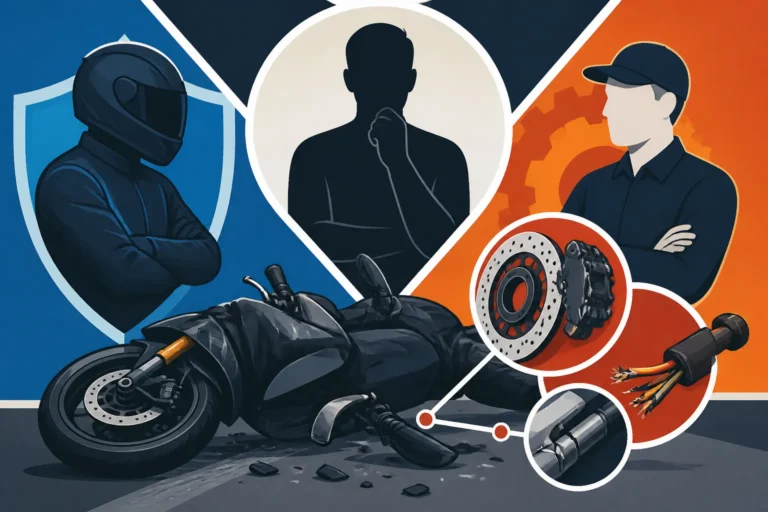
It's incredibly frustrating and often overwhelming to navigate the aftermath of a motorcycle accident, especially when you're trying to figure out who's responsible and what that means for your recovery. Many riders in Colorado find themselves caught in a confusing web of legal jargon and insurance company tactics, wondering if they'll ever get a fair shake. This guide is here to cut through that confusion, explaining Colorado's specific fault laws for motorcycle accidents so you can understand your rights and the path forward.
Understanding Colorado's Fault System for Motorcycle Accidents
When you're involved in a motorcycle accident in Colorado, one of the first and most critical things to understand is how the state handles "fault." Unlike some states where it doesn't really matter who caused the crash for certain types of insurance claims (those are known as "no-fault" states), Colorado operates under an "at-fault" system, also known as a "tort" system. This means that the person or entity responsible for causing the accident is generally liable for the damages that result from it. This fundamental principle dictates who pays for medical bills, property damage, lost wages, and other financial and emotional losses.
However, it's rarely as simple as one person being 100% to blame. Motorcycle accidents, by their very nature, often involve complex scenarios, and sometimes, more than one party shares some degree of responsibility. This is where Colorado's specific rules on shared fault come into play, which can significantly impact your ability to recover compensation. Understanding the nuances of this system is paramount because it's what insurance adjusters and legal teams will use to determine how much, if anything, you are entitled to.
Modified Comparative Negligence Explained
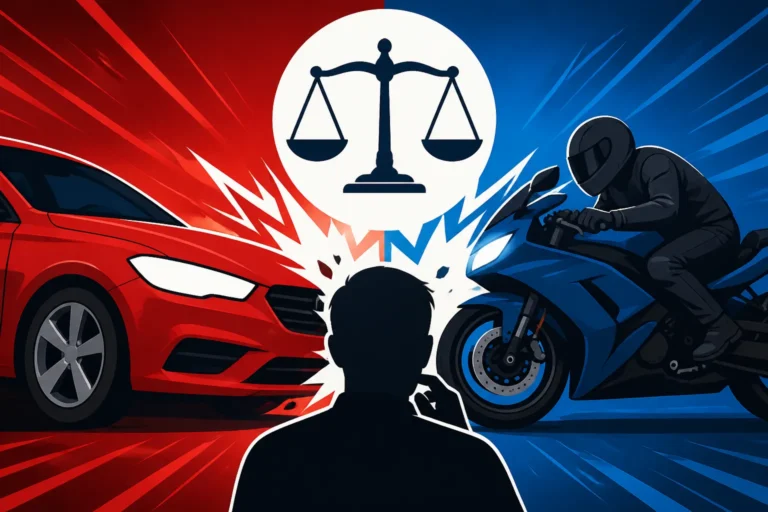
Colorado uses a specific legal doctrine called "modified comparative negligence," often referred to as the "50% rule." This rule is designed to address situations where multiple parties bear some level of responsibility for an accident. Here’s how it works: you can still recover damages even if you were partially at fault for the motorcycle accident, as long as your percentage of fault is determined to be less than 50%. If a court or insurance company finds you to be 50% or more responsible for the crash, you are legally barred from recovering any compensation from the other party. This is a critical distinction and often a source of contention in many motorcycle accident claims.
Let's imagine you're riding your motorcycle through downtown Denver and a driver suddenly makes a left turn directly in front of you without yielding. Clearly, the driver is largely at fault for failing to yield. However, if it's found that you were, say, going 5 miles over the speed limit, a jury might assign you 10% of the fault. Under Colorado's modified comparative negligence law, you would still be able to recover 90% of your total damages. But if that same jury decided you were 50% or more at fault because you were also distracted or driving recklessly, you would walk away with nothing. This "all or nothing" aspect if you hit the 50% mark makes fault determination incredibly high stakes. To learn more about how fault is typically assigned, you might find our guide on who is at fault in a motorcycle accident helpful.
Contrasting with Other Fault Systems
It’s important to distinguish Colorado's 50% modified comparative negligence from other systems you might encounter in different states, as this helps highlight its unique implications for riders here.
- Pure Comparative Negligence: Some states, like California, follow a "pure comparative negligence" rule. In these states, you can recover damages even if you are 99% at fault, though your compensation will be reduced by your percentage of blame. So, if you're 99% at fault and your damages are $100,000, you could still recover $1,000. This offers a much broader opportunity for recovery, regardless of how much responsibility you bear.
- Contributory Negligence: On the other end of the spectrum are "contributory negligence" states, which are far rarer today. In these jurisdictions, if you are found even 1% at fault for an accident, you are completely barred from recovering any damages whatsoever. This is an extremely harsh rule that places a heavy burden on the injured party and is often seen as unfair. Thankfully, Colorado does not employ this stringent system.
Understanding that Colorado falls squarely in the middle, with its 50% modified comparative negligence rule, helps you appreciate the importance of proving the other party's fault and minimizing any blame placed on you. The way damages are calculated is directly tied to this fault assessment, making it a pivotal part of any claim. For an in-depth look at these different systems, check out our piece on comparative negligence in motorcycle accidents.
How Shared Fault Works in Colorado
The concept of shared fault is something every motorcyclist in Colorado needs to grasp, because it's precisely where insurance companies and defense attorneys will try to undermine your claim. It's not uncommon for an initial accident report or an insurance adjuster's assessment to attempt to shift some, or even a significant portion, of the blame onto the motorcyclist. This isn't necessarily because you were truly at fault, but often because of the inherent biases against riders or an attempt to minimize their payout.
Let’s be realistic: sometimes, riders do contribute to an accident, even if minimally. Maybe you were momentarily distracted, didn't notice a hazard as quickly as you could have, or were riding slightly faster than ideal for conditions. The crucial point in Colorado is where that "percentage of fault" lands.
The 50% Bar Rule in Action
As we discussed, Colorado's 50% bar rule is an absolute threshold. If you are found to be 49% at fault, you can recover 51% of your damages. If you are found to be 50% at fault, you get nothing. Zero. This is a stark reality that can make or break your ability to pay for your extensive medical treatment, repairs, and lost income after a serious crash.
Consider a scenario in Colorado Springs: a driver pulls out from a side street, failing to see your motorcycle, leading to a collision. The police report initially places 70% of the blame on the driver for failure to yield. However, the driver's insurance company investigates and argues that you were traveling slightly above the speed limit, contributing to the accident. They push for a 35% fault assignment to you. If your total damages are $100,000, with 35% fault, you would recover $65,000. That’s a significant reduction, but at least it's something. But what if they successfully argue for 50% fault on your part? Then that $100,000 settlement becomes $0. It’s a harsh reality that emphasizes the need for diligent evidence collection and a clear understanding of your case.
This is why, after an accident, it's so important to be careful about what you say and do. Admissions of fault, even seemingly innocuous ones, can be twisted and used against you. Your actions immediately following the accident can seriously affect how fault is determined, impacting your potential payout. Our guide on what to do after a motorcycle accident offers crucial first steps.
How Damages Are Reduced by Shared Fault
If your fault is determined to be less than 50%, your total damages will be reduced proportionally. This reduction applies to all recoverable damages, including economic damages (like medical bills, lost wages, and property damage) and non-economic damages (like pain and suffering, emotional distress, and loss of enjoyment of life).
Let's use another example. Suppose you were involved in a motorcycle accident near Boulder where a distracted driver swerved into your lane, but it was found you briefly checked your phone right before the impact. A jury finds the driver 80% at fault and you 20% at fault for distracted driving. If your total damages (including medical bills, bike repair, and pain and suffering) amount to $250,000, your final award would be reduced by 20%. You would receive $200,000. While not the full amount, it's a substantial recovery, vital for getting your life back on track.
The insurance company of the at-fault driver will often focus heavily on finding ways to assign blame to the motorcyclist. This tactic is a cornerstone of their strategy to minimize payouts. They might try to use stereotypes against riders, suggesting you were riding recklessly or "asking for it." Understanding these tactics is part of protecting yourself. It can be incredibly disheartening when insurance companies assign blame to riders without solid evidence.
Key Factors in Proving Fault in Colorado Motorcycle Crashes
Proving who is at fault after a motorcycle accident in Colorado isn't just about pointing fingers; it's about building a solid case with compelling evidence. Without clear, documented proof, your claim can quickly become a "he said, she said" battle, leaving you vulnerable to the strict 50% comparative negligence rule. Every piece of information collected, every detail documented, can be crucial in demonstrating the other driver's negligence and minimizing any potential blame directed your way.
From the immediate aftermath of the crash to long after you've left the scene, what you do and what evidence you gather directly influences the outcome of your fault assessment. This is especially true in a state like Colorado, where the stakes are so high due to the modified comparative negligence rule.
Types of Evidence Critical for Your Claim
When it comes to proving fault, variety and thoroughness in your evidence collection are key.
- Police Reports: A police report from the responding officer at the scene of the accident is usually one of the first and most important pieces of evidence. It details the officer's observations, statements from parties involved, and sometimes, a preliminary determination of fault. While not always conclusive, it sets a baseline for the investigation. However, remember that police reports can sometimes be inaccurate or biased, and they are not always the final word on fault. Our resource on how police reports establish fault delves deeper into this.
- Witness Statements: Independent witnesses who saw the accident unfold can provide invaluable, unbiased accounts. Their perspective can often corroborate your version of events and refute claims made by the other driver or their insurance company. Getting their contact information at the scene is critical. You can learn more about how witnesses affect motorcycle fault.
- Photographs and Videos: In today's world, nearly everyone has a smartphone. Taking pictures of the accident scene from various angles, including vehicle damage, road conditions, skid marks, traffic signals, and your injuries, can be incredibly powerful. If you have a dashcam or helmet camera, that footage can be gold standard evidence, providing an objective view of exactly what happened. Here's more on how dashcam footage proves fault.
- Accident Reconstruction: For complex or severe accidents, experts can be brought in to reconstruct the accident scene. By analyzing vehicle damage, tire marks, debris fields, and other physical evidence, they can create a detailed account of how the accident occurred, often providing compelling proof of fault.
- Medical Records: Your medical records document your injuries and treatment, directly correlating them to the accident. These records prove the extent of your damages, which is directly tied to the value of your claim once fault is established.
Common Accident Causes and Fault Determination
Many motorcycle accidents in Colorado stem from common scenarios where drivers of larger vehicles simply fail to see or acknowledge motorcyclists.
- Left-Turn Accidents: These are notoriously dangerous for motorcyclists. A driver making a left turn often misjudges a motorcycle's speed or distance, or simply doesn't look carefully enough, turning directly into the path of an oncoming rider. In these cases, the turning driver is almost always at fault for failing to yield the right-of-way. Learn more about left-turn motorcycle accidents explained.
- Lane Splitting: While lane splitting is not legal in Colorado, its legality can affect fault in states where it is allowed. In Colorado, if you were lane splitting and an accident occurred, you would likely be assigned a high percentage of fault, potentially barring your recovery under the 50% rule.
- Distracted Driving: With the prevalence of smartphones, distracted driving is a growing menace. Drivers glancing at their phones, adjusting navigation, or talking to passengers often miss seeing motorcycles, leading to collisions. Proving the other driver was distracted can be challenging but highly impactful for fault determination.
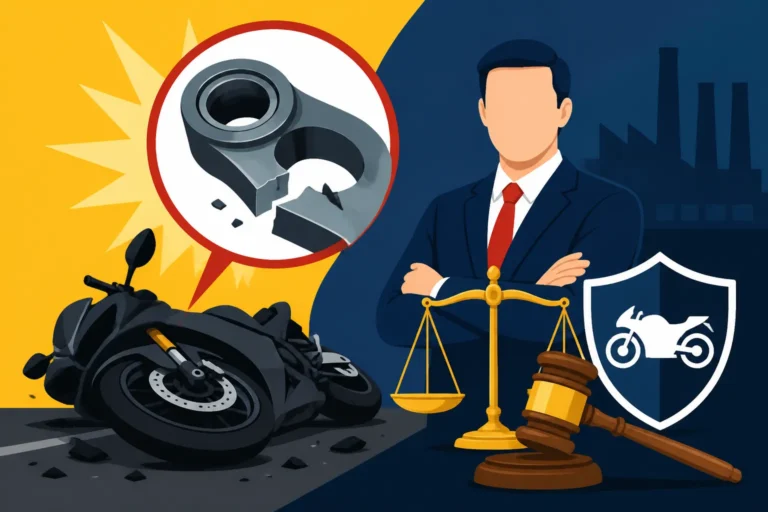
- Road Hazards: Sometimes, neither driver is entirely at fault. Poor road conditions, like potholes, unmarked construction, or gravel on a turn, can cause a motorcyclist to crash. In such cases, the government entity responsible for road maintenance or a construction company might be liable.
After any accident, ensuring you document the scene to prove fault is one of the most proactive steps you can take to protect your claim. Take photos, get witness contact info, and make notes about everything you can remember.
The Impact of Fault on Your Colorado Motorcycle Accident Claim
The determination of fault in a Colorado motorcycle accident isn't just a matter of principle; it has a direct, tangible effect on the amount of compensation you can recover. In a modified comparative negligence state like Colorado, even a small percentage of fault attributed to you can significantly reduce your settlement, and a 50% or higher fault finding can eliminate it entirely. This financial reality makes the fault discussion the most critical battleground in almost every motorcycle accident claim.
It's not just about proving the other driver was wrong; it's about minimizing any potential claims that you contributed to the accident yourself. Every dollar of your medical bills, every day of lost wages, and every moment of pain and suffering hangs in the balance of this fault assessment.
How Fault Directly Impacts Your Settlement Amount
As we've explored, if you are found to be 25% at fault for an accident with $100,000 in damages, your maximum recovery will be $75,000. This deduction is automatic and applies across the board to all categories of damages. This means that if you suffered severe injuries requiring extensive medical treatment, lost significant income, and experienced considerable pain and suffering, your total compensation will be proportionally diminished by your assigned fault.
For example, imagine a catastrophic injury from a crash in Pueblo, resulting in $300,000 in medical bills, $100,000 in lost wages, and $200,000 in pain and suffering, totaling $600,000. If the insurance company manages to convince a jury that you were 40% at fault because you didn't have your headlight on during daylight hours, your potential $600,000 settlement immediately drops to $360,000. This massive reduction underscores why every percentage point of fault matters so much in Colorado. Our article on how fault affects your settlement can provide further insights.
Insurance Adjusters and Blame Shifting
Insurance companies are businesses, and their primary goal is to minimize payouts. They are highly skilled at investigating accidents and often employ tactics designed to shift blame onto the motorcyclist. This isn't necessarily malicious, but it's an economic reality. Adjusters might look for any minor traffic infraction you committed, any perceived lack of caution, or even rely on negative stereotypes about motorcyclists to argue for a higher percentage of fault on your part. They might seize on factors like:
- Allegations of Speeding: Even if you weren't speeding excessively, they might argue you were going too fast for conditions.
- Lack of conspicuity: Claiming your motorcycle wasn't visible enough, even if the other driver was clearly negligent.
- "I Didn't See the Motorcycle" Defense: This common defense is often used by drivers, and adjusters will sometimes try to imply that if you weren't seen, you weren't being careful enough.
It's crucial to be aware of these tactics and avoid giving statements that could be used against you. Insurers will often push for early, lowball settlements before the full extent of your injuries or the complexities of fault are clear. Knowing how insurance companies assign blame to riders is vital for protecting your claim.
The Role of Helmet Laws
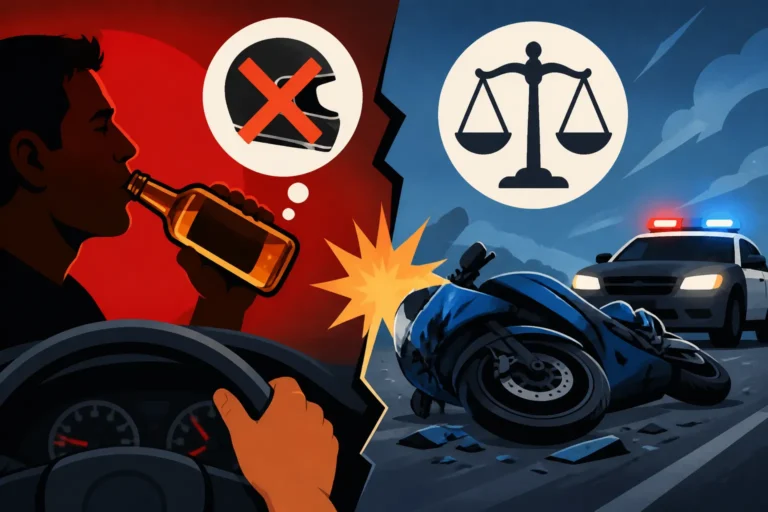
Colorado has a partial helmet law, meaning only riders and passengers under the age of 18 are required to wear a helmet. For adult riders 18 and over, helmets are not legally mandated. However, even if you, as an adult rider, were not legally required to wear a helmet, the other side's insurance company might still attempt to use your non-helmet use against you. This is known as the "helmet defense."
They might argue that even if they caused the accident, your head injuries would have been less severe if you had been wearing a helmet, and therefore, you contributed to the severity of your injuries. While this typically doesn't impact fault for the collision itself, it could potentially reduce the portion of your settlement related to head injuries. The efficacy and application of this defense vary, but it's a tactic often tried. Our detailed explanation of the helmet defense provides more context.
Given the complexities of Colorado's fault laws and the aggressive tactics often employed by insurance companies, navigating a motorcycle accident claim can be incredibly challenging alone. Having an experienced advocate on your side can make all the difference in proving fault and securing the compensation you deserve.
| Fault System | Description | Impact on Recovery in Colorado |
|---|---|---|
| Modified Comparative Negligence (50% Rule) | Injured party can recover damages only if found less than 50% at fault. If 50% or more at fault, recovery is barred. Damages are reduced by the percentage of fault. | Applicable in Colorado |
| Pure Comparative Negligence | Injured party can recover damages regardless of their percentage of fault (even if 99% at fault), but their recovery is reduced by their assigned percentage of fault. | Not applicable |
| Contributory Negligence | Injured party is completely barred from recovering any damages if found even 1% at fault for the accident. | Not applicable |
Disclaimer
Please remember that this article provides general information and is not a substitute for professional legal advice. Every motorcycle accident claim is unique, and the laws surrounding fault can be complex. It is always recommended to consult with a qualified legal professional to discuss the specifics of your situation and understand your legal options.