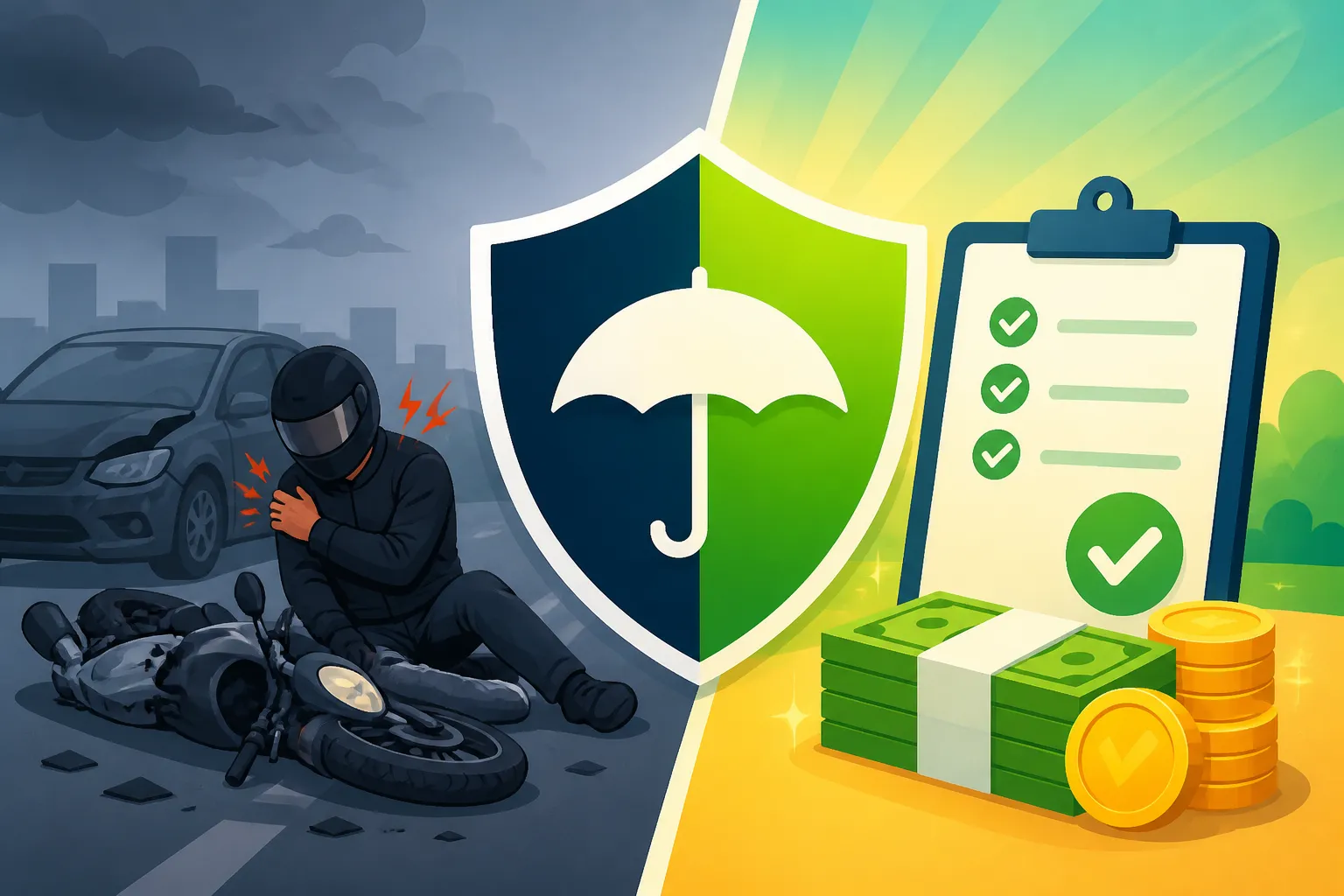
How Insurance Policy Limits Affect Your Payout
It's an unfortunate truth: after a motorcycle accident, when you're already dealing with pain, medical appointments, and the headache of a damaged bike, you then have to navigate the confusing world of insurance. And one of the biggest shocks many riders face is realizing that even when another driver is clearly at fault, their payout might be severely limited. This guide is dedicated to shedding light on how insurance policy limits directly impact your motorcycle accident claim, helping you understand the real financial ceiling you might hit and how to prepare for it.
Understanding Insurance Policy Limits: The Basics
When you or another driver purchases an auto insurance policy, you're not buying an unlimited safety net. Instead, you're buying a contract that specifies the maximum amount of money the insurance company will pay out for various types of damages. These "policy limits" are often the invisible wall that dictates the real-world value of your settlement, no matter how severe your injuries or how extensive your property damage might be. It’s a frustrating reality for many accident victims, especially motorcyclists who often face more severe injuries.
What are Policy Limits?
Think of policy limits as the top dollar the insurance company is on the hook for. They're typically broken down into different categories, each with its own maximum payout amount. For example, a common liability policy might be expressed as "$25,000/$50,000/$10,000." This seemingly cryptic string of numbers actually tells you a lot: the first number is the maximum the policy will pay for bodily injury to one person in an accident, the second is the maximum for bodily injury to all persons in one accident, and the third is the maximum for property damage. If your medical bills alone hit $75,000 and the at-fault driver only has a $25,000 bodily injury limit, you're immediately looking at a significant gap. This is where the rubber meets the road, and many riders find themselves in a precarious financial situation through no fault of their own.
Why Policy Limits Matter for Motorcycle Accidents
Motorcycle accidents, by their very nature, often result in more severe injuries compared to car accidents. Without the protective shell of a vehicle, riders are far more exposed, leading to extensive road rash, broken bones, traumatic brain injuries, and spinal cord damage. These injuries translate into skyrocketing medical bills, lost wages, and profound pain and suffering. When these damages far exceed the at-fault driver's policy limits, you, the injured rider, are left to pick up the tab for the difference. It's not just about getting compensation for your bike; it's about covering catastrophic medical expenses that can quickly exhaust even seemingly high policy limits. Understanding the true impact of these limits is crucial from the moment you're involved in a crash, as it directly affects How Insurance Companies Assign Blame to Riders and the negotiation process.
Minimum vs. Recommended Coverage
Every state has minimum liability insurance requirements. While these minimums might seem like a baseline, they are often woefully inadequate for serious motorcycle accidents. For example, a state like Florida might have minimums as low as $10,000 for property damage liability and $10,000 for personal injury protection (PIP), but zero requirements for bodily injury liability for a private passenger vehicle. Meanwhile, California requires $15,000/$30,000/$5,000 for bodily injury and property damage. These numbers might cover a fender bender, but for a severe motorcycle crash involving hospitalization and lost work, they barely scratch the surface. That's why many insurance professionals and seasoned riders recommend carrying much higher limits – often $100,000/$300,000 or even $250,000/$500,000 for bodily injury liability, plus substantial property damage and uninsured/underinsured motorist coverage. Relying solely on minimum coverage, whether it's yours or the at-fault driver's, can put you in a financial bind that far outweighs the seemingly small savings on premiums.
Types of Coverage and Their Limits
Understanding the different types of insurance coverage, and the limits associated with each, is absolutely critical. It’s not just about if you have insurance, but what kind and how much coverage is actually in play. Each component of an insurance policy serves a specific purpose, and its limits dictate its usefulness in the aftermath of a motorcycle crash.
Bodily Injury Liability Limits
This is perhaps the most crucial type of coverage when it comes to personal injury claims. Bodily Injury Liability (BIL) coverage pays for the medical expenses, lost wages, pain and suffering, and other damages of another person if you are at fault in an accident. Conversely, if another driver hits you, their BIL coverage is what you'll be claiming against for your injuries. As mentioned, these limits are typically shown as two numbers, like $50,000/$100,000. This means the policy will pay up to $50,000 for any single injured person and up to $100,000 total for all injured parties in that one accident, regardless of how many people were hurt. If you sustain a traumatic brain injury and your medical bills alone hit $150,000, and the at-fault driver only carries $50,000 in BIL, you can see the immediate problem. This is a common and deeply frustrating scenario for many injured riders, and it's a primary reason why What Happens When Damages Exceed Coverage is such an important topic to understand.
Property Damage Liability Limits
Property Damage Liability (PDL) coverage is separate from bodily injury and covers the costs to repair or replace another person's property if you are at fault. This typically applies to their vehicle, but it can also include damage to fences, mailboxes, or other structures. For motorcyclists, this often means the cost to repair or replace their bike. If you're involved in an accident where your motorcycle is totaled, and the at-fault driver only has a $10,000 PDL limit, but your custom Harley-Davidson was worth $25,000, that $15,000 difference again falls on you. While property damage might seem less critical than bodily injury, the cost of a modern motorcycle can easily exceed these minimum limits, leaving you without your ride or facing a significant financial hit.
Uninsured/Underinsured Motorist (UM/UIM) Coverage
This is arguably one of the most vital coverages a motorcyclist can have, yet many riders don't fully understand its importance or even carry enough of it. Uninsured Motorist (UM) coverage kicks in when the at-fault driver has no insurance at all. Underinsured Motorist (UIM) coverage helps when the at-fault driver has insurance, but their policy limits aren't enough to cover your damages. UM/UIM coverage acts as a safety net, allowing you to make a claim against your own insurance policy for your bodily injuries and, sometimes, property damage, up to your UM/UIM limits. In states like California, UM/UIM is offered as a combined coverage and is highly recommended. Given the number of uninsured drivers on the road and the low minimum liability limits some drivers carry, UM/UIM coverage is often the only way for severely injured motorcyclists to recover adequate compensation. It's your insurance company stepping in to pay you what the at-fault driver's insurance should have paid, up to your policy limits. Without it, even if you are demonstrably not at fault in a motorcycle accident, you could be left with massive unpaid bills.
Medical Payments (MedPay) and Personal Injury Protection (PIP)
Medical Payments (MedPay) and Personal Injury Protection (PIP) are crucial no-fault coverages that can help cover immediate medical expenses, regardless of who was at fault for the accident.
- MedPay typically covers medical and funeral expenses for you and your passengers if injured in an accident, up to the policy limit. It's often a smaller coverage (e.g., $5,000 or $10,000) and can be used to pay for deductibles, co-pays, or expenses that your health insurance might not cover. It’s a fast-acting cushion.
- PIP is more common in "no-fault" states (like Florida, Michigan, or New York, although specifics vary by state). It's a broader coverage that can pay for medical expenses, lost wages, and essential services (like hiring someone to clean your house if you're injured). PIP limits can range from state minimums (e.g., $10,000 in Florida) to much higher amounts, depending on the policy. The key difference from liability coverage is that PIP pays your own expenses, regardless of fault, helping you get treatment without waiting for fault to be determined. However, even with PIP, there are often deductibles, co-pays, and strict limits on what it will cover. For example, in Florida, PIP only covers 80% of medical expenses up to the limit, so you're still on the hook for the remaining 20%.
These coverages, while helpful for immediate needs, also have their own strict limits and often don't begin to cover the full extent of damages a motorcyclist might incur.
How Policy Limits Directly Cap Your Settlement
It’s a bitter pill to swallow, but the stark reality is that even if your damages far exceed the at-fault driver's insurance coverage, their policy limits generally represent the most you can hope to recover from their insurance company. This isn't just a hypothetical scenario; it's a daily frustration for accident victims across the country.
The "Ceiling" Effect of Liability Coverage
Imagine you’ve been in a severe motorcycle accident. You broke your leg, suffered a concussion, and have substantial road rash. Your medical bills quickly climb to $60,000, you’ve lost $10,000 in wages from being unable to work, and your motorcycle is totaled at $15,000. Total damages come out to $85,000, not even counting your pain and suffering. Now, let’s say the driver who hit you only carries the state minimum liability insurance of $25,000 for bodily injury and $10,000 for property damage.
In this scenario, their insurance company will likely offer you the full $25,000 for your bodily injuries and the full $10,000 for your property damage. That's it. That's the ceiling. Despite your actual damages being $85,000 (plus pain and suffering), the at-fault driver's insurance will only pay $35,000. The remaining $50,000+ is left uncovered by their policy. This is the brutal "ceiling" effect in action. It doesn't matter how badly you're hurt or how much financial hardship you face; their insurance company is only contractually obligated to pay up to their policy's maximum.
When Your Damages Exceed the At-Fault Driver's Limits
This is where things get really tough. When your medical bills, lost wages, and other damages blow past the at-fault driver's policy limits, you’re left with a few unenviable options. You could try to pursue the at-fault driver personally for the excess amount. However, this is often a difficult and sometimes fruitless endeavor. Most individuals who carry low insurance limits don't have substantial personal assets that can be easily seized to cover a large judgment. Even if you win a judgment against them in court, collecting that money can be an uphill battle, taking years, and potentially never yielding the full amount. This is a situation where How Underinsurance Affects Your Claim becomes a very real and pressing concern. Many riders realize too late that the other driver's cheap insurance ends up costing them a fortune.
The Role of Your Own Policy Limits
This is where your own insurance policy can become your knight in shining armor, or at least a helpful squire. If you have robust Uninsured/Underinsured Motorist (UM/UIM) coverage, you can make a claim against your own policy to cover the difference between your total damages and what the at-fault driver's insurance paid out. For instance, in our previous example, if you had $100,000 in UM/UIM coverage, your own insurance could potentially pay the additional $50,000 your damages incurred (bringing your total recovery up to $85,000).
However, even your UM/UIM coverage has its own limits. If your total damages were $200,000 and the at-fault driver paid $25,000, and your UM/UIM coverage was $100,000, you could still be left with $75,000 in uncovered damages. It's a layer of protection, but it’s still a capped one. This highlights why understanding How Comparative Negligence in Motorcycle Accidents works and ensuring you have sufficient UM/UIM coverage are critical components of protecting yourself on the road.
Navigating Underinsured Motorist (UIM) Coverage
Uninsured/Underinsured Motorist (UM/UIM) coverage is often the unsung hero for motorcyclists. It’s designed precisely for those moments when the at-fault driver simply doesn’t have enough insurance, or any at all, to cover the true cost of your injuries. This coverage can make the difference between financial ruin and being able to actually recover from a devastating crash.
What is UIM and How Does It Work?
As we touched on, UIM coverage (often packaged with UM) allows you to turn to your own insurance policy when the at-fault driver's liability coverage is insufficient to cover your damages. Think of it this way: your damages are $100,000, but the negligent driver only has a $25,000 bodily injury liability policy. Their insurance pays the $25,000, but you're still $75,000 in the hole. If you have a UIM policy with limits of $100,000, your own insurance company can then pay you the remaining $75,000, effectively "filling the gap" up to your policy's maximum.
It's a critical safety net because, unfortunately, many drivers carry only the bare minimum insurance required by their state. When a motorcycle accident often leads to severe injuries, these minimums are almost never enough. UIM coverage exists to protect you from the inadequate choices of other drivers. It's not about assigning blame to your own insurance; it's about utilizing a policy you wisely purchased to ensure you're compensated.
Stacking UIM Coverage for Increased Payouts
"Stacking" is a concept that can significantly increase your UIM payout, depending on your state's laws and your specific policy. There are generally two types of stacking:
- Intra-policy Stacking: This applies if you have multiple vehicles insured on a single policy. In some states, you might be able to multiply your UM/UIM coverage by the number of vehicles insured. For example, if you have $50,000 in UIM coverage and three motorcycles on your policy, you might be able to "stack" that coverage to effectively have $150,000 in UIM protection.
- Inter-policy Stacking: This applies if you have multiple insurance policies (e.g., one for your car and one for your motorcycle, or policies from different companies). In certain states, you might be able to combine the UIM limits from each policy.
However, many states prohibit stacking, or insurance companies will include anti-stacking language in their policies to prevent it. It's absolutely crucial to review your policy documents carefully or discuss this with an attorney or insurance agent to understand if stacking is allowed in your state (like Florida, for instance, which generally allows stacking unless specifically rejected). If stacking is an option, it can dramatically increase your available coverage when faced with catastrophic injuries and low liability limits from the at-fault driver. This is a prime example of how understanding these nuanced rules can help How to Maximize Your Motorcycle Accident Settlement.
When to Tap into Your Own UIM Policy
You usually can't immediately make a claim against your UIM policy. First, you typically need to exhaust the bodily injury liability limits of the at-fault driver's policy. This often involves negotiating with their insurance company and obtaining a settlement or judgment for the full amount of their policy limits. Once those limits are exhausted, you can then formally pursue a claim with your own insurance company under your UIM coverage.
It's important to understand that your own insurance company, when acting as a UIM provider, will still treat you somewhat like an adversarial party. They will investigate your claim, assess your damages, and look for ways to minimize their payout, just as the at-fault driver's insurer would. This is why having strong documentation of your injuries, medical treatments, and lost wages is so important. Navigating a UIM claim can be complex, and this is often where the expertise of a motorcycle accident attorney truly shines, ensuring you don't leave money on the table.
Strategies When Policy Limits Are Insufficient
Hitting the ceiling of an insurance policy limit can feel like a dead end, especially when your injuries and losses are far greater. However, it's not always the absolute final word. While challenging, there are still avenues to explore when the initial insurance payout doesn't come close to covering your damages.
Seeking Damages Beyond Insurance Coverage
If the at-fault driver's insurance limits are exhausted and your own UM/UIM coverage still isn't enough, you might consider pursuing the at-fault driver personally. This means filing a lawsuit against them directly to seek compensation from their personal assets. This can include their savings, investments, or even future wages (though wage garnishment laws vary significantly by state).
However, this is often a strategy of last resort for a reason. Most drivers who carry minimum insurance limits do so because they don't have substantial assets to protect. Even if a court awards you a judgment for hundreds of thousands of dollars, actually collecting that money from an individual with limited resources can be incredibly difficult, costly, and time-consuming. You could end up with a piece of paper (the judgment) that has little practical value. Before embarking on this path, it's crucial to have an attorney investigate the at-fault driver's assets to determine if such a pursuit would be financially worthwhile.
Pursuing Multiple Insurance Policies
Sometimes, there isn't just one insurance policy at play. Depending on the circumstances of the accident, you might be able to tap into multiple sources of coverage:
- Commercial Policies: If the at-fault driver was working at the time of the accident, their employer's commercial insurance policy might come into play. Commercial policies typically have much higher limits than personal auto policies, offering a significant lifeline for severe injuries. For example, if a delivery driver for a company like Amazon or FedEx caused your crash while on the clock, their employer's robust commercial policy would likely be the primary source of compensation.
- Umbrella Policies: Some individuals, especially those with significant assets, carry personal umbrella insurance policies. These policies provide an extra layer of liability coverage, sitting "on top" of their underlying auto and home insurance. If the at-fault driver has an umbrella policy, it could provide substantial additional coverage once their primary auto liability limits are exhausted.
- Other Responsible Parties: Who is at fault in a motorcycle accident is not always just one person or driver. Sometimes, other parties might share responsibility. For instance, if a road hazard caused or contributed to the accident, you might have a claim against a government entity. If a defective motorcycle part failed, the manufacturer could be liable. Each of these parties could have their own insurance policies that could be tapped for additional compensation. This is where a thorough investigation by an experienced legal team is vital to uncover all potential sources of recovery.
The Importance of Early Legal Consultation
This is not just a polite suggestion; it's a critical piece of advice. The moment you're in a motorcycle accident, especially if your injuries are serious, you need to speak with an attorney who specializes in motorcycle accidents. They understand the nuances of policy limits, UM/UIM coverage, and how to identify all potential sources of compensation. They can help you understand Do You Need a Motorcycle Accident Lawyer and explore avenues you might not even know exist. An attorney can also help you:
- Investigate all potential policies: They can uncover commercial policies, umbrella policies, or other coverages that you might not be aware of.
- Negotiate strategically: They know how to negotiate with insurance companies to secure the maximum possible payout, both from the at-fault driver's insurer and your own UIM provider.
- Protect your rights: Insurance companies, even your own, are not on your side when it comes to payouts. An attorney acts as your advocate, ensuring your rights are protected and you're treated fairly.
- Evaluate the at-fault driver's assets: If necessary, they can conduct asset checks to advise you on the viability of pursuing a personal judgment.
Bringing in legal expertise early can literally save you hundreds of thousands of dollars and immense stress down the line.
The Impact of State Laws on Policy Limits and Payouts
It might feel like a nationwide problem, but how policy limits affect your payout can vary significantly based on where the accident occurred. State laws dictate everything from minimum coverage requirements to how fault is assessed, all of which play a pivotal role in your potential recovery.
Minimum Liability Requirements by State
As discussed, every state sets its own minimums for liability insurance. These numbers are rarely static and can change over time. It's crucial to be aware of the specific requirements in your state and, more importantly, to understand that these minimums are often dangerously low for motorcyclists. For example, some states may require as little as $15,000 for bodily injury per person, while others might be $25,000 or even $50,000. Property damage minimums can range from $5,000 to $25,000.
Here's a snapshot of typical minimum liability requirements in a few states, expressed as bodily injury per person/bodily injury per accident/property damage per accident:
| State | Minimum BI/PD Liability Coverage (Example) | Notes |
|---|---|---|
| California | $15,000 / $30,000 / $5,000 | Requires UM/UIM offer; high accident rates |
| Texas | $30,000 / $60,000 / $25,000 | Known for "30/60/25" |
| Florida | $10,000 PIP / $10,000 PDL (No BI required) | No BI liability required for private vehicles |
| New York | $25,000 / $50,000 / $10,000 | Requires UM/UIM |
| Ohio | $25,000 / $50,000 / $25,000 | |
| Pennsylvania | $15,000 / $30,000 / $5,000 |
It's clear that relying on these minimums, from either your policy or the at-fault driver's, is a recipe for potential financial disaster after a serious motorcycle crash.
Comparative Negligence and How It Affects Payouts Within Limits
Beyond policy limits, state laws on comparative negligence can further complicate your payout. Most states follow some form of comparative negligence (as opposed to the harsher contributory negligence rules in a few states). This legal principle allows you to recover damages even if you were partially at fault for the accident, but your total compensation will be reduced by your percentage of fault.
For example, if you sustain $100,000 in damages, but are found 20% at fault for the accident, your maximum potential recovery is reduced to $80,000. Now, combine this with policy limits. If the at-fault driver only has a $50,000 policy limit, and you were 20% at fault, your theoretical maximum recovery would be $80,000, but you'd still only receive the $50,000 policy limit from the other driver's insurance, assuming your own UIM doesn't kick in.
In states with "modified comparative negligence" (like Texas or Ohio, which often use a 51% rule), you might be barred from any recovery if you are found to be 51% or more at fault. This concept of shared fault is deeply important when considering Who Is at Fault in a Motorcycle Accident and how it interacts with the at-fault driver's policy limits.
No-Fault vs. At-Fault States and Their Implications
The fundamental distinction between "no-fault" and "at-fault" states dramatically impacts how you pursue compensation after a motorcycle accident.
- At-Fault States: In most states (known as "at-fault" or "tort" states), the driver who caused the accident is responsible for paying for the damages. This means you typically pursue a claim against the at-fault driver's bodily injury and property damage liability insurance. Your ability to recover for pain and suffering and extensive medical bills directly depends on proving the other driver's fault and the extent of their policy limits.
- No-Fault States: In "no-fault" states (like Florida or Michigan, although Michigan recently reformed its system), your own Personal Injury Protection (PIP) coverage pays for your medical expenses and lost wages up to a certain limit, regardless of who caused the accident. This is designed to streamline claims for minor injuries and reduce litigation. However, for serious motorcycle accidents, there's often a "threshold" (either monetary or injury-based, like a permanent injury) that you must meet to step outside the no-fault system and sue the at-fault driver for non-economic damages like pain and suffering. If your injuries are severe enough to meet this threshold, then you can pursue the at-fault driver's liability insurance, which again brings us back to the issue of their policy limits.
For motorcyclists, navigating no-fault states can be particularly complex, as motorcycle insurance often has different PIP rules than car insurance, and the coverage might be optional or limited. Understanding these state-specific nuances is paramount for any rider to protect their rights and potential payout.
Real-World Scenarios and Practical Advice
It’s one thing to understand the definitions of policy limits and another to experience their impact firsthand. Let's look at some real-world examples and practical steps you can take to protect yourself.
Case Study: The Underinsured Driver Nightmare
Consider Sarah, a dedicated rider from Phoenix, Arizona. She was cruising down I-10 when a distracted driver, swerving from a phone call, merged into her lane without looking, causing her to lose control. Sarah suffered a broken arm, a fractured collarbone, and significant road rash requiring multiple surgeries. Her medical bills quickly reached $80,000. She was out of work for three months, losing $15,000 in wages. Her totaled Kawasaki Ninja was worth $12,000.
The at-fault driver, a young college student, carried Arizona's minimum liability: $25,000 bodily injury per person, $50,000 bodily injury per accident, and $15,000 property damage. Sarah's total damages were well over $100,000 (excluding pain and suffering), but the at-fault driver's insurance would only pay $25,000 for her injuries and $12,000 for her bike. That left a gap of over $60,000.
Fortunately, Sarah had wisely purchased $100,000 in Uninsured/Underinsured Motorist (UM/UIM) coverage on her own policy. Her attorney, knowing How to Negotiate a Motorcycle Accident Settlement, successfully secured the maximum $25,000 from the at-fault driver's insurance. Then, he presented a comprehensive claim to Sarah's own insurer under her UIM policy, ultimately recovering an additional $75,000 to cover her remaining medical bills, lost wages, and pain and suffering. Without that UIM coverage, Sarah would have been left with huge medical debts and no compensation for her lost income. This scenario, unfortunately, plays out all too often for riders who are unprepared.
Proactive Steps to Protect Yourself
The best defense against inadequate policy limits is a strong offense. Here are crucial steps to take proactively:
- Purchase High UM/UIM Coverage: This is, without a doubt, the most important advice for any motorcyclist. Buy as much UM/UIM coverage as you can reasonably afford. Aim for limits that match your own bodily injury liability limits, ideally $100,000/$300,000 or higher.
- Carry Ample Bodily Injury Liability: While this covers others you might injure, carrying high limits (e.g., $250,000/$500,000) shows financial responsibility and can provide a stronger position in negotiations, as it suggests you understand the value of protection.
- Consider an Umbrella Policy: If you have significant assets, an umbrella policy provides an extra layer of liability protection above your auto and home policies. These policies are surprisingly affordable for the amount of coverage they provide and can be invaluable in a catastrophic accident.
- Understand Your Policy: Don't just pay your premium. Read your insurance policy documents. Understand your limits, what's covered, and any exclusions. If something is unclear, call your agent and ask for clarification.
- Regularly Review Your Coverage: Your life circumstances change, and so should your insurance. Review your policy annually with your agent to ensure your coverage is still adequate for your needs and current economic realities.
Taking these steps before an accident occurs can make all the difference in your financial recovery after a crash.
Documentation is Your Best Friend
Whether you're dealing with the at-fault driver's insurance or your own UM/UIM policy, meticulous documentation is your most powerful tool. The more evidence you have of your injuries, medical treatments, and financial losses, the harder it is for an insurance company to dispute your claim or deny compensation. This is where Motorcycle Accident Evidence for Proving Fault and damages truly shines.
- Medical Records: Keep every single medical record, bill, and prescription related to your injuries. This includes emergency room reports, doctor's notes, physical therapy records, and imaging results (X-rays, MRIs).
- Lost Wages Documentation: Gather pay stubs, tax returns, and a letter from your employer confirming your time off and lost income. If you're self-employed, compile business records to demonstrate your income loss.
- Accident Scene Evidence: Photos and videos of the accident scene, vehicle damage, and your injuries immediately after the crash are invaluable.
- Injury Journal: Keep a daily journal documenting your pain levels, limitations, emotional distress, and how your injuries affect your daily life. This helps quantify non-economic damages like pain and suffering.
- Receipts for Out-of-Pocket Expenses: Track all expenses related to your accident, such as transportation to medical appointments, over-the-counter medications, and assistive devices.
Comprehensive documentation not only strengthens your claim but also helps demonstrate the full extent of your damages, which is crucial when trying to maximize your payout within the constraints of policy limits. Without it, you're essentially asking an insurance company to take your word for it, and that's a gamble you don't want to take.
Negotiating Within and Beyond Policy Limits
Once you understand the landscape of policy limits, the next crucial step is effective negotiation. Insurance companies are businesses, and their goal is to minimize payouts. Your goal, especially after a serious motorcycle accident, is to secure maximum compensation.
The Art of the Demand Letter
A demand letter is a formal document, usually prepared by your attorney, that outlines the facts of your accident, details your injuries and damages, references supporting evidence (medical records, bills, lost wage documentation), explains the at-fault driver's negligence, and concludes with a request for a specific settlement amount. When policy limits are a concern, this letter is critical.
A well-crafted demand letter will meticulously build a case for damages that often exceed the at-fault driver's policy limits, even if you know the insurer will only pay up to their maximum. This strategy is important for a few reasons:
- Justifies the Policy Limit Tender: It forces the at-fault driver's insurer to see the full value of your claim, making it harder for them to argue against tendering their full policy limits.
- Sets Up UIM Claim: If you have UM/UIM coverage, presenting damages that exceed the at-fault policy limits helps lay the groundwork for a subsequent claim against your own UIM policy.
- Demonstrates Intent: It signals to all parties that you are serious about pursuing full and fair compensation, potentially including seeking damages beyond insurance coverage if necessary.
The demand letter is not just a request; it's a strategic opening move in the negotiation process, outlining the true extent of your losses.
When Litigation Becomes Necessary
While most motorcycle accident claims settle out of court, there are times when filing a lawsuit becomes unavoidable. This often happens when:
- Insurance companies refuse to offer a fair settlement: Even with clear liability and significant damages, insurers might make lowball offers, especially if they believe they can minimize their payout.
- Fault is heavily disputed: When both parties' insurance companies blame each other, litigation might be required to resolve the dispute and establish clear fault.
- Damages significantly exceed policy limits: If the at-fault driver has substantial personal assets, and your damages far surpass their policy limits, a lawsuit might be necessary to pursue those additional funds.
- Complex legal issues: Cases involving multiple at-fault parties, government liability for road hazards, or defective products often require the formal process of litigation to untangle.
Going to court is a serious decision, and it's a lengthy, expensive, and emotionally draining process. However, it can also be a powerful tool to compel insurance companies to offer a fairer settlement, as they often prefer to avoid the risks and costs of a trial. An attorney can help you weigh the pros and cons and advise you on the best course of action. This is a situation where understanding Motorcycle Accident Settlement vs Trial becomes paramount.
Dealing with Insurance Adjusters
Insurance adjusters, whether from the at-fault driver's company or your own, are trained negotiators. They work for the insurance company, not for you, and their primary goal is to settle your claim for the lowest possible amount. They are experts at finding inconsistencies, downplaying injuries, and using any information you provide against you.
When dealing with adjusters, especially concerning policy limits:
- Be cautious what you say: Never admit fault or make definitive statements about your injuries or prognosis without consulting an attorney. A simple "I'm fine" at the scene could be used to minimize your injuries later.
- Do not sign anything: Do not sign any medical releases, settlement offers, or general releases without legal review. These documents can waive your rights to future claims or inadvertently hurt your case.
- Direct all communication: Once you have an attorney, direct all communication from insurance adjusters to your legal team. This protects you from making unintentional mistakes and ensures all negotiations are handled professionally.
- Don't accept the first offer: The first offer is almost always a lowball. An experienced attorney knows how to counter these offers and negotiate for a higher, fairer settlement within or beyond policy limits.
- Understand their tactics: Adjusters may try to delay, dispute medical necessity, or argue that your injuries are pre-existing. Your attorney will be prepared to counter these tactics.
Navigating the complexities of insurance policy limits after a motorcycle accident is a daunting task, fraught with potential pitfalls. Knowing your rights, understanding the various types of coverage, and taking proactive steps to protect yourself are absolutely essential. When in doubt, always seek the advice of a qualified legal professional specializing in motorcycle accident claims.
Disclaimer
The information provided in this guide is intended for general informational purposes only and does not constitute legal advice. Motorcycle accident laws, insurance policies, and settlement processes are complex and vary significantly by state and individual circumstances. It is essential to consult with a qualified attorney in your jurisdiction for advice tailored to your specific situation. Relying solely on the information presented here without professional legal counsel is not recommended.