How Accident Reconstruction Determines Fault
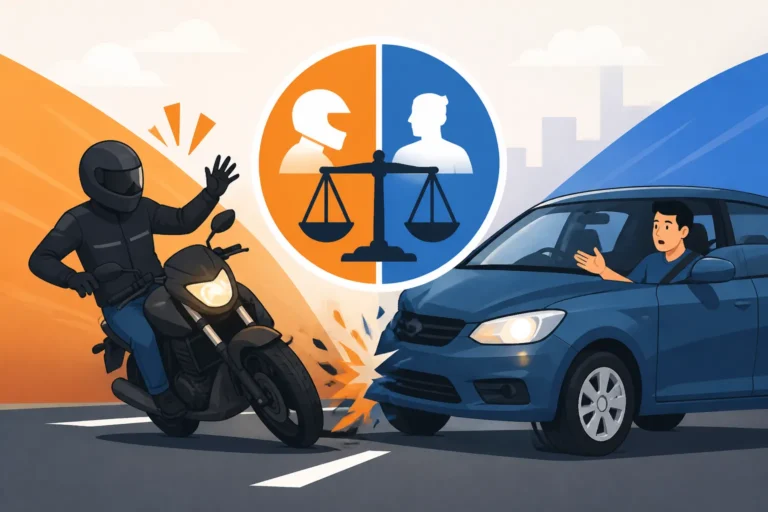
When you've been in a motorcycle accident, the immediate aftermath is often a whirlwind of pain, confusion, and fear. But once the dust settles, a different kind of battle begins: determining fault. It's a frustrating reality for many riders that despite clear circumstances, the blame can often be unfairly shifted, especially when the other driver insists they "didn't see" you. This guide is here to shed light on a powerful tool that can cut through the noise and objectively establish what truly happened: accident reconstruction. We'll dive deep into how this scientific process can be your strongest ally in proving fault and getting the justice you deserve in a motorcycle accident claim.
The Fog of Impact and the Quest for Clarity
A motorcycle crash is a chaotic, instantaneous event. In the blink of an eye, metal twists, bodies are thrown, and lives are irrevocably changed. What seems clear to you as the rider, the one who experienced the impact, can often become murky and disputed in the eyes of insurance companies and legal teams. This immediate confusion and the often-biased perception against motorcyclists make proving who was truly responsible an uphill battle.
Why Fault Is Often Disputed in Motorcycle Accidents
It's an unfortunate truth that motorcyclists frequently face an inherent bias. The common refrain, "I didn't see the motorcycle," is more than just an excuse; it's a deeply ingrained defense often used by drivers and accepted by insurers. This defense often implies that if a driver didn't see you, you must have been invisible, reckless, or somehow at fault for your own lack of visibility. This notion contributes significantly to why fault is often disputed in motorcycle accidents, even when the evidence points squarely to the other party. Car drivers are trained to look for other cars, not always smaller, more agile motorcycles, leading to perception failures that have devastating consequences. When you're trying to recover from severe injuries, fighting this narrative feels overwhelming.
The Limitations of Standard Police Reports
While a police report is an absolutely critical piece of initial evidence and the first step in documenting the crash, it often provides only a snapshot of the scene, not the full picture. Police officers, while diligent, are often dealing with multiple priorities and may not have the specialized training or time to conduct a forensic analysis of a complex accident. They gather statements, note visible evidence, and might make an initial determination of fault, but their report can sometimes miss crucial subtleties that only a deep dive can uncover. For instance, a quick sketch of skid marks might not fully capture their length, type, or position relative to critical impact points, information that is vital in reconstructing vehicle speeds and trajectories. This is precisely where the need for a more comprehensive approach, like accident reconstruction, comes into play to complement and, if necessary, correct the initial findings in a police report.
Unpacking Accident Reconstruction: A Scientific Deep Dive
So, what exactly is accident reconstruction? Think of it as forensic science applied to vehicle collisions. It’s not just an educated guess; it’s a systematic process using principles of physics, engineering, and mathematics to piece together precisely what happened before, during, and after a crash. This method reconstructs the sequence of events leading up to an accident, identifying crucial factors like vehicle speeds, braking distances, points of impact, and occupant kinematics. It’s about transforming raw data and physical evidence into a coherent, defensible narrative of the crash.
The Scientific Approach to Unraveling a Crash
At its core, accident reconstruction is about applying scientific method to a real-world event. This involves collecting all available data, formulating hypotheses about the crash sequence, testing those hypotheses against physical laws, and ultimately arriving at a conclusion supported by demonstrable evidence. Experts use complex calculations involving momentum, energy, friction, and acceleration to determine factors like speed at impact, braking effectiveness, and vehicle paths. For example, by analyzing the deformation of a motorcycle’s frame and the corresponding damage to a car, an expert can calculate the force of impact, which, in turn, can help determine the speed of the vehicles involved. This objective, data-driven approach is invaluable, especially when insurers or opposing parties try to leverage rider bias in fault determination. It can provide concrete answers that are hard to refute.
Who Are Accident Reconstructionists?
These aren't just folks who've seen a lot of accidents. Accident reconstructionists are highly specialized professionals, often with backgrounds in engineering, physics, or law enforcement, who have undergone extensive training in collision dynamics and forensic investigation. Many are certified by recognized bodies and constantly update their skills with the latest technologies and methodologies. They're often called upon when the cause of an accident is unclear, or when there's a significant dispute over who is at fault in a motorcycle accident. They might have experience working for law enforcement agencies, private firms, or even as expert witnesses in court cases. Their job isn't to take sides but to interpret the physical evidence impartially and present their findings. When you're facing a complex claim, having a qualified expert can make all the difference, particularly if you need to prove fault in a motorcycle accident.
The Evidence Trail: What Reconstructionists Scrutinize
To paint an accurate picture of the crash, accident reconstructionists meticulously gather and analyze a vast array of evidence. They leave no stone unturned, recognizing that even the smallest detail can be a critical piece of the puzzle. This comprehensive approach is essential for building an undeniable case.
On-Scene Physical Evidence
This is often the first layer of data an expert will examine. When you think about documenting the scene to prove fault, you might snap some photos, which is great. But reconstructionists go far beyond that. They're looking for specific, measurable indicators:
- Skid Marks and Yaw Marks: These tell a story about braking, speed, and sudden changes in direction. The length and type of skid marks can be used to calculate a vehicle's speed before braking. Yaw marks, caused by tires sliding sideways, indicate a vehicle was turning sharply and losing control.
- Debris Fields: The scatter pattern of broken glass, plastic, and metal can pinpoint the exact area of impact. The location of the debris relative to the vehicles is critical.
- Fluid Spills: Oil, coolant, or fuel spills can show where vehicles came to rest or where they leaked immediately after impact, further corroborating impact points.
- Gouges and Scrapes on the Roadway: These marks indicate where parts of the vehicles, particularly the motorcycle, made contact with the road surface, offering clues about angle of impact and direction of travel.
- Vehicle Damage: The extent and nature of damage to both the motorcycle and the other vehicle are forensically analyzed to determine impact angles, forces, and deformation. This isn't just about noting a dent; it's about measuring crush depth and analyzing structural integrity.
- Road Conditions and Environment: This includes examining the presence of road hazards, such as potholes or debris, lighting conditions, weather, and traffic control devices (signs, signals). If an accident was caused by road hazards, this evidence becomes paramount.
Vehicle Data Recorders and Digital Clues
In our increasingly digital world, vehicles are essentially computers on wheels, and this is a game-changer for accident reconstruction. Modern cars and motorcycles often contain a wealth of electronic data that can be retrieved and analyzed:
- Event Data Recorders (EDRs): Often called "black boxes," EDRs are found in most modern vehicles. They record critical data in the seconds leading up to a crash, such as vehicle speed, brake application, throttle position, seatbelt use, and steering input. This data is incredibly objective and can decisively prove or disprove claims about speed or braking. Retrieving and interpreting EDR data often requires specialized tools and expertise, but it's one of the most powerful pieces of evidence available.
- GPS Data: If either vehicle had an active GPS system, navigation device, or even a smartphone tracking app, the recorded speed and location data can corroborate or contradict driver statements.
- Infotainment Systems: Some vehicles log data related to driver activity, which could reveal if a driver was distracted or using their phone. This directly relates to proving how the other driver was distracted.
- Dashcam Footage: This is perhaps the most straightforward and compelling digital evidence. If another vehicle, a nearby business, or even your own motorcycle had a dashcam, the footage can provide an undeniable, real-time visual record of the crash. How dashcam footage proves fault cannot be overstated; it often ends disputes swiftly.
Witness Accounts and Rider Statements
While physical and digital evidence are paramount, witness statements and your own account are still crucial. Reconstructionists use these narratives to inform their investigation and cross-reference them with the physical data.
- Witness Statements: Independent witnesses can provide valuable perspectives on vehicle speeds, movements, and driver behavior. However, human memory can be fallible, so their accounts are weighed against the objective physical evidence.
- Rider Statements: Your own recollection of the event, though traumatic, is important. A reconstructionist can listen to your statement and look for corroborating evidence, or identify areas where physical evidence might offer a different perspective. It's vital to provide your statement honestly and as clearly as possible, but remember, never admit fault at the scene.
Crafting the Narrative: How Reconstruction Uncovers Fault
Once all the evidence is collected, the real magic of accident reconstruction begins: turning disparate pieces of data into a cohesive, scientific narrative that definitively shows how fault is determined in motorcycle accidents. This process often involves sophisticated technology and expert interpretation.
Recreating the Scene Step-by-Step
Accident reconstructionists don't just guess; they simulate. Using computer-aided design (CAD) software and advanced physics modeling programs, they can recreate the crash sequence with astounding precision. This often involves:
- Pre-Impact Analysis: Determining the speeds, directions, and actions of all vehicles involved in the moments leading up to the collision. This might involve analyzing traffic camera footage, EDR data, and skid mark calculations to understand driver behavior.
- Impact Dynamics: Pinpointing the exact point of impact, the angle of collision, and the forces involved. This crucial phase directly addresses who hit whom, and at what relative speeds and positions.
- Post-Impact Trajectories: Tracking where the vehicles and the rider traveled after the initial impact, matching this with the debris field and final resting positions. This helps confirm the energy exchange during the crash.
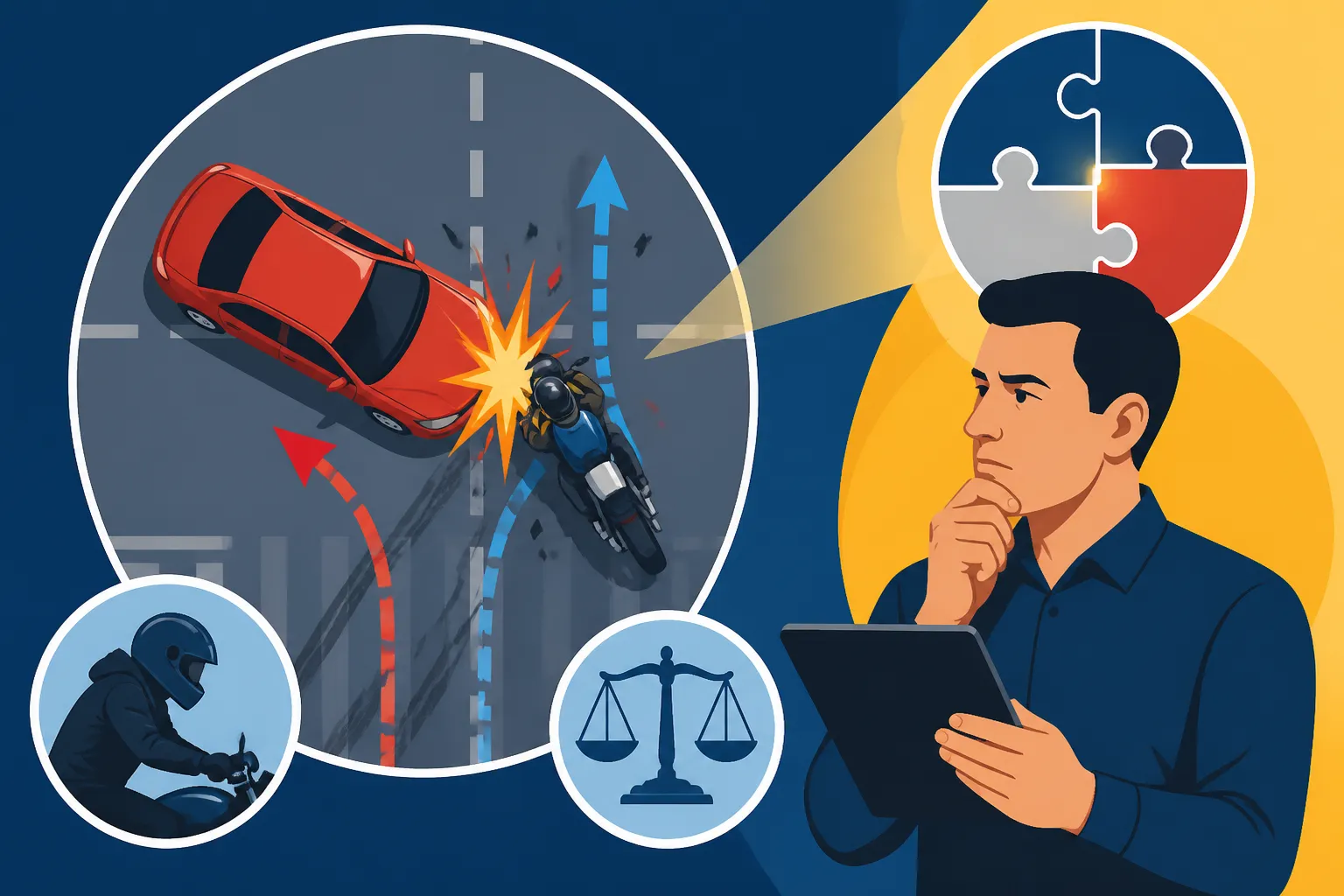
Imagine a scenario: a car makes a sudden left turn in front of you. You might know you couldn't react in time, but the driver claims you were speeding. A reconstructionist can use your motorcycle's tire marks, the car's EDR data, and the damage profiles to calculate your speed and the car's speed. They can then definitively show whether the car initiated the turn when it was unsafe, regardless of your speed, or if your speed was indeed a contributing factor. This objective modeling helps to answer the complex questions of who is at fault in a left-turn collisions motorcycle accident.
Overcoming Biases and Challenging Narratives
One of the most powerful aspects of accident reconstruction is its ability to directly confront and refute biased claims or misleading narratives. We talked about the "I didn't see the motorcycle" defense. A reconstructionist can use sightline analysis, vehicle positions, and environmental factors to prove that the driver should have seen you, or that their failure to see you was due to negligence (e.g., distracted driving, failure to check mirrors).
For instance, if a driver claims you darted out of nowhere, but the physical evidence shows a clear path of travel for your motorcycle and no sudden evasive maneuvers on your part, the reconstructionist's report can dismantle that claim. This scientific evidence can be crucial in fighting an unfair fault assignment by insurance companies who might rely on common stereotypes about riders. Their findings are often presented in detailed reports, animations, or even 3D models that make the complex physics understandable to a jury or claims adjuster.
Presenting Findings in a Motorcycle Accident Claim
The findings of an accident reconstruction are not just theoretical; they are a powerful tool in settlement negotiations and, if necessary, in court.
- Strengthening Your Demand Letter: When you're ready to negotiate a settlement, a comprehensive accident reconstruction report provides undeniable evidence of the other party's fault, bolstering your demand for compensation for your injuries and damages.
- Expert Testimony: If your case goes to trial, the accident reconstructionist can serve as an expert witness. Their testimony, backed by scientific data and analysis, can be incredibly persuasive to a judge or jury, explaining the complex dynamics of the crash in an accessible manner. Their role is to provide objective truth, making it very difficult for the opposing side to dispute the facts. This can be particularly important when shared fault in motorcycle accidents is being alleged, as the expert can precisely delineate each party's contribution to the crash.
Here's a quick look at some common evidence types and what information they provide:
| Evidence Type | Information Provided to Reconstructionist | Impact on Fault Determination |
|---|---|---|
| Skid Marks | Vehicle speed before braking, braking efficiency, direction of travel | Proves if a vehicle was speeding, braked effectively, or changed direction dangerously |
| Vehicle Damage | Point of impact, angle of collision, forces involved, relative speeds | Identifies initial contact, confirms who hit whom, supports speed calculations |
| Debris Field | Area of initial impact, post-impact movement, direction of force | Pinpoints exact crash location, corroborates impact sequence |
| Event Data Recorder | Speed, brake application, throttle position, seatbelt use, steering angle (pre-crash data) | Directly proves driver actions (or inactions) leading up to impact, often irrefutable |
| Dashcam Footage | Real-time visual of crash, vehicle movements, traffic signals, environmental factors | Provides undeniable visual proof of fault, driver negligence, or adherence to traffic laws |
| Roadway Scrapes/Gouges | Points of contact between vehicle parts and road, vehicle orientation, slide paths | Helps confirm impact angle and trajectory, supports sequence of events |
| Witness Statements | Perceptions of speed, direction, driver behavior, sequence of events | Corroborates physical evidence, identifies potential contributing factors like distracted driving |
When to Bring in the Big Guns: Consulting an Accident Reconstruction Expert
After a motorcycle crash, it's natural to feel overwhelmed. You're likely dealing with significant physical pain, financial stress, and the emotional toll of the incident. The thought of adding another layer of complexity with an accident reconstruction expert might seem daunting. However, there are very specific situations where their expertise isn't just helpful, but absolutely essential to securing your rightful compensation.
Complex Accident Scenarios
Not all motorcycle accidents are straightforward. Sometimes, there are multiple vehicles involved, or the sequence of events is highly confusing. Perhaps a driver made an unsafe lane change, causing a chain reaction. Or maybe you were hit by a car that then fled the scene. These kinds of situations require a deep dive to disentangle the various factors contributing to the crash. When fault is disputed in a motorcycle crash, especially in a multi-vehicle incident or one involving unusual circumstances, an accident reconstructionist can be the key to understanding who caused the chaos. Their scientific analysis can clarify ambiguous situations, which a standard police investigation might not fully capture.
Disputed Fault and "He Said, She Said" Situations
This is perhaps the most common reason to hire an accident reconstruction expert. If the other driver is blaming you, or if the insurance company is trying to assign you partial fault, you need an objective way to prove your side of the story. The "I didn't see the motorcycle" defense, as we've discussed, is pervasive. An expert can analyze sightlines, visibility, and vehicle speeds to demonstrate that the other driver should have seen you and had ample time to react, thus proving their negligence. This expert opinion can be invaluable in countering narratives that portray motorcyclists as inherently reckless. If you find yourself in a scenario where you're struggling to prove the other driver was distracted, an expert can often find objective evidence to support your claim.
Significant Injuries or Catastrophic Damages
Motorcycle accidents, unfortunately, often result in severe injuries like traumatic brain injury, spinal cord injury, or multiple broken bones. When the stakes are this high, and you're facing astronomical medical bills, lost wages, and long-term care needs, you cannot afford to have your claim undervalued or denied due to disputed fault. A strong, undeniable case of fault, backed by accident reconstruction, ensures that you have the best possible chance of recovering the full compensation you deserve. The investment in an expert can pay dividends by securing a significantly higher settlement that truly reflects the severity of your injuries. This is a critical factor in how fault affects your settlement.
Challenges to Your Credibility or Conduct
Sometimes, the opposing side will try to discredit you as a rider, implying you were speeding, lane splitting illegally, or otherwise riding recklessly, even if these claims are unfounded. An accident reconstructionist can analyze the physical evidence to either confirm or refute these accusations. For example, if you were accused of speeding, but the skid marks and vehicle damage analysis show you were well within the speed limit, the expert's findings can protect your credibility and your claim. This is especially important in states where comparative negligence laws apply, as even partial fault can significantly reduce your payout. Getting an expert opinion helps to provide motorcycle accident evidence for proving fault, protecting you from unfair accusations.
Remember, the sooner an accident reconstructionist can examine the scene and collect evidence, the better. Over time, crucial physical evidence like skid marks and debris can disappear or be compromised. If you're wondering when to hire an accident reconstruction expert, the general rule is: if fault is disputed, if injuries are severe, or if the accident scene holds complex evidence, it's wise to consult with an expert early in the process.
Disclaimer
Please remember that the information provided in this article is for general informational purposes only and does not constitute legal advice. Every motorcycle accident claim is unique, and the laws governing personal injury vary significantly by state. It is crucial to consult with a qualified legal professional regarding your specific situation to understand your rights and options. Relying solely on the information presented here without seeking professional legal counsel is not recommended.