Motorcycle Insurance Requirements by State
Riding a motorcycle offers unparalleled freedom, but hitting the open road without understanding your state’s insurance requirements can turn that freedom into a real headache after an accident. Many riders find themselves utterly confused by the patchwork of laws across different states, leaving them vulnerable to legal and financial devastation if they're caught unprepared. This guide will cut through that confusion, giving you a clear, state-by-state look at what you need to know about motorcycle insurance.
Why Motorcycle Insurance Matters Beyond the Law
Beyond simply complying with state mandates, having the right motorcycle insurance is a cornerstone of responsible riding. It’s not just about avoiding a ticket; it’s about safeguarding your financial future and providing peace of mind every time you kickstand up. Many riders, especially those new to the lifestyle, tend to focus solely on the minimum requirements, not realizing how much more comprehensive coverage can benefit them in the long run.
Protecting Yourself and Your Ride
Imagine cruising down a beautiful scenic highway, perhaps along the Pacific Coast Highway in California, when suddenly a distracted driver swerves into your lane. Even if it's not your fault, the aftermath can be incredibly costly. Your bike could be totaled, and your gear, from your helmet to your riding jacket, could be severely damaged. Without adequate coverage, replacing your cherished machine and all your safety essentials falls squarely on your shoulders. It's a gut-wrenching scenario that can happen in an instant, and having insurance that goes beyond basic liability means you won't be left financially stranded when you're already physically and emotionally shaken. This protection extends to your valuable accessories as well, meaning your custom paint job or that high-end exhaust system might be covered.
Financial Security After a Crash
A motorcycle accident, even a minor one, can quickly lead to substantial medical bills. We're talking emergency room visits, specialist consultations, physical therapy, and potentially long-term care for serious injuries like road rash or a broken leg. If you’re at fault, or even partially at fault, the costs can escalate dramatically. And if the other driver involved is uninsured or underinsured, which is unfortunately common, your own bodily injury coverage or uninsured motorist protection becomes a lifesaver. This coverage steps in to pay for your medical expenses and even lost wages if your injuries prevent you from working. It’s the safety net that prevents a single incident from derailing your entire financial stability, allowing you to focus on recovery instead of worrying about looming debt.
Understanding Common Motorcycle Insurance Coverage Types
When you start looking at policies, you’ll encounter a variety of terms and options. It can feel like reading a foreign language at first, but each type of coverage serves a distinct purpose. Knowing what each one does helps you build a policy that truly protects you. Don’t just nod along when your agent starts talking; understand the nuts and bolts of what you're buying.
Liability Coverage: Bodily Injury and Property Damage
This is the most fundamental type of insurance and is legally required in most states. Think of it as protection for others if you are found to be at fault in an accident. Bodily injury liability covers the medical expenses and lost wages of anyone you injure, while property damage liability pays for repairs to another vehicle or property you damage. For example, if you accidentally rear-end a car at a stoplight in Houston, Texas, your liability coverage would kick in to pay for the other driver's whiplash treatment and the damage to their bumper. These coverages are usually expressed as three numbers, like "25/50/25," which means $25,000 for bodily injury per person, $50,000 for total bodily injury per accident, and $25,000 for property damage. It’s crucial to understand that these minimums are often quite low and might not cover the full extent of damages in a serious crash, leaving you personally responsible for the remainder. This is why many experienced riders opt for higher liability limits.
Uninsured/Underinsured Motorist (UM/UIM) Coverage
This coverage is incredibly important for motorcyclists, yet it's often overlooked or minimized. Unfortunately, many drivers on the road either carry no insurance at all (uninsured) or carry only the bare minimum liability coverage (underinsured). If one of these drivers causes an accident with you, and you're left with significant injuries and damages, their insurance might not be enough to cover your costs – or they might have none at all. UM/UIM coverage steps in to pay for your medical bills, lost wages, and even pain and suffering if the at-fault driver can't. In states like Florida, where there are many uninsured drivers, this coverage is practically indispensable for riders. Without it, you could be left footing the bill for someone else's negligence, a truly unfair burden. This is a vital layer of protection that helps ensure that you can still recover even if you were partially at fault but the other driver was also negligent and underinsured.
Collision and Comprehensive Coverage
These are the "physical damage" coverages that protect your motorcycle. Collision coverage pays to repair or replace your bike if it's damaged in an accident, regardless of who is at fault. So, if you hit a deer on a back road in rural Pennsylvania, or if you lay your bike down trying to avoid a collision, your collision coverage would help with the repair costs. Comprehensive coverage, on the other hand, covers damage to your motorcycle from non-collision events. This includes things like theft, vandalism, fire, natural disasters (hail, floods), or hitting an animal. If your bike is stolen from your garage in Los Angeles, or vandalized while parked at a local cafe, comprehensive coverage would help you replace it. While not legally required, these coverages are highly recommended for most riders, especially if you have a newer, more expensive bike, or if you rely on your motorcycle for daily transportation. Many financial institutions will require both collision and comprehensive coverage if you have a loan on your motorcycle.
Personal Injury Protection (PIP) / Medical Payments (MedPay)
PIP and MedPay are both designed to cover medical expenses for you and your passengers after an accident, regardless of who was at fault. The key difference lies in how they work and in which states they are typically offered. MedPay is generally simpler, covering medical bills up to a certain limit. PIP, often found in "no-fault" states, can be more expansive, covering medical expenses, lost wages, and even essential services like childcare if you're injured and can't perform daily tasks. In a no-fault state like Michigan, for example, your own PIP coverage would pay for your immediate medical costs after a crash, regardless of fault, before any liability claims are even processed. This can be incredibly beneficial for getting prompt medical attention without waiting for fault to be determined, which can often be a lengthy process, particularly in complex cases where shared fault in motorcycle accidents is a factor.
State-Specific Motorcycle Insurance Requirements
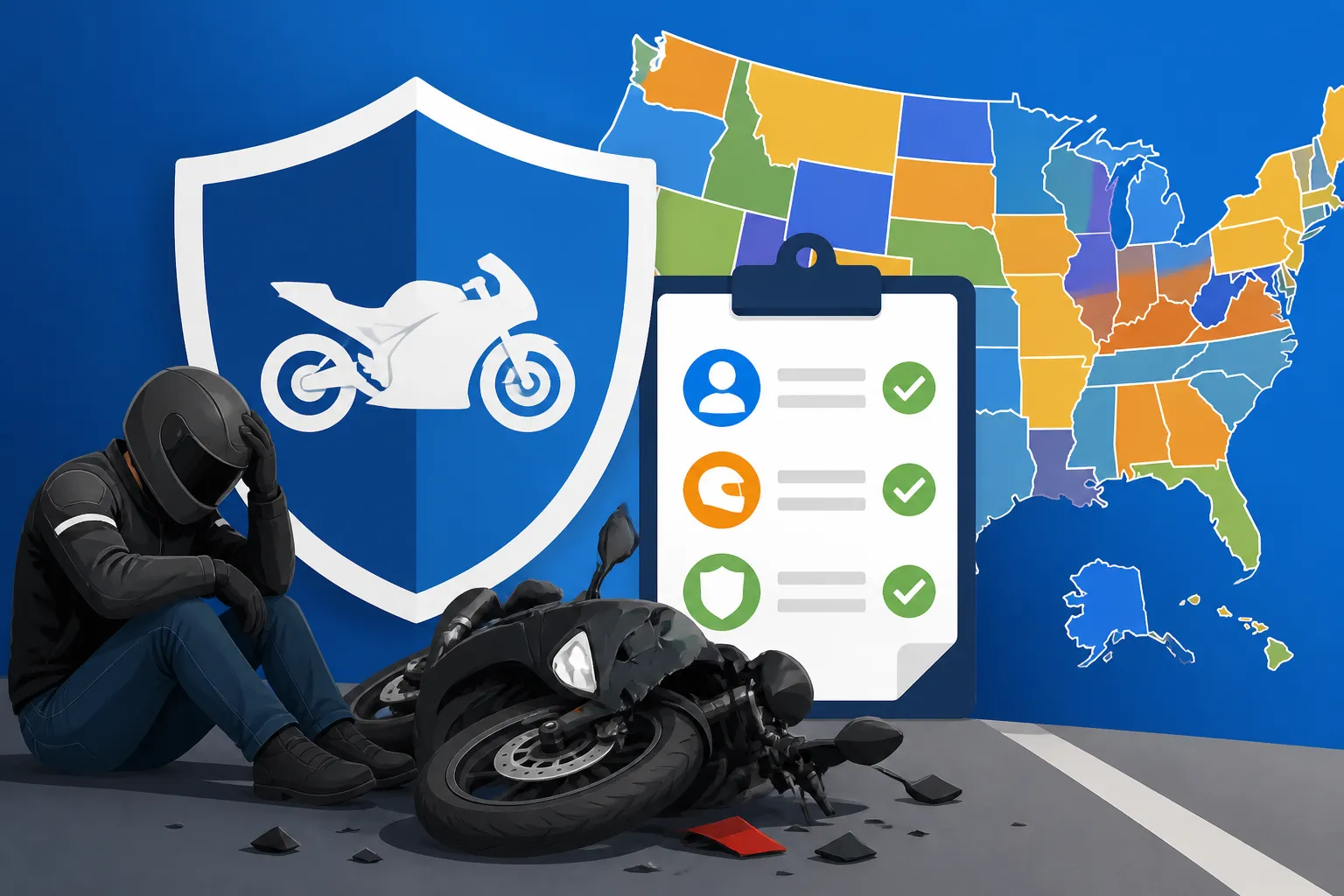
This is where things get interesting, and often confusing, for riders. Each state has its own specific laws regarding minimum motorcycle insurance coverage. What's perfectly legal in one state could get you a hefty fine or even impoundment in another. It's not a "one size fits all" situation, and knowing your local laws, and those of any state you plan to ride through, is absolutely essential. Let's break down some general trends and specific examples.
Universal Coverage States
Most states operate under an "at-fault" system for motorcycle accidents, meaning the person who caused the accident is responsible for the damages. In these states, minimum liability insurance is almost always required. The specific dollar amounts vary significantly. For instance:
- California: Requires minimum liability coverage of 15/30/5 ($15,000 for bodily injury per person, $30,000 for bodily injury per accident, and $5,000 for property damage). Given the high cost of living and medical care in California, these minimums are notoriously low, making higher coverage essential for serious protection.
- Florida: Mandates 10/20/10 liability coverage, but crucially, Florida is a no-fault state for cars, which can sometimes lead to misunderstandings for motorcyclists. However, motorcycles are generally exempt from the PIP requirement for cars, meaning they typically operate under an at-fault system for personal injury claims. Many riders in Florida opt for substantial MedPay or UM/UIM coverage to compensate for the higher risk of encountering uninsured drivers.
- Texas: Requires 30/60/25 liability coverage. Texas is an at-fault state, and while these limits are slightly higher than California's, they still might not be enough for catastrophic injuries, which are unfortunately common in motorcycle accidents.
- New York: Like Texas, New York is an at-fault state for motorcycle accidents and has mandatory minimum liability limits, often requiring 25/50/10. Riders often find themselves needing to understand "Motorcycle Accident Fault Laws in New York" if they’re involved in a crash.
- Illinois: Requires minimum liability of 25/50/20. Like many states, Illinois follows an at-fault system and applies a modified comparative negligence rule, meaning your ability to recover damages is reduced by your percentage of fault.
It's clear that while most states require liability, the actual numbers are often very different. For a rider planning a cross-country trip, understanding these variations is crucial.
| State | Bodily Injury Per Person | Bodily Injury Per Accident | Property Damage Per Accident | Unique Notes |
|---|---|---|---|---|
| California | $15,000 | $30,000 | $5,000 | At-fault state; universal helmet law. These limits are very low. |
| Texas | $30,000 | $60,000 | $25,000 | At-fault state; partial helmet law (riders 21+ with training/insurance exempt). Higher property damage minimum. |
| Florida | $10,000 | $20,000 | $10,000 | At-fault for bikes (not subject to PIP); partial helmet law (riders 21+ with $10k MedPay exempt). Low bodily injury limits. |
| New York | $25,000 | $50,000 | $10,000 | At-fault state; universal helmet law. |
| Illinois | $25,000 | $50,000 | $20,000 | At-fault state; no helmet law for adults. |
| Ohio | $25,000 | $50,000 | $25,000 | At-fault state; partial helmet law (riders 18+ exempt). |
| Pennsylvania | $15,000 | $30,000 | $5,000 | At-fault state; partial helmet law (riders 21+ with 2 years experience or training exempt). Very low property damage. |
| Washington | $25,000 | $50,000 | $10,000 | At-fault state; universal helmet law. |
| Arizona | $25,000 | $50,000 | $15,000 | At-fault state; partial helmet law (riders 18+ exempt). |
| Georgia | $25,000 | $50,000 | $25,000 | At-fault state; universal helmet law. |
| North Carolina | $30,000 | $60,000 | $25,000 | At-fault state; universal helmet law. Contributory negligence state, which can severely impact recovery if you are even 1% at fault. |
States with Unique Requirements or Exemptions
Some states have particularly interesting or lenient approaches to motorcycle insurance, which can be a double-edged sword for riders.
- New Hampshire: Famously known for its "Live Free or Die" motto, New Hampshire does not legally require motorcycle insurance. However, if you are involved in an accident and are deemed at fault, you will be required to prove financial responsibility (which often means buying insurance after the fact or facing license suspension). While it might seem appealing to save money, riding uninsured in New Hampshire is a massive gamble, as you’d be personally liable for all damages, which could lead to total financial ruin.
- States with Proof of Financial Responsibility Alternatives: Some states allow you to forgo traditional insurance if you can prove you have sufficient financial assets to cover potential damages, such as posting a bond or depositing a significant amount of cash with the state treasury. This is rarely a practical option for the average rider but exists as a legal alternative. Always check local Department of Motor Vehicles or equivalent state agencies for the most up-to-date and specific details on these less common alternatives.
No-Fault vs. At-Fault Systems and Their Impact
Understanding whether your state is "no-fault" or "at-fault" is critical, as it dictates how claims are handled and how damages are recovered after an accident.
- At-Fault States: The majority of states in the U.S. operate under an at-fault system. This means that after a motorcycle accident, the person determined to be responsible for the crash is liable for all damages (medical bills, property damage, lost wages, pain and suffering) incurred by the injured parties. For example, if a driver turns left in front of you in Arizona, causing a crash, their insurance company would typically be responsible for your damages. However, remember that proving fault in a motorcycle accident can be complex, and often, insurance companies will try to assign some percentage of blame to the rider. This is where the concept of comparative negligence comes into play, a system used in many at-fault states that reduces your potential settlement by your percentage of fault. If you are found to be 20% at fault for an accident, your total damages would be reduced by 20%.
- No-Fault States: A smaller number of states have "no-fault" insurance systems. In these states, after an accident, your own insurance company (through PIP coverage) pays for your medical expenses and lost wages, regardless of who caused the accident, up to certain limits. Only if your injuries meet a specific threshold (e.g., severe injury, permanent disfigurement, or high medical costs) can you step outside the no-fault system and sue the at-fault driver for further damages, including pain and suffering. This system is primarily designed to reduce litigation and ensure prompt medical treatment. However, as mentioned earlier, motorcycles are often treated differently than cars in no-fault states. For instance, in New Jersey, while car drivers are under a no-fault system, motorcyclists typically operate under the traditional at-fault system for injuries. This distinction means that in many cases, motorcyclists involved in accidents in a no-fault state still have to prove the other driver's fault to recover compensation for their injuries and other damages, just like in a traditional at-fault state. It’s a nuance that can profoundly impact how your claim progresses and how much compensation you can expect. This is why learning more about No-Fault States and Motorcycle Accidents is incredibly beneficial.
Navigating Your Insurance Policy and Making Smart Choices
Once you've got a handle on the basic types of coverage and what your state requires, the next step is to tailor a policy that genuinely meets your needs. It's not just about getting the cheapest rate; it's about getting the right coverage that offers real protection when you need it most. After all, what good is saving a few bucks a month if a single accident could cost you hundreds of thousands? Many riders browse brands like Cycle Gear for their latest helmets and jackets, but the focus on safety should extend to adequate insurance coverage as well.
Understanding Policy Limits and Deductibles
Every insurance policy comes with limits and deductibles, and understanding them is crucial.
- Policy Limits: These are the maximum amounts your insurance company will pay out for a covered loss. As we discussed with liability coverage (e.g., 25/50/25), these numbers cap what the insurer will pay. If your damages exceed these limits, you're on the hook for the rest. For catastrophic injuries, especially common in motorcycle accidents, even higher limits like 100/300/50 might not be enough. For example, a traumatic brain injury can incur millions in lifetime medical care. If your policy only covers $100,000 for bodily injury per person, you could face immense out-of-pocket expenses. This is where understanding How Policy Limits Cap Your Settlement becomes vital.
- Deductibles: This is the amount of money you agree to pay out-of-pocket before your collision or comprehensive coverage kicks in. If you have a $500 deductible for collision coverage and your bike suffers $3,000 in damage, you pay the first $500, and your insurer pays the remaining $2,500. A higher deductible typically means lower monthly premiums, but it also means you'll pay more upfront if you need to file a claim. You need to weigh your financial comfort level against the potential savings.
The Importance of Adequate Coverage
It’s easy to think, "I'm a safe rider, I don't need all that extra coverage." But accidents are, by definition, unexpected, and often involve other drivers. The financial implications of a serious motorcycle accident can be staggering. We're talking tens of thousands, potentially hundreds of thousands, in medical bills, lost income, and property damage. Minimum state requirements are almost always inadequate to cover these costs in a severe crash. Opting for higher liability limits, robust UM/UIM coverage, and comprehensive/collision coverage means you’re truly protected. This isn’t an area to skimp on, especially considering the severe injuries riders often sustain. Think about your future, your savings, and your ability to recover financially and physically.
How to Shop for Motorcycle Insurance
Shopping for motorcycle insurance can feel daunting, but it doesn't have to be. Start by getting quotes from multiple providers. Don't just stick with your car insurance company; specialized motorcycle insurers often offer better rates and more tailored coverage. Look for companies that understand the unique risks and needs of motorcyclists. Websites like Progressive, Geico, and Dairyland often offer competitive motorcycle insurance rates and allow you to compare various coverage options easily. Make sure to inquire about discounts for things like safe rider courses, multi-bike policies, anti-theft devices, or being a member of a motorcycle club. Be upfront about your riding habits, type of bike, and storage. And remember, while online quotes are a great starting point, a conversation with a knowledgeable agent can help you understand the nuances of a policy and ensure you’re not overlooking critical protections. As you're upgrading your riding gear at a place like Cycle Gear, remember to also review your insurance policy to ensure it's up to date with the value of your bike and gear.
What Happens If You Ride Without Insurance?
Thinking about skipping motorcycle insurance to save a few bucks? It's a dangerous gamble, and the consequences can be far more costly than any premium. While the roar of your engine might fill you with a sense of invincibility, the reality of riding without proper coverage is anything but. It’s important to remember that even if you feel you can handle the risks, the legal and financial repercussions can be devastating, impacting your life for years to come.
Legal Penalties and Fines
Riding without the legally required minimum insurance is a serious offense in most states. The penalties vary, but they can be quite severe. You could face:
- Hefty Fines: These can range from a few hundred dollars to several thousand, depending on your state and whether it’s a first offense or repeat violation. In states like California, the fines can be steep, often accompanied by additional fees.
- License Suspension/Revocation: Your motorcycle endorsement and even your driver's license for cars could be suspended or revoked. This means no legal riding or driving until you comply with insurance laws and pay reinstatement fees.
- Vehicle Impoundment: Police officers have the authority to impound your motorcycle on the spot if you're caught riding without insurance. Getting it back means paying towing fees, storage fees, and proving you now have valid insurance, which can quickly add up to hundreds or even thousands of dollars.
- SR-22 Requirement: Many states will require you to file an SR-22 form (proof of financial responsibility) with the DMV for several years. This is a red flag for insurance companies and typically results in significantly higher premiums once you are able to get coverage again.
- Jail Time: In some states, especially for repeat offenses or if you're involved in an accident causing injuries while uninsured, you could even face misdemeanor charges and potential jail time.
These legal consequences are designed to deter uninsured driving, and they can significantly disrupt your life and finances.
Financial Consequences After an Accident
The legal penalties are just the beginning. The financial fallout from an accident while uninsured can be catastrophic.
- Personal Liability for All Damages: If you cause an accident and don't have insurance, you are personally responsible for every penny of the damages. This includes the other driver's medical bills, lost wages, property damage to their vehicle, and their pain and suffering. If they sue you, and a judge or jury awards them a large sum, your assets could be at risk. This means your house, your savings, your future earnings – everything could be on the line. These can be astronomical amounts, far exceeding what even the most expensive insurance premium would cost.
- No Coverage for Your Own Injuries or Damages: You won't have any collision coverage to repair your own motorcycle, nor will you have medical payments or personal injury protection to cover your own medical bills. You'll be left to pay for your own injuries out-of-pocket, which, as we know, can be extensive for motorcyclists. This burden can lead to severe debt, bankruptcy, and a long-term struggle to recover.
- Difficulty Getting Future Insurance: Having a record of driving without insurance, especially if it involved an accident, will make it incredibly difficult and expensive to get insurance in the future. Insurers will view you as a high-risk driver, leading to exorbitant premiums for years to come.
Riding without insurance isn’t just breaking the law; it’s rolling the dice with your entire financial future. A single misstep on the road could lead to a lifetime of debt and regret. Prioritize getting the right coverage, not just the minimum, to protect yourself and your passion for riding.
Disclaimer
This article is for general informational purposes only and does not constitute professional advice. Laws and regulations vary by location and change over time. Consult a qualified professional for guidance on your specific situation.