Motorcycle Knee Injury: Claims and Compensation
Experiencing a motorcycle accident is terrifying, but often, the true nightmare begins after the initial chaos, especially when you realize the extent of your injuries. A knee injury, in particular, can be devastating for riders, transforming simple daily activities into agonizing challenges and casting a long shadow over your future ability to ride or even walk comfortably. This guide is here to walk you through the complex world of claims and compensation for motorcycle knee injuries, helping you understand your rights and the path to recovery.
Understanding Common Motorcycle Knee Injuries
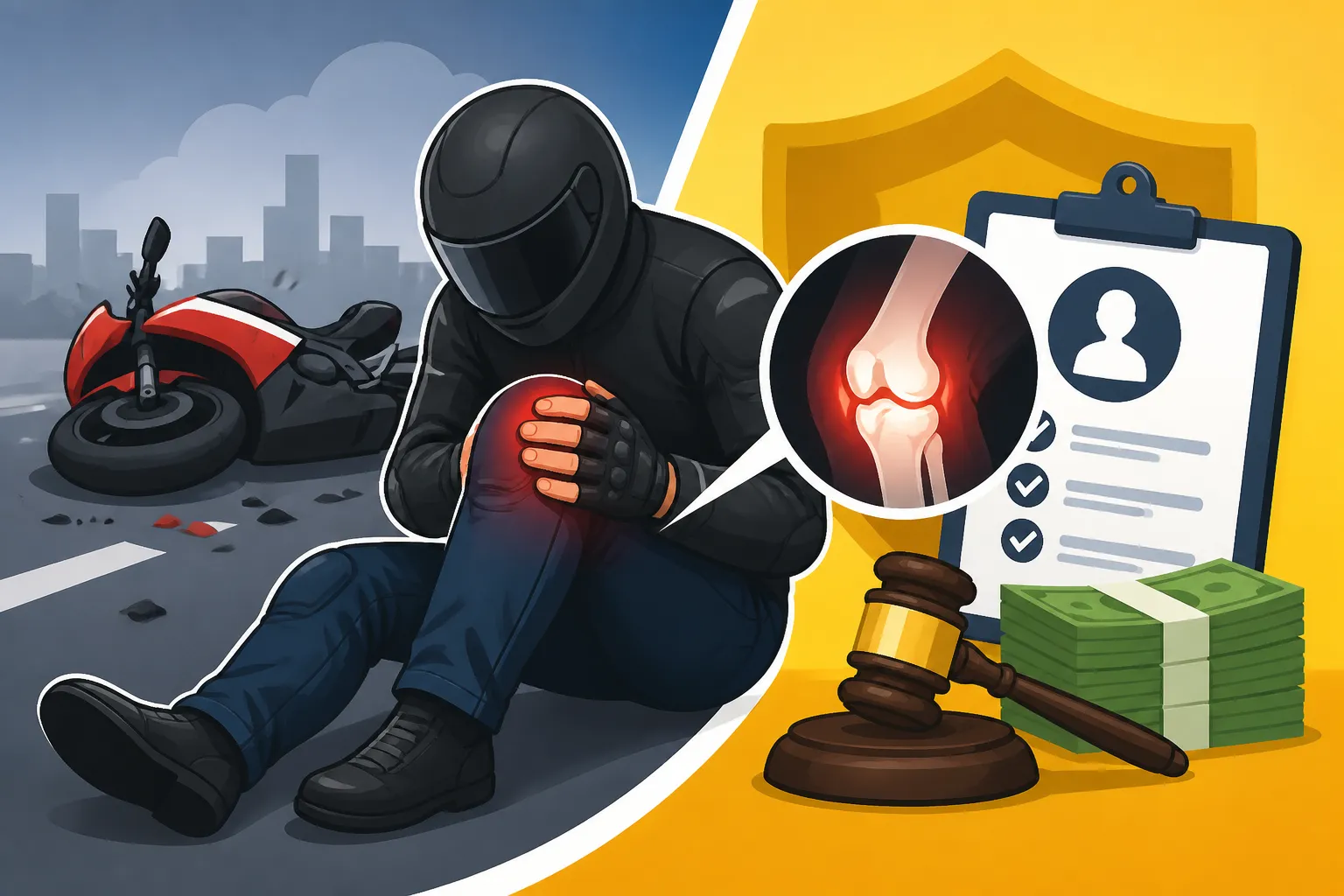
When a motorcycle goes down, the rider’s legs and knees are incredibly vulnerable. They're often the first point of contact with the road, or they get twisted and crushed beneath the bike or another vehicle. It’s not just about the impact; the shearing forces, rotational trauma, and simple abrasion can lead to a wide array of severe and long-lasting knee injuries.
Types of Knee Injuries from Motorcycle Accidents
The knee is a complex joint, a marvel of engineering that allows us to walk, run, and, of course, ride. Unfortunately, its complexity also makes it highly susceptible to damage during a high-impact event like a motorcycle crash. Riders often suffer from a range of knee injuries, each with its own recovery challenges and implications for a claim.
One of the most common and debilitating injuries is a ligament tear. The anterior cruciate ligament (ACL) and posterior cruciate ligament (PCL) are vital for knee stability. A sudden twist or hyperextension can completely tear these ligaments, often requiring intensive surgery and a long, arduous rehabilitation process. Similarly, the medial collateral ligament (MCL) and lateral collateral ligament (LCL) can be stretched or torn, usually from direct impact or sideways force. A fully torn ACL or PCL can leave you with a knee that feels unstable, prone to giving out, and significantly impacts your ability to bear weight or engage in physical activity.
Another frequent casualty of motorcycle crashes is the meniscus, the C-shaped cartilage that acts as a shock absorber between your thigh and shin bones. Meniscal tears can result from twisting motions or direct compression, leading to pain, swelling, and a "locking" or "catching" sensation in the knee. Depending on the location and severity, these tears might require arthroscopic surgery to repair or remove damaged tissue. Imagine trying to shift gears or even just getting on and off your bike with a knee that constantly catches or locks up – it's not just painful, it's a constant source of frustration and limitation.
Then there are fractures. The kneecap (patella), the top of the shin bone (tibial plateau), or the end of the thigh bone (femoral condyles) can all sustain fractures. A patella fracture, for instance, can occur from a direct blow, making it impossible to straighten your leg and often necessitating surgery to realign the bone fragments. Tibial plateau fractures are particularly nasty because they involve the joint surface, which can lead to early onset arthritis and chronic pain even after healing. These types of breaks often involve significant displacement and can require plates, screws, or rods to stabilize the bone, leaving behind substantial scarring and a long road to regaining mobility.
Beyond these, riders can also suffer from knee dislocations, where the bones of the knee joint are forced out of alignment. While less common, these are medical emergencies that can damage surrounding nerves and blood vessels. And let's not forget the ever-present risk of road rash around the knee area. While often superficial, deep road rash can extend into the muscle and bone, leading to severe infection, nerve damage, and disfiguring scars that can restrict movement and cause chronic pain, making even wearing trousers uncomfortable.
The Mechanics of Motorcycle Knee Trauma
Understanding how these injuries happen can be crucial in proving fault and the extent of your damages. Motorcycle knee trauma isn't usually a simple, clean break. It's often a complex interplay of forces.
Consider a common scenario: a car makes a sudden left turn in front of a motorcyclist. The rider might swerve, lay the bike down, or be struck directly. If the rider's leg gets trapped between the motorcycle and the road or between their bike and the other vehicle, the forces are immense. This can lead to a crushing injury, often resulting in complex fractures of the tibia or fibula, or even a complete knee dislocation. The instantaneous compression and shearing forces can wreak havoc on the joint's intricate structure. This is often the case in a scenario where a rider is involved in a left-turn motorcycle accident, where the impact point is frequently the side of the motorcycle.
Alternatively, a rider might be ejected from their bike. Upon impact with the ground, the knee could take the brunt of the fall, leading to hyperextension or twisting injuries that tear ligaments like the ACL or MCL. The knee might also strike a hard surface directly, causing a patellar fracture or deep road rash. The angle of impact, the speed, and the specific dynamics of the crash all contribute to the severity and type of knee injury sustained. Even when wearing protective gear, the sheer force involved in a motorcycle accident can overwhelm even the toughest knee pads, leading to injuries beneath the surface. This is why documenting the scene to prove fault and the forces involved is so important.
The Immediate Aftermath and Medical Treatment
After the dust settles from a motorcycle accident, the immediate steps you take regarding your medical care are paramount. Not only are they critical for your physical recovery, but they also lay the groundwork for any future claim for compensation. Many riders, in the shock of the moment, might downplay their pain or delay seeking treatment, which can unfortunately hurt both their health and their legal standing later on.
Why Prompt Medical Attention is Crucial
The adrenaline surge immediately following a crash can mask significant pain and serious injuries. You might feel a dull ache in your knee, but think it’s just a bruise, only for it to swell up painfully the next day. This delayed onset of symptoms is incredibly common, especially with soft tissue injuries or even some fractures. That's why seeking immediate medical attention, even if you "feel fine," is not just a suggestion – it’s a necessity. Go to the emergency room, urgent care, or your primary care physician as soon as possible after the accident.
Prompt medical care does several things. First and foremost, it addresses your injuries. A knee injury, if left untreated, can worsen over time, leading to long-term complications like chronic pain, instability, or even permanent disability. Getting an immediate diagnosis ensures you receive the correct treatment plan to minimize damage and maximize your recovery potential. Beyond your health, prompt medical attention creates an official record. This medical documentation is crucial evidence in your motorcycle accident claim, clearly linking your knee injury to the crash. Gaps in treatment or delays in seeking care can be exploited by insurance companies, who might argue that your injuries weren't severe or weren't caused by the accident itself. They might suggest your injury was from something else entirely, trying to reduce their liability.
Diagnostic Procedures and Initial Treatments
When you arrive at a medical facility with a suspected knee injury, doctors will typically begin with a thorough physical examination. They’ll assess swelling, tenderness, range of motion, and stability. Expect to undergo various diagnostic procedures to pinpoint the exact nature and extent of your injury.
X-rays are often the first step, used to rule out fractures or dislocations. However, X-rays don't show soft tissues like ligaments or cartilage, so if a fracture isn't immediately apparent but pain persists, a magnetic resonance imaging (MRI) scan is usually ordered. An MRI provides detailed images of soft tissues, allowing doctors to identify ligament tears (ACL, PCL, MCL, LCL), meniscal tears, cartilage damage, and other internal derangements. In some cases, a CT scan might be used for more detailed bone imaging, especially for complex fractures like those involving the tibial plateau.
Initial treatments will vary widely depending on the diagnosis. For minor sprains or tears, the RICE method (Rest, Ice, Compression, Elevation) might be prescribed, along with pain medication and anti-inflammatory drugs. You might also be fitted with a brace or crutches to limit movement and weight-bearing. For more severe injuries, however, the treatment path quickly becomes more intensive.
Surgical Interventions and Rehabilitation
Many significant motorcycle knee injuries, particularly complete ligament tears or displaced fractures, will require surgical intervention. ACL reconstruction, meniscal repair, or open reduction internal fixation (ORIF) for fractures are common procedures. These surgeries are complex and often involve significant recovery time. For instance, an ACL reconstruction involves replacing the torn ligament with a graft, followed by months of carefully structured rehabilitation.
After surgery, or for injuries not requiring surgery but still severe, physical therapy and rehabilitation become the cornerstone of recovery. This isn't just about regaining strength; it's about restoring full range of motion, improving stability, and re-educating the muscles around the knee. A typical rehabilitation program might involve exercises to increase flexibility, strengthen the quadriceps and hamstrings, improve balance, and gradually progress to weight-bearing and functional activities. This process can be incredibly challenging, physically and emotionally, requiring immense dedication and often causing setbacks. It's a long road, often stretching for many months, and sometimes, a full return to pre-accident function is simply not possible. This long-term commitment to recovery can significantly influence how much compensation for motorcycle knee injury you might need.
Calculating Damages for a Knee Injury Claim
When you're dealing with a serious knee injury from a motorcycle accident, the financial burden can quickly become overwhelming. From immediate medical bills to lost time at work, and the sheer physical and emotional toll, these damages need to be carefully calculated to ensure you receive fair compensation. Understanding the different categories of damages is crucial for building a strong claim.
Economic Damages: Medical Bills and Lost Wages
Economic damages, often called "special damages," are the tangible, quantifiable financial losses you incur due as a direct result of your motorcycle knee injury. These are the easiest to prove because they come with receipts, invoices, and pay stubs.
The most obvious component is medical expenses. This includes everything from the ambulance ride and emergency room visit to doctor consultations, diagnostic tests like X-rays and MRIs, surgery costs, anesthesia, prescription medications, physical therapy sessions, and durable medical equipment like crutches, braces, or even a wheelchair. Keep meticulous records of all medical bills, co-pays, and deductibles, even if your health insurance covers some of it. Your claim will seek to recover the full amount of these costs, not just what you paid out of pocket. For serious knee injuries, medical expenses can easily soar into the tens or hundreds of thousands of dollars, particularly if multiple surgeries or long-term rehabilitation are needed.
Next are lost wages and loss of earning capacity. If your knee injury prevents you from working, even temporarily, you can claim the income you've lost. This isn't just your regular salary; it can also include lost overtime, bonuses, commissions, and even benefits. For self-employed riders, documenting lost income can be a bit trickier but is still absolutely recoverable with proper financial records. Even if you're able to return to work, but your knee injury forces you into a less physically demanding (and lower-paying) role, or you can no longer perform certain aspects of your job, you can claim for "loss of earning capacity." This accounts for the difference in your potential income over your working lifetime due to the permanent limitations imposed by your injury. For example, a construction worker with a permanently damaged knee might never be able to return to their trade, suffering a lifetime of reduced income. This can be a substantial part of your overall settlement.
Non-Economic Damages: Pain, Suffering, and Lost Quality of Life
While economic damages cover your direct financial losses, non-economic damages, or "general damages," compensate you for the intangible impacts of your knee injury. These are often more challenging to quantify but are a vital part of any personal injury claim, especially given the severe nature of motorcycle accident injuries.
Pain and suffering is a broad category that encompasses the physical pain you've endured from the moment of the accident, through surgeries, rehabilitation, and into your future, as well as the emotional distress that accompanies such a traumatic event. This includes discomfort, agony, headaches, and the general misery of being injured. Emotional distress can manifest as anxiety, depression, fear of riding again, sleep disturbances, or even Post-Traumatic Stress Disorder (PTSD) stemming from the accident. The chronic pain associated with a severe knee injury, like post-traumatic arthritis or nerve damage, can continue indefinitely, affecting every aspect of your life. Documenting your pain through a daily journal can be incredibly helpful here.
Beyond pain, loss of enjoyment of life is a critical component. Think about all the activities your knee injury has prevented you from doing or made incredibly difficult. Riding your motorcycle, playing sports with your kids, hiking, dancing, even simple gardening – if these things were once important to you and are now impossible or severely limited, you deserve compensation for that loss. This can also extend to hobbies, social activities, and intimate relationships. The impact on your overall quality of life is profound. The inability to ride your bike, a passion for many, can be a particularly hard hit.
Accounting for Future Medical Needs and Long-Term Impact
A major mistake many accident victims make is settling their claim before fully understanding the long-term implications of their knee injury. While you might have paid for initial surgeries and therapy, severe knee injuries often lead to future medical needs.
This includes the possibility of future surgeries, such as knee replacement surgery down the line due to accelerated arthritis or the need to revise previous repairs. Regular follow-up doctor visits, ongoing physical therapy, pain management treatments, and expensive prescription medications can accumulate over years, if not decades. For example, a severe tibial plateau fracture might lead to degenerative arthritis, necessitating a total knee replacement within 10-15 years, a major and costly procedure.
You might also need adaptive equipment or modifications to your home or vehicle to accommodate a permanent disability. For instance, if your knee injury leaves you with a significantly limited range of motion or chronic pain, you might need special ergonomic chairs, ramps, or even a modified vehicle for easier access. The costs of these future needs must be estimated by medical experts and included in your claim. An experienced attorney can work with medical professionals to project these long-term expenses, ensuring that your settlement truly covers the lifetime cost of your injury. This holistic view of damages is what helps determine the true value of your claim, far beyond the initial medical bills.
The Claims Process for Motorcycle Knee Injuries
Navigating a motorcycle accident claim, especially with a serious knee injury, can feel like a daunting task. You're trying to heal, deal with pain, and manage your daily life, all while facing complex legal and insurance procedures. Understanding the typical steps involved can help you feel more prepared and in control.
Documenting Your Injuries and Expenses
Thorough documentation is the backbone of any successful personal injury claim. Without solid evidence, it's incredibly difficult to prove the extent of your losses. Immediately after the accident, when you're dealing with the initial shock and medical care, it's easy to overlook crucial details. This is why having a clear plan for documentation is so important.
First, medical records are paramount. This includes every single document related to your injury: emergency room reports, doctor's notes, diagnostic imaging results (X-rays, MRIs, CT scans), surgical reports, physical therapy notes, prescription lists, and billing statements. These records not only confirm your diagnosis and treatment but also link your knee injury directly to the accident. Any gaps in treatment can be used by the insurance company to argue that your injuries weren't severe or were unrelated to the crash. Keep a detailed log of all appointments, treatments, and communications with medical providers.
Beyond medical records, you need to document all financial losses. This means keeping receipts for everything: transportation to appointments, over-the-counter pain relievers, adaptive equipment, and any other out-of-pocket expenses. For lost wages, gather pay stubs, employment contracts, tax returns, and letters from your employer confirming missed work. If you're self-employed, compile business records that clearly show your income before and after the accident. A detailed journal of your daily pain levels, limitations, and how your knee injury impacts your life, including your inability to pursue hobbies or engage with family, can also be invaluable evidence of your pain and suffering. Photos and videos of your visible injuries and your recovery process can also powerfully convey the physical toll. This comprehensive approach to documentation helps you in How to Document Injuries for a Claim.
Dealing with Insurance Adjusters
After a motorcycle accident, you'll inevitably find yourself communicating with insurance adjusters – both from your own policy and the at-fault driver's policy. It's crucial to remember that these adjusters, while seemingly friendly, are primarily focused on protecting their company's bottom line. Their goal is often to minimize the payout, not to ensure you receive maximum compensation.
Be extremely cautious about what you say. Never admit fault or make statements that could be interpreted as admitting fault, even if you feel partially responsible. For instance, don't say "I didn't see him," or "I should have been more careful." Fault in motorcycle accidents can be complex, and initial perceptions can be misleading. Stick to the facts and don't speculate. Provide only basic information, such as your name, contact details, and policy number. When discussing your injuries, be truthful but avoid giving detailed medical information or signing any medical release forms without first consulting an attorney. Adjusters may try to get you to provide a recorded statement, but it's generally advisable to decline this until you've spoken with legal counsel. These statements can easily be twisted or used against you later to devalue your claim. They might also offer a quick, lowball settlement, especially if they know you're in financial distress. Do not accept any offer or sign any releases without a full understanding of your rights and the true value of your claim. An attorney can help you understand How to Handle a Lowball Settlement Offer and negotiate on your behalf.
The Role of Legal Representation
Given the complexities of motorcycle accident claims, especially those involving severe knee injuries and potential long-term impacts, hiring an experienced motorcycle accident lawyer is often the most strategic decision you can make. Trying to navigate this process alone while recovering from a debilitating injury is incredibly challenging and often leads to lower compensation.
A skilled attorney understands the nuances of personal injury law, how insurance companies operate, and how to effectively value a claim. They can conduct a thorough investigation, gather crucial evidence (including accident reports, witness statements, and expert testimony), and communicate with medical professionals to accurately project your future medical needs and lost earning capacity. They will handle all communications with insurance adjusters, protecting you from common tactics used to minimize payouts. Your lawyer will meticulously calculate both your economic and non-economic damages, ensuring that all aspects of your suffering and loss are considered. They can also provide guidance on What to Do After a Motorcycle Accident to protect your interests from the very start.
Furthermore, an attorney can help you understand the specific fault laws in your state, such as comparative negligence rules, which can significantly impact your potential compensation. For example, if you are found partially at fault for the accident, your compensation might be reduced. An attorney will fight to minimize any alleged fault on your part. If negotiations with the insurance company don't yield a fair settlement, your lawyer can prepare your case for litigation and represent you in court, advocating fiercely for your rights. Ultimately, having legal representation allows you to focus on your recovery while ensuring your claim is handled professionally and effectively, maximizing your chances of receiving fair compensation for your devastating knee injury. If you're wondering Do You Need a Motorcycle Accident Lawyer, the answer is almost always yes for serious injuries.
Factors Affecting Your Compensation
The amount of compensation you receive for a motorcycle knee injury claim isn't a fixed number. It's influenced by a myriad of factors, some within your control, and others dictated by state law and the specifics of your insurance policies. Understanding these variables is key to setting realistic expectations and strategizing to maximize your payout.
Severity of Injury and Prognosis
Unsurprisingly, the severity of your knee injury is perhaps the most significant determinant of your compensation. A minor sprain that heals completely with a few weeks of physical therapy will naturally result in a much lower settlement than a complex fracture requiring multiple surgeries, or a ligament tear that leads to permanent instability and chronic pain.
Factors that contribute to the severity assessment include:
- Type of Injury: As discussed, ACL tears, meniscal tears, and complex fractures carry higher compensation values due to the intensive treatment and long recovery periods.
- Need for Surgery: Surgical intervention significantly increases medical costs and recovery time, thus increasing the value of the claim.
- Recovery Period: Longer recovery periods mean more lost wages, more medical bills, and more pain and suffering.
- Permanent Impairment: If your knee injury results in permanent limitations, chronic pain, or disability (e.g., restricted range of motion, weakness, instability, or post-traumatic arthritis), your compensation will be substantially higher. This accounts for the lifelong impact on your quality of life and earning capacity.
- Prognosis: What do medical experts say about your long-term outlook? Will you need future surgeries? Will you be able to return to your previous activities? A poor prognosis, indicating ongoing medical needs or reduced functionality, directly increases your potential settlement amount. This is where How Future Medical Costs Are Estimated becomes particularly relevant.
The more comprehensive your medical documentation, showing the full extent of your injury, treatment, and long-term prognosis, the stronger your argument for higher compensation.
Impact of Comparative Negligence
Even if the other driver was clearly at fault, your own actions leading up to or during the accident could impact your compensation through the legal principle of comparative negligence. Most states follow some form of comparative negligence, meaning your payout can be reduced by your percentage of fault.
For example, if you were speeding, riding without proper lighting, or engaging in unsafe lane splitting, an insurance company or jury might assign you a percentage of fault for the accident, even if another driver was primarily negligent. In a state like California, which follows pure comparative negligence, if your damages are assessed at $100,000, but you're found 20% at fault, your compensation would be reduced to $80,000. In modified comparative negligence states (like Texas, Ohio, or Pennsylvania), if you are found to be 50% or 51% or more at fault (depending on the specific state law), you might be barred from recovering any damages at all.
Insurance adjusters will actively look for any reason to place partial blame on the motorcyclist, playing into existing biases against riders. They might claim you were speeding, not visible, or failed to take evasive action. This is where an attorney's expertise is invaluable. They can investigate the accident thoroughly, challenge unfair fault assignments, and argue to minimize any percentage of fault attributed to you, ensuring your compensation isn't unfairly diminished. Understanding How Comparative Fault Reduces Your Payout is critical for managing expectations.
Insurance Policy Limits and Coverage
Even with a severe knee injury and clear fault on the other driver's part, your compensation is ultimately capped by the available insurance coverage. This is a harsh reality for many accident victims.
The primary source of compensation will typically be the at-fault driver's bodily injury liability insurance. Every state mandates minimum liability coverage, but these minimums are often quite low (e.g., $25,000 in California or Florida, $30,000 in Texas). For a catastrophic knee injury requiring multiple surgeries, extensive rehabilitation, and resulting in lost earning capacity, these minimums can be quickly exhausted. In such cases, if the at-fault driver only carries minimum coverage, and your damages exceed that amount, you may face challenges recovering the full value of your claim directly from them, as most individuals don't have significant personal assets to cover large judgments.
This is where your own Underinsured Motorist (UIM) coverage becomes critically important. If the at-fault driver's insurance isn't enough to cover your damages, your UIM policy can kick in to cover the difference, up to your policy limits. Many riders opt for higher UIM coverage precisely for this reason, recognizing the severe financial implications of a serious accident. If you don't have UIM coverage, or if both policies are exhausted, you might need to explore other avenues, such as personal assets of the at-fault driver (though this is often difficult) or other insurance policies. Understanding How Insurance Policy Limits Affect Your Payout is paramount when considering your own coverage and after an accident. This table provides a simplified overview of how different factors can influence a knee injury claim:
| Factor | Impact on Claim Value | Example Scenario |
|---|---|---|
| Injury Severity | Higher value for severe, permanent injuries | ACL tear with meniscal damage, requiring surgery and long-term rehab |
| Medical Expenses | Direct increase with higher bills | Multiple surgeries, extensive physical therapy, future knee replacement |
| Lost Wages | Direct increase with longer time off work/reduced capacity | Manual laborer unable to return to trade, forced into lower-paying sedentary job |
| Pain & Suffering | Subjective but significant increase for chronic pain/distress | Daily chronic knee pain, inability to enjoy hobbies (riding, hiking), anxiety |
| Comparative Negligence | Can significantly reduce payout | Rider found 20% at fault for speeding, reducing $100k claim to $80k |
| Insurance Policy Limits | Hard cap on total available compensation | At-fault driver only has $25,000 liability, but rider's damages are $150,000 |
| UIM Coverage | Can increase payout if at-fault driver is underinsured | Rider's UIM policy covers the $125,000 gap beyond the at-fault driver's $25,000 |
| Legal Representation | Generally leads to higher settlements | Attorney negotiates skillfully, identifies hidden damages, and fights unfair blame |
Dealing with a motorcycle knee injury is a marathon, not a sprint. The physical recovery is grueling, and the claims process adds another layer of stress and complexity. By understanding the types of injuries, the importance of medical documentation, how damages are calculated, and the critical role of legal support, you can better protect your rights and pursue the full compensation you deserve. Remember, your health and future well-being are paramount, and advocating for yourself in the claims process is a vital part of your recovery journey.
Disclaimer
The information provided in this guide is for general informational purposes only and does not constitute legal or medical advice. Motorcycle accident claims are highly fact-specific and subject to the laws of the jurisdiction where the accident occurred. It is crucial to consult with a qualified personal injury attorney and medical professionals for advice tailored to your specific situation. Reliance on any information provided in this guide is solely at your own risk.