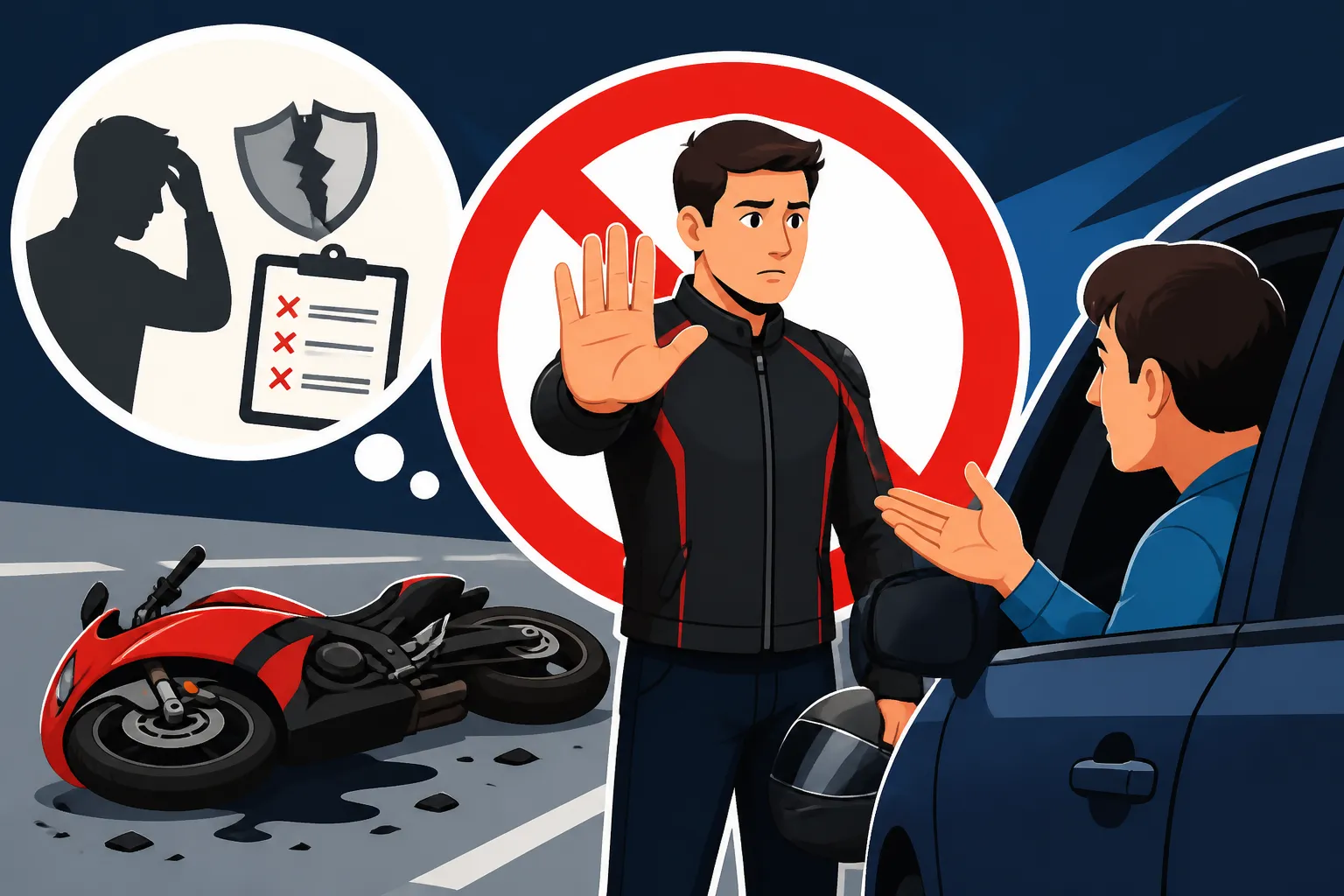
Why You Should Never Admit Fault at the Scene
In the chaotic, adrenaline-fueled moments right after a motorcycle accident, it's incredibly easy to say the wrong thing. Many riders, shaken and disoriented, might utter phrases like "I didn't see them" or "It was my fault," believing they're being honest or helpful. However, admitting fault, even partially, at the scene of a motorcycle crash can severely jeopardize your future claim and rightful compensation. This guide will meticulously explain why staying silent regarding fault is one of the most crucial actions you can take after an accident.
The Immediate Aftermath: Why Silence is Golden
When you've just been involved in a motorcycle accident, your mind and body are reeling. It's a high-stress, high-impact situation that can leave even the most seasoned rider completely disoriented. This isn't the time or place to make definitive statements about what happened or who was to blame.
Shock, Trauma, and Misinformation
Immediately following a collision, your body goes into fight-or-flight mode. Adrenaline surges, dulling pain and clouding judgment. You might be experiencing a range of intense emotions—fear, anger, confusion, or even an overwhelming desire to de-escalate the situation. In this state, your perception of events can be skewed. You might not fully grasp the sequence of events, the actions of other drivers, or the full extent of your own injuries.
For instance, you might genuinely believe you contributed to the crash because you were turning, even if the other driver ran a red light. Or, perhaps, another driver quickly blames you, and in your confused state, you internalize it. This isn't just about protecting yourself; it's about acknowledging that your immediate assessment of a complex incident is likely incomplete and potentially inaccurate. Trying to piece together what happened when you're hurt and overwhelmed is a recipe for misinformation.
The Legal Ramifications of an Admission
Any statement you make at the accident scene, especially one admitting fault, can and will be used against you. This isn't just a dramatic line from a TV show; it's a harsh reality. When you communicate with the police, other drivers, or even bystanders, your words are noted. If you tell the investigating officer, "I didn't see the car coming," that statement can become part of the official police report. If you apologize to the other driver with "I'm so sorry, I think I cut you off," that apology can be interpreted as an admission of legal liability.
These seemingly innocent remarks can severely undermine your ability to recover damages for your injuries, medical bills, lost wages, and property damage. Once an admission of fault is on record, it becomes incredibly difficult to refute later, even if further investigation proves you were not, in fact, at fault. Insurance companies, especially those dealing with motorcycle accident claims, are quick to seize on any such statements to deny or reduce your settlement.
How Fault is Determined and Why Your Initial Assessment Doesn't Matter
The process of determining fault in a motorcycle accident is far more complex than a quick statement at the scene. It involves a thorough investigation by multiple parties, none of whom rely solely on an emotional, immediate declaration of responsibility.
The Complexities of Accident Investigation
Establishing who is at fault in a motorcycle accident is a detailed, often lengthy, process. It typically involves:
- Police Reports: Law enforcement officers investigate the scene, gather witness statements, note physical evidence like skid marks and vehicle damage, and often make an initial determination of fault based on traffic laws. However, even police reports can sometimes get things wrong or be influenced by unconscious biases against motorcyclists. For a deeper dive into how fault is determined, you might find our guide on How Fault Is Determined in Motorcycle Accidents helpful.
- Insurance Adjusters: Both your insurance company and the other driver's insurer will conduct their own investigations. They'll review police reports, interview parties and witnesses, examine photos, and assess property damage. Their primary goal, especially for the other driver's insurer, is to limit their payout.
- Accident Reconstruction Experts: In more serious cases, especially those involving significant injuries or disputed fault, accident reconstructionists may be brought in. These experts use scientific principles, physics, and detailed data from the scene to recreate the accident and determine precisely how and why it occurred.
- Legal Professionals: Your attorney will conduct their own independent investigation, gathering evidence, identifying witnesses, and often challenging initial fault determinations made by police or insurance adjusters. They understand the nuances of Comparative Negligence in Motorcycle Accidents and work to prove the other party's negligence.
Given this intricate process, it's clear that your split-second impression of fault immediately after the crash is largely irrelevant to the official, legal determination. You simply don't have all the facts, the training, or the emotional detachment to make such a crucial judgment.
Comparative Negligence and Shared Responsibility
Many states operate under principles of comparative negligence, which acknowledge that fault in an accident isn't always black and white. It's often shared between multiple parties. For example, if a car made a sudden lane change into your path (a clear case of negligence ), but you were slightly speeding, you might be found partially at fault.
There are different types of comparative negligence, such as pure comparative negligence (where you can recover damages even if you're 99% at fault, though your payout is reduced proportionally) and modified comparative negligence (where you cannot recover if you are 50% or 51% or more at fault, depending on the state). This is why admitting "it was all my fault" when you might only be 10% responsible under the law is such a detrimental mistake. Such an admission can lead to a significant reduction in your potential settlement, or even bar you from recovery entirely. Our article on Shared Fault in Motorcycle Accidents offers a comprehensive overview of how shared fault can impact your claim.
| Action to Take at Scene | What to Say/Do | What to Avoid Saying/Doing |
|---|---|---|
| Safety First | Check for injuries, move to safety if possible | Downplaying injuries ("I'm fine"), ignoring pain |
| Information Exchange | Exchange only essential contact and insurance info | Discussing fault, apologizing, getting into arguments |
| Police Interaction | State facts clearly, be polite, provide required documents | Admitting fault, speculating, making excuses, fabricating details |
| Witnesses | Ask for contact information | Asking witnesses to lie or speculate |
| Documentation | Take photos, note conditions | Relying on memory alone |
| Medical Care | Seek medical attention, even for minor symptoms | Refusing medical care, minimizing symptoms |
| Fault | State "I don't know" or "I need to speak with an attorney" | "It was my fault," "I'm so sorry," blaming others aggressively |
Protecting Your Rights and Future Claim
Instead of admitting fault, your primary focus after an accident should be on your safety, getting medical attention, and gathering objective information. These actions are paramount to protecting your legal rights and potential for compensation.
What to Say and What to Avoid
When interacting with others at the scene, especially the other driver and law enforcement, practice restraint.
- To the Other Driver: Exchange only essential information: name, contact details, insurance information, and vehicle registration. Do not discuss the accident details, who was at fault, or the extent of injuries. A simple "Are you okay?" is acceptable, but do not apologize or make statements that could imply fault. If they press you, politely state, "I'm shaken up right now, and I need to let the police and insurance companies handle the details."
- To the Police: Cooperate fully, but stick to the verifiable facts. Provide your driver's license, registration, and insurance. Describe what you observed ("The car suddenly pulled out in front of me," or "I was proceeding straight when they turned left"). Avoid speculating or offering opinions about what caused the crash. If asked if you are injured, be honest, but don't downplay pain. If you're unsure about fault, it's perfectly acceptable to say, "I'm not sure what happened, I'm still trying to process it," or "I'll provide all the facts to my insurance company and attorney." Our guide on What to Say to Police After a Motorcycle Accident offers more detailed advice on this critical interaction.
- To Witnesses: Collect their contact information. Ask them what they saw, not what they think happened. Their objective observations can be vital evidence later.
Remember, your words at the scene are permanent. Once they're out there, they're part of the record.
The Importance of Documentation, Not Declaration
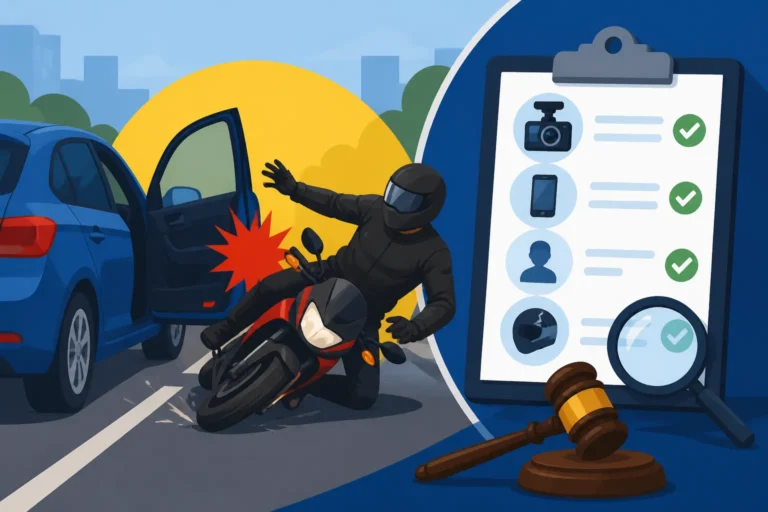
Instead of verbally declaring fault, focus your energy on thoroughly documenting the scene. This objective evidence speaks volumes and is far more reliable than emotional statements.
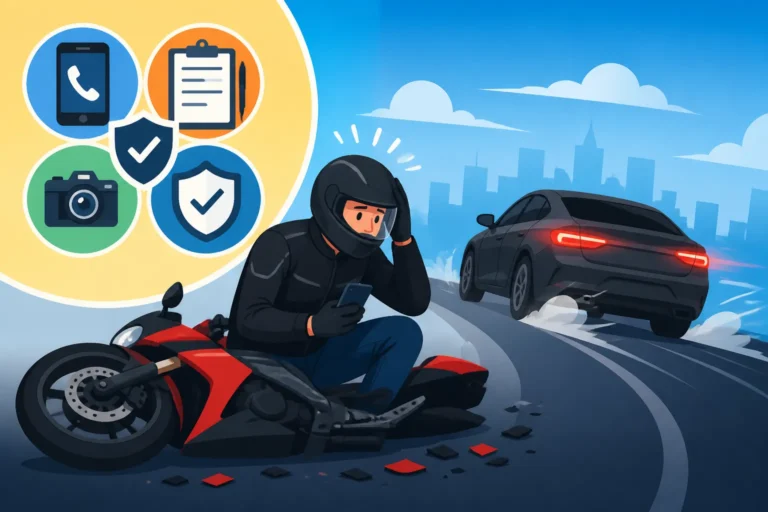
- Take Photos and Videos: Use your smartphone to capture extensive photos and videos of the accident scene. This includes:
- Damage to your motorcycle and the other vehicle(s) from multiple angles.
- The position of all vehicles involved.
- Skid marks, debris, and any other road evidence.
- Traffic signs, signals, and road conditions (potholes, gravel, construction).
- The general weather conditions and time of day.
- Your injuries, if visible, and any damaged gear.
These visual records are critical for proving fault and the extent of your damages, as detailed in How Lawyers Prove Fault and Damages .
- Collect Information: Get the other driver's name, contact information, insurance policy details, and license plate number. Note the make, model, and color of their vehicle. If there are any witnesses, get their names and phone numbers.
- Note the Environment: Jot down the exact location of the accident, the time, and any significant environmental factors.
By meticulously documenting the scene, you're building a strong foundation for your claim without making any potentially damaging statements about fault. This allows your legal team to build a case based on facts, not assumptions or misinterpretations. These visual records are crucial for your case.
The Long-Term Impact of an Early Admission
Admitting fault prematurely doesn't just make the immediate aftermath harder; it can have profound and lasting consequences on your ability to recover compensation and rebuild your life after a crash.
Insurance Companies and Their Tactics
Insurance companies are businesses, and their goal is to minimize payouts. They are incredibly skilled at leveraging any statement made at the scene, especially an admission of fault, to their advantage. If you tell the other driver's insurer, or even your own, that you were at fault, they will seize on that information.
They might use your statement to:
- Deny your claim outright: If you admit full fault, they may argue that their insured bears no responsibility for your injuries or property damage.
- Offer a significantly reduced settlement: Even if they don't deny it entirely, they'll use your admission to argue for a much lower payout, claiming you contributed heavily to the crash. This is a common tactic, as discussed in How Insurers Lowball Motorcycle Riders .
- Shift the burden of proof: Instead of them having to prove their driver wasn't at fault, your admission effectively shifts the burden to you to prove you weren't at fault. This can be an uphill battle.
Remember, the insurance adjuster is not on your side, even if they sound friendly and empathetic. Their job is to protect their company's bottom line. Any communication with them should be handled with extreme caution, ideally after consulting with an attorney.
Implications for Your Settlement
The most direct and painful consequence of admitting fault is the severe impact on your potential settlement. Motorcycle accident injuries are often catastrophic, leading to extensive medical bills, lost wages, and pain and suffering. If your claim is denied or significantly reduced because of a careless statement at the scene, you could be left footing the bill for expenses that are rightfully the other driver's responsibility.
For example, if you suffer a serious injury and your medical bills amount to tens of thousands of dollars, an admission of fault could prevent you from recovering any of that money. Even if you're only partially at fault in a comparative negligence state, your payout will be reduced by your percentage of fault. An early admission can be used to inflate your percentage of fault, severely cutting into the compensation you receive. Our article on How Comparative Negligence Reduces Your Payout explains how this works.
Fighting an unfair fault assignment or trying to undo an admission of fault requires significant legal expertise and resources. It can complicate your case, prolong the settlement process, and ultimately result in a much lower payout than you might have received if you had simply refrained from making any statements about fault. If you find yourself in a situation where fault is being unfairly assigned, it's crucial to understand comparative negligence and seek legal help.
In conclusion, while it might feel natural or even courteous to apologize or offer an explanation at the scene of a motorcycle accident, doing so can have devastating consequences for your physical and financial recovery. The best course of action is to prioritize your safety, seek medical attention, gather objective information, and reserve any discussions about fault for your attorney and insurance company after careful consideration and a full investigation.
Disclaimer
This article provides general informational guidance and does not constitute legal advice. Motorcycle accident laws vary significantly by state, and the specifics of your situation are unique. For personalized advice regarding your motorcycle accident claim, it is crucial to consult with a qualified legal professional in your jurisdiction.