How Much Can No Helmet Reduce a Settlement
Riding a motorcycle offers an unparalleled sense of freedom, but it also comes with unique risks. One of the most disheartening experiences after an accident, beyond the physical pain and financial stress, is when the insurance company tries to diminish your claim because you weren't wearing a helmet. It feels like they're blaming you for your injuries, even when someone else was clearly at fault. This guide will meticulously break down how not wearing a helmet can impact your settlement, what the "helmet defense" truly means, and how to navigate these challenging waters to protect your right to fair compensation.
The "Helmet Defense" in Motorcycle Accident Claims
It’s a tough reality, but insurance companies are in the business of minimizing payouts. When a motorcycle rider isn't wearing a helmet at the time of a crash, it hands them a powerful argument known as the "helmet defense." This isn't just a casual observation; it's a legal strategy designed to reduce the amount of compensation you might receive, particularly for head injuries.
What the Helmet Defense Entails
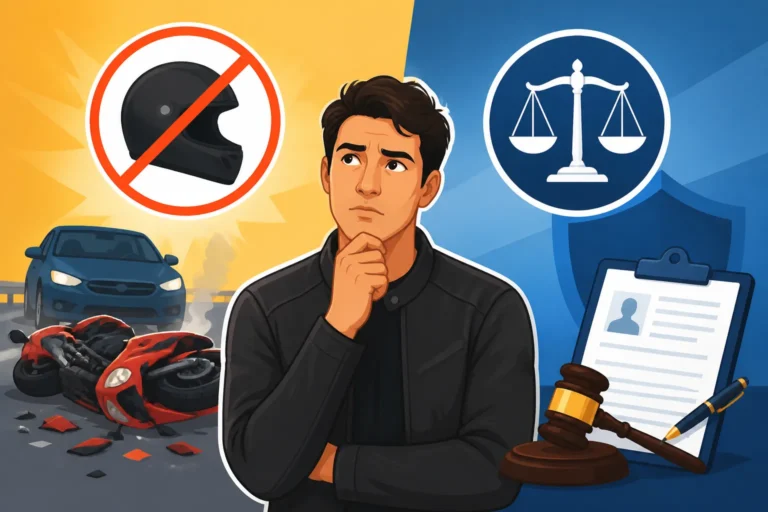
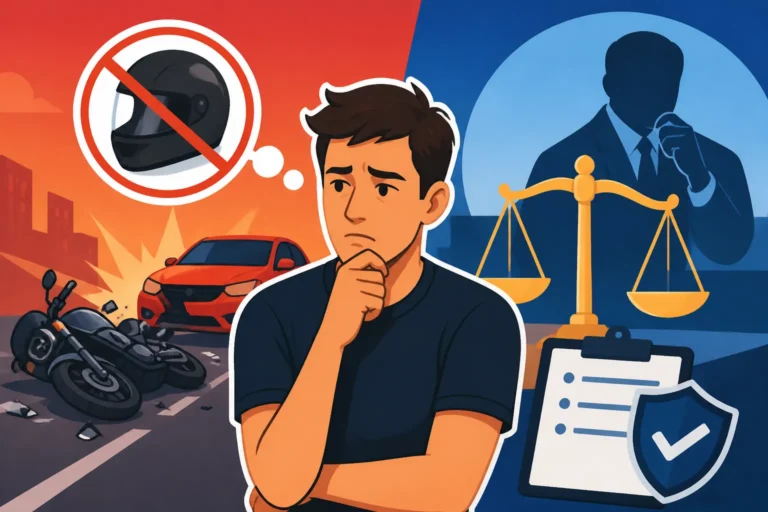
Essentially, the helmet defense is an assertion by the at-fault driver's insurance company that your injuries, specifically those to your head or brain, would have been less severe—or even entirely avoided—had you been wearing a proper, DOT-compliant helmet. They argue that your decision not to wear a helmet contributes to the extent of your own injuries, even if the other driver was primarily responsible for causing the accident itself. It places a portion of the blame for your injuries back on your shoulders.
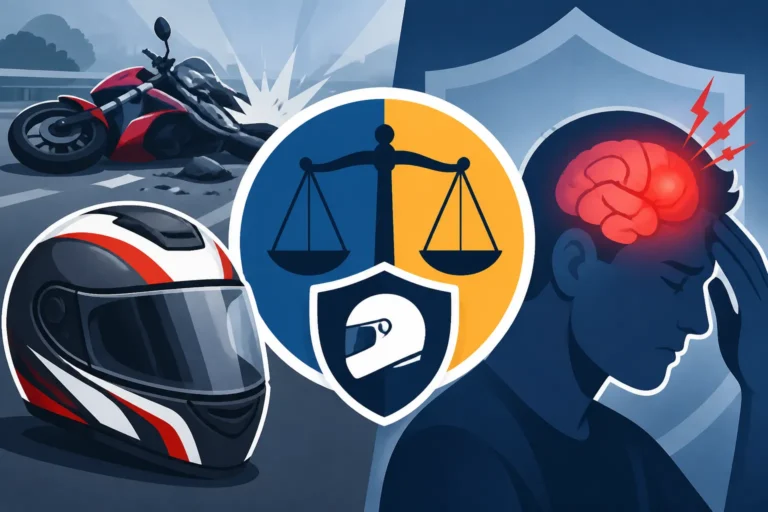
This defense doesn't necessarily mean you were at fault for the collision. It's about your responsibility to mitigate your own damages. Imagine you're riding your favorite route through the Pacific Coast Highway in California, and a distracted driver pulls out in front of you. Even if that driver is 100% at fault for the crash, their insurance company might argue that your traumatic brain injury, for example, could have been less severe if you had been wearing a helmet. They aren't saying you caused the crash, but that you contributed to the severity of your injuries. This nuanced distinction is incredibly important because it can directly affect your final settlement amount. The insurer's goal is to establish a causal link between your lack of a helmet and the severity of your head injuries, allowing them to reduce the payout they owe you.
Why Insurers Utilize This Argument
Insurance companies aren't trying to be malicious; they're simply operating within a framework designed to protect their bottom line. The helmet defense is a highly effective tactic for them to reduce payouts, especially given the catastrophic nature of many motorcycle head injuries. Without a helmet, riders are significantly more susceptible to severe head trauma, which often translates into higher medical bills, longer recovery times, and substantial pain and suffering. By successfully employing the helmet defense, an insurer can argue that a portion of these significant costs should not be their responsibility.
They'll often cite statistics about helmet effectiveness, even if those statistics aren't directly applicable to your specific accident. Their adjusters are trained to look for any factor that can shift liability, and the absence of a helmet is low-hanging fruit. It's a way for them to leverage a rider's personal choice against them in a settlement negotiation. This is why understanding The Helmet Defense Explained is so crucial, as it’s a standard play in the insurance company's playbook. They aim to exploit any perceived negligence on your part to lower the financial burden on their insured driver.
How State Helmet Laws Shape Your Case
The legal landscape surrounding motorcycle helmets varies dramatically from state to state, and these differences directly influence how the "helmet defense" can be applied to your claim. What might be a strong defense for an insurance company in one state could be a much weaker argument in another.
Universal Helmet Laws and Their Strictness
States with universal helmet laws, like California and Georgia, require all motorcyclists, regardless of age, to wear a DOT-compliant helmet. In these states, not wearing a helmet is not only a traffic violation but also a clear breach of state law. This makes it easier for an insurance company to argue that your failure to wear a helmet constitutes negligence or a failure to mitigate damages. If you sustain a head injury in a state with a universal helmet law while riding without one, the causal link between your non-compliance and your injury severity becomes harder to dispute.
For example, in California, if you're involved in a crash and suffered a traumatic brain injury (TBI) but weren't wearing a helmet, the opposing insurance company (and possibly a jury) will likely factor your violation of the law into the equation. This can lead to a significant reduction in the portion of your settlement allocated to your head injury damages. It's not just about what caused the crash, but what contributed to the severity of the specific injuries. The law in these states provides a clear standard of conduct, and deviating from it can have severe financial consequences for your claim. This is a primary reason why folks at places like Cycle Gear emphasize the importance of compliance with Motorcycle Helmet Laws by State.
Partial Helmet Laws and Exceptions
Many states operate under partial helmet laws. These laws typically require helmets for specific age groups (often riders under 18 or 21) or for riders who do not carry sufficient medical insurance coverage. Florida, for instance, requires riders under 21 to wear a helmet, and those 21 and older can ride without one if they carry at least $10,000 in medical benefits. Texas similarly has age restrictions, but allows exceptions for riders over 21 who complete a safety course or have specific insurance.
In states with partial helmet laws, the application of the helmet defense becomes more complex. If you are an adult rider over 21 in Florida, carrying the required insurance, and choose not to wear a helmet, you are not violating the law. In such a scenario, the insurance company's argument shifts from "you broke the law" to "you failed to exercise reasonable care to protect yourself." While not a legal violation, it can still be used to argue that you contributed to the severity of your injuries under comparative negligence principles. However, proving this might be more challenging for the insurer than in a universal helmet state. The legal framework provides a different battleground for these arguments, where the focus moves from statutory violation to general principles of personal responsibility.
States Without Helmet Mandates for Adults
A handful of states, such as Iowa and New Hampshire, have no helmet laws for adult riders (though New Hampshire still requires them for riders under 18). In these states, an adult rider has the legal right to choose whether or not to wear a helmet. This is where the helmet defense faces its toughest challenge. An insurance company cannot argue that you violated a law by not wearing a helmet if no such law exists for you.
However, even in these "no helmet law" states, insurers can still try to argue that your failure to wear a helmet constitutes a failure to mitigate damages or a lack of reasonable self-care. They might contend that a "prudent person" would wear a helmet, regardless of legal requirements. While this argument is generally weaker than in states with mandatory helmet laws, it's not impossible for an insurer to pursue. It highlights that the insurance company's primary goal remains the same: to find any viable path to reduce their payout, regardless of the explicit legal mandates. This nuanced scenario is precisely why understanding How Helmet Use Affects Comparative Negligence is vital, even in seemingly rider-friendly states.
Here's a quick overview of how helmet laws generally impact the helmet defense:
| State Helmet Law Type | Legal Obligation for Adults | Impact on Helmet Defense | Likelihood of Settlement Reduction for Head Injuries |
|---|---|---|---|
| Universal | Mandatory | Stronger | High |
| Partial | Conditional (age, insurance) | Moderate to Strong | Moderate, depending on compliance with exceptions |
| None | Optional | Weaker, but still possible | Low to Moderate, based on "reasonable care" argument |
Quantifying the Impact on Your Settlement
So, what does this "helmet defense" actually mean for the money you might receive in a motorcycle accident settlement? It's not just a theoretical argument; it has very real, tangible consequences for your financial recovery. Understanding how these reductions are calculated is key to protecting your claim.
The Principle of Comparative Negligence
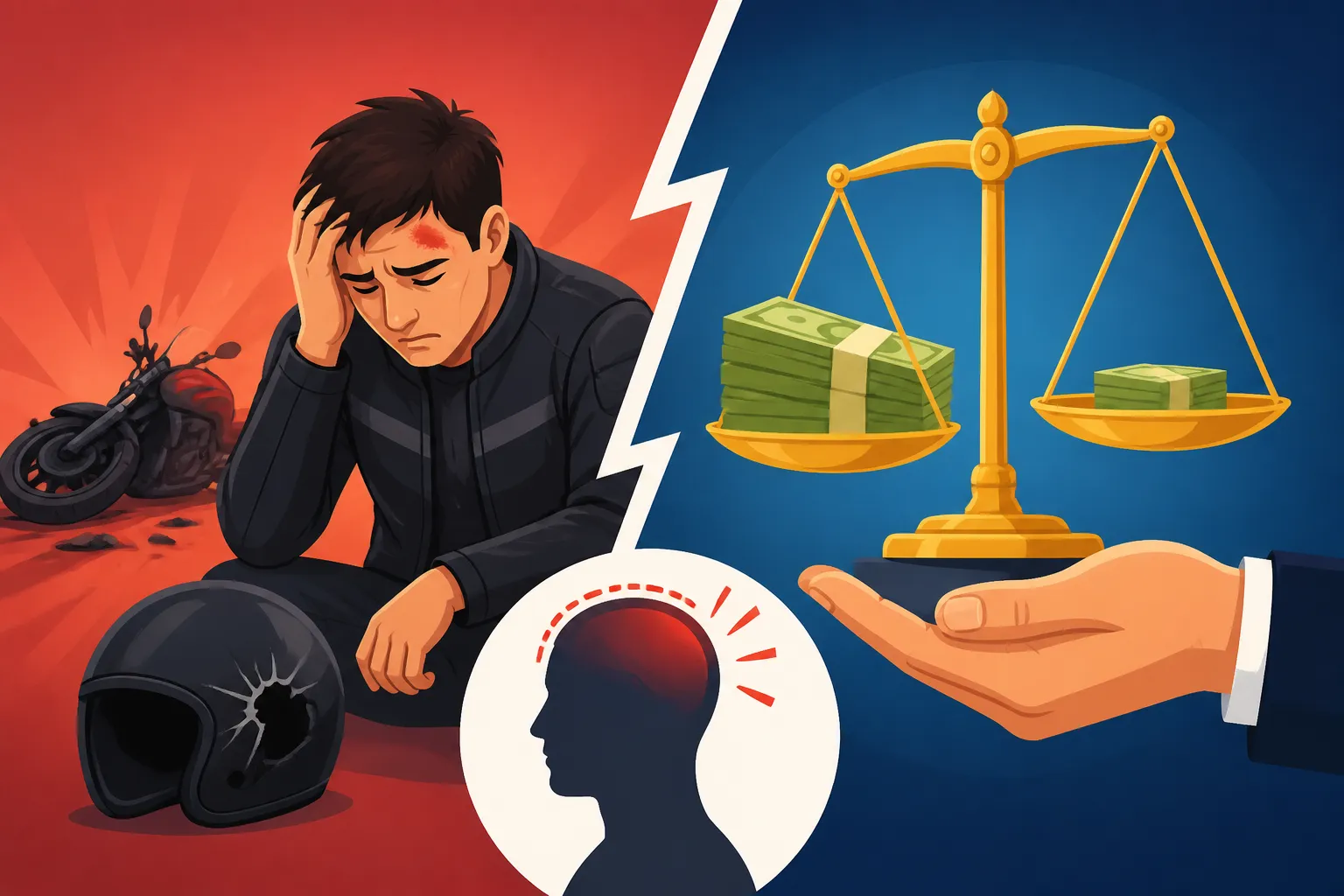
Most states in the U.S. follow some form of comparative negligence. This legal doctrine allows injured parties to recover damages even if they were partially at fault for their injuries, but their compensation will be reduced by their percentage of fault. For example, in a pure comparative negligence state like California, if your total damages are $100,000, but you are found 20% responsible for the severity of your head injury because you weren't wearing a helmet, your compensation for that specific injury portion would be reduced by 20%. So, if your head injury damages were $50,000, you'd only recover $40,000 for them. Other damages not related to the helmet (like a broken leg or property damage) generally wouldn't be affected by this specific argument.
The key here is that the helmet defense doesn't usually argue you caused the accident. Instead, it argues you contributed to the severity of your injuries. This is a crucial distinction. The process of determining fault, especially when it comes to comparative negligence, can be incredibly complex. Factors like driver distraction, road conditions, and adherence to traffic laws all play a role in establishing Who Is at Fault in a Motorcycle Accident. When a helmet isn't worn, it adds another layer to this already intricate assessment, specifically for head and brain injuries. The insurance company will push hard to assign as much blame as possible for those particular injuries to your decision not to wear proper gear from places like Cycle Gear.
Specific Damages Affected by Helmet Non-Use
When the helmet defense is successfully employed, it primarily targets damages related to head injuries. These can include:
- Medical Expenses for Head Trauma: Costs for emergency treatment, surgeries, medication, rehabilitation, and long-term care for conditions like concussions or Motorcycle Accident Traumatic Brain Injuries. If a helmet could have prevented or lessened these, a portion might be reduced.
- Pain and Suffering: The physical pain, emotional distress, and reduced quality of life stemming from head injuries. These subjective damages are often a significant part of a settlement, and a reduction here can dramatically impact your overall payout.
- Lost Wages and Earning Capacity: If a head injury prevents you from working or limits your future earning potential, the helmet defense might argue that your lack of a helmet contributed to this lost income, particularly if it's a severe TBI.
It’s important to remember that damages unrelated to head injuries, such as road rash, broken bones in other parts of your body, or damage to your motorcycle, are generally not subject to the helmet defense. These damages were not (or could not have been) mitigated by wearing a helmet. For instance, if you suffered a severe broken leg and were riding without a helmet, the insurance company would be hard-pressed to argue that the helmet would have prevented your leg injury. Therefore, a successful helmet defense would typically only reduce the portion of your claim directly linked to head and brain injuries. Understanding How Comparative Negligence Reduces Your Payout for each category of damages is essential for a comprehensive claim.
Protecting Your Claim Against the Helmet Defense
Even if you weren't wearing a helmet, all hope is not lost for your motorcycle accident claim. While it's certainly a hurdle, there are proactive steps and legal strategies that can be employed to counter the helmet defense and still secure fair compensation for your injuries. This requires a nuanced understanding of accident reconstruction, medical causation, and legal precedent.
Proving No Causal Link
One of the most powerful ways to fight the helmet defense is to demonstrate that the absence of a helmet did not cause or worsen your specific injuries, or that the accident itself was so severe that a helmet wouldn't have made a material difference. This involves a thorough investigation into the physics of the crash and the nature of your injuries. For instance:
- Impact Points: If your head did not strike anything during the accident, or if the primary impact was to another part of your body (like your chest or legs), then the lack of a helmet becomes less relevant to your head's condition. Photos from the scene, vehicle damage reports, and witness statements can help establish what parts of your body, if any, made contact with the road or other objects.
- Injury Type: Not all head injuries are caused by direct impact. Whiplash, for example, can cause concussions or other brain injuries due to rapid acceleration and deceleration forces, regardless of helmet use. If your medical records indicate such a mechanism of injury, it can weaken the helmet defense.
- Severity of Impact: In some catastrophic collisions, the forces involved are so extreme that even the most robust helmet might not prevent severe head injury. While this is a harder argument to make, it's not impossible if the evidence supports it.
Gathering detailed medical records, physician statements, and accident reconstruction reports are vital to building this argument. An experienced motorcycle accident lawyer will work closely with experts to analyze the data and present a compelling case that breaks the direct causal link the insurance company tries to establish between helmet non-use and injury severity.
Expert Witness Testimony
When countering complex arguments like the helmet defense, expert witnesses become invaluable. These professionals can provide authoritative opinions that lend significant weight to your claim:
- Accident Reconstructionists: These experts can analyze skid marks, vehicle damage, debris fields, and impact angles to determine precisely how the accident occurred and what forces were exerted on your body. They can often provide insights into whether a helmet would realistically have prevented or reduced the specific head injuries you sustained. They might be able to testify, for example, that the impact forces were concentrated on your torso, or that your head never actually made ground contact.
- Medical Experts: Neurologists, trauma surgeons, and other medical specialists can explain the exact nature of your head injuries, their specific causes, and how they would have likely manifested even with helmet use, given the circumstances. They can clarify that certain injuries, like a whiplash-induced concussion, are less about direct impact and more about the brain shifting within the skull due to violent motion.
These experts essentially provide a scientific and medical rebuttal to the insurance company's generalized claims. Their detailed analysis can dismantle the causal link that the opposing side is trying to establish, making it much harder for them to reduce your settlement amount significantly.
Documenting Other Injuries and Damages
It's crucial to remember that the helmet defense typically only targets head injuries. Any other injuries you sustained, such as broken bones, [Motorcycle Road Rash], spinal injuries, or internal injuries, are generally not affected by whether or not you wore a helmet. These non-head-related damages should still be fully recoverable.
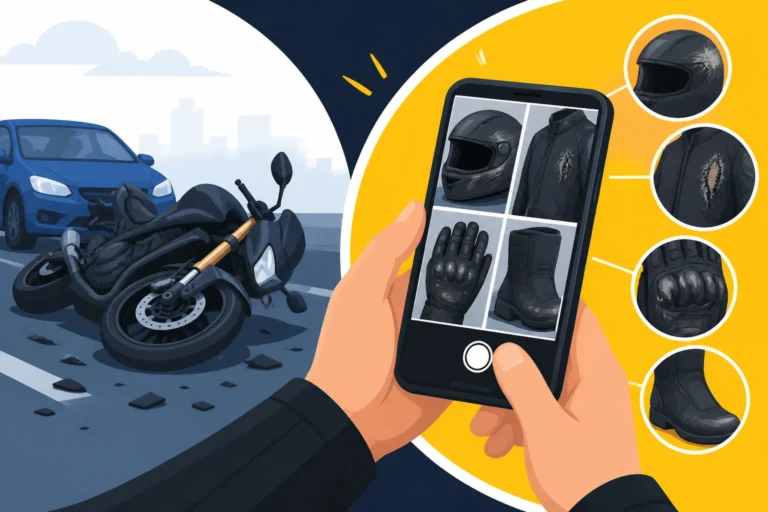
This is why meticulous documentation of all your injuries is paramount. Keep detailed records of every medical visit, diagnosis, treatment, and medication. Take photographs of all injuries, including road rash and bruising, as they progress through healing. Also, accurately track all your medical bills, lost wages, and any property damage to your motorcycle or gear. Even if some portion of your head injury claim is reduced, ensuring that your other damages are fully accounted for and aggressively pursued can still result in a substantial settlement. For more guidance on this, refer to our article on How to Document Injuries for a Claim. Remember to keep damaged gear, like jackets, gloves, or even what’s left of your bike, as evidence. Many riders buy quality gear from retailers like Cycle Gear specifically for protection, and the damage to it can speak volumes about the crash's severity.
The Importance of Legal Counsel
Navigating a motorcycle accident claim where the helmet defense is raised is incredibly challenging. Insurance companies are skilled at exploiting this argument, and trying to handle it on your own can lead to a significantly reduced settlement or even a denied claim. This is where an experienced motorcycle accident lawyer becomes indispensable.
A lawyer specializing in motorcycle accidents understands the nuances of helmet laws in your state, the intricacies of comparative negligence, and how to effectively counter the helmet defense. They will:
- Investigate thoroughly: Gather all necessary evidence, including police reports, medical records, witness statements, and accident reconstruction data.
- Engage Experts: Connect you with the right accident reconstructionists and medical professionals to build a strong case against the helmet defense.
- Negotiate Aggressively: Confront the insurance company's arguments directly, using evidence and legal precedent to protect your claim's value.
- Represent You in Court: If negotiations fail, they will be prepared to take your case to trial, presenting your evidence to a judge or jury.
Having a dedicated advocate on your side, especially one who understands the inherent biases against motorcyclists, can make all the difference. While the question of Are Motorcycle Accidents Usually the Rider's Fault is often debated, a skilled attorney can ensure that an unfair helmet defense doesn't unfairly punish you. Consulting with an attorney early in the process is one of the most critical steps you can take to maximize your recovery.
Disclaimer
Please remember that this article provides general information and insights into motorcycle accident claims and the helmet defense. It is not a substitute for professional legal advice. Every accident and claim is unique, and the laws governing motorcycle accidents vary significantly by state. For personalized advice regarding your specific situation, you should consult with a qualified motorcycle accident attorney in your jurisdiction.