Motorcycle Turn Signal Requirements
Riding a motorcycle offers unparalleled freedom, but it also comes with a unique set of responsibilities and challenges, especially when it comes to legal requirements for your bike. One area that often causes confusion and frustration for riders is turn signal requirements. These aren't just minor details; understanding and complying with them is critical for your safety on the road and can even impact you significantly if you ever find yourself in an accident. This comprehensive guide aims to demystify motorcycle turn signal laws, helping you navigate the specifics to ensure you're riding safely and legally.
Understanding the Legal Landscape of Motorcycle Turn Signal Requirements
It's easy to assume that a turn signal is just a turn signal, but the reality in the world of motorcycling is far more nuanced. What's perfectly fine in one state might be a ticketable offense in another. This patchwork of regulations can be maddening, but knowing the lay of the land is your first line of defense.
Federal Guidelines and State-Specific Mandates
At a fundamental level, the U.S. federal government sets certain safety standards for vehicles sold in the country, including motorcycles. These are often referred to as Federal Motor Vehicle Safety Standards (FMVSS). For lighting, FMVSS 108 dictates general requirements for lamps, reflective devices, and associated equipment. This means that any new motorcycle sold in the United States must comply with these standards, which typically include turn signals.
However, here's where it gets tricky: while federal standards guide manufacturers, it's actually individual states that pass laws governing whether turn signals are required equipment for all motorcycles, regardless of their age, or if hand signals can suffice, especially for older bikes.
For instance, many states mandate turn signals on any motorcycle manufactured after a certain year, often the early 1970s. If your vintage hog rolled off the line before that cutoff, you might legally be allowed to use only hand signals, provided you know them and use them properly. But even then, some states have moved towards requiring turn signals on all motorcycles currently on the road, regardless of their original manufacturing date. This is why a motorcycle perfectly legal in Pennsylvania, where older bikes might be exempt from turn signal requirements if they were not originally equipped, might face scrutiny in California, which generally enforces universal turn signal requirements. Always check your specific state's Department of Motor Vehicles or equivalent transportation agency for the most up-to-date information.
The Critical Role of Turn Signals in Preventing Accidents
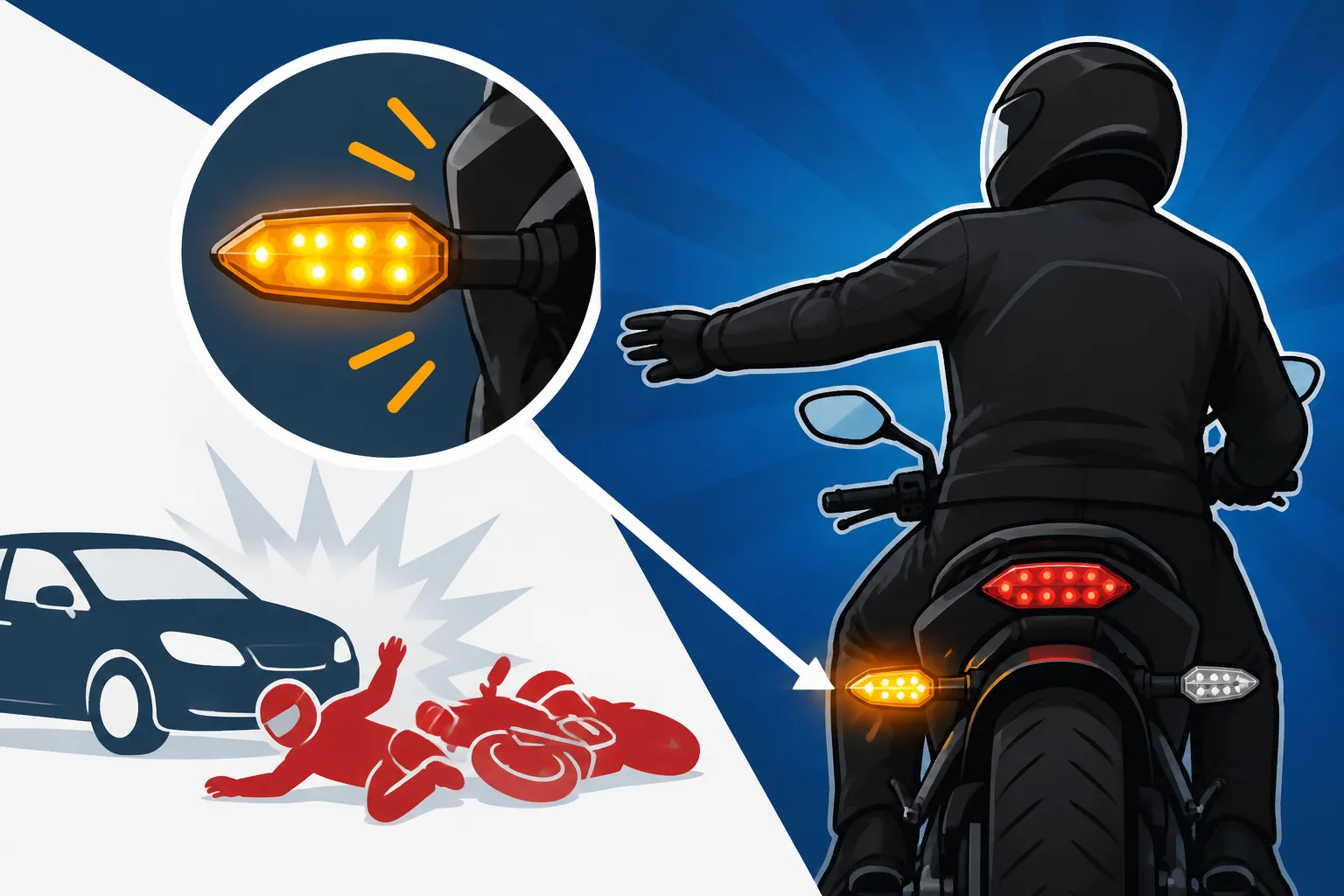
Beyond the legalities, turn signals are fundamentally a safety device. As riders, we're acutely aware of how often drivers claim they "didn't see" us. Turn signals are your primary tool for communicating your intentions to other road users, reducing ambiguity and giving them crucial time to react.
Imagine you're cruising down a busy street in Miami and need to make a left turn. Without a clear signal, the driver behind you or oncoming traffic might not anticipate your maneuver. This lack of clear communication is a major contributor to accidents, especially common scenarios like Left-Turn Motorcycle Accidents Explained. A car turning left in front of you, or a car behind you attempting to pass while you're initiating a turn, can lead to devastating collisions. Your turn signals are a universal language on the road, telling everyone exactly where you intend to go.
They are also vital when you're changing lanes. An Unsafe Lane Changes Motorcycle Accident can often be avoided if you signal your intention well in advance, giving the drivers around you sufficient notice to adjust their speed or lane position. It's not just about obeying the law; it's about proactively protecting yourself by broadcasting your movements as clearly as possible. A bright, properly functioning turn signal cuts through the visual noise of traffic and helps prevent those dangerous "I didn't see you" moments that can have severe consequences for motorcyclists.
Diving Into Specific State Requirements for Motorcycle Turn Signals
The variation in state laws can be a real headache. Let's break down some common scenarios and specific rules you might encounter.
Mandatory Equipment vs. Permissible Hand Signals
Most states today lean towards making turn signals mandatory equipment for all motorcycles. This is often an update from older laws that grandfathered in vintage bikes. For example, states like California and Florida generally require all motorcycles to be equipped with and use functional turn signals. This means if you're riding your beloved vintage Triumph in these states, and it didn't come with factory turn signals, you'd likely need to install aftermarket ones to be compliant.
However, some states, particularly those with a strong classic vehicle culture, might still have provisions where hand signals are acceptable if the motorcycle was not originally manufactured with turn signals. For instance, in some parts of Ohio or Pennsylvania, if your antique Harley-Davidson rolled off the assembly line in 1965 without electronic turn signals, you might still legally use proper hand signals to indicate turns and lane changes. But let's be realistic: in today's fast-paced traffic, relying solely on hand signals, while legal in some niche cases, can significantly reduce your visibility and reaction time for other drivers. It's generally safer to have and use electronic signals whenever possible.
When hand signals are permitted, there are strict guidelines on how they must be performed. The Uniform Vehicle Code (which many states base their laws on) specifies distinct hand signals for left turn, right turn, and slowing/stopping. These signals must be clear, unambiguous, and held long enough to communicate intent effectively.
Design, Placement, and Visibility Standards
Beyond just having turn signals, states also regulate their design, placement, and how visible they need to be. These aren't arbitrary rules; they're designed to ensure your signals are actually seen by other drivers.
Typically, turn signals must emit an amber light both to the front and rear. However, some states allow red rear turn signals. There are also usually minimum and maximum height requirements for their placement on the motorcycle. For example, turn signals usually need to be mounted at least 15 inches off the ground, but not more than 83 inches. They also often require a certain separation distance between the two front signals and the two rear signals to ensure they are distinct and recognizable as a turn indicator, not just a running light. In many states, the rear signals need to be at least 8 inches apart.
Visibility is key, and signals must be visible from specific distances (e.g., 100 feet in normal sunlight) and from certain angles. This is where integrated tail lights, which combine brake lights and turn signals into one unit, can sometimes be a gray area. While many are legal, some designs might not provide sufficient separation or distinctiveness for the turn signal function to meet all state requirements. If you're considering an integrated unit, it's wise to check local laws or consult with an expert at a specialty retailer like Cycle Gear to ensure the product meets all regulatory standards for your area.
State-Specific Examples of Turn Signal Laws
To illustrate the diversity, let's look at a few state examples:
- California: Known for its comprehensive motor vehicle laws, California generally requires all motorcycles to have operational front and rear turn signals. The state's Vehicle Code specifies requirements for signal color (amber to the front, red or amber to the rear), visibility, and activation. If your bike was manufactured after 1972, turn signals are mandatory. Given that California also has Universal vs Partial Helmet Laws Explained, it's clear they prioritize robust safety equipment.
- Texas: Similar to California, Texas law mandates turn signals on motorcycles, particularly those manufactured after 1975. The signals must be clearly visible and emit an amber light to the front and an amber or red light to the rear. Hand signals are generally only permitted if the motorcycle is not equipped with turn signals (which for newer bikes is usually not the case) or if the signals are temporarily malfunctioning.
- Florida: Florida Statute 316.222 specifies that every motor vehicle, including motorcycles, must be equipped with turn signal lamps. These must be visible from a distance of at least 100 feet during daylight and night. Florida's commitment to clear road signaling is part of its broader focus on road safety.
- New York: New York Vehicle and Traffic Law generally requires turn signals on all motorcycles manufactured after 1971. Like other states, it sets standards for color and visibility.
As you can see, while there are common threads, the specifics can differ. A quick search of your state's motor vehicle code can save you from an unexpected ticket or, more importantly, a dangerous situation.
Navigating Challenges with Motorcycle Turn Signals
Beyond simply knowing the laws, there are practical challenges and misconceptions surrounding turn signals that every rider should be aware of. What you do with your signals, or even how you choose them, can have significant implications.
Aftermarket Modifications and Legal Compliance
Many riders love to customize their bikes. Aftermarket turn signals, whether they're sleek flush-mount LEDs, sequential signals, or mini bullet lights, are popular upgrades. The problem is, some of these modifications, while aesthetically pleasing, might not meet state or federal visibility requirements.
For example, ultra-small flush-mount LED signals might look clean, but if they aren't visible from a sufficient angle or distance, they could be deemed non-compliant. Sequential signals, which light up in a flowing pattern, are legal in many places, but their legality can depend on the specific state and if they meet the required illumination and visibility standards for the entire duration of the signal. If you're buying new turn signals, always ensure they are DOT (Department of Transportation) compliant. This usually means they've met minimum safety standards. When you're browsing for parts, whether online or at a store like Cycle Gear, prioritize those explicitly labeled as DOT compliant. Don't sacrifice safety and legality for a cool look; a ticket is annoying, but an accident is devastating.
Maintenance, Malfunctions, and Their Implications
It's easy to take your turn signals for granted, but a non-functional signal is not only a safety hazard but also a legal liability. A burnt-out bulb or a wiring issue can lead to a traffic citation. Beyond that, if you're involved in an accident and your turn signal was not working, or if you failed to use it, the other party's insurance company could attempt to assign a portion of fault to you. This is a critical point: How Traffic Violations Affect Fault in an accident claim can significantly reduce the compensation you receive.
It's crucial to make a quick check of your turn signals (both front and rear) a part of your pre-ride routine. Just a quick flick of the switch before you hit the road can confirm they're all working. If one is out, get it fixed immediately. Neglecting simple maintenance like this can have disproportionate consequences if you end up in a crash. Replacing a bulb is far cheaper and less stressful than fighting an insurance company over perceived negligence.
The "Helmet Defense" and Turn Signal Negligence in Accident Claims
While the term "helmet defense" specifically refers to arguments against injury claims when a rider wasn't wearing a helmet (or a DOT-compliant one), the underlying principle applies to other forms of rider negligence, including turn signal use. Insurance companies are always looking for ways to minimize payouts, and they will scrutinize every detail of an accident.
If you fail to use a working turn signal and are involved in a collision, the other driver's insurance company will almost certainly argue that your negligence contributed to the crash. This falls under the legal concept of Comparative Negligence in Motorcycle Accidents, where fault can be shared between parties. If you're found even partially at fault, your potential settlement can be reduced proportionally. For instance, if you had $100,000 in damages but were deemed 20% at fault for not signaling, you might only recover $80,000.
In states with Pure vs Modified Comparative Negligence rules, this can play out differently. In a pure comparative negligence state like California, you can recover damages even if you're 99% at fault, though your recovery will be minuscule. In a modified comparative negligence state (e.g., Texas, where you typically can't recover if you're 51% or more at fault), failing to signal could push you over that threshold, barring you from any recovery.
This isn't to say that the other driver is absolved if you didn't signal, especially if they were clearly at fault for something like distracted driving or speeding. However, it gives the insurance company leverage. This is part of How Insurance Companies Assign Blame to Riders. Always remember, after an accident, what you say and what evidence exists about your actions (or inactions) can be used to determine How Fault Is Determined in Motorcycle Accidents. Proving Fault in a Motorcycle Accident can be an uphill battle, and anything that weakens your case, like a lack of proper signaling, makes it harder.
Enhancing Visibility and Proactive Safety
Meeting the minimum legal requirements for turn signals is a good start, but as riders, we know that "minimum" isn't always "safe" or "optimal." Taking proactive steps to enhance your visibility goes a long way in preventing accidents and safeguarding your claim should the worst happen.
Beyond Minimum Requirements: Maximizing Your Presence
Think of your turn signals as just one part of your overall visibility strategy. While they tell others where you're going, you want to ensure you're seen long before you even need to signal. Many riders opt for brighter, more robust LED turn signals, even if their stock signals are technically compliant. LED signals consume less power and are significantly brighter, making your intentions clearer, especially in bright sunlight.
Consider auxiliary lighting systems that incorporate turn signals or supplement your existing ones. Some aftermarket kits provide additional amber running lights that flash brighter when the turn signal is activated, creating a larger, more noticeable signal. You can find a wide array of these options, including various types of Motorcycle Equipment Laws You Should Know and specific upgrades, at reputable motorcycle gear shops like Cycle Gear. These investments aren't just about aesthetics; they're about survival. Every extra lumen of light, every additional flash, increases your chance of being seen and understood on the road.
Moreover, while turn signals are crucial, they are part of a larger safety ecosystem. Understanding other Motorcycle Gear Laws and Requirements and ensuring your overall riding gear is highly visible (bright colors, reflective elements) further contributes to your safety.
Developing Good Signaling Habits
Ultimately, even the brightest, most compliant turn signals are useless if you don't use them. Developing consistent, early signaling habits is one of the most effective ways to prevent accidents.
- Signal Early: Don't wait until the last second. Activate your turn signal well in advance of your turn or lane change. This gives other drivers ample time to see your signal, process it, and react appropriately. On a highway, this might mean signaling for several seconds and observing traffic before initiating a lane change. In a city, it means signaling as you approach an intersection, not in the middle of it.
- Signal Consistently: Make it a habit to signal every single time, even if you think no one else is around. Sometimes, a vehicle you didn't see is in your blind spot, or a pedestrian is about to step into your path. Consistency builds muscle memory and ensures you're never caught off guard.
- Cancel Your Signal: Just as important as activating your signal is cancelling it after your maneuver is complete. A flashing signal that's not indicating an active turn can be confusing and lead other drivers to misinterpret your intentions, potentially causing an accident.
- Combine with Head Checks: Your turn signal is a communication tool, not a substitute for active observation. Always combine signaling with thorough head checks to confirm your path is clear before moving.
By integrating these practices, you're not just following the law; you're actively engaging in defensive riding that prioritizes your safety.
Overview of Turn Signal Regulations by Type
Here's a quick look at how different aspects of turn signal regulations typically stack up across various states. Keep in mind that specific distances, angles, and exceptions can vary greatly, so always verify your local laws.
| Feature | Common Requirement | Potential State Variations/Nuances |
|---|---|---|
| Mandatory Use | Required on all motorcycles manufactured after a specific year (e.g., 1970s). | Some states (e.g., California, Florida) require signals on all motorcycles currently on the road. Others (e.g., some older bikes in PA/OH) allow hand signals if not factory-equipped. |
| Signal Color | Front: Amber. Rear: Amber. | Many states also permit red rear turn signals (e.g., Texas, New York). |
| Visibility | Visible from 100-500 feet (day/night) from front and rear, within specific angles. | Specific minimum candlepower/lumens might be defined. Integrated tail lights must still provide distinct turn indication. Aftermarket signals must meet these visibility criteria. |
| Placement | Minimum height (e.g., 15 inches from ground) and maximum height (e.g., 83 inches). Minimum separation distance (e.g., 8 inches rear, 16 inches front). | Specific mounting points might be required (e.g., not under the seat). Some states have more lenient rules for custom bikes, while others are very strict. |
| Hand Signals | Permissible only if the motorcycle is not equipped with functional electronic turn signals or during temporary malfunction. | Specific hand signals for left, right, and stop/slow must be used clearly and for a reasonable duration. In states where electronic signals are mandatory for all bikes, hand signals alone are generally insufficient for primary communication, though they remain good practice for reinforcement. |
| Maintenance | Signals must be in proper working order. | Failure to maintain can result in traffic citations and potentially be used as evidence of comparative negligence in an accident claim, significantly impacting your settlement amount. This is why it's so important to perform regular What to Do Immediately After a Motorcycle Accident if a crash occurs. |
| Aftermarket Mods | Must comply with all state and federal requirements for visibility, color, and placement. | Smaller, flush-mount, or sequential LEDs can be risky if they don't meet visibility standards. Always look for DOT compliance. Consider asking an expert at your local Cycle Gear if a specific aftermarket product is legal in your state. |
Knowing these details is part of being a responsible and safe rider. While no one wants to think about the aftermath of an accident, being compliant with all vehicle laws, including those for turn signals, can play a significant role if you ever need to pursue a motorcycle accident claim.
Disclaimer
Please remember that this article provides general information and insights into motorcycle turn signal requirements and related legal concepts. Laws can change, and interpretations vary by jurisdiction. This content is not a substitute for professional legal advice. For specific guidance on your situation or the laws in your state, it is always recommended to consult with a qualified legal professional specializing in motorcycle accident law.