Do You Need Mirrors on a Motorcycle
Riding a motorcycle offers a unique sense of freedom and connection to the open road, but it also comes with a host of responsibilities, not least of which is understanding the legal and safety requirements for your bike. Many riders wonder about the necessity of mirrors, often debating aesthetics versus utility or grappling with conflicting information. This guide will clarify whether mirrors are legally required on your motorcycle and delve into their critical role in your safety and, crucially, how their presence (or absence) can impact you in the unfortunate event of a motorcycle accident claim.
The Legal Landscape of Motorcycle Mirrors
One of the most common questions riders have is about the legal necessity of mirrors. It’s not just a matter of personal preference; federal and state laws often dictate whether you need one, two, or even none in specific circumstances. Understanding these laws is paramount to avoiding tickets and, more importantly, protecting yourself.
State-by-State Mirror Requirements
While the federal government sets some baseline standards for new motorcycles sold in the U.S., state laws are what truly govern a rider's obligations on the road. This is where things can get a little murky and frustrating for riders who travel across state lines or live near borders.
Most states, like California, Texas, and Florida, require at least one rear-view mirror on a motorcycle. Many of these states specify that the mirror must be mounted to provide a clear view of the highway to the rear for a certain distance, typically 200 feet. However, some states, such as New York, mandate two mirrors for motorcycles. These usually specify one on the left and one on the right, ensuring a broader field of vision. The specific placement and size might also be detailed, though usually in general terms to allow for various motorcycle designs. It’s not uncommon to see riders pulled over for having mirrors that are too small, obstructed, or missing entirely, especially in areas with strict enforcement. Before hitting the road, especially for a long trip, it's a good idea to check the specific motorcycle equipment laws in any state you plan to ride through.
Federal vs. State Regulations
The federal government, through the National Highway Traffic Safety Administration (NHTSA), sets Federal Motor Vehicle Safety Standards (FMVSS). For motorcycles, FMVSS No. 111, for example, addresses rear visibility systems. These standards generally apply to manufacturers, dictating what equipment new motorcycles must come with when they roll off the assembly line. This typically includes at least one rear-view mirror.
However, once a motorcycle is purchased and registered, state laws take precedence for daily operation. This means that while your new Honda Rebel might have come with two mirrors to meet federal standards, if you live in a state like Arizona where only one mirror is legally required, you might theoretically be able to remove one without violating state law (though we'll discuss why that's a bad idea for safety). Conversely, if you bought a vintage bike that originally came with only one mirror and you live in a two-mirror state like Maryland, you'd be required to add another to be street-legal. The disconnect can be confusing, but remember that the state law where you are currently riding is the one you need to adhere to.
Consequences of Non-Compliance
Riding without legally required mirrors isn't just a minor infraction; it can have significant repercussions. The immediate consequence is usually a traffic citation, which can range from a minor fix-it ticket to a substantial fine depending on the jurisdiction and officer's discretion. In some places, it could even lead to your motorcycle being impounded until it's brought into compliance.
Beyond the immediate legal trouble, non-compliance can severely impact your position in a motorcycle accident claim. If you're involved in a crash and it's discovered that your motorcycle didn't have the legally required mirrors, or they were improperly installed or maintained, the opposing party's insurance company (or their legal team) will almost certainly use this against you. They might argue that your lack of proper mirrors contributed to the accident or prevented you from avoiding it, potentially reducing your compensation under principles of Comparative Negligence in Motorcycle Accidents. Even if the other driver was clearly at fault, this non-compliance creates a difficult hurdle to overcome, highlighting the importance of understanding all Motorcycle Equipment Laws and Requirements.
Beyond the Law: Why Mirrors are Essential for Safety
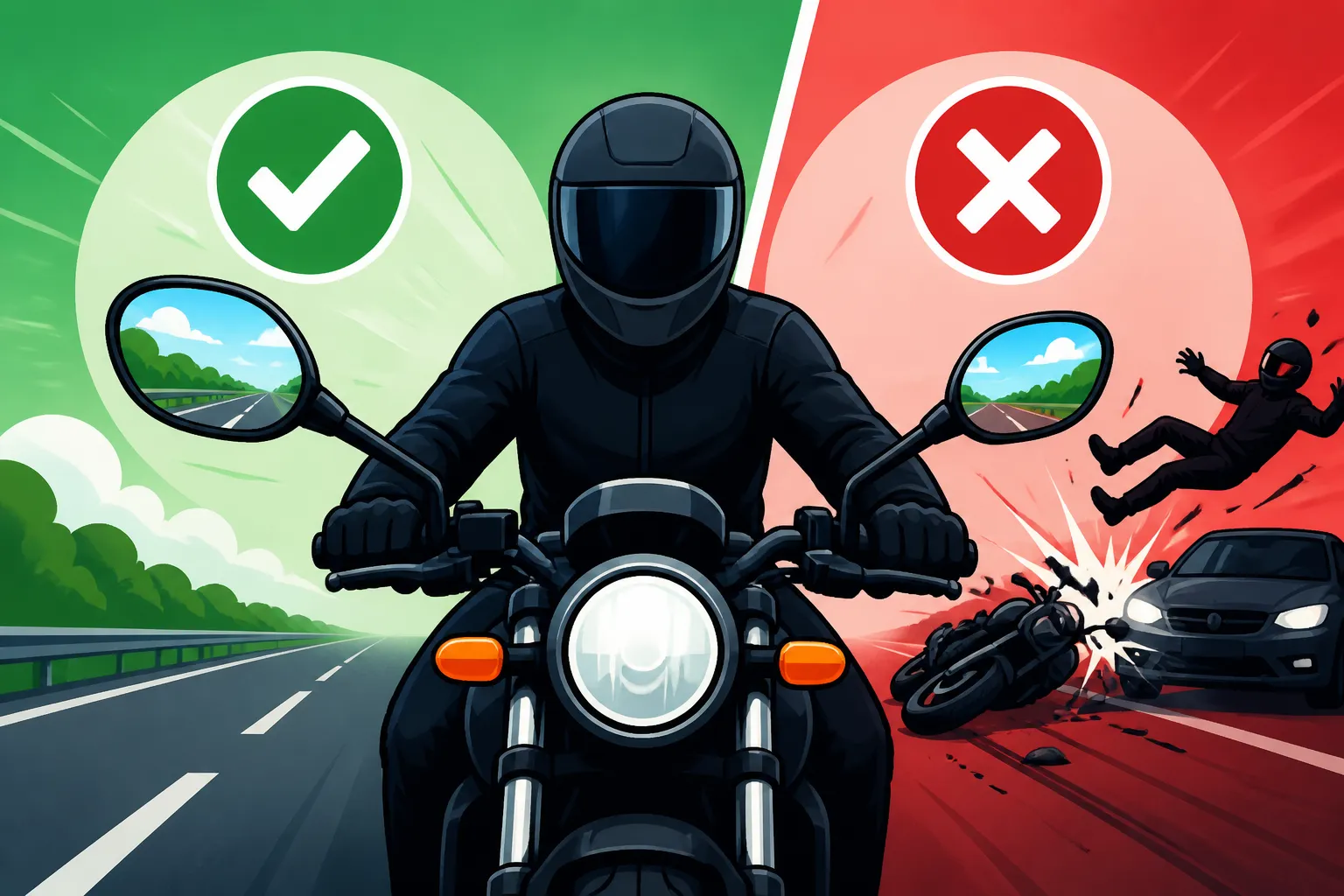
While legal requirements provide a floor, true motorcycle safety demands more than just bare minimum compliance. Mirrors are not just a bureaucratic mandate; they are fundamental tools that significantly enhance a rider's ability to navigate traffic safely and react to changing road conditions. Ignoring their importance is akin to riding blindfolded.
Enhancing Situational Awareness
Think of your mirrors as extensions of your peripheral vision, giving you crucial information about what's happening around you without forcing you to constantly turn your head. On a motorcycle, maintaining situational awareness is a dynamic, continuous process. You're not just looking forward; you're constantly scanning your surroundings, predicting potential hazards, and identifying escape routes.
Mirrors provide real-time updates on traffic approaching from behind, vehicles in adjacent lanes, and even the intentions of drivers around you. Are they preparing to pass? Are they drifting into your lane? Is there an emergency vehicle behind you? This continuous feed of information allows you to anticipate movements, adjust your speed, and position yourself defensively. Without effective mirrors, you're constantly guessing, and guessing is a luxury no rider can afford. Many Common Causes of Motorcycle Accidents stem from a lack of situational awareness or a driver failing to see a motorcycle, and good mirrors go a long way in countering that.
Blind Spots and Shoulder Checks
It’s a common misconception that mirrors eliminate blind spots. They don’t. Every mirror, no matter how well-adjusted, will have areas it simply cannot show you. This is particularly true for motorcycles, where blind spots can be surprisingly large, especially when dealing with larger vehicles like trucks or SUVs. This is precisely why the shoulder check, or "head check," is an indispensable part of safe riding.
However, mirrors drastically reduce the size of your blind spots and allow you to quickly assess most of the critical zones around your bike. They give you the initial information you need to decide when and where to perform a shoulder check. Imagine needing to change lanes quickly: a glance at your mirror tells you if the lane is clear enough for a quick head turn. Without that initial information, you're performing a blind head turn, potentially swerving into an unseen vehicle. Properly adjusted mirrors, in conjunction with diligent shoulder checks, create a comprehensive safety net.
Preventing Accidents
The role of mirrors in accident prevention cannot be overstated. Consider these everyday scenarios:
- Lane Changes: This is perhaps the most obvious use. Before you signal and smoothly transition, your mirrors give you a critical overview of traffic. You can spot that car trying to speed up and cut you off, or the one lingering in your blind spot.
- Braking and Deceleration: When you apply your brakes, especially suddenly, checking your mirrors allows you to see if the driver behind you is paying attention and reacting. This gives you a precious split second to potentially adjust your braking, pull off to the shoulder, or brace for impact if a rear-end collision is imminent. Motorcycle Accidents Caused by Rear-End Collisions are surprisingly common and mirrors can provide a critical warning.
- Intersection Safety: While approaching and navigating intersections, mirrors help you keep an eye on vehicles behind you, especially if you're making a turn or waiting to proceed. They can also alert you to potential dangers from vehicles attempting to pass illegally or run a red light from behind.
- Defensive Riding: At its core, defensive riding is about anticipating dangers. Mirrors are your primary tool for seeing those dangers developing from the sides and rear, giving you the time to adjust your speed, position, or even execute an evasive maneuver. Without them, your reaction time is severely compromised, putting you at much higher risk of an incident.
Choosing and Maintaining Your Motorcycle Mirrors
Given their critical role in both legality and safety, investing in quality mirrors and maintaining them properly is a no-brainer for any responsible rider. It’s not just about bolting something on; it’s about ensuring they work effectively for you.
Types of Motorcycle Mirrors
There’s a surprising variety of mirrors out there, each with its own benefits and drawbacks, often appealing to different riding styles and aesthetic preferences.
- Traditional Bar-Mounted Mirrors: These are the most common, attaching to your handlebars. They offer a generally clear view and are easy to adjust. Many stock motorcycles come with these. The main variations involve stem length, shape, and whether they are convex (wider field of view, objects appear smaller/further) or flat (true perception, narrower field of view).
- Bar-End Mirrors: Popular with café racers, custom bikes, and sport bikes, these mirrors attach to the ends of your handlebars. They often provide a wider, clearer view than traditional mirrors because they extend further out, reducing elbow interference. However, they can make your bike wider, which is a consideration for lane splitting (where legal) or tight spaces. They also tend to be more susceptible to damage in a tip-over.
- Fairing-Mounted Mirrors: Found primarily on touring bikes, sport tourers, and some cruisers with full fairings, these mirrors are integrated into the fairing itself. They often offer excellent stability and a clean look but can be more challenging to adjust and might vibrate more at high speeds depending on the fairing design.
- Helmet-Mounted Mirrors: Less common but gaining traction, these small mirrors attach to your helmet. They offer a remarkably stable and consistent view, as the mirror moves with your head. This can practically eliminate blind spots and provide an incredibly wide field of vision. However, they take some getting used to and might not suit everyone's comfort or aesthetic.
When considering options, remember that visibility and stability are key. A vibrating mirror is almost as useless as no mirror at all.
Selecting DOT-Compliant Mirrors
No matter what style you choose, ensure your mirrors are Department of Transportation (DOT) compliant. This usually means they meet certain standards for size, reflectivity, and mounting strength. You'll often see a DOT stamp or marking on the product packaging or the mirror itself. Purchasing mirrors from reputable retailers, like those found at Cycle Gear or other established motorcycle accessory shops, is a good way to ensure compliance and quality. Avoid cheap, unbranded mirrors online that might not meet safety standards or simply won't last.
When replacing stock mirrors, especially if you're aiming for a custom look, it's easy to inadvertently install mirrors that don't provide adequate visibility or aren't street legal in your state. Always prioritize function over form, especially when it comes to such a vital safety component. A good set of mirrors is an investment in your safety and peace of mind.
Proper Adjustment and Maintenance
Having the right mirrors is only half the battle; they need to be properly adjusted and maintained.
- Adjustment: Sit on your bike in your normal riding position. Adjust each mirror so that a small sliver of your elbow/shoulder is visible on the inside edge of the mirror. The rest of the mirror should show the road and lanes behind you. This allows you to quickly shift your gaze slightly to see if your arm is blocking a vehicle, but primarily focuses on traffic. Fine-tune them so that as a car passes you, it transitions smoothly from your peripheral vision to your mirror, then to your shoulder check, minimizing blind spots.
- Regular Cleaning: Dirt, grime, and bugs quickly obscure your view. Make mirror cleaning a part of your pre-ride check.
- Tightness Check: Vibrations can loosen mirrors over time. Before each ride, give your mirrors a quick wiggle. If they're loose, tighten them down. A mirror that shifts while you're riding is a serious hazard.
- Damage Assessment: If your bike takes a tumble, even a minor one, check your mirrors for cracks, misalignment, or damage to their mounting points. A compromised mirror won't provide a reliable view.
The Impact of Mirror Usage on Accident Claims
This is where the rubber meets the road, so to speak, in terms of your overall Motorcycle Accident Liability: A Complete Guide. In the aftermath of an accident, every detail of your motorcycle's condition and your riding behavior will be scrutinized. Properly equipped and utilized mirrors can be your silent witnesses and strong advocates.
How Non-Compliance Can Affect Fault
If you are involved in a motorcycle accident and it's discovered that your motorcycle did not have the legally required mirrors, or if they were obstructed, damaged, or improperly adjusted, this can significantly impact the determination of fault. Even if the other driver made an egregious error, the insurance company or opposing legal counsel will try to argue that your non-compliant mirrors contributed to the crash.
For example, if a car makes an unsafe lane change and hits you, but you didn't have a legally required left-side mirror, the defense might claim that if you had a proper mirror, you would have seen them sooner and had more time to react. This falls under the legal concept of comparative negligence, which is relevant in many states. This means your share of fault could be increased, directly reducing the amount of compensation you receive for your injuries and damages. In states with modified comparative negligence rules, if your fault exceeds a certain percentage (e.g., 50% or 51%), you could be barred from recovering any damages. So, even a seemingly minor legal infraction regarding your mirrors could have catastrophic financial consequences.
The "I Didn't See the Motorcycle" Defense
This is perhaps one of the most common and frustrating defenses employed by drivers involved in collisions with motorcycles. It speaks to the inherent vulnerability of motorcycles due to their smaller profile and can be used to shift blame onto the rider. However, if you have properly installed and utilized mirrors, along with other defensive riding techniques, you have a stronger case against this defense.
While your mirrors won't magically make you visible, your use of them demonstrates that you were taking all reasonable precautions to be aware of your surroundings. If you can show that you were constantly monitoring traffic, and the accident still occurred due to the other driver's negligence, it makes it harder for them to argue that you simply "appeared out of nowhere." Detailed accounts of your riding leading up to the crash, emphasizing mirror checks and situational awareness, can strengthen your claim. This is especially true in scenarios like Left-Turn Motorcycle Accidents Explained, where drivers often claim they didn't see the oncoming bike.
Documenting Your Motorcycle's Condition Post-Accident
After an accident, emotions run high, and pain can be overwhelming. But one of the most critical steps you can take is to document everything, including the condition of your motorcycle. This means taking clear, well-lit photos and videos of your bike from multiple angles.
- Evidence of Compliance: Make sure to get shots that clearly show your mirrors (both if required by your state). This serves as concrete evidence that your bike was legally equipped at the time of the crash.
- Damage Assessment: Photograph any damage to the mirrors themselves. A broken mirror might indicate the point of impact or the force involved. This can be crucial Motorcycle Accident Evidence for Proving Fault.
- Overall Condition: Document the general condition of your bike, showing that it was well-maintained. This can counter any claims from the defense that your motorcycle itself was somehow unsafe or poorly kept.
Thorough documentation of your motorcycle's condition, including its mirrors, can be invaluable in building a strong case and ensuring you receive fair compensation. Remember, What to Do After a Motorcycle Accident includes protecting your claim, and physical evidence is a huge part of that.
| State/Jurisdiction | Minimum Mirror Requirement | Common Details | Impact on Claim if Non-Compliant |
|---|---|---|---|
| California | At least one mirror | Left or right side, clear view 200ft to rear. | Potential for reduced settlement based on comparative negligence. |
| Texas | At least one mirror | Clear view 200ft to rear. | Defense can argue contribution to accident. |
| Florida | At least one mirror | Clear view 200ft to rear. | Could lead to reduced compensation or even bar recovery if fault threshold met. |
| New York | Two mirrors | One on left, one on right, clear view 200ft. | Strong argument for contributory negligence, increasing rider's fault. |
| Illinois | At least one mirror | Clear view 200ft to rear. | Non-compliance used to assign partial fault to rider. |
| Federal Standards | At least one mirror | Manufacturers must equip new bikes with at least one. | Sets baseline for new bikes, state laws govern operation. |
Disclaimer
The information provided in this guide is for general informational purposes only and does not constitute legal advice. Motorcycle laws, including those concerning mirrors and accident liability, vary significantly by state and can change. It is always recommended to consult with a qualified legal professional regarding your specific situation and to verify local laws and regulations.