Average Motorcycle Accident Settlement in Virginia
Riding the open roads of Virginia on your motorcycle is an unparalleled feeling of freedom, but that sense of peace can be shattered in an instant by a collision. When that happens, you're not just dealing with the pain of your injuries and the damage to your bike; you're often left grappling with immense uncertainty about how you'll recover financially. You might be wondering, "What's the average motorcycle accident settlement in Virginia?" The truth is, there's no single, simple answer, and trying to find one can be incredibly frustrating. This comprehensive guide will peel back the layers, helping you understand the many complex factors that truly determine a motorcycle accident payout in the Commonwealth of Virginia.
Understanding "Average" Settlements in Virginia: Why It's Not a Simple Number
When you're hurting and facing significant losses after a motorcycle accident, it's natural to look for a quick estimate of what your claim might be worth. You might see numbers floating around online – perhaps a national average or an average for car accidents – and think that gives you a ballpark. But in reality, applying a generic "average" to your specific situation in Virginia is like trying to guess the weather in Virginia Beach based on a forecast for Seattle; it just doesn't work. Every motorcycle accident is a unique confluence of circumstances, and the resulting settlement is equally distinct.
The Illusion of a Single Average Figure
The concept of an "average" settlement is incredibly misleading because it lumps together cases of vastly different scales. Think about it: a rider who suffered minor road rash and a few days of lost work isn't going to have the same settlement value as someone who sustained a traumatic brain injury, multiple broken bones, and will require lifelong care. An average would combine these very different outcomes, giving you a number that is probably irrelevant to your particular situation.
Furthermore, many settlements are confidential, making it nearly impossible for any public entity to accurately track and report truly representative "average" figures. The data points available often come from aggregated claims data that doesn't account for the granular details of injury severity, medical costs, lost wages, or the specific legal nuances that differentiate one case from another. Relying on such a broad number can lead to unrealistic expectations, either too high or too low, potentially affecting your decisions during the claims process. Instead of focusing on an elusive average, it’s far more productive to understand the individual elements that build up a settlement value specific to your unique situation.
Factors Making Virginia Unique
Virginia is a fascinating place, rich in history, but its legal landscape for personal injury claims, particularly motorcycle accidents, has a few quirks that significantly impact potential settlements. The most critical and often devastating factor for accident victims here is Virginia's adherence to the strict doctrine of pure contributory negligence. This rule, unlike the more common comparative negligence systems in most other states, means that if you are found even 1% at fault for the accident, you are barred from recovering any damages.
Imagine you're cruising down I-95 near Richmond, and a driver makes an illegal lane change, hitting you. If the insurance company or a jury determines you were, for instance, speeding by a mere 5 mph, even if the other driver was 95% at fault for the collision, Virginia's contributory negligence rule could mean you walk away with nothing. This isn't just a hypothetical; it's a very real and harsh reality for riders in the Commonwealth. Understanding Contributory vs Comparative Negligence Explained is paramount in Virginia, as it forms the bedrock of liability in personal injury cases. This distinct legal environment means that proving the other party was solely at fault is not just important – it's absolutely essential to your claim's success.
Key Factors Influencing Your Virginia Motorcycle Accident Settlement
Since a simple average doesn't exist, let's dive into the real factors that insurance adjusters and courts consider when determining a motorcycle accident settlement in Virginia. These elements, when combined, create the unique value of your claim.
Severity and Nature of Your Injuries
Without a doubt, the most significant driver of your settlement value is the extent and nature of your injuries. Motorcycle accidents, unfortunately, often result in more severe injuries compared to car accidents due to the lack of structural protection. What kind of injuries did you sustain? Are they soft tissue injuries that heal with physical therapy, or did you suffer catastrophic harm?
For instance, a case involving Motorcycle Traumatic Brain Injury: Claims and Compensation or a spinal cord injury will invariably have a much higher settlement value than one involving minor cuts and bruises. Why? Because these severe injuries come with massive medical expenses, require extensive ongoing treatment, potentially lead to permanent disability, and dramatically impact your quality of life. Even common motorcycle injuries like Motorcycle Road Rash: Claims and Compensation can be more serious than many people realize, sometimes requiring skin grafts and leading to permanent scarring. Your medical records, diagnoses, treatment plans, and prognoses are the core evidence here. The more severe and long-lasting the injury, the higher the damages for medical care, pain, and suffering are likely to be.
Economic vs. Non-Economic Damages
Motorcycle accident settlements in Virginia are designed to compensate you for both your tangible and intangible losses, typically categorized as economic and non-economic damages. Understanding Types of Damages in a Motorcycle Accident Claim is crucial for valuing your case accurately.
Economic Damages
These are the calculable, out-of-pocket expenses you've incurred or will incur as a direct result of the accident. They are often straightforward to prove with receipts, invoices, and pay stubs.
- Medical Expenses: This includes everything from the ambulance ride and emergency room visit to surgeries, hospital stays, prescription medications, physical therapy, rehabilitation, and future medical care. If you need special medical equipment or home modifications to accommodate a disability, those costs are also included.
- Lost Wages and Earning Capacity: If your injuries prevent you from working, you can claim compensation for the income you've already lost. More critically, if your injuries lead to a permanent disability that affects your ability to earn at the same level in the future, you can claim for "loss of earning capacity." This is often a significant component of a settlement, especially for younger riders with many working years ahead.
- Property Damage: This covers the cost to repair or replace your motorcycle, helmet, and any other damaged gear. It's important to document the damage thoroughly and get professional estimates.
Non-Economic Damages
These are the intangible losses that are harder to put a dollar figure on but profoundly impact your life. Virginia law recognizes these damages as legitimate components of a personal injury claim.
- Pain and Suffering: This is perhaps the most significant non-economic damage. It accounts for the physical pain and discomfort you've endured, both immediately after the accident and during your recovery. It also covers the emotional distress, mental anguish, and psychological impact of the crash. Pain and Suffering in Motorcycle Settlements can be substantial, especially for severe, long-term injuries.
- Loss of Enjoyment of Life: If your injuries prevent you from participating in hobbies, recreational activities, or daily functions that you once enjoyed – perhaps riding your motorcycle, playing with your kids, or even simply walking without pain – you can seek compensation for this loss.
- Disfigurement and Scarring: Severe road rash, burns, or surgical scars can lead to permanent disfigurement, causing emotional distress, self-consciousness, and a loss of confidence. Compensation for this is a recognized part of non-economic damages.
The Critical Role of Fault: Virginia's Contributory Negligence Rule
As mentioned earlier, Virginia is one of the few states that still applies the harsh rule of pure contributory negligence. This single factor can make or break your entire claim. If the other driver's insurance company, or later a jury, can prove that you contributed to the accident in any way, even minimally, you will not be able to recover damages.
This places an immense burden on the motorcycle rider to demonstrate that the other party was 100% at fault. Insurance companies, like GEICO or State Farm, are keenly aware of this rule and will often aggressively look for any evidence, no matter how small, to pin some degree of fault on the rider. For instance, they might argue you were speeding, not paying attention, or even that your aftermarket exhaust system contributed to the accident by making you less visible, even if these claims are tenuous. Understanding How Fault Is Determined in Motorcycle Accidents and gathering robust evidence to prove the other driver's negligence is critical to overcoming this legal hurdle. This is why preserving evidence from the scene, like photos, witness statements, and traffic camera footage, is so incredibly important for your claim.
Insurance Policy Limits and Coverage
Even if you have a rock-solid case proving the other driver was entirely at fault and you have extensive damages, your potential settlement can still be limited by the available insurance coverage. In Virginia, the minimum liability insurance requirements are relatively low: $30,000 for bodily injury per person, $60,000 for bodily injury per accident, and $20,000 for property damage. While these minimums are sometimes enough for minor accidents, they can be woefully inadequate for severe motorcycle crash injuries.
If your damages exceed the at-fault driver's policy limits, you may have limited options. This is where your own Uninsured/Underinsured Motorist (UM/UIM) coverage becomes a lifeline. If you carry UM/UIM coverage, it can step in to cover your damages beyond what the at-fault driver's insurance pays, up to your policy limits. Many riders unfortunately forgo this crucial coverage, only realizing its importance after a devastating crash. This highlights why understanding How Insurance Policy Limits Affect Your Payout is so vital before an accident ever happens.
Here's a simplified look at how various factors might affect a potential settlement range, assuming 0% fault on the rider's part in Virginia:
| Injury Severity & Type | Typical Medical Costs (Estimate) | Lost Wages Potential | Pain & Suffering Impact | Overall Settlement Range (Estimate) |
|---|---|---|---|---|
| Minor (Road Rash, Bruises) | $1,000 – $10,000 | Low – Moderate | Moderate | $5,000 – $30,000 |
| Moderate (Fractures, Whiplash) | $10,000 – $50,000 | Moderate – High | High | $30,000 – $150,000 |
| Severe (Multiple Fractures, TBI) | $50,000 – $250,000+ | High – Very High | Very High | $150,000 – $750,000+ |
| Catastrophic (Spinal Cord, Amputation) | $250,000 – Millions+ | Very High – Lifetime | Extreme | $750,000 – Multi-Million |
Note: These ranges are highly generalized estimates for informational purposes only and do not constitute legal advice or guarantee specific outcomes. Actual settlement values depend on numerous unique factors.
Navigating the Claims Process in Virginia
The moments and days following a motorcycle accident are often chaotic and stressful. Knowing what to do and what to expect can make a significant difference in the outcome of your claim.
Immediate Steps After a Crash
After any motorcycle accident in Virginia, your first priority is always safety and medical attention. Even if you feel okay, it's crucial to seek immediate medical evaluation. Some serious injuries, like concussions or internal bleeding, might not be immediately apparent. Gaps in medical treatment can be used by insurance companies to argue that your injuries weren't serious or weren't caused by the accident.
Once your safety is secured, documenting the scene is paramount. Take photos and videos of everything: your bike, the other vehicle, the road conditions, traffic signs, skid marks, and your injuries. Get contact information from witnesses. If the police respond, make sure a police report is filed, as How Police Reports Establish Fault can be a critical piece of evidence. Remember, never admit fault at the scene, even if you're unsure of what happened. Emotions run high, and anything you say can be used against you later. These initial steps are vital for First Steps to Protect Your Motorcycle Claim.
Gathering Evidence and Documentation
Building a strong motorcycle accident claim in Virginia is all about evidence. The more comprehensive and organized your documentation, the better equipped you'll be to negotiate with insurance companies.
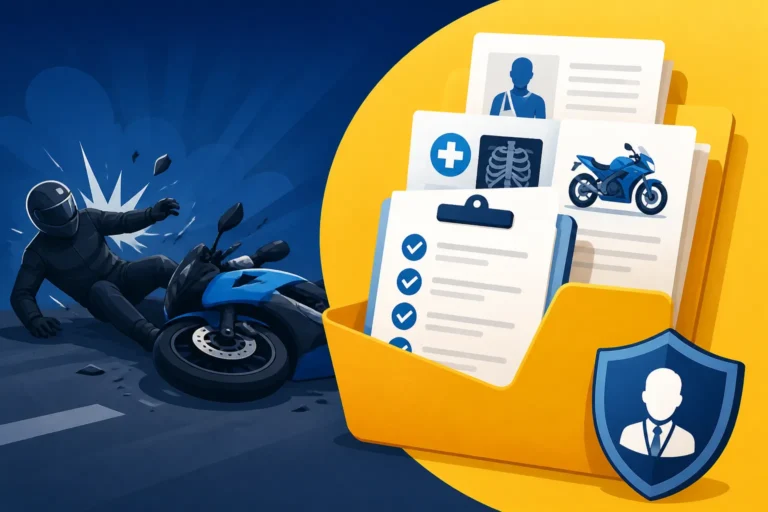
Beyond the initial scene photos and police report, you'll need to meticulously gather all medical records related to your injuries, including doctor's notes, hospital bills, physical therapy records, and prescription costs. Keep a detailed journal of your pain levels, how your injuries impact your daily life, and any emotional distress you experience. If you've missed work, collect pay stubs or employer statements to prove lost wages. Get repair estimates for your motorcycle and any damaged gear. Evidence like dashcam footage, if available, can also be invaluable for How Dashcam Footage Proves Fault. All of this documentation helps paint a complete picture of your damages and directly supports the value of your claim.
The Negotiation Dance with Insurers
Dealing with insurance companies after a motorcycle accident can feel like an uphill battle, especially when you're injured and vulnerable. Insurers, whether it's Progressive or USAA, are in the business of minimizing payouts, and they often employ tactics to do so. They might offer a quick, lowball settlement hoping you'll accept it before fully understanding the extent of your injuries and long-term costs. They might also try to get you to give a recorded statement, which can be twisted and used against you later.
This is where having a clear understanding of your damages and Virginia's laws comes into play. You need to be prepared to counter their offers with solid evidence and a realistic assessment of your claim's value. How to Negotiate a Motorcycle Accident Settlement involves understanding what your case is truly worth, presenting your evidence effectively, and being prepared to stand firm. Often, the negotiation process goes back and forth multiple times before a fair resolution is reached, if at all. Remember, you don't have to accept the first offer, or even the second.
Maximizing Your Settlement in the Old Dominion
Given Virginia's challenging legal environment for motorcycle accident claims, taking proactive steps to maximize your potential settlement is not just advised—it's absolutely essential.
Seeking Timely Medical Treatment
This cannot be stressed enough: seek medical attention immediately after a motorcycle accident, regardless of how you feel. Adrenaline can mask pain, and some serious injuries have delayed symptoms. Beyond protecting your health, timely medical treatment also creates a crucial record that links your injuries directly to the accident. If you delay seeking care, or if there are significant gaps in your treatment, the insurance company will almost certainly argue that your injuries aren't as severe as you claim, or that they weren't caused by the crash itself. Consistent medical documentation is your best friend in proving both the extent and causation of your injuries. Follow all doctor's recommendations for specialists, physical therapy, and follow-up appointments.
Understanding the Statute of Limitations
Every state has a deadline for filing a personal injury lawsuit, known as the statute of limitations. In Virginia, the statute of limitations for personal injury claims, including those arising from motorcycle accidents, is generally two years from the date of the accident. While most cases settle out of court, if you don't reach a settlement with the insurance company and fail to file a lawsuit within this two-year window, you will almost certainly lose your right to pursue compensation forever.
There are very few exceptions to this rule, so it's critical to be aware of this deadline from day one. This two-year clock starts ticking immediately. This is why it’s so important to understand the Statute of Limitations for Motorcycle Claims in Virginia and act swiftly. Even if you're still in treatment or negotiating, missing this deadline can effectively end your claim.
The Advantage of Legal Representation
Given Virginia's complex contributory negligence rule, the aggressive tactics of insurance companies, and the intricacies of valuing and proving damages, having an experienced motorcycle accident lawyer on your side can significantly impact your settlement. While you might wonder Do You Need a Motorcycle Accident Lawyer for every claim, in Virginia, their expertise is often indispensable.
A skilled attorney understands Virginia's unique laws and how to navigate them to your advantage. They can:
- Investigate thoroughly: Gather crucial evidence, interview witnesses, and work with accident reconstructionists to establish fault unequivocally, which is vital in a contributory negligence state.
- Communicate with insurers: Shield you from aggressive insurance adjusters, handle all communications, and prevent you from accidentally saying something that could harm your claim.
- Accurately value your claim: Assess all economic and non-economic damages, including future medical costs and lost earning capacity, to ensure you seek full and fair compensation.
- Negotiate aggressively: Leverage their experience to negotiate a fair settlement, and if necessary, prepare your case for trial.
- Navigate liens: Help manage medical liens and other financial obligations that arise from your settlement.
Studies and anecdotal evidence often show that accident victims who retain legal counsel typically receive significantly higher settlements than those who try to handle their claims alone. An attorney levels the playing field against large insurance corporations, protecting your rights and fighting for the maximum compensation you deserve.
Disclaimer
Please remember that the information provided in this guide is for general informational purposes only and does not constitute legal advice. Motorcycle accident laws, including those in Virginia, are complex and subject to change. Every case is unique, and the outcome depends on specific facts and circumstances. You should consult with a qualified Virginia motorcycle accident attorney for advice regarding your individual situation.