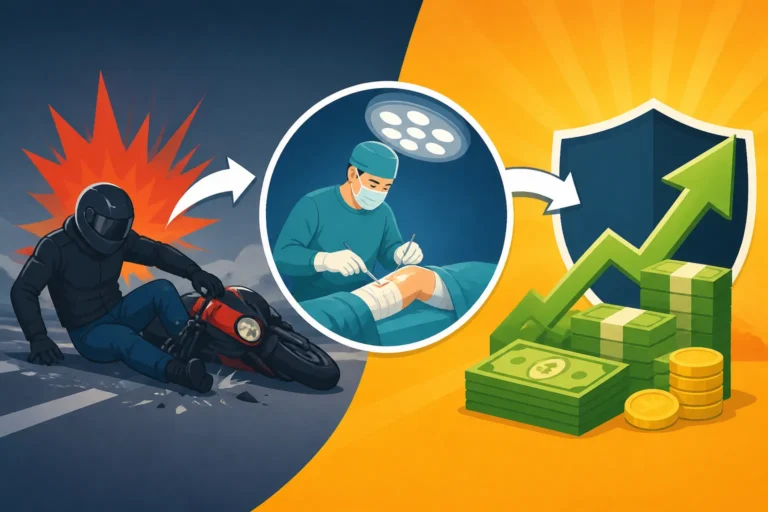
Average Motorcycle Accident Settlement in Washington
Getting into a motorcycle accident is one of the most frightening experiences a rider can face, and the aftermath can feel overwhelming, especially when you're grappling with injuries, mounting medical bills, and a damaged bike. Trying to figure out what a fair settlement might look like in Washington State can add another layer of stress to an already difficult situation. This guide aims to shed light on how motorcycle accident settlements are typically calculated in Washington, helping you understand the factors involved and what you might expect during your recovery journey.
Understanding Motorcycle Accident Settlement Factors in Washington
When you've been in a motorcycle accident in Washington, there's no magic calculator that spits out an exact settlement figure. Instead, it's a complex process influenced by a multitude of factors, all unique to your specific situation. Insurance companies look at everything, from the severity of your injuries to the nuances of who was at fault on Washington roads, to determine what they believe is a fair payout. It’s never as simple as comparing notes with a buddy who had a similar crash; every claim has its own intricate details that swing the final number one way or another.
Severity of Injuries and Medical Expenses
Let's be real, motorcycle accidents often result in much more severe injuries than car accidents. Riders are simply more exposed. The extent of your injuries is arguably the most significant factor in determining your settlement. A minor case of road rash, while painful, is going to result in a vastly different settlement than a catastrophic spinal cord injury or a traumatic brain injury. In Washington, this means insurance adjusters will meticulously review all your medical records, including emergency room visits, hospital stays in places like Harborview Medical Center in Seattle or Providence Sacred Heart in Spokane, specialist consultations, physical therapy, prescription medications, and any long-term care plans.
The total cost of your past and future medical care directly impacts the economic damages portion of your claim. If you've undergone surgery, require ongoing rehabilitation, or face a lifetime of care due to a permanent disability, these costs will significantly drive up the potential settlement value. It's not just about the bills you've already accumulated; it's about the financial burden of future treatment that you might need for years to come. For instance, if you suffered a complex fracture in your leg that required multiple surgeries and extensive physical therapy, those expenses alone could quickly climb into the tens or even hundreds of thousands of dollars, making your claim substantially higher than someone who only experienced minor bruising.
Lost Wages and Loss of Earning Capacity
Another critical piece of the settlement puzzle is how your injuries have impacted your ability to work. If you're out of commission, missing work, and losing income, that needs to be compensated. This includes not just the wages you've already lost while recovering, but also any future income you might lose if your injuries prevent you from returning to your previous job or earning at the same capacity. Maybe you're a construction worker in Tacoma who can no longer perform strenuous tasks, or a tech professional in Redmond whose cognitive functions were impaired by a concussion.
Insurance companies will require documentation like pay stubs, employment records, and doctor's notes detailing your inability to work. For those with long-term or permanent disabilities, calculating the "loss of earning capacity" becomes a crucial and often complex task. This involves projecting your potential income over your working lifetime, which might require expert testimony from vocational specialists or economists. The goal is to make you financially whole again, as if the accident never happened, accounting for every dollar of income you've lost or will lose. This can be especially frustrating for self-employed riders in Washington who might find it harder to document a consistent income stream.
Property Damage and Other Tangible Losses
While your personal injuries are paramount, don't forget the immediate, tangible damage from the crash. Your motorcycle likely sustained significant damage, perhaps even being totaled. The cost to repair or replace your bike, along with any damaged gear – helmets, jackets, gloves, boots – is a direct economic loss that factors into your settlement. This can include towing fees, storage costs, and even rental transportation if you needed a temporary vehicle.
Documenting these damages thoroughly is key. Photos of your wrecked motorcycle, repair estimates from reputable shops in areas like Seattle's University District or Spokane Valley, and receipts for your damaged gear will all be important evidence. Even minor items like a broken cell phone or prescription eyeglasses that were damaged in the crash should be included. These are often the easiest damages to quantify and are typically covered by the at-fault driver's property damage liability insurance.
Pain and Suffering and Emotional Distress
Beyond the purely financial aspects, motorcycle accident settlements in Washington also account for the non-economic damages, often referred to as "pain and suffering." This category is much harder to quantify because it deals with the subjective experience of your injuries. It includes physical pain, discomfort, emotional distress, mental anguish, loss of enjoyment of life, and even the psychological impact like PTSD or anxiety that can follow a traumatic event. If you're now scared to ride your bike on I-5, or constantly relive the crash while driving through downtown Olympia, that's a real consequence.
In Washington, pain and suffering damages are highly subjective and can be influenced by how effectively your experience is documented. Journaling about your daily pain levels, how your injuries restrict your hobbies or daily activities, and the emotional toll the accident has taken on you can all help support this part of your claim. Insurance adjusters and juries look at factors like the severity and duration of your pain, the invasiveness of your medical treatments, and how your life has fundamentally changed. There isn't a strict formula, but severe, long-lasting injuries that significantly diminish your quality of life will typically warrant higher pain and suffering awards.
Washington's Comparative Negligence Laws and Their Impact
One of the most crucial aspects to understand about motorcycle accident settlements in Washington State is its pure comparative negligence rule. This legal principle can have a profound impact on the final amount you receive, especially if there's any suggestion that you, as the rider, were partially at fault for the crash. It's not uncommon for insurance companies to try and assign some blame to the motorcyclist, often using unfair stereotypes or the "I didn't see the motorcycle" defense.
How Pure Comparative Negligence Works in Washington
Washington is one of the few states that follows a "pure comparative negligence" standard. This means that even if you are found to be partly at fault for the motorcycle accident, you can still recover damages from the other driver. However, your total compensation will be reduced by your percentage of fault. For example, if your total damages are calculated at $100,000, but a jury or settlement negotiation determines you were 20% at fault, you would only receive $80,000.
This differs significantly from "modified comparative negligence" states, where if you are found to be 50% or 51% or more at fault, you might recover nothing at all. In Washington, you could theoretically be 99% at fault and still recover 1% of your damages. This system is designed to allow injured parties to recover something, even if they bear significant responsibility for the incident. Understanding this rule is absolutely vital to predicting your potential settlement in Washington. For a deeper dive, read about Comparative Negligence in Motorcycle Accidents.
Examples of Shared Fault Scenarios
Let's imagine a common scenario in Spokane: You're riding your motorcycle, perhaps slightly exceeding the speed limit on a residential street, and a car suddenly pulls out from a driveway without looking, causing a collision. The car driver is clearly negligent for failing to yield, but the insurance company might argue that your speeding contributed to the severity of the accident or your inability to react in time. If a court decides the car driver was 80% at fault and you were 20% at fault due to speeding, your $100,000 in damages would be reduced to $80,000.
Another scenario could involve Lane Splitting and Motorcycle Accident Liability, if you were lane splitting where it's not explicitly legal or safe, and a driver changed lanes into you. While the driver's unsafe lane change might be the primary cause, an argument could be made about your contributing factor, even if minor. The challenge often lies in proving fault, as insurance companies will go to great lengths to shift blame. This is where evidence like traffic camera footage, witness statements, and police reports become incredibly important. Getting prompt legal advice after a crash is critical, as you can read more about in What to Do After a Motorcycle Accident.
The Role of Insurance Policy Limits in Washington Settlements
Even if you have an iron-clad case and zero fault, the amount of money you can actually collect is often capped by the available insurance coverage. This is a hard truth many accident victims face in Washington and across the country. The at-fault driver's insurance policy limits, as well as your own uninsured/underinsured motorist (UM/UIM) coverage, play a significant role in your potential payout.
At-Fault Driver's Policy Limits
Every driver in Washington is required to carry minimum liability insurance. The minimums are typically $25,000 for bodily injury per person, $50,000 for bodily injury per accident, and $10,000 for property damage. If your injuries and damages exceed these amounts, and the at-fault driver only has minimum coverage, you could be left with significant unpaid expenses. For instance, if you incur $75,000 in medical bills and lost wages from a crash caused by a driver with only $25,000 in bodily injury coverage, you're looking at a substantial shortfall.
Insurance companies will only pay up to the policy limits of their insured, regardless of how severe your damages are. This means that even if your case is "worth" $150,000, if the at-fault driver only has a $50,000 policy, that's often the maximum you can recover from their insurance. This can be incredibly frustrating, especially for riders who suffer Catastrophic Motorcycle Injuries Explained that clearly exceed these limits. Understanding How Policy Limits Cap Your Settlement is crucial for setting realistic expectations.
Uninsured/Underinsured Motorist (UM/UIM) Coverage
This is where your own insurance policy can become your best friend. Uninsured/Underinsured Motorist (UM/UIM) coverage is designed to protect you when the at-fault driver has no insurance (uninsured) or not enough insurance (underinsured) to cover your damages. In Washington, insurance companies are required to offer UM/UIM coverage, and you generally have to reject it in writing if you don't want it. Having robust UM/UIM coverage on your own policy can make all the difference if you're hit by a driver with insufficient coverage.
If the at-fault driver's policy limits are exhausted, your UM/UIM coverage can kick in to cover the remaining damages, up to your policy limits. For example, if your damages are $100,000, and the at-fault driver only has $25,000 in coverage, your UM/UIM policy with a $75,000 limit could cover the remaining $75,000. It essentially acts as a safety net, protecting you from other drivers' poor insurance choices. It's a smart investment for any rider in Washington, given the potential for severe injuries in motorcycle accidents.
Average Motorcycle Accident Settlements in Washington: What the Numbers Suggest
While there's no single "average" settlement that applies to everyone, we can look at ranges and general trends that emerge from motorcycle accident claims in Washington. These numbers are highly dependent on the factors we've discussed, but they can give you a rough idea of what to expect, recognizing that your individual case will always be unique. Keep in mind that these are gross settlement figures, before attorney fees, medical liens, and other costs are deducted.
General Settlement Ranges
Motorcycle accident settlements in Washington, like elsewhere, can range from a few thousand dollars for minor injuries to several million dollars for catastrophic, life-altering injuries.
Table: Estimated Settlement Ranges for Motorcycle Accident Injuries in Washington
| Injury Severity / Type | Common Economic Damages (Medical, Lost Wages, Property) | Potential Non-Economic Damages (Pain & Suffering) | Estimated Total Settlement Range (Gross) | Key Factors Affecting Payout |
|---|---|---|---|---|
| Minor Injuries | $2,000 – $15,000 | $1,000 – $10,000 | $3,000 – $25,000 | Soft tissue injuries, minor road rash, short recovery time. |
| Moderate Injuries | $15,000 – $75,000 | $10,000 – $50,000 | $25,000 – $125,000 | Fractures requiring casts/minor surgery, moderate road rash, concussions, longer recovery. |
| Significant Injuries | $75,000 – $250,000 | $50,000 – $200,000 | $125,000 – $450,000 | Multiple fractures, significant internal injuries, spinal disc issues, TBIs (moderate), long-term rehab. |
| Severe/Catastrophic Injuries | $250,000 – $1,000,000+ | $200,000 – $1,000,000+ | $450,000 – Multi-Million | Amputations, severe spinal cord injuries (paralysis), severe TBIs, burns, permanent disability, loss of earning capacity. |
It's crucial to remember that these are just estimates. A seemingly "minor" injury can sometimes lead to unexpected complications, long-term pain, or a need for ongoing care that pushes it into a higher category. For example, a "minor" concussion can sometimes develop into a debilitating post-concussion syndrome, dramatically increasing its value. This is why it's so important to let your medical treatment run its course and reach maximum medical improvement (MMI) before seriously discussing settlement figures.
Factors Pushing Settlements Higher (or Lower)
Beyond the direct injury type, several other elements can significantly influence whether a Washington motorcycle accident settlement lands at the higher or lower end of the spectrum:
- Clear Liability: When the other driver is clearly 100% at fault, without any contributory negligence on your part, your case is stronger, and settlements tend to be higher. This reduces the argument that your payout should be reduced.
- Strong Evidence: Comprehensive documentation, including police reports, witness statements, accident reconstruction reports, medical records, and photos/videos of the scene and your injuries, strengthens your claim. Motorcycle Accident Evidence for Proving Fault is vital.
- Permanent Impairment: If your injuries result in permanent disability, scarring, disfigurement, or chronic pain that impacts your daily life and earning potential, the settlement will reflect this long-term impact.
- Emotional Distress: Documented psychological trauma, like PTSD or severe anxiety, especially from a particularly horrific crash, can increase non-economic damages.
- High Policy Limits: If both the at-fault driver and you (via UM/UIM) have high insurance policy limits, there's more money available to cover substantial damages.
- Jurisdiction: While this guide focuses on Washington, even within the state, jury pools in King County (Seattle) might react differently to certain cases than those in more rural counties.
- Legal Representation: Generally, individuals represented by an experienced motorcycle accident attorney receive significantly higher settlements than those who try to negotiate directly with insurance companies. Insurance companies know when you're going it alone. If you're wondering Do You Need a Motorcycle Accident Lawyer, the answer is almost always yes for anything beyond a minor fender-bender.
Strengthening Your Motorcycle Accident Claim in Washington
While the factors that determine an average settlement can seem complex and sometimes out of your control, there are concrete steps you can take to strengthen your claim in Washington State and ensure you receive the fairest possible compensation. Being proactive and meticulous from the moment an accident occurs can make a world of difference.
Document Everything Meticulously
From the moment the accident happens, documentation is your best friend. This includes photos and videos of the accident scene, vehicle damage, road conditions, and your injuries. Get contact information for any witnesses. Obtain the official police report from the Washington State Patrol or local law enforcement, such as the Seattle Police Department or Tacoma Police Department.
Continue documenting your recovery journey. Keep detailed records of all medical appointments, treatments, diagnoses, and medications. Maintain a journal to track your pain levels, limitations, and how the injuries impact your daily life, hobbies, and emotional well-being. Keep all receipts related to medical expenses, damaged property, lost wages, and any other out-of-pocket costs. The more evidence you have, the harder it is for insurance companies to dispute your claim. This diligent record-keeping is critical for both Economic vs Non-Economic Damages Explained and proving your overall suffering.
Seek Immediate Medical Attention and Follow Through
Even if you feel okay after a motorcycle accident, it's absolutely crucial to seek medical attention immediately. Adrenaline can mask pain, and some serious injuries, like internal bleeding or concussions, might not show symptoms right away. A prompt medical evaluation establishes a clear link between the accident and your injuries, which is vital for your claim. Gaps in medical treatment can be used by insurance companies to argue that your injuries weren't severe or weren't caused by the accident.
Once you're under a doctor's care, follow all medical advice and treatment plans precisely. Attend all follow-up appointments, complete all prescribed physical therapy, and take all medications as directed. If a doctor recommends surgery or specialist consultations, pursue them. Non-compliance can be used by the insurance company to suggest that you weren't seriously injured or weren't doing your part to recover. Showing consistent, diligent medical care demonstrates the legitimate nature and severity of your injuries, significantly helping to establish How Medical Bills Affect Your Settlement.
Consult with an Experienced Motorcycle Accident Attorney
Navigating the complexities of a motorcycle accident claim in Washington can be incredibly challenging, especially when you're trying to recover from injuries. Insurance companies are businesses, and their primary goal is to pay out as little as possible. They have vast resources and experienced adjusters whose job it is to minimize your claim, often employing tactics like trying to assign partial blame to the rider or offering lowball settlements.
An experienced motorcycle accident attorney in Washington understands the state's specific laws, including pure comparative negligence, and knows how to effectively negotiate with insurance companies. They can gather evidence, interview witnesses, work with accident reconstructionists, and handle all communications, allowing you to focus on your recovery. Crucially, they know how to accurately calculate the full scope of your damages, including future medical costs and lost earning capacity, which are often overlooked by unrepresented individuals. An attorney can help you fight back against unfair tactics and pursue the maximum compensation you deserve, helping you truly understand How to Maximize Your Motorcycle Accident Settlement.
Disclaimer
This article is for general informational purposes only and does not constitute professional advice. Laws and regulations vary by location and change over time. Consult a qualified professional for guidance on your specific situation.