Does Not Wearing a Helmet Affect a Claim in Colorado
Getting into a motorcycle accident is one of the most jarring, life-altering experiences a rider can face. Beyond the immediate pain and physical recovery, you're thrust into a confusing legal landscape where every detail of the crash is scrutinized, often including whether you were wearing a helmet. For riders in Colorado, understanding how helmet use, or the lack thereof, can impact your personal injury claim is absolutely crucial, even if you weren't legally required to wear one.
Colorado's Helmet Law Explained
Let's cut right to it: Colorado operates under a "partial" helmet law. This isn't a universal mandate like you find in some other states. For riders who are 18 years of age or older, wearing a helmet is generally optional. However, if you're a rider or passenger under the age of 18, you are legally required to wear a DOT-approved helmet at all times while on a motorcycle. This distinction is paramount, but it doesn't mean your helmet choice, or lack thereof, won't become a contentious issue if you're involved in a collision.
Who Must Wear a Helmet in Colorado?
In Colorado, the law specifically targets younger riders and passengers. If you’re a minor – meaning anyone under 18 years old – you must wear a DOT-compliant motorcycle helmet. This isn't just a recommendation; it's a legal requirement designed to protect those deemed less experienced or more vulnerable on the road. For example, if you're a 16-year-old tearing down Highway 24 near Colorado Springs and get into an accident without a helmet, you're not only facing potential injuries but also a clear violation of state law. This violation can have immediate consequences with law enforcement, and more significantly, it can drastically alter the trajectory of any personal injury claim you might pursue. The law sees this as a clear failure to adhere to safety regulations, and that perception can be hard to shake in a civil case.
For those of us 18 and over, the choice is ours. You can cruise through Rocky Mountain National Park with the wind in your hair, legally speaking. But just because it's legal doesn't make it advisable, especially when considering the potential aftermath of an accident. The legal freedom to choose often comes with significant personal responsibility, and in the context of an accident claim, that responsibility can weigh heavily on your ability to recover damages.
Penalties for Non-Compliance on the Road
If you're under 18 and caught riding without a helmet in Colorado, you can expect to face a fine. While the exact amount can vary, it’s typically in the range of $60 to $75, and you might also get points on your driving record. These might seem like minor penalties compared to the potential medical bills and trauma of an actual accident, but they're important because they establish a legal precedent. A citation for not wearing a helmet, even a relatively small one, is documented evidence of non-compliance with a safety law.
Now, imagine that 16-year-old rider, cited for not wearing a helmet, who then gets into a crash. That police report detailing the helmet violation becomes a piece of evidence that the opposing insurance company or defense attorney will undoubtedly use. They will argue that the rider was already breaking the law, potentially implying a general disregard for safety that could extend to how they were operating their motorcycle. This doesn't directly speak to fault for the accident, but it certainly sets a negative tone for the rider's credibility and responsibility. For riders over 18, since there's no legal requirement, there are no direct penalties or citations for simply choosing not to wear a helmet, absent an accident. However, the absence of a legal requirement doesn't mean the absence of consequences in a civil claim, which we’ll delve into next.
The "Helmet Defense" in a Motorcycle Accident Claim
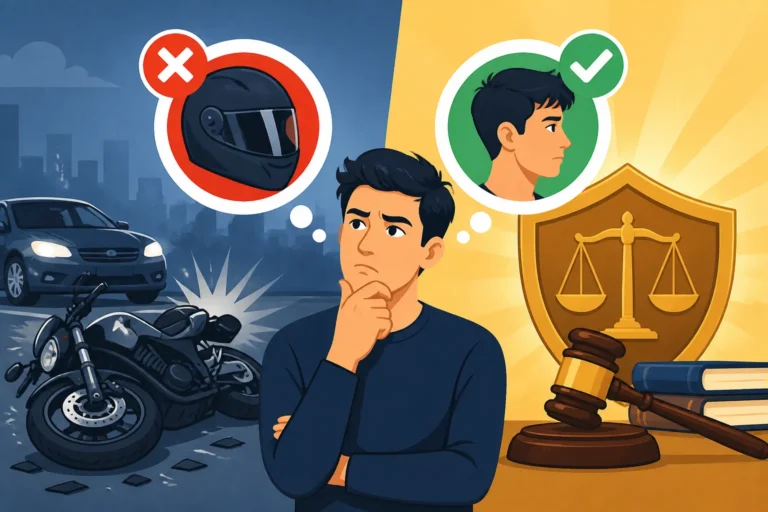
Even if you, as an adult rider in Colorado, aren't legally mandated to wear a helmet, the decision not to wear one can still significantly impact your motorcycle accident claim. This is where the concept of the "helmet defense" comes into play. Insurance companies and opposing counsel are always looking for ways to reduce the amount they have to pay out, and your choice regarding a helmet provides a powerful argument for them, especially if you suffered head injuries. They will argue that had you worn a helmet, your injuries would have been less severe, or perhaps even avoided altogether.
Understanding Comparative Negligence
Colorado operates under a "modified comparative negligence" system, specifically the 50% rule. This means that if you are found to be 50% or more at fault for the accident, you cannot recover any damages from the other party. If you are found to be less than 50% at fault, your recoverable damages will be reduced by your percentage of fault. For example, if you suffer $100,000 in damages but are found to be 20% at fault, you would only be able to recover $80,000.
The "helmet defense" doesn't necessarily argue that you caused the accident. Instead, it argues that your injuries were made worse by your decision not to wear a helmet. This can be viewed as a form of comparative negligence regarding the severity of your injuries, rather than the cause of the collision itself. The defense might argue that even if the other driver ran a red light and hit you, your head injury would have been less severe if you had worn a helmet. Therefore, they might contend that a portion of your head injury damages are "your fault" for failing to protect yourself. This can be a particularly tricky area of law, and it's why understanding Comparative Negligence in Motorcycle Accidents is so important. It's a subtle but significant distinction that can chip away at your potential settlement.
The Argument of "Mitigation of Damages"
Beyond comparative negligence, another powerful tool in the defense's arsenal is the "failure to mitigate damages" argument. This legal principle basically says that an injured party has a responsibility to take reasonable steps to minimize the extent of their injuries and losses after an accident. If they fail to do so, they might not be able to recover compensation for the portion of damages that could have been avoided.
In the context of a motorcycle accident, this argument often targets head injuries. The defense will assert that wearing a helmet is a reasonable and easily accessible safety measure that almost universally reduces the risk and severity of head trauma. Therefore, if you chose not to wear a helmet and suffered a traumatic brain injury (TBI), the opposing side will argue that you "failed to mitigate your damages" by not taking that simple preventative step. They aren't saying you weren't injured; they're saying you made your injuries worse, and thus, they shouldn't be fully liable for the exacerbated damages. This argument can be incredibly effective in states like Colorado where helmets aren't universally mandated for adults, as it shifts the focus from the other driver's actions to your own choices regarding safety gear.
How Not Wearing a Helmet Impacts Injury Claims
The direct impact of not wearing a helmet on your injury claim largely depends on the nature of your injuries. It's a hard truth, but insurance adjusters and defense attorneys will seize on any opportunity to connect the severity of your harm to your personal choices, especially when those choices involve widely accepted safety measures.
Head and Brain Injuries
If you weren't wearing a helmet and sustained a head injury or Motorcycle Accident Traumatic Brain Injuries, the link is unfortunately direct and often undeniable. This is where the helmet defense is at its strongest. The other side will argue, sometimes successfully, that:
- Causation: The specific head injury you suffered either wouldn't have occurred or would have been significantly less severe if you had been wearing a DOT-approved helmet. They'll bring in medical experts and accident reconstructionists to support this claim, trying to demonstrate that the helmet would have absorbed or dispersed the impact force.
- Reduced Settlement Value: Even if the other driver is clearly at fault for the collision, the damages attributable to your head injury could be substantially reduced. For example, if your total damages are $200,000, and $150,000 of that is related to your TBI, the defense might argue that 50% of the TBI damages should be attributed to your failure to wear a helmet, effectively reducing your overall recoverable compensation by $75,000.
- Jury Perception: Juries, like anyone, are susceptible to common sense arguments. The idea that helmets protect heads is ingrained in public consciousness. If they see a rider with a severe head injury who wasn't wearing a helmet, they may be less inclined to award full damages, even if the law doesn't explicitly mandate helmet use for adults. This "rider bias" can be a significant hurdle.
This doesn't mean you can't recover anything for your head injury, but it means you'll face a much steeper climb. The burden will be on you to prove that the helmet, or lack thereof, had no bearing on the severity of your specific injury, which can be an incredibly difficult task depending on the circumstances of the crash.
Other Injuries and the Indirect Impact
What about injuries that aren't head-related, like a broken leg, Motorcycle Road Rash: Claims and Compensation, or a spinal injury? If you weren't wearing a helmet, but your injuries are to other parts of your body, the direct "helmet defense" is less potent. It's hard for the defense to argue that a helmet would have prevented a broken ankle or internal organ damage. However, the absence of a helmet can still have an indirect, detrimental effect on your claim.
Here's how:
- Credibility and Perception: Even if your injuries are not head-related, not wearing a helmet can still paint a picture of a rider who was irresponsible or disregarded their own safety. This perception, while perhaps unfair, can subtly influence how adjusters or jurors view your entire case. It can make them more critical of your actions, more skeptical of your pain and suffering claims, and generally less sympathetic to your plight.
- General Comparative Fault Arguments: While the lack of a helmet might not cause the accident, it can be lumped in with broader arguments about shared fault. For instance, if the defense can argue you were speeding, or making an unsafe lane change, the lack of a helmet can reinforce a narrative that you were generally less careful on the road. This makes it easier for them to argue for a higher percentage of fault being assigned to you for the accident itself, thereby reducing all of your damages, not just those related to your head. When a Rider Is Partially at Fault discusses this in more detail.
- Negotiating Leverage: Insurance companies thrive on leverage. If they know they can raise the "helmet defense" regarding any aspect of your case, even if indirectly, it gives them a strong bargaining chip to offer a lower settlement. They know you might want to avoid the risk of a jury trial where this issue could be highlighted and potentially reduce your award.
In essence, while a helmet might not prevent road rash, the absence of one can still make the fight for full compensation for that road rash significantly harder due to the surrounding legal and perceptual factors.
Strategies to Counter the Helmet Defense
Facing the helmet defense can feel like an uphill battle, especially when you're already dealing with the physical and emotional aftermath of a crash. However, it's not an insurmountable obstacle. There are specific strategies and legal approaches that can be employed to counter this defense and protect your right to fair compensation.
Proving Causation is Key
The crucial point here is that the defense must prove a direct link between your lack of a helmet and the specific head injury you sustained. They can't just broadly state, "You weren't wearing a helmet, so your head injury is your fault." They need to show, with evidence, that if you had worn a helmet, that particular injury would have been prevented or significantly mitigated. This is known as establishing causation.
For instance, if you suffered a severe skull fracture, the defense would need to demonstrate through expert testimony how a DOT-compliant helmet would have absorbed the impact energy in a way that prevented that specific fracture. If the impact occurred in such a way that even a helmet would have offered minimal protection (e.g., a direct, crushing blow from a heavy vehicle), then the defense's argument weakens considerably. Your legal team would work to highlight any gaps in their causation argument, emphasizing that not all head injuries are preventable by helmets, or that the force and nature of this particular impact were beyond what a helmet could reasonably protect against. The burden of proof for the helmet defense often rests with the defendant, meaning they have to convince the court that your helmet choice made your injuries worse.
Expert Testimony and Accident Reconstruction
This is where the big guns come out. To effectively counter the helmet defense, your legal team might employ expert witnesses, particularly accident reconstructionists and biomechanical engineers.
- Accident Reconstruction Experts: These professionals can meticulously analyze the scene of the accident, vehicle damage, impact points, and witness statements to recreate the sequence of events. They can often determine the forces involved in the crash and the exact trajectory of your body during the impact. By understanding exactly how your head struck a surface, they can sometimes demonstrate that the type of impact was so severe that even a helmet might not have prevented or substantially lessened the specific injury. This might mean showing your head hit something at an unusual angle, or that the forces involved were simply overwhelming. Understanding How Accident Reconstruction Determines Fault is also a valuable area of expertise these professionals bring.
- Biomechanical Engineers: These experts focus on how forces affect the human body. They can evaluate your specific head injury and correlate it with the forces determined by the accident reconstructionist. They might be able to testify that, given the specific type and severity of impact, the helmet would not have prevented the injury or made a significant difference. For example, if a crushing injury occurred, they might argue that even a helmet wouldn't have prevented the underlying brain trauma.
These experts provide scientific, evidence-based counterarguments to the insurance company's generalized claims. Their detailed analysis can be instrumental in dismantling the defense's causation argument and demonstrating that your lack of a helmet was not the cause or exacerbating factor of your head injury.
Documentation of All Other Damages
While fighting the helmet defense is critical for head injuries, it's equally important to thoroughly document and pursue all other damages, both economic and non-economic. Even if a portion of your head injury claim is reduced due to the helmet defense, you should still be able to recover full compensation for other injuries and losses not directly related to your head.
This means meticulously tracking:
- Medical Expenses: All bills for emergency room visits, hospital stays, surgeries, physical therapy, medications, and ongoing medical care.
- Lost Wages: Any income you lost due to your inability to work after the accident, including future lost earning capacity.
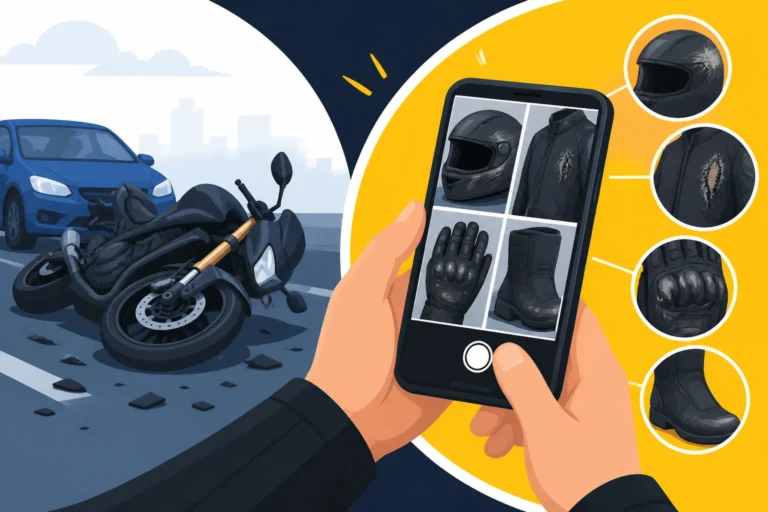
- Property Damage: The cost to repair or replace your motorcycle and any damaged gear.
- Pain and Suffering: The physical pain, emotional distress, loss of enjoyment of life, and inconvenience caused by your injuries.
- Other Gear: Documenting all the safety gear you did wear, such as a sturdy jacket, riding pants, gloves, and boots, can also help establish a general pattern of safety-consciousness, even if a helmet wasn't part of it. When I’m looking for new gear, I always check out places like Cycle Gear, not just for helmets, but for quality jackets and protective pants that can make a huge difference in avoiding severe road rash.
By building a comprehensive case around all your damages, you ensure that even if the helmet defense impacts one aspect of your claim, you still have a strong foundation for recovering maximum compensation for everything else you've endured.
Protecting Your Claim Moving Forward
After an accident, the chaos and confusion can be overwhelming. But taking specific, proactive steps is crucial for protecting your legal claim, especially when issues like helmet use could be brought into question. It’s about being smart, prepared, and looking out for your future self.
Always Wear a DOT-Compliant Helmet
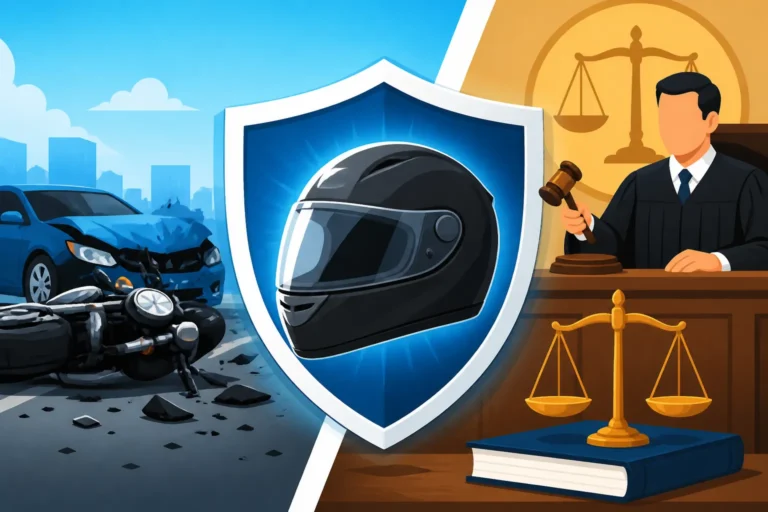
This is the golden rule, regardless of Colorado's specific laws for adult riders. Even if you're over 18 and the law says you don't have to, wearing a DOT-compliant helmet is simply the smartest decision you can make. From a safety perspective, it drastically reduces your risk of severe head injury or death in a crash. From a legal standpoint, it eliminates the "helmet defense" entirely. If you're wearing an approved helmet, the insurance company cannot argue that your injuries were made worse by your failure to protect your head.
Investing in a high-quality, DOT-approved helmet from a reputable retailer like Cycle Gear is not just about compliance; it's about life-saving protection and safeguarding your future legal options. Make sure it fits properly, is well-maintained, and always wear it. This simple act can prevent catastrophic injuries and remove a significant obstacle from any potential personal injury claim. For a deeper dive into what makes a helmet truly protective, you might want to look into DOT Helmet Requirements Explained.
Seek Immediate Medical Attention and Document Everything
The moments and days following an accident are critical for both your health and your legal claim. Even if you feel okay after a motorcycle crash, always seek immediate medical attention. Adrenaline can mask pain, and some serious injuries, especially concussions or internal bleeding, might not present symptoms right away.
- Prompt Medical Care: Going to the emergency room or seeing a doctor immediately establishes a clear link between the accident and your injuries. Any delay can be used by the defense to argue that your injuries weren't severe or were caused by something else.
- Thorough Documentation: Keep meticulous records of all your medical appointments, diagnoses, treatments, medications, and physical therapy sessions. Take photos of your injuries as they heal (or don't heal), track your pain levels, and document how your injuries impact your daily life. An injury journal can be an invaluable tool. Learning How to Document Injuries for a Claim effectively can make a substantial difference in the strength of your case.
- Property Damage: Take detailed photos of your damaged motorcycle and any other gear, including your helmet if you were wearing one. This can help illustrate the force of impact and corroborate your account of the accident.
Consult a Motorcycle Accident Attorney
Navigating the aftermath of a motorcycle accident, especially when facing a "helmet defense," is incredibly complex. Insurance companies are not on your side; their primary goal is to pay out as little as possible. They have vast resources and experienced legal teams dedicated to minimizing their liability. This is why consulting with a specialized motorcycle accident attorney is absolutely essential.
An attorney who understands the nuances of motorcycle law in Colorado can:
- Evaluate Your Case: They can assess the strength of your claim, including how the helmet issue might affect it, and give you a realistic idea of your options.
- Counter the Helmet Defense: They will know the legal strategies, such as employing expert witnesses and challenging causation, to effectively fight arguments related to non-helmet use.
- Handle Negotiations: Your lawyer will deal directly with insurance adjusters, preventing you from accidentally saying something that could harm your case. They will negotiate aggressively for a fair settlement.
- Represent You in Court: If a fair settlement cannot be reached, they are prepared to take your case to trial and present a compelling argument to a jury.
- Maximize Your Settlement: Attorneys are experts at identifying and valuing all types of damages, ensuring you don't leave any money on the table.
Don't wait to seek legal advice. The sooner you speak with an attorney, the better equipped you'll be to protect your rights and pursue the compensation you deserve. Thinking about Do You Need a Motorcycle Accident Lawyer is often the first and best step you can take.
Final Thoughts on Your Safety and Rights
Riding a motorcycle in Colorado offers an unparalleled sense of freedom and connection to the open road. But with that freedom comes a heightened need for personal responsibility and awareness of the legal landscape. While the choice to wear a helmet as an adult is yours, the decision can have profound implications if you're ever involved in an accident. Protecting yourself on the road with proper gear, like a quality helmet from Cycle Gear, and knowing your rights after a crash are two sides of the same coin. Your safety and your ability to recover fully, both physically and financially, are intertwined with the choices you make every time you swing your leg over your bike.
Disclaimer
Please remember, the information provided in this article is intended for general informational purposes only and does not constitute legal advice. Motorcycle accident laws are complex and vary by jurisdiction. For advice specific to your situation, it is crucial to consult with a qualified attorney in your state.