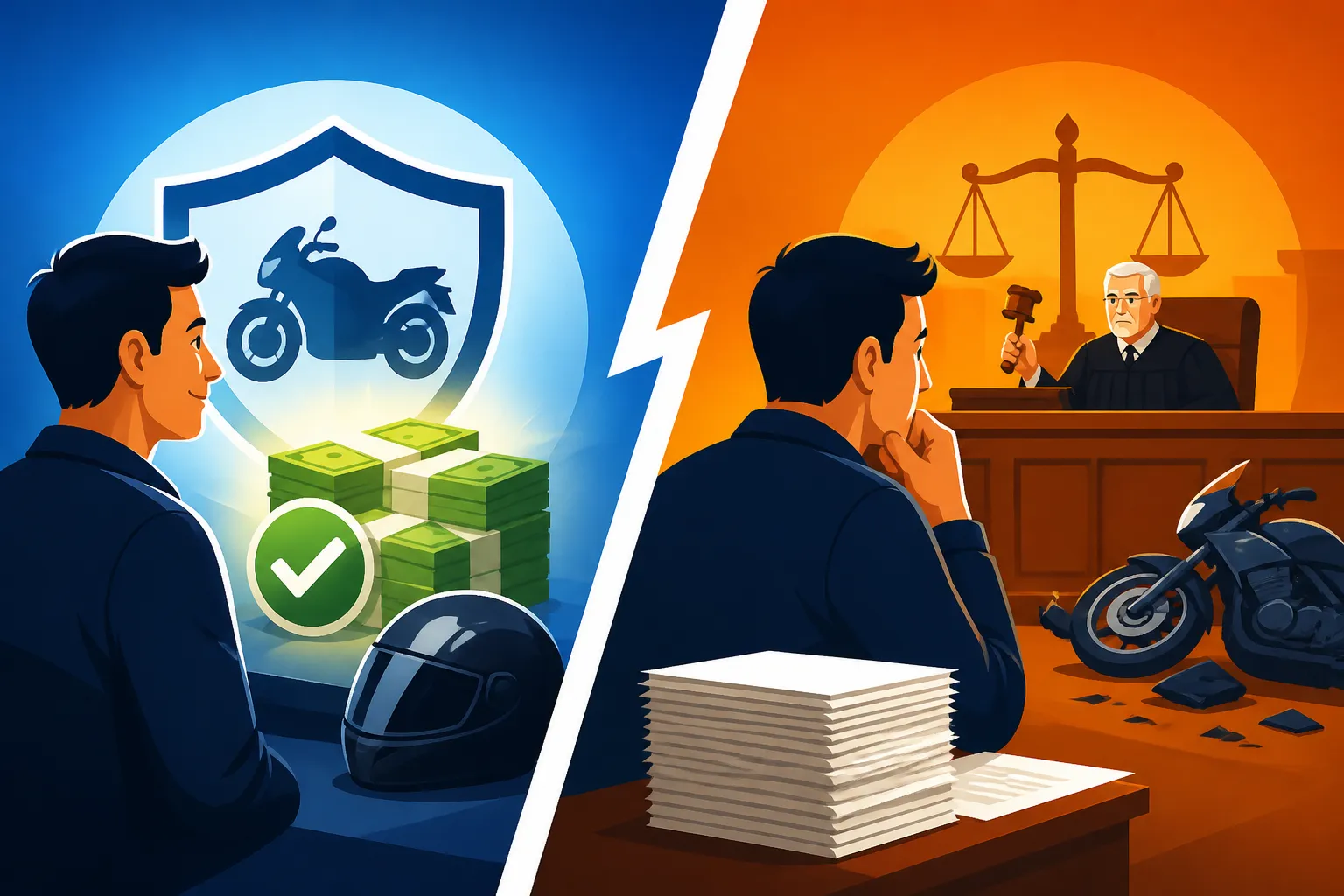
How Going to Trial Affects Your Payout
Facing a motorcycle accident can turn your world upside down, and for many riders, the thought of taking their claim to court after the initial settlement negotiations fall through is daunting, to say the least. There's a lot of uncertainty about what happens next, how it might affect your overall compensation, and whether it's even worth the emotional rollercoaster. This guide is here to shed light on how electing to go to trial can significantly impact your motorcycle accident payout, for better or for worse, helping you understand the stakes involved.
The Stress and Uncertainty of Going to Trial
Let's be real, the legal system isn't exactly known for its speedy resolutions or calming atmosphere. Deciding to take your motorcycle accident claim to trial is a massive step, one that brings with it a whole new set of pressures, anxieties, and unknowns. Many riders would prefer to settle out of court, even if it means compromising a bit, just to avoid the protracted battle that litigation often entails. It's a perfectly understandable sentiment given how much these cases demand from you.
Emotional Toll and Time Commitment
One of the most immediate impacts of pursuing a trial is the sheer emotional drain it places on you. Imagine reliving the details of your accident, your injuries, and the subsequent recovery process, not just once or twice for an insurance adjuster, but repeatedly under oath, in front of strangers. This isn't just a brief interrogation; it involves depositions, cross-examinations, and direct testimony, all of which can be incredibly stressful and re-traumatizing. You might find yourself grappling with anxiety, anger, or even symptoms of post-traumatic stress disorder (PTSD) as you're forced to confront painful memories. This emotional burden often extends to your family as well, who might have to witness your struggles and offer support throughout the grueling process.
Beyond the emotional toll, there's the monumental time commitment. A typical motorcycle accident settlement process, while sometimes lengthy, is often resolved within a few months to a year. Going to trial, however, can stretch that timeline significantly. It's not uncommon for trials to last anywhere from several days to several weeks, and that's just the actual courtroom proceedings. Before that, there's discovery, pre-trial motions, scheduling conflicts, and countless hours of preparation with your legal team. You might be asked to provide additional documentation, attend more medical evaluations, and spend considerable time in meetings. This extended period of uncertainty can put your life on hold, making it hard to move forward, plan for the future, or fully focus on your recovery. The thought of waiting years to finalize your claim can be truly exhausting, and it’s a major reason why many people opt for a settlement. You might want to understand more about How Long Does a Motorcycle Settlement Take to compare timelines.
Financial Risks and Costs Involved
While many motorcycle accident lawyers work on a contingency fee basis, meaning they only get paid if you win, going to trial still carries significant financial risks and costs. Contingency fees typically range from 33% to 40% of the final award, sometimes even higher if the case goes to trial due to the increased work involved. But that's not the only financial consideration. There are also "case costs" or "litigation expenses." These are the out-of-pocket expenses required to prepare and present your case, and they can be substantial.
These costs include things like court filing fees, deposition transcript fees, expert witness fees, travel expenses, exhibit preparation, and more. For complex cases involving serious injuries or disputed fault, these expenses can easily run into tens of thousands of dollars, or even hundreds of thousands. While your lawyer might advance these costs, they are typically deducted from your final payout before the contingency fee is calculated. If you lose at trial, you could be on the hook for some or all of these costs, in addition to receiving no compensation for your injuries. This risk is a huge deterrent for many, as it means potentially facing significant debt after an already devastating incident. It’s crucial to understand How Attorney Fees Affect Your Net Payout when considering this path.
Potential Upsides and Downsides of a Jury Verdict
When you decide to go to trial, you're essentially handing the decision-making power over to a jury (or sometimes a judge). This can be a double-edged sword, offering the potential for a much higher payout than an insurance company might offer, but also carrying the significant risk of receiving far less, or even nothing at all. It's a gamble, and understanding the potential outcomes is key to making an informed decision.
Higher Payout Potential if Successful
One of the primary reasons riders consider trial is the hope of a significantly larger payout. Insurance companies, by their very nature, are businesses looking to minimize their expenses. Their settlement offers are often carefully calculated to resolve claims for the lowest possible amount while avoiding the cost and unpredictability of a trial. A jury, however, is not bound by these corporate objectives. If your legal team can effectively present compelling evidence of the other driver's fault and the full extent of your damages, a jury might award you a much more substantial sum. This could include higher amounts for Pain and Suffering in Motorcycle Settlements, lost wages, future medical care, and other non-economic damages that insurers often try to downplay.
For instance, in a case involving a catastrophic injury like a spinal cord injury or a traumatic brain injury, the long-term care costs alone can be astronomical. While an insurer might offer a few hundred thousand dollars, a jury could award millions to cover a lifetime of medical expenses, lost earning capacity, and profound impact on quality of life. This is where the true value of a trial can manifest, especially when an insurer's offer doesn't come close to covering your actual losses. A well-prepared trial, backed by expert testimony and a clear demonstration of liability, can unlock compensation that adequately reflects the devastating impact of your accident. Understanding How Motorcycle Accident Settlements Are Calculated helps illuminate what factors juries consider.
Risk of a Lower Award or No Compensation
On the flip side, the jury system is inherently unpredictable. There's no guarantee that a jury will see things your way, no matter how strong your case might seem. Juries are made up of ordinary people who bring their own biases, experiences, and perspectives into the courtroom. Unfortunately, one common hurdle in motorcycle accident cases is "rider bias," where some jurors might harbor preconceived notions about motorcyclists being reckless or inherently risk-takers. This bias, even if subconscious, can directly influence their perception of fault and the severity of your injuries, potentially leading to a reduced award or, in the worst-case scenario, no compensation at all. For more on this, you might look into Rider Bias in Fault Determination.
Furthermore, the defense will present their own narrative, attempting to minimize their client's fault or even shift blame onto you. They might argue that your injuries weren't as severe as claimed, or that you contributed to the accident in some way. If the jury finds you partially at fault, your payout could be significantly reduced based on the state's comparative negligence laws. For example, in a state like Florida, if you're found 20% at fault, your total award would be reduced by 20%. In some states with contributory negligence rules (though rare now), even 1% fault can bar you from recovery entirely. The final verdict could be lower than the initial settlement offer, leaving you with less money and a mountain of legal bills. This is the ultimate risk that makes the decision to go to trial such a weighty one.
How Trial Preparation Shapes Your Potential Payout
The journey to a trial is long and arduous, and every step of the preparation process is meticulously designed to build a strong case that maximizes your potential payout. This isn't just about showing up in court; it's about months, sometimes years, of strategic groundwork. Your legal team will essentially recreate the entire incident and its aftermath, ensuring that every detail supports your claim for compensation.
The Role of Evidence and Expert Testimony
Before ever stepping foot into a courtroom, your legal team will dedicate an enormous amount of time and resources to gathering and meticulously organizing evidence. This includes everything from police reports, accident scene photos, and witness statements to medical records, bills, and expert opinions. The more comprehensive and compelling this evidence is, the stronger your case will be. For instance, detailed photos of the accident scene can illustrate the impact and road conditions, while traffic camera footage or dashcam video can definitively prove who was at fault in a Left-Turn Motorcycle Accidents Explained scenario.
Expert testimony plays a critical role, especially in complex cases involving serious injuries or disputed liability. Accident reconstruction experts can analyze vehicle damage, skid marks, and other physical evidence to provide a scientific explanation of how the crash occurred. Medical experts, such as orthopedists, neurologists, or rehabilitation specialists, can explain the extent of your injuries, the necessity of your treatments, and the long-term prognosis, including future medical costs and loss of earning capacity. Vocational experts might assess how your injuries impact your ability to work and your potential future income. These experts lend credibility to your claims and provide crucial insights that can sway a jury's decision and, consequently, your payout. Knowing What Evidence Disproves Rider Fault can be essential here.
Mediation and Last-Minute Settlement Offers
It's important to remember that even if you've decided to proceed to trial, the door for settlement is rarely completely closed until a verdict is rendered. Many courts actually require parties to attempt mediation before a trial date. Mediation is a process where a neutral third party helps both sides negotiate a resolution. It’s often a final attempt to avoid the costs and uncertainties of a trial. Sometimes, the threat of trial itself, and the significant preparation undertaken by your legal team, can compel the insurance company to make a more reasonable settlement offer at the eleventh hour.
The insurance company knows the risks involved for them as well. A jury could award a figure far exceeding what they anticipated, especially if your legal team has done an excellent job presenting the full scope of your damages, including both Economic vs Non-Economic Damages Explained. Therefore, as the trial date looms closer, and particularly during or after mediation, you might receive a significantly improved settlement offer. This is a crucial point where you, in consultation with your attorney, must weigh the certainty of a guaranteed settlement against the uncertainty and potential for a higher award (or no award) at trial. The goal is always to Maximize Your Motorcycle Accident Settlement, whether through negotiation or litigation.
Factors Influencing a Jury's Decision and Your Payout
When your case finally goes before a jury, their decision isn't solely based on the cold, hard facts. Human elements, perceptions, and the specific legal framework of the state where the accident occurred all play a significant role in how they perceive your case and, ultimately, how your payout is determined. This is where the art of advocacy meets the intricacies of the law.
Jury Bias and Perceptions of Riders
It's an unfortunate truth that motorcyclists often face an uphill battle in the court of public opinion. Stereotypes about reckless riders, "crotch rockets," or inherent danger can subtly, or sometimes overtly, influence a jury's perspective. Despite efforts to select unbiased jurors, these preconceived notions can creep into deliberations. A juror who has personally witnessed a motorcyclist speeding or weaving through traffic might unconsciously attribute some level of fault to you, even if the evidence in your specific case clearly shows the other driver was solely responsible. This can make it harder for the jury to fully accept the severity of your injuries or the extent of your losses.
Your attorney's job in such situations is to diligently vet potential jurors during voir dire (jury selection) to identify and challenge those with strong anti-motorcyclist biases. Furthermore, your legal team will work to humanize you, presenting you not just as a "motorcyclist" but as an individual with a family, a job, and a life tragically impacted by someone else's negligence. They might use demonstrative evidence, personal stories, and clear explanations to counter negative stereotypes and ensure the jury focuses on the specific facts of your accident, not on generalizations about riders. This nuanced approach is vital because if a jury perceives you negatively, it can absolutely affect their willingness to award you full compensation.
The Impact of State Laws and Precedent
Every state has its own specific laws that govern personal injury claims, and these laws can profoundly impact your potential payout at trial. For example, some states follow "pure comparative negligence," where you can recover damages even if you are 99% at fault, though your award will be reduced by your percentage of fault. Other states adhere to "modified comparative negligence" (either 50% or 51% bar rules), where if you are found to be equally or more at fault than the other driver, you might recover nothing at all. This distinction, often discussed in depth when dealing with Comparative Negligence in Motorcycle Accidents, is crucial and can be the difference between a significant payout and walking away empty-handed.
Furthermore, state laws dictate things like the statute of limitations (how long you have to file a lawsuit), rules regarding punitive damages (designed to punish egregious conduct, not just compensate for losses), and caps on non-economic damages (which limit how much you can recover for pain and suffering, emotional distress, etc.). For instance, some states like Texas do not cap non-economic damages in most personal injury cases, while others like Maryland may have specific caps. Legal precedent from previous cases in your jurisdiction can also guide how judges and juries view certain types of evidence or arguments. Your attorney will be well-versed in these specific state laws and precedents, using them to craft the strongest possible case and ensuring that any jury award aligns with legal standards. This legal landscape is a major element in determining What Affects Your Motorcycle Accident Payout once you go to trial.
Settlement vs. Trial Outcomes: A Comparison
Deciding whether to settle or proceed to trial is a monumental choice, and it's essential to understand the fundamental differences in their potential outcomes. Here's a brief comparison to help put things in perspective.
| Feature | Settlement | Trial |
|---|---|---|
| Control | You (with attorney guidance) have control over acceptance. | Judge and jury make the final decision. |
| Predictability | Higher predictability; negotiated amount is known. | Lower predictability; verdict amount is unknown. |
| Timeframe | Generally shorter, months to a year, sometimes less. | Significantly longer, often years. |
| Costs | Generally lower in terms of litigation expenses. | Potentially much higher litigation expenses (e.g., expert witnesses). |
| Payout Potential | Often a compromise; less than ideal but guaranteed. | Potentially much higher, but also potentially much lower or zero. |
| Emotional Toll | Less intense, but still involves negotiation stress. | Highly intense; can be re-traumatizing and stressful. |
| Privacy | Generally private; terms are often confidential. | Public record; all proceedings and verdicts are public. |
| Finality | Provides immediate closure and release from legal obligations. | Verdict may be appealed, prolonging the process. |
Ultimately, the choice between settlement and trial is a deeply personal one, made after careful consideration of all these factors with your legal counsel. It involves balancing the certainty of a guaranteed, albeit potentially lower, sum against the hope of a higher award through trial, coupled with the significant risks and demands that accompany litigation.
Disclaimer
The information provided in this guide is intended for general informational purposes only and does not constitute legal advice. Every motorcycle accident claim is unique, and the outcome depends on specific facts, applicable laws, and individual circumstances. It is crucial to consult with a qualified and experienced motorcycle accident attorney to discuss your specific situation and receive personalized legal advice.