How the Helmet Defense Reduces Settlements
It's a frustrating reality that even when another driver is clearly at fault for a motorcycle accident, the fact that you weren't wearing a helmet can be used against you, potentially slashing the compensation you desperately need for your injuries and damages. This tactic, known as the "helmet defense," can be a significant hurdle in your journey to recovery. This comprehensive guide will explore the intricacies of the helmet defense, how it impacts your settlement, and what you can do to protect your rights and maximize your claim.
Understanding the Helmet Defense in Motorcycle Accidents
Riding a motorcycle comes with its own set of unique risks, and unfortunately, deeply ingrained biases against riders often surface in the aftermath of an accident. One of the most common and damaging defenses insurance companies deploy is the "helmet defense," arguing that a rider's failure to wear a helmet, or a DOT-compliant one, contributed to their injuries, thereby reducing the insurer's liability.
What the Helmet Defense Is
The helmet defense is a legal strategy employed by the at-fault party's insurance company to reduce the amount of damages they have to pay out to an injured motorcyclist. Essentially, it argues that had the rider been wearing a proper helmet, their injuries, particularly head injuries, would have been less severe or avoided altogether. This argument suggests that the rider somehow contributed to their own harm, even if the primary cause of the accident was the other driver's negligence. It's a particularly insidious defense because it often shifts the focus away from the negligent driver and onto the rider's personal choice.
Imagine a scenario: you're riding your motorcycle on a beautiful Saturday morning, minding your own business, when a distracted driver swerves into your lane without looking, causing a collision. You suffer a concussion and significant road rash. The insurance company for the at-fault driver might concede their client was negligent, but then immediately pivot to argue, "Well, if you had been wearing a helmet, your concussion wouldn't have been as bad, and we shouldn't have to pay for the full extent of that particular injury." This is the helmet defense in action, an attempt to chip away at your legitimate claim for damages.
How Insurance Companies Use It
Insurance companies are profit-driven entities, and their primary goal is to pay out as little as possible on claims. They are masters at finding loopholes and legal arguments to diminish a claimant's entitlement. When it comes to motorcycle accidents, they frequently leverage the public's perception and, where applicable, state laws regarding helmet use. They might gather evidence, such as police reports that note the absence of a helmet, or medical records detailing head injuries, to build their case.
Their strategy isn't just about head injuries, either. They'll try to apply the principle broadly, suggesting that a rider who chose not to wear a helmet is inherently irresponsible and therefore more culpable for any injury. It's a way to paint the rider in a negative light, aiming to sway adjusters, juries, or even the rider themselves into accepting a lower settlement. For a more detailed look at how insurers assign blame, check out our guide on How Insurance Companies Assign Blame to Riders. They might even send investigators to the scene or review photos to confirm the helmet's condition or absence. If you were wearing a helmet, they might scrutinize its DOT compliance, claiming a "novelty" helmet offered insufficient protection.
Legal Basis for the Defense
The legal basis for the helmet defense often stems from principles of comparative negligence or contributory negligence, depending on the state. In many states, if you are found partially at fault for your injuries, your overall compensation can be reduced. The helmet defense argues that by not wearing a helmet, you were comparatively negligent in protecting yourself from head injuries. For example, if you're in a state with modified comparative negligence (like Texas), and a jury determines you were 20% responsible for your head injury because you weren't wearing a helmet, your awarded damages for that specific injury could be reduced by 20%.
It's important to understand that wearing a helmet generally does not affect who is at fault for causing the accident itself. If another driver ran a red light and hit you, they are still at fault for causing the collision. The helmet defense only pertains to the damages you suffered, specifically head injuries, by arguing you failed to mitigate those damages. This distinction is crucial and often misunderstood. However, in practice, it can be hard to separate the two in the minds of a jury or even an insurance adjuster. States like California have a universal helmet law, making the helmet defense potentially more potent there than in states with partial or no helmet laws for adult riders.
State Helmet Laws and Their Impact
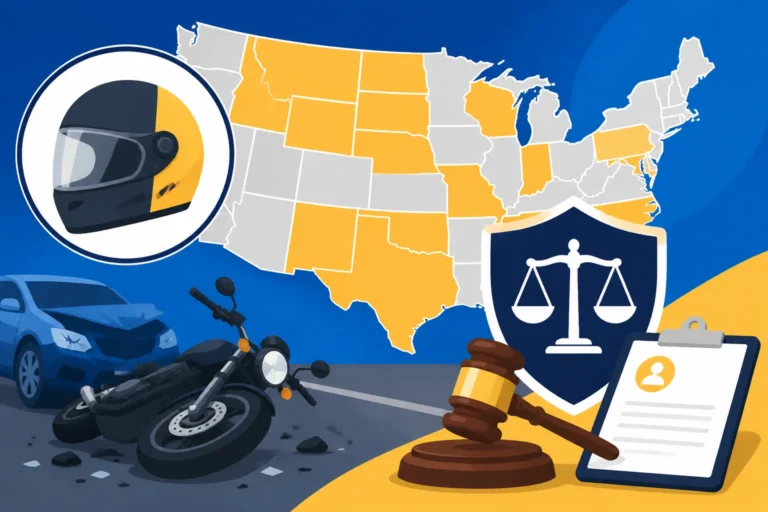
Motorcycle helmet laws vary drastically across the United States, creating a complex patchwork of regulations that can significantly influence the application and effectiveness of the helmet defense in a motorcycle accident claim. Understanding the specific laws in your state, and where the accident occurred, is absolutely critical.
Universal Helmet Laws
States with universal helmet laws require all motorcycle riders, regardless of age or experience, to wear a helmet at all times when operating or riding on a motorcycle. These laws are typically in place to enhance rider safety and reduce severe head injuries. For example, California is one of the states that mandates helmet use for all riders. In these jurisdictions, if you are involved in an accident and were not wearing a helmet, the helmet defense can be particularly powerful.
In a universal helmet state, an insurance company or defense attorney can more easily argue that you violated a clear legal mandate, making your non-compliance a straightforward point of negligence. The argument shifts from a "should have worn one for safety" to a "you broke the law, and that contributed to your injuries." This makes it much harder to dispute the assertion that your head injuries could have been less severe had you been compliant. Jurors might also be less sympathetic to a rider who knowingly broke the law. You can delve deeper into Motorcycle Helmet Laws by State to see where your state stands.
Partial Helmet Laws and Exceptions
Many states operate under partial helmet laws, which typically require helmets for specific age groups, often riders under 18 or 21. Some partial laws might also mandate helmets if a rider doesn't carry a certain level of insurance, like Florida, where riders over 21 can forego a helmet if they have at least $10,000 in medical benefits coverage. These laws introduce more complexity to the helmet defense.
If you are an adult rider in a partial helmet state and are not legally required to wear a helmet, the helmet defense becomes less about a legal violation and more about a failure to mitigate damages. While the defense can still be raised, it's generally a tougher sell for the insurance company. They must prove, usually through expert testimony, that a helmet would have specifically prevented or lessened your injuries, rather than just pointing to a statute you violated. The absence of a legal requirement means the argument focuses solely on causation and injury mitigation, rather than statutory negligence. This distinction can be a significant difference when negotiating a settlement or presenting a case in court.
States with No Helmet Laws
A handful of states have no universal or partial helmet laws for adult riders, meaning individuals 18 or 21 and older are free to choose whether or not to wear a helmet. For instance, Iowa and New Hampshire are among the states that do not impose universal helmet mandates for adults. In these states, the helmet defense faces its greatest challenge.
Without a legal requirement for helmet use, the defense attorney cannot argue that you broke the law. Their argument must rely solely on the concept of avoidable consequences or failure to mitigate damages. They would need to present compelling medical and accident reconstruction evidence to convince a jury that your specific head injuries were directly and demonstrably worsened by the absence of a helmet. This is a high bar. Furthermore, the argument can run into issues with the "eggshell skull" rule, which states that a negligent defendant must take their victim as they find them, meaning they are responsible for the full extent of injuries, even if a pre-existing condition or lack of protective gear made the victim more susceptible. However, defense attorneys will still try to argue that a reasonable person would wear a helmet for safety, regardless of the law.
How Helmet Non-Use Affects Your Claim's Value
The helmet defense, when successfully applied, can have a profound and detrimental effect on the total value of your motorcycle accident claim. It directly attacks the very core of your compensation for suffering and recovery.
Reducing Medical Damages
One of the most immediate and tangible ways the helmet defense reduces settlements is by targeting your medical expenses, particularly those related to head and brain injuries. If you suffered a traumatic brain injury (TBI), concussion, skull fracture, or any injury to the head area and were not wearing a helmet, the defense will argue that these injuries would have been less severe, or perhaps even entirely avoided, had you been wearing a DOT-compliant helmet.
Let's say your medical bills for a TBI total $150,000. The insurance company, through their medical experts, might argue that with a helmet, those costs would have been only $50,000. They would then propose to only cover the $50,000, claiming you are responsible for the additional $100,000 due to your own negligence. This can be devastating, especially with the high costs of long-term care, rehabilitation, and future medical treatments associated with severe head injuries. It's a direct attack on the most expensive component of many accident claims. Understanding How Medical Bills Affect Your Settlement is crucial here.
Impact on Pain and Suffering
Beyond the calculable economic damages like medical bills and lost wages, motorcycle accident claims include non-economic damages such as pain and suffering. These are subjective and intended to compensate you for the physical pain, emotional distress, loss of enjoyment of life, and mental anguish you endure as a result of your injuries. The helmet defense can significantly reduce these crucial components of your settlement.
If the defense successfully argues that your injuries were preventable or worsened by not wearing a helmet, a jury or an insurance adjuster might view your pain and suffering as partially self-inflicted. This can lead to a drastic reduction in the amount awarded for pain and suffering. For instance, if your initial calculation for pain and suffering was $200,000, and the defense convinces a jury you were 30% responsible for the severity of your head trauma due to not wearing a helmet, that $200,000 could shrink to $140,000. It's a way for the defense to devalue your suffering by implying you contributed to it. Our article on Pain and Suffering in Motorcycle Settlements explains how these damages are typically valued.
Comparative Negligence and Settlement Reduction
The helmet defense often operates under the umbrella of comparative negligence (or contributory negligence in a few states). Most states follow some form of comparative negligence, which allows an injured party to recover damages even if they were partially at fault for their injuries, but their award will be reduced by their percentage of fault.
For instance, in a modified comparative negligence state like Ohio, if you are found to be 51% or more at fault for your injuries (not necessarily the accident itself), you may be barred from recovering any damages. Even if you are found to be 20% at fault for the severity of your head injuries due to not wearing a helmet, your total settlement will be reduced by that 20%. So, if your total damages were $300,000, a 20% comparative fault attribution related to helmet non-use would reduce your payout to $240,000. This principle directly links the perceived "negligence" of not wearing a helmet to a tangible reduction in your final settlement amount. It's a complex area, and exploring Comparative Negligence in Motorcycle Accidents can offer deeper insights into how this works.
Challenging the Helmet Defense
While the helmet defense can be a formidable obstacle, it is not insurmountable. There are several effective strategies to challenge this defense and protect your right to full compensation. It requires a nuanced understanding of accident reconstruction, medical causation, and legal precedent.
Proving Helmet Non-Use Wasn't a Factor
The most direct way to counter the helmet defense is to demonstrate that your failure to wear a helmet (or a DOT-compliant one) had no bearing on the specific injuries you sustained. This often involves detailed medical and scientific analysis. For example, if you sustained a broken leg, internal organ damage, or severe road rash on your body, the absence of a helmet could not reasonably be argued to have caused or worsened these injuries. In such cases, the helmet defense simply doesn't apply to those particular damages.
Even with head injuries, an experienced legal team can challenge the defense. Perhaps the impact force was so severe that even a helmet wouldn't have prevented the injury, or a specific angle of impact rendered the helmet ineffective. This would involve accident reconstruction experts who can analyze impact forces and medical professionals who can testify that your injuries would have been substantially the same even if you had worn a helmet. They might present studies showing helmet limitations or specific circumstances where helmet use wouldn't alter the outcome. This detailed evidence directly refutes the causal link the defense tries to establish.
Expert Witness Testimony
To effectively challenge the helmet defense, you often need to bring in expert witnesses. These professionals can provide credible testimony that undermines the opposing side's arguments about injury causation and mitigation.
- Accident Reconstructionists: These experts can analyze the dynamics of the crash, impact points, speeds, and forces involved. They can then offer an informed opinion on whether a helmet would have realistically prevented or reduced the specific head injury you sustained, given the severity and nature of the collision. They might use simulations or physical models to support their conclusions.
- Medical Experts: Doctors, neurologists, and forensic pathologists can testify about the nature of your head injuries, their severity, and their likely causes. They can explain whether your specific injury pattern is typical of someone wearing a helmet versus not wearing one, or if the force of the impact was so great that a helmet's protective capabilities would have been overwhelmed. Their testimony is crucial for countering the insurance company's medical claims. They can also explain why immediate medical attention was necessary, regardless of helmet use, which is critical for your claim.
Jurisdictional Nuances and Legal Strategies
The legal strategies employed to challenge the helmet defense are highly dependent on the state where the accident occurred and the specific laws in place. In states with no helmet laws, your attorney can argue that you had no legal duty to wear one, making the defense less about negligence and more about a speculative "what if."
In states with partial helmet laws, if you were not legally required to wear a helmet due to your age or insurance coverage, your attorney can focus on disproving causation rather than legal non-compliance. They might also argue that the defense is prejudicial and attempts to paint the rider as reckless, thus infringing on the right to a fair assessment of fault. Furthermore, some states may have specific case law that limits the application of the helmet defense, and a skilled attorney will be well-versed in these nuances. This is where having an attorney who understands Motorcycle Accident Fault Laws in California or other specific states becomes invaluable, as they can navigate the legal landscape effectively.
Evidence and Documentation to Protect Your Claim
After a motorcycle accident, collecting and preserving evidence is paramount, especially when facing a potential helmet defense. Thorough documentation can make or break your claim.
Importance of Medical Records
Your medical records are the backbone of any personal injury claim, and they become even more critical when confronting the helmet defense. Seek immediate medical attention after an accident, even if you feel fine. Delayed symptoms, especially with head injuries, are common. Comprehensive medical records will document the exact nature and extent of your injuries, the treatments you received, and your prognosis.
Make sure your medical professionals clearly document any lack of head injury if you weren't wearing a helmet, or detail the severity if you were. If you were wearing a helmet, ensure it's noted in your records. These records help establish the direct link between the accident and your injuries, making it harder for the defense to argue that helmet non-use was the primary cause. They also demonstrate the continuity of care, which is crucial for proving the ongoing impact of your injuries. Our guide on How to Document Injuries for a Claim offers helpful advice.
Accident Scene Documentation
The scene of the accident itself holds a wealth of information that can be vital in countering the helmet defense. If possible and safe to do so, document everything.
- Photographs and Videos: Take numerous photos and videos of the accident scene. Capture your motorcycle, the other vehicle, road conditions, traffic signs, and any skid marks. Importantly, take clear photos of yourself and your gear (or lack thereof). If you were wearing a helmet, photograph it from multiple angles, especially any damage it sustained. This visually demonstrates that you were indeed wearing protection and that it performed its function, or that the impact was so severe that even a helmet couldn't prevent injury. If your helmet was damaged, preserving it as evidence is crucial.
- Police Reports: While police reports aren't always definitive on fault, they often contain details about whether a helmet was worn. Review the report carefully for accuracy. If it incorrectly states you weren't wearing a helmet when you were, or vice versa, this needs to be addressed immediately.
- Witness Statements: Independent witnesses can corroborate whether you were wearing a helmet and provide objective accounts of the accident itself, helping to establish the other driver's fault.
Witness Statements and Police Reports
The statements of witnesses and the official police report carry significant weight in a motorcycle accident claim. While a police report might not be admissible as direct evidence of fault in all states, it serves as an official record of the accident, including details like road conditions, vehicle positions, and, crucially, whether a helmet was worn.
If the police report indicates you were not wearing a helmet, and that's accurate, the defense will use it. However, a police report might also contain details that undermine the helmet defense, such as severe vehicle damage indicating high impact force, or statements from the other driver admitting fault for traffic violations. Independent witnesses can also be invaluable. They can testify to the other driver's actions (e.g., distracted driving, failure to yield) and corroborate details about your helmet use or non-use. Sometimes, a witness might even observe the helmet coming off during the crash, which isn't the same as not wearing one. This kind of objective third-party account can be incredibly persuasive in negotiations or court, helping to frame the narrative around the defendant's negligence, rather than your helmet choice.
Mitigating the Impact of the Helmet Defense
Even if you find yourself in a situation where the helmet defense is being leveraged against you, there are proactive steps you can take to mitigate its impact and strengthen your overall claim.
Wearing DOT-Compliant Gear
This might seem obvious, but the single best way to counter the helmet defense is to wear a Department of Transportation (DOT)-compliant helmet every single time you ride. DOT certification means the helmet meets specific safety standards designed to protect your head in a crash. Beyond helmets, wearing full protective gear, such as armored jackets, gloves, and sturdy boots (like those found at retailers like Cycle Gear), can prevent other severe injuries like road rash, broken bones, and abrasions. This demonstrates a commitment to safety and responsibility.
If you are wearing a DOT-compliant helmet and still sustain a head injury, the defense's argument is significantly weakened. They can no longer claim you failed to take basic safety precautions. Instead, they would have to argue that the helmet was defective (shifting blame to the manufacturer) or that your injury was so severe that no helmet could have prevented it, which often necessitates stronger expert testimony on their part. Furthermore, wearing full protective gear generally reduces the overall severity of injuries, which inherently leads to a stronger claim. Learn more about Motorcycle Safety Gear and Legal Protection.
Seeking Immediate Medical Attention
As mentioned earlier, getting immediate medical attention after an accident is crucial, regardless of whether you wore a helmet or the apparent severity of your injuries. This creates an immediate and official record of your injuries and their direct link to the accident. Any delay can allow the insurance company to argue that your injuries were not serious, or worse, that they were caused by something other than the motorcycle accident.
For head injuries, this is particularly vital. Symptoms of a concussion or TBI can be subtle or delayed, sometimes appearing days or even weeks after the crash. A timely medical evaluation by a doctor, especially if you report any head trauma or disorientation, can establish a baseline for your recovery and document the initial diagnosis. This solid medical paper trail makes it much harder for the defense to attribute your head injury to prior events or downplay its severity.
The Role of a Skilled Attorney
Navigating a motorcycle accident claim, especially when the helmet defense is in play, is incredibly complex. Insurance companies have vast resources and experienced legal teams dedicated to minimizing payouts. This is precisely why you need a skilled motorcycle accident attorney on your side.
An experienced attorney understands the nuances of helmet laws in your state, the intricacies of comparative negligence, and the strategies insurance companies use. They can:
- Gather and Preserve Evidence: They'll know exactly what evidence to collect, from accident scene photos and police reports to expert witness reports and medical records, to build a robust case.
- Negotiate with Insurers: Attorneys are adept at countering the helmet defense in negotiations, presenting compelling arguments and evidence that prevent adjusters from unfairly devaluing your claim. They know how to handle lowball offers and fight for fair compensation.
- Engage Experts: They have access to a network of accident reconstructionists, medical professionals, and other expert witnesses who can provide credible testimony to support your case and refute the defense's claims.
- Represent You in Court: If negotiations fail, a seasoned attorney is prepared to take your case to trial, presenting your evidence and arguments to a jury in a persuasive manner, ensuring your rights are protected.
Trying to handle this on your own against a formidable insurance company is like trying to put out a wildfire with a garden hose. A legal professional can make all the difference in achieving a just settlement. If you're wondering if you need professional help, consider reading Do You Need a Motorcycle Accident Lawyer. They are essential for fighting back against the "rider bias" often present in these cases and ensuring your focus remains on recovery.
Disclaimer
Please remember that this information is for educational purposes only and does not constitute legal advice. Every motorcycle accident claim is unique, and the laws governing helmet use and personal injury claims vary significantly by state. It is crucial to consult with an experienced motorcycle accident attorney to discuss the specifics of your situation and understand your legal rights and options.