Who Is at Fault in a Poor Road Conditions Motorcycle Accident
Riding a motorcycle offers unparalleled freedom, but that feeling can be instantly shattered by a sudden, unexpected accident. It's especially infuriating when a crash isn't due to another driver's negligence or your own mistake, but rather a dangerous condition on the road itself—a gaping pothole, loose gravel, or missing sign. This guide will meticulously break down how fault is determined in motorcycle accidents caused by poor road conditions, helping you understand your rights and the steps to take.
Understanding What Constitutes Poor Road Conditions
When we talk about "poor road conditions," it's more than just a bumpy ride. These are usually hazards that are unexpected, improperly maintained, or could have been prevented with reasonable care by the entity responsible for the road. The frustration for riders is immense because these aren't always things you can swerve to avoid without creating an even bigger danger for yourself or others. You're simply riding along, minding your own business, and suddenly your safety is compromised by someone else's oversight.
Types of Dangerous Road Hazards
The spectrum of road hazards that can cause a motorcycle accident is surprisingly broad. It's not just the obvious issues that jump out at you, but often subtle, overlooked dangers that can be catastrophic for a two-wheeled vehicle. For instance, a small divot in the pavement that a car barely registers can send a motorcycle into a wobble or even a full-blown crash.
Common culprits include:
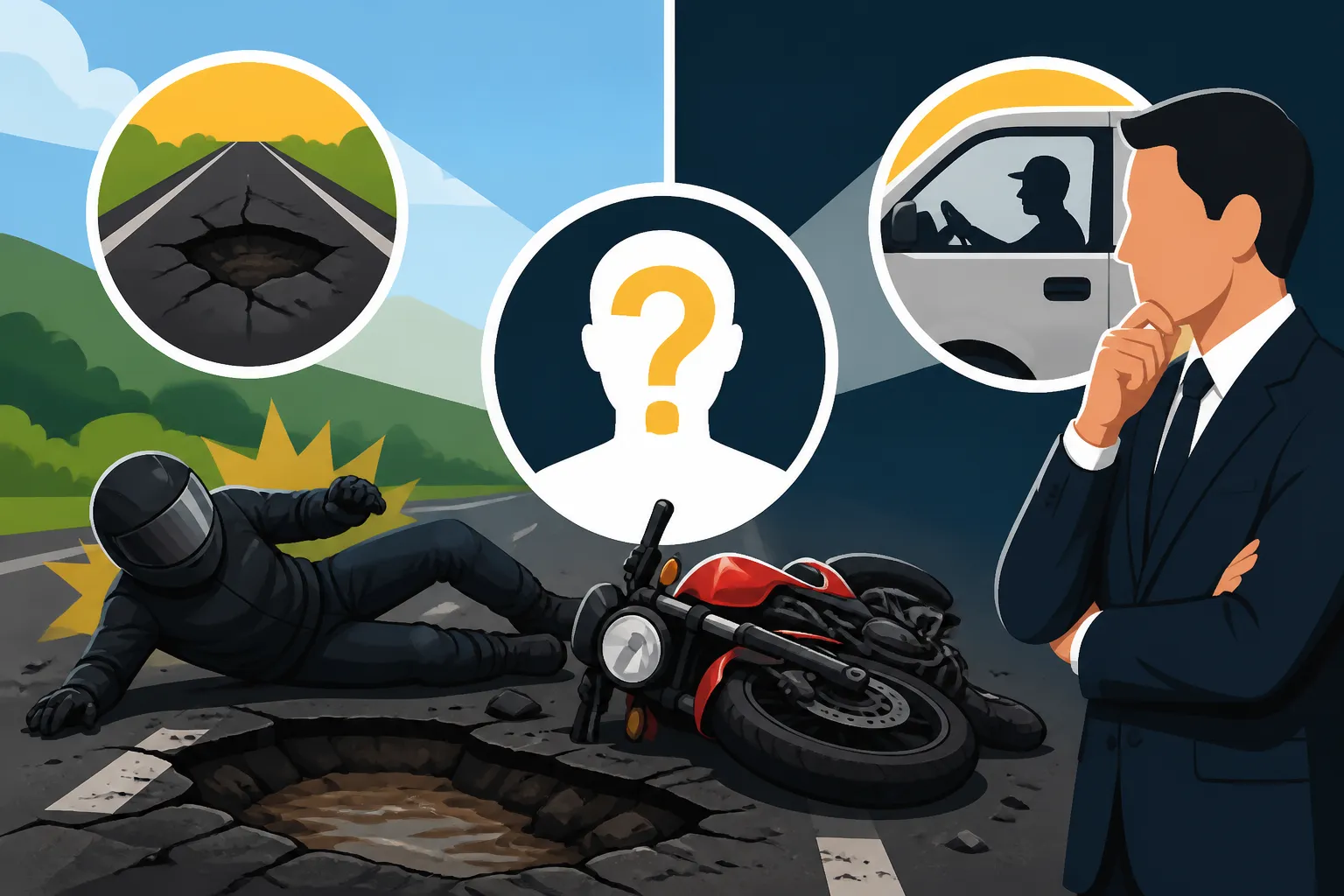
- Potholes and Cracks: These are probably the most infamous. A deep pothole can easily swallow a motorcycle tire, causing a loss of control, especially at speed. Cracks, if wide and deep enough, can also grab tires or create uneven surfaces that lead to instability.
- Uneven Pavement or Drops: This often happens where road work has been left incomplete, or where lanes shift dramatically without proper grading. A sudden drop-off between lanes or a significant change in pavement height can cause a rider to lose balance or even flip.
- Loose Gravel, Sand, or Debris: Picture this: you're leaning into a curve, enjoying the ride, when suddenly your tires hit a patch of loose gravel spilled from a construction truck. It's a classic scenario for a motorcycle crash, as these materials drastically reduce traction. This could also include sand, oil spills, or even fallen branches and trash.
- Missing or Damaged Road Signs: While not a direct physical hazard, inadequate signage for curves, construction zones, or sudden lane merges can leave a rider unprepared for upcoming dangers, contributing significantly to an accident. For example, a missing warning sign for a sharp turn on a rural road can be just as dangerous as a physical obstruction.
- Malfunctioning Traffic Signals: A broken traffic light or one that cycles incorrectly can lead to confusion and accidents, even if the road surface itself is fine. These create unexpected traffic patterns that can catch riders off guard.
- Poor Drainage and Standing Water: After a heavy rain, standing water can hide potholes or create hydroplaning risks for motorcycles, which have a smaller tire contact patch than cars. I've seen riders take nasty spills just from hitting an unexpected puddle that concealed a hazard.
- Unmarked Construction Zones: Nothing is more frustrating than coming across a construction zone that isn't properly marked with cones, barriers, or warning signs. These areas often have uneven surfaces, loose materials, or sudden lane shifts that become extremely dangerous when a rider isn't given proper notice.
When These Conditions Become a Legal Issue
It’s one thing to encounter a rough patch of road; it’s another for that rough patch to be the direct cause of your injuries and property damage. For a poor road condition to become a legal issue, it generally needs to meet the criteria of negligence. This means that the entity responsible for maintaining the road — typically a government agency or a private contractor — knew or should have known about the dangerous condition and failed to address it within a reasonable timeframe.
Think about it: if a massive pothole appears overnight after a storm, the city can't be expected to fix it immediately. However, if that same pothole sits there for weeks, steadily growing larger, and multiple complaints have been filed, then a failure to act becomes much harder to defend. This distinction is crucial when trying to determine liability. It's about demonstrating that there was a duty to maintain, a breach of that duty, and that breach directly caused your accident and injuries. This is often where things get complicated, as these entities will try to deflect blame or claim they had no knowledge of the hazard.
Determining Fault in Road Hazard Accidents
Assigning fault in a motorcycle accident is always a complex dance, but it becomes particularly intricate when the road itself is implicated. You can't sue the road, right? Instead, you have to identify the specific entity responsible for that road and then prove they were negligent in their duties. This means digging deep into who owns and maintains that stretch of asphalt, and whether they lived up to their responsibilities.
The Role of Government Entities
More often than not, the roads we ride on are owned and maintained by some level of government. This could be a local municipality like a city or county, a state Department of Transportation (DOT), or even a federal agency for certain highways. Each of these entities has a legal duty to keep their roads reasonably safe for motorists, including motorcyclists. However, proving fault against a government agency is notoriously difficult.
Government entities often benefit from something called "sovereign immunity" or "governmental immunity," which provides them with certain protections from lawsuits. While this immunity isn't absolute, it means there are often stricter rules, shorter deadlines, and specific procedures you must follow to even begin a claim against them. For example, in many states, you might only have a few months to file a formal "notice of claim" against a government agency, as opposed to the standard two or three-year statute of limitations for claims against private citizens. This is a crucial detail that many riders overlook, potentially costing them their ability to seek compensation. If you're wondering how to initiate such a claim, you'll need to understand the nuances of Suing a City for a Dangerous Road.
Proving Negligence Against a Municipality
To successfully argue that a government entity is at fault, you generally need to prove a few key things:
- Existence of a Dangerous Condition: You must clearly identify the specific poor road condition that caused your accident. Was it a massive pothole, an unmarked change in elevation, or an accumulation of gravel? You need concrete evidence of this hazard.
- The Entity Knew or Should Have Known: This is often the trickiest part. You need to show that the government agency either had actual knowledge of the dangerous condition (e.g., someone reported it, or their maintenance crews observed it) or that they should have known about it through reasonable inspection and maintenance practices. This could involve looking at maintenance schedules, public complaint logs, or even previous accident reports in the same area.
- Failure to Remedy the Condition: The entity must have failed to fix the condition, put up warning signs, or take other reasonable steps to prevent accidents within a reasonable amount of time after gaining knowledge of the hazard. A city isn't expected to fix every pothole the second it appears, but they are expected to have a system for identifying and repairing hazards.
- Causation: The dangerous condition must have been the direct cause of your motorcycle accident and injuries. This means demonstrating that if the road condition hadn't been there, the accident wouldn't have happened.
Imagine a scenario in Phoenix, Arizona. A major thoroughfare, say Camelback Road, develops a large, deep crack after unusual heavy monsoon rains. Multiple residents report it to the City of Phoenix Public Works Department over several weeks. Despite these reports, no repairs are made, and no warning signs are posted. A motorcyclist then hits this crack, loses control, and suffers severe injuries. In this case, the rider would have a strong argument that the city had actual knowledge of the defect and failed to act, thus being liable. Understanding Government Liability for Road Hazards can be critical here.
When Private Entities or Contractors Are Liable
While government agencies maintain most public roads, there are situations where a private entity or contractor might be responsible for a dangerous road condition. This typically occurs in a few scenarios:
- Construction Zones: If a private construction company is working on a public road, they are responsible for maintaining safe conditions within their work zone. This includes properly marking hazards, ensuring even surfaces, and cleaning up debris. If their negligence—say, leaving sharp, uneven pavement transitions or a pile of loose asphalt unmarked—causes an accident, they could be held liable.
- Private Roads: Some roads are privately owned and maintained, such as those within large housing developments, private campuses, or commercial properties. The owners of these properties have a duty to ensure their roads are safe for those invited onto them.
- Utility Work: Utility companies (for gas, water, electricity, internet) often dig up roads to access underground lines. They are responsible for properly backfilling and repairing the road surface to its original safe condition. If they leave behind a shoddy patch job that creates a hazard, they could be liable.
In these cases, the legal hurdles might be slightly different than with government immunity, but the core principle of proving negligence remains the same. You'd still need to demonstrate that they had a duty to maintain the road, they breached that duty, and that breach directly caused your accident. This often requires careful investigation into contracts, work permits, and safety protocols established for the project. For a deeper dive into the specifics, consider how How Road Defects Cause Motorcycle Crashes can bolster your claim.
Steps to Take After an Accident Caused by Road Conditions
Being involved in any motorcycle accident is traumatic, but when you realize a defective road caused it, the immediate aftermath can be even more confusing. Knowing what to do in those crucial moments can make a monumental difference in proving your case later on. Don't let the shock prevent you from securing vital evidence.
Documenting the Scene and the Hazard
Your first priority, always, is safety. Get yourself and your motorcycle to a safe location if possible, but before anything is moved, if you are able, start documenting. This isn't just about showing your injuries or bike damage; it's about making the road hazard the star of the evidentiary show.
- Take Extensive Photos and Videos: This is paramount. Capture wide shots showing the overall scene, the road, and landmarks (like street signs or specific buildings) to establish the precise location. Then, zoom in on the specific road defect that caused your accident. Get multiple angles, use objects like a shoe or a ruler for scale if you can. Show how deep a pothole is, how wide a crack is, or the extent of loose gravel. Take photos of your bike in relation to the hazard, especially if it's still at rest where the impact occurred. If there's missing signage, photograph the absence of the sign where one should clearly be. For more on this, check out Photos to Take to Prove Motorcycle Fault.
- Note Environmental Conditions: Was it raining? Was it dark? Was the sun in your eyes? These factors can sometimes be used by defense attorneys to suggest shared fault, so having your own clear account is important.
- Identify Responsible Agencies/Companies: Look for any signage indicating road work, construction companies, or utility companies in the vicinity. Jot down their names and any identifying project numbers.
- Call the Police: Even if it feels like a "single-vehicle accident," it's vital to get law enforcement on the scene. Their report will officially document the date, time, and location of the incident, and importantly, they may note the road hazard in their report. This objective third-party documentation is extremely valuable. When police investigate a motorcycle crash, their findings can be crucial for establishing fault, even in complex scenarios.
Gathering Evidence for Your Claim
The immediate aftermath is just the beginning. Building a strong claim against a government entity or private contractor requires diligent evidence collection over time.
- Witness Information: Did anyone see your accident or, more importantly, did anyone else comment on the road condition before your accident? Get their names, phone numbers, and email addresses. They could be key in proving the responsible entity had notice of the hazard. This also applies to other riders who might have experienced near-misses due to the same defect.
- Medical Records: Seek immediate medical attention, even if you feel fine. Some serious injuries, like internal bleeding or concussions, might not be apparent until hours or days later. Your medical records will create a clear paper trail linking your injuries directly to the accident. Any gap in treatment can be used by insurance companies to devalue your claim. For more information, see How to Document Injuries for a Claim.
- Maintenance Records: This is where a legal professional often comes in handy. Your attorney can request maintenance logs, inspection reports, and complaint records from the relevant government agency or private company. This information can prove that the entity had prior knowledge of the hazard but failed to act.
- Expert Testimony: In complex cases, an accident reconstructionist or a civil engineer might be needed to analyze the road defect, its impact on motorcycle handling, and whether it met safety standards. They can provide expert opinions on how the road condition caused your crash and why it constituted a dangerous hazard.
- Traffic Camera Footage: Some municipalities have traffic cameras at intersections or along major roads. This footage could potentially capture your accident and the contributing road hazard.
- Social Media and News Reports: Sometimes, dangerous road conditions are hot topics in local community groups online or in local news. Searching for mentions of the specific location and hazard can uncover valuable evidence of prior complaints or public knowledge.
Remember, the goal is to build an undeniable case that clearly demonstrates the negligence of the responsible party. For comprehensive advice, reviewing a guide on Motorcycle Accident Evidence for Proving Fault can be incredibly helpful.
Seeking Medical Attention and Legal Guidance
Once the dust settles, your health and legal rights become paramount. Don't delay on either front.
- Prioritize Medical Care: This cannot be stressed enough. Go to the emergency room or urgent care immediately if you have any doubts about your condition. Follow all medical advice, attend all follow-up appointments, and keep meticulous records of all treatments, medications, and expenses. Your physical recovery is the most important, but solid medical documentation is also the backbone of any personal injury claim. Ignoring or delaying care gives insurance companies an easy out to claim your injuries aren't serious or weren't caused by the accident.
- Consult an Experienced Motorcycle Accident Lawyer: Dealing with insurance companies and government agencies after an accident is a minefield. They are not on your side and will actively look for ways to minimize their payout. An attorney who specializes in motorcycle accidents and understands claims against municipalities is invaluable. They know the specific laws and deadlines (like those short notice-of-claim periods for government entities), how to gather the necessary evidence, and how to negotiate effectively. They can also help you understand how How Fault Is Determined in Motorcycle Accidents applies to your specific situation and whether you might be dealing with Shared Fault in Motorcycle Accidents. In fact, if you're wondering Do You Need a Motorcycle Accident Lawyer, a case involving government liability for poor road conditions is almost certainly a resounding yes. They will be your best advocate against powerful and often bureaucratic defendants.
Challenges and Defenses in Road Condition Claims
Even with compelling evidence, claims against government entities or contractors for poor road conditions are rarely straightforward. These defendants have significant resources and legal teams dedicated to minimizing their liability. Understanding the common defenses they employ can help you prepare for the battle ahead.
The "Open and Obvious" Defense
One of the most frequent arguments you'll encounter is the "open and obvious" defense. This essentially states that the road hazard was so apparent and noticeable that a reasonably prudent motorcyclist should have seen it and avoided it. If a large, unavoidable pothole was in broad daylight with no obstructions, they might argue you simply weren't paying enough attention.
This defense puts some of the onus back on the rider, suggesting a degree of contributory or comparative negligence. However, this defense isn't absolute. What's "open and obvious" to a car driver might not be for a motorcyclist, who has less stability and maneuverability, especially at speed. Factors like lighting, weather conditions (rain might obscure a hazard), traffic volume, and the suddenness of the hazard can all undermine this defense. For instance, a pothole hidden by shadows at dusk, or one that appears suddenly after a vehicle ahead swerves, might not be considered "open and obvious." This is where your detailed photos and witness statements about the road conditions become critical, especially if you can show the hazard was obscured or camouflaged.
Shared Fault and Comparative Negligence
Even if the government or a private contractor is found negligent, they will almost certainly try to argue that you, the rider, bear some percentage of fault for the accident. This brings us to the concept of Comparative Negligence in Motorcycle Accidents. Most states follow some form of comparative negligence, which means your compensation can be reduced by the percentage of fault assigned to you.
For example, if the court determines the city was 80% at fault for a massive, unmarked pothole, but you were 20% at fault because you were mildly speeding, your total settlement will be reduced by 20%. In some states, like North Carolina, if you are found even 1% at fault, you might be entirely barred from recovering any damages, under a strict rule known as contributory negligence. Thankfully, most states are more lenient with comparative negligence rules. They might argue you were:
- Speeding: Exceeding the speed limit could be seen as contributing to your inability to react safely to the hazard.
- Distracted: Were you looking at your phone or engaging in any other distracting behavior?
- Riding Recklessly: Making sudden maneuvers, riding too close to other vehicles, or engaging in unsafe lane changes could all be cited.
- Improper Equipment: Were your tires worn out? Were your brakes in poor condition? They might try to blame your equipment.
It's vital to have a lawyer who understands how to counter these allegations and protect your percentage of fault. Your lawyer can argue that even if you made a minor error, the primary cause of the accident was the egregious road hazard, which you had no reasonable way to anticipate or avoid.
Navigating Government Immunity Laws
As briefly mentioned earlier, government entities enjoy various forms of immunity from lawsuits. These laws vary significantly from state to state and can be incredibly complex. For instance, a city might be immune from liability for certain "discretionary" functions (like deciding whether to build a road) but not for "ministerial" functions (like how to maintain an existing road safely).
Key aspects of navigating government immunity include:
- Strict Deadlines: The "notice of claim" deadlines are often drastically shorter than standard personal injury statutes of limitations. Missing this deadline, even by a day, can permanently bar your claim, regardless of how strong your evidence is.
- Specific Procedures: There are usually precise forms and methods for filing a claim against a government entity. Any deviation can result in dismissal.
- Limits on Damages: Some states impose caps on the amount of damages you can recover from a government entity. This means even if you have hundreds of thousands in medical bills, you might be limited to a much lower recovery amount.
These complexities highlight precisely why having an attorney experienced in governmental claims is not just helpful, but often essential. They can guide you through the bureaucratic maze, ensure all deadlines are met, and build the strongest possible case within the confines of these unique laws. Don't try to go it alone against a city, county, or state Department of Transportation; the odds are stacked against you without expert legal help.
Table: Common Road Hazards and Responsible Parties
Understanding who is typically responsible for different types of road hazards can help in identifying potential defendants in your claim.
| Road Hazard Type | Common Responsible Parties | Key Factors for Liability |
|---|---|---|
| Potholes/Cracks | City/County/State DOT | Known existence, failure to repair/warn in reasonable time. |
| Uneven Pavement/Drops | City/County/State DOT, Contractors | Improper construction, negligent repair, inadequate warning. |
| Loose Gravel/Sand | City/County/State DOT, Contractors | Failure to clean up spills, improper road maintenance. |
| Debris (e.g., branches) | City/County/State DOT, Property Owners | Failure to remove hazards, negligent maintenance of adjacent property. |
| Missing/Damaged Signs | City/County/State DOT | Failure to install or replace crucial warning/regulatory signs. |
| Malfunctioning Signals | City/County/State DOT | Negligent maintenance, failure to repair known issues. |
| Poor Drainage/Standing Water | City/County/State DOT | Design flaws, failure to clear storm drains, negligent maintenance. |
| Unmarked Construction | Contractors, City/County/State DOT | Failure to adhere to safety standards, inadequate signage. |
| Utility Trench Defects | Utility Companies, Contractors | Improper backfilling, inadequate repair of road surface. |
Disclaimer
Please note that this article provides general information and should not be considered legal advice. Motorcycle accident claims, especially those involving government entities or complex fault determination, are highly fact-specific and depend on the laws of your particular state. It is crucial to consult with an experienced motorcycle accident attorney to discuss the specifics of your situation and understand your legal options.