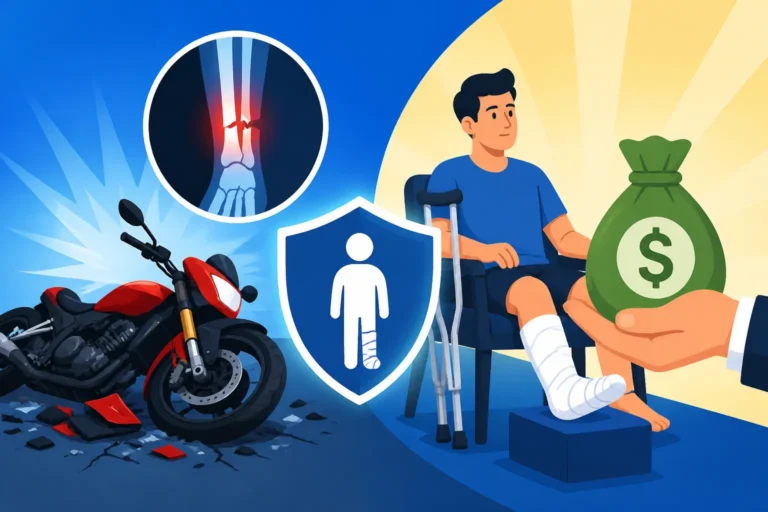
How Comparative Negligence Affects Settlements in Arizona
It's incredibly frustrating when you're involved in a motorcycle accident, and instead of clear-cut fault, you find yourself facing accusations that you contributed to the crash. This murky area, often called comparative negligence, can throw a real wrench into your ability to recover damages, especially when you're trying to heal. This comprehensive guide will demystify how comparative negligence specifically impacts motorcycle accident settlements in Arizona, helping you understand your rights and what steps to take to protect your claim.
Understanding Arizona's Pure Comparative Negligence Law
Arizona operates under a "pure comparative negligence" system, which is a big deal when it comes to motorcycle accident claims. Unlike some states where even a little bit of fault on your part can completely bar your recovery, Arizona allows you to seek compensation even if you are mostly to blame for the crash. This system recognizes that accidents are rarely black and white, and often, multiple parties share some degree of responsibility.
What Pure Comparative Negligence Means for Riders
For us riders, pure comparative negligence is a double-edged sword. On one hand, it means that if you're involved in a collision and the other driver caused 80% of the accident, but you were 20% at fault (maybe you were slightly speeding, or your headlight wasn't as bright as it should have been), you can still recover 80% of your total damages. This is a significant protection that many other states don't offer. It ensures that even if an insurance company or a jury determines you bear some responsibility, you're not left completely high and dry, facing huge medical bills and repair costs on your own.
However, the flip side is that any percentage of fault assigned to you will directly reduce the amount of compensation you receive. So, while you might recover something, it won't be the full amount if you're deemed partly responsible. This makes proving the other driver's fault and minimizing your own critically important. For a deeper dive into how different states handle shared responsibility, you might want to read about Contributory vs Comparative Negligence Explained.
The Key Difference from Other States
Many states follow what's known as "modified comparative negligence." In these states, if you are found to be at fault beyond a certain threshold—often 50% or 51%—you are completely barred from recovering any damages at all. Imagine being 51% responsible in a modified comparative negligence state; you'd get nothing, even if the other driver was clearly also negligent.
Arizona, however, doesn't have such a cutoff. Whether you are 10% at fault, 50% at fault, or even 90% at fault, you can still recover the corresponding percentage of your damages from the other party. This makes Arizona one of the more forgiving states for injured parties who might have contributed in some small way to their own accident. This distinction is crucial because it affects the entire strategy for negotiation and litigation in a motorcycle accident claim here.
How It Applies to Motorcycle Accidents Specifically
Motorcycle accidents are often prone to "rider bias in fault determination." There's an unfortunate stereotype that motorcyclists are inherently reckless, leading some juries and even insurance adjusters to assign a disproportionate amount of fault to riders. This is where Arizona's pure comparative negligence system, while fair in theory, can still present challenges in practice.
For example, if you were involved in a Left-Turn Motorcycle Accidents Explained scenario, where a car turned in front of you, the car driver is usually considered at fault. But an insurer might argue you were going too fast, or your motorcycle wasn't conspicuous enough, trying to assign you 10-20% fault to reduce their payout. Under Arizona law, if they succeed, your total compensation will be reduced by that percentage. It's not about being completely denied, but about the fight to keep that percentage as low as possible.
How Your Percentage of Fault Reduces Your Settlement
When shared fault comes into play in Arizona, it directly impacts your final settlement figure. It's a mathematical reduction that applies to every dollar you're awarded for your injuries, medical bills, lost wages, and pain and suffering. This means understanding how this calculation works is essential for managing your expectations and negotiating effectively.
Calculating Damages with Shared Fault
The calculation is straightforward: your total damages are determined, and then that amount is reduced by your assigned percentage of fault. For instance, let's say a jury determines your total damages from a motorcycle accident are $100,000. If they also find that you were 25% at fault for the accident, your recoverable damages would be $100,000 minus 25% ($25,000), leaving you with a $75,000 settlement.
This reduction applies uniformly across all types of damages – economic and non-economic. Economic damages cover tangible losses like medical bills, lost wages, and property damage. Non-economic damages, often referred to as "pain and suffering," compensate you for the intangible impacts of your injuries, such as emotional distress, loss of enjoyment of life, and physical discomfort. Both categories are subject to the comparative negligence reduction. Understanding How Motorcycle Accident Settlements Are Calculated can provide further context here.
Real-World Examples of Settlement Reductions
Let's look at a couple of hypothetical situations to really drive this home.
- Scenario 1: Minor Fault. Imagine you're riding your Harley-Davidson on Loop 101 in Phoenix, and a distracted driver veers into your lane, causing a crash. You suffer significant road rash, a broken arm, and your bike is totaled. Your total damages are calculated at $150,000. However, the police report notes you were riding about 5 mph over the speed limit. The insurance company successfully argues you were 10% at fault. Your $150,000 settlement would be reduced by 10% ($15,000), leaving you with $135,000.
- Scenario 2: Significant Fault. Now, consider a case where you were performing a lane-splitting maneuver in heavy traffic near downtown Tucson, which is a legal gray area in Arizona, and a car unexpectedly changed lanes, clipping you. While the car driver was negligent, the adjuster argues your lane splitting contributed significantly to the collision's severity. If a jury awards you $200,000 in total damages but assigns you 40% fault, your settlement would be reduced by $80,000, bringing your net recovery to $120,000. This clearly illustrates How Comparative Negligence Reduces Your Payout.
These scenarios highlight why every percentage point matters so much. A skilled legal team can often argue effectively to minimize your perceived fault, directly increasing your final compensation.
| Assessed Damages | Rider's Percentage of Fault | Driver's Percentage of Fault | Recoverable Amount |
|---|---|---|---|
| $50,000 | 10% | 90% | $45,000 |
| $50,000 | 25% | 75% | $37,500 |
| $50,000 | 50% | 50% | $25,000 |
| $50,000 | 70% | 30% | $15,000 |
The Impact on Economic vs. Non-Economic Damages
While both types of damages are reduced by your percentage of fault, the impact can feel different. Economic damages are quantifiable – a hospital bill is $X, lost wages are $Y per week. A percentage reduction here feels very concrete and can leave you scrambling to cover outstanding costs. For example, if your medical bills are $30,000 and you're 20% at fault, you're essentially on the hook for $6,000 of those bills, even though the other driver was primarily responsible.
Non-economic damages, like Pain and Suffering in Motorcycle Settlements, are more subjective but often constitute a significant portion of a motorcycle accident claim, especially in cases of severe injury. A reduction in this category means less compensation for your enduring physical discomfort, emotional trauma, and the lifestyle changes you've had to make. When you're recovering from a serious injury, a diminished payout for your pain can feel particularly unjust. This makes documentation of your injuries and their impact even more critical to justify higher initial damage valuations.
Strategies for Proving the Other Driver's Fault and Minimizing Your Own
Navigating comparative negligence in Arizona requires a proactive approach. Since any fault assigned to you can reduce your settlement, your primary goal after ensuring your safety and seeking medical attention should be to build a strong case that emphasizes the other driver's negligence and diminishes any perceived fault on your part.
Gathering Evidence at the Scene
The moments immediately following a motorcycle accident are chaotic, but they are also crucial for gathering evidence. If you're able and it's safe to do so, document everything. Take copious photos and videos of the accident scene from multiple angles. This includes damage to your motorcycle and the other vehicle, skid marks, road debris, traffic signs, traffic lights, and any road hazards that might have contributed. Don't forget to capture photos of the weather conditions and overall visibility.
Collect contact information from any witnesses who saw the crash. Their testimony can be invaluable in corroborating your version of events and countering any claims that you were at fault. Remember, every detail can serve as Motorcycle Accident Evidence for Proving Fault. It's also vital to call the police and get a formal police report. While not definitive proof of fault, it's often the first piece of evidence insurance companies consider, and it can set the narrative for the claim. Always be factual but avoid admitting fault at the scene, as this can severely prejudice your case.
The Role of Accident Reconstruction and Expert Testimony
In complex cases where fault is heavily disputed, especially when there are significant injuries, hiring an accident reconstruction expert can be a game-changer. These professionals can analyze physical evidence, vehicle data, witness statements, and even traffic camera footage to recreate the accident sequence. They can provide a detailed, scientific assessment of how the crash occurred and, critically, who was primarily responsible.
Their expert testimony can be powerful in court or during negotiations, helping to definitively assign fault and challenge any attempts by the opposing side to shift blame onto you. For example, if an insurance company claims you were speeding, an accident reconstructionist can use skid mark analysis to refute that claim, or perhaps show that the other driver's speed was far more impactful. These experts can also demonstrate how specific actions, like a driver's failure to yield, were the direct cause of the collision.
Dealing with Insurers' Attempts to Blame You
Insurance companies are businesses, and their goal is to pay out as little as possible. In Arizona, this often means they will actively try to assign you a percentage of fault, even if it's minor, because it directly reduces their financial obligation. They might try to use common stereotypes against motorcyclists, arguing you were reckless, hard to see, or speeding, even if there's little evidence to support these claims. This is known as How Insurance Companies Assign Blame to Riders.
It's crucial to be wary of their tactics. Never give a recorded statement without first consulting with an attorney. Insurers will often ask leading questions designed to elicit responses that can be used to assign you fault. They might also offer you a quick, lowball settlement, hoping you'll accept before fully understanding the extent of your injuries or the true value of your claim, especially before you've reached maximum medical improvement (MMI). Your best defense against these tactics is a clear understanding of your rights and a strong legal advocate.
The Importance of Legal Counsel in Comparative Negligence Cases
When you're dealing with injuries and the complexities of Arizona's comparative negligence laws, trying to handle a motorcycle accident claim on your own can be incredibly overwhelming. This is where an experienced motorcycle accident lawyer becomes not just helpful, but often indispensable. They understand the nuances of the law and the tactics insurance companies employ.
Navigating Complex Legal Arguments
Comparative negligence isn't just a simple calculation; it often involves complex legal arguments about causation, duty of care, and reasonable conduct. An attorney can dissect the specifics of your accident, identify applicable traffic laws, and build a compelling case that clearly outlines the other driver's negligence. They can also anticipate and counter the defense's arguments, such as claims that you were not wearing proper Motorcycle Safety Gear and Legal Protection or that your actions contributed to the crash.
They know how to challenge biased police reports, secure expert witnesses like accident reconstructionists or medical professionals, and present evidence in a way that maximizes the other party's fault and minimizes yours. This expertise is particularly valuable in Arizona, where every percentage point matters in securing your rightful compensation. For those wondering, Do You Need a Motorcycle Accident Lawyer is a common concern.
Maximizing Your Payout Even with Shared Fault
Even if there's an undeniable element of shared fault in your accident, a skilled lawyer can work to ensure that the percentage assigned to you is as low as possible. They can also fight to ensure your total damages are accurately and comprehensively calculated, including future medical expenses, lost earning capacity, and the full extent of your pain and suffering. By maximizing the total damages, even after a reduction for comparative negligence, your net payout can still be significantly higher than what you might achieve on your own.
For instance, if your total damages are initially undervalued at $50,000, and you're found 20% at fault, you get $40,000. But if a lawyer helps prove your true damages are $100,000, that same 20% fault leaves you with $80,000. It's about fighting for every aspect of your claim. Learn more about How a Lawyer Increases Your Settlement.
When to Hire a Motorcycle Accident Lawyer in Arizona
It's almost always a good idea to consult with a motorcycle accident lawyer immediately after an accident, especially in Arizona's comparative negligence system. The sooner they are involved, the better they can protect your interests by gathering crucial evidence, advising you on what to say (and not to say) to insurance adjusters, and ensuring that important deadlines, like the statute of limitations, are met.
If you're dealing with significant injuries, property damage, or if the other party's insurance company is already trying to place blame on you, hiring an attorney becomes even more critical. They can handle all communication with the insurance companies, allowing you to focus on your recovery without the added stress of complex legal battles. Many offer free initial consultations, so there's no risk in seeking their professional opinion on your case.
Disclaimer
Please remember that this article provides general information and insights into how comparative negligence laws in Arizona can affect motorcycle accident settlements. It is not intended as legal advice. Every accident case is unique, and the outcome depends on specific facts and applicable laws. For personalized advice regarding your situation, it is crucial to consult with a qualified motorcycle accident attorney in Arizona.