Motorcycle Accident Fault Laws in Texas
Riding a motorcycle in Texas offers unparalleled freedom, but the open road can also present unexpected dangers. When an accident inevitably happens, especially one that wasn't your fault, the aftermath can feel like a confusing maze of legal jargon and insurance company tactics. You're left not only dealing with potential injuries and bike damage but also the immediate, nagging question: "Who's truly at fault, and what does that mean for my recovery under Texas law?" This guide aims to demystify motorcycle accident fault laws in the Lone Star State, helping you understand your rights and the unique challenges riders face.
Navigating Texas's Modified Comparative Negligence Rule
Texas operates under a specific legal framework known as "modified comparative negligence." This isn't just a fancy legal term; it's the bedrock of how fault is assigned and how much compensation you can potentially recover after a motorcycle accident. Understanding this rule is absolutely crucial because it can make or break your ability to secure the funds you need for recovery.
The Critical 51% Bar Rule in Action
In most accident claims, including those involving motorcycles, Texas law requires determining each party's percentage of fault. The core concept behind comparative negligence is that you can still recover damages even if you were partially to blame for the accident. However, the "modified" part of the Texas rule introduces a critical threshold: the 51% bar. If you are found to be 51% or more at fault for the motorcycle accident, Texas law unfortunately bars you from recovering any damages from the other party. This is a tough pill to swallow for many riders who might have contributed only slightly to an incident but find their claim entirely dismissed.
Imagine you're cruising through Austin, and a car suddenly pulls out in front of you from a side street, leading to a collision. The driver clearly failed to yield. However, during the investigation, it's determined that you might have been going slightly over the speed limit, or perhaps your headlight wasn't as bright as it should have been, contributing in some small way. If the court or insurance adjusters decide you were 40% at fault, you can still pursue compensation. But if they push that number to 51% or higher, your claim against the other driver essentially evaporates. This stringent rule is why disputes over fault percentages become incredibly contentious and why precise evidence gathering is paramount in a Texas motorcycle accident claim.
How Your Percentage of Fault Directly Impacts Your Settlement
When a motorcycle accident occurs in Texas and fault is shared, your ability to recover compensation for your injuries, medical bills, lost wages, and pain and suffering is directly reduced by your assigned percentage of fault. This proportional reduction means that every single percentage point matters when it comes to your potential payout. It's not just an abstract legal concept; it directly impacts your financial future after a crash.
Let's consider a practical example. Suppose you were involved in a serious motorcycle accident in Dallas, and it was determined that the other driver was 80% at fault, while you were found to be 20% at fault for some contributing factor, perhaps an unsafe lane change on your part. If your total damages (medical expenses, lost income, pain and suffering, property damage) were calculated to be $100,000, your final settlement or award would be reduced by your 20% share of fault. This would mean you could only recover $80,000 (80% of $100,000). You can see how even a small percentage of fault can significantly diminish the funds available to cover your recovery and losses. This proportional reduction is a core aspect of Comparative Negligence in Motorcycle Accidents and highlights why accurately determining fault is so critical. The greater your percentage of fault, the less compensation you stand to receive, making the negotiation process with insurance companies particularly challenging for motorcyclists.
Key Factors and Evidence in Texas Fault Determinations
Determining who is at fault in a Texas motorcycle accident is rarely a straightforward process. It involves a meticulous examination of various elements, from traffic laws and driver behavior to physical evidence left at the scene. Insurance companies and courts will scrutinize every detail to assign percentages of blame, so understanding what factors weigh heavily in these determinations is vital for protecting your claim.
The Weight of Traffic Laws and Violations
Traffic laws form the backbone of fault determination. When a driver or rider violates a traffic law, it often points directly to their negligence and can be a significant factor in assigning fault. In Texas, for instance, common violations like speeding, distracted driving (e.g., texting while driving), or making an unsafe lane change can all contribute to an accident and subsequently impact fault. If the other driver ran a red light or failed to yield, that's a clear indicator of their negligence. Conversely, if you as the rider were exceeding the speed limit or engaging in reckless behavior, your actions could lead to you being assigned a higher percentage of fault, impacting your ability to recover damages under Texas's 51% rule.
A common point of confusion for motorcyclists in many states, including Texas, is lane splitting. It's important to clarify that lane splitting, which is riding a motorcycle between lanes of stopped or slow-moving traffic, is generally not legal in Texas. If a rider is involved in an accident while lane splitting, even if another driver makes a careless mistake, the act of lane splitting itself could be used by the insurance company or opposing counsel to assign a significant percentage of fault to the motorcyclist. This is a prime example of how How Traffic Violations Affect Fault can severely undermine a claim, even when another party's negligence is apparent.
Gathering Critical Evidence to Prove Your Case
Successfully navigating fault determinations in Texas hinges on the quality and quantity of evidence you can present. Immediately following an accident, gathering as much information as possible is paramount. A detailed police report from the responding officers often provides an initial assessment of fault and documents crucial scene details like vehicle positions, witness information, and any citations issued. Witness statements, especially from impartial third parties, can corroborate your account and contradict the other driver's version of events. In more complex cases, accident reconstruction experts might be employed to scientifically determine vehicle speeds, points of impact, and other dynamics that establish fault.
Beyond official reports and witness accounts, modern technology offers powerful tools. Dashcam footage, if available from your motorcycle or another vehicle, can provide irrefutable evidence of what transpired. Even cellphone records can be critical if distracted driving is suspected, showing if a driver was actively using their phone at the time of the crash. Furthermore, documenting your injuries through medical records and photographing all property damage to your motorcycle and the other vehicle helps to establish the severity of the impact and injuries sustained, directly supporting your claims for damages. This comprehensive approach to Motorcycle Accident Evidence for Proving Fault is often the difference between a fair settlement and an unfair denial. It is also important to know How Police Reports Establish Fault and how to ensure the report accurately reflects the scene.
Common Accident Scenarios and How Texas Law Assigns Blame
While every motorcycle accident is unique, certain scenarios occur frequently and present particular challenges for fault determination in Texas. Understanding how the law typically views these common situations can help riders anticipate potential arguments against their claims and prepare to defend their position.
Understanding Left-Turn Collisions and the 'I Didn't See You' Defense
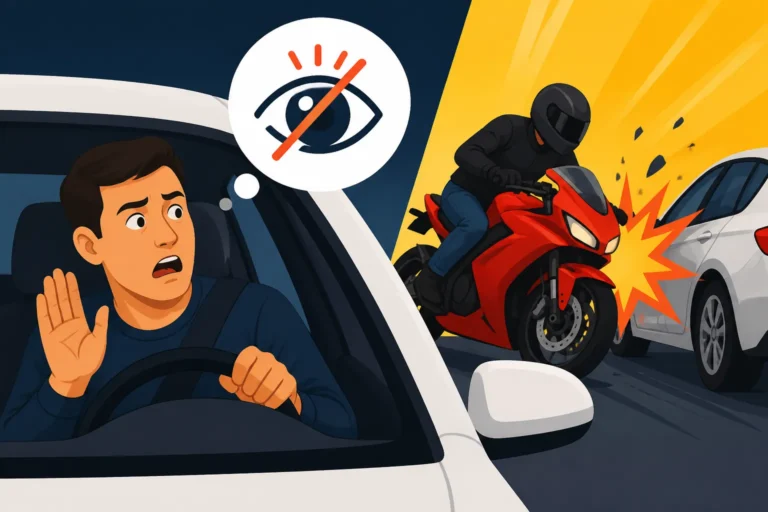
One of the most dangerous and common types of motorcycle accidents involves a car making a left turn directly in front of an oncoming motorcycle. This scenario accounts for a significant percentage of multi-vehicle crashes involving motorcycles. Often, the driver making the left turn will claim, "I didn't see the motorcycle," attempting to shift blame or minimize their responsibility. However, under Texas law, drivers have a duty to operate their vehicles safely and to see what is plainly visible on the road. A driver's claim of not seeing a motorcycle rarely absolves them of fault, especially if they violated a right-of-way law.
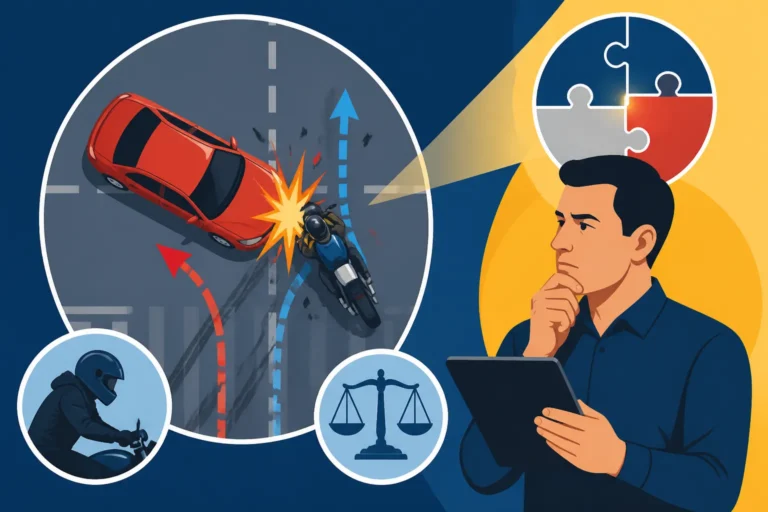
In Texas, the general rule is that a driver making a left turn must yield the right-of-way to oncoming traffic. Therefore, if a driver turns left in front of you, they are almost always considered primarily at fault for the collision. However, this doesn't mean a rider is automatically free of all blame. Insurance companies might try to argue that the motorcyclist was speeding, riding without a headlight, or otherwise contributed to the "invisibility" factor. While these arguments are often weak against the driver's clear failure to yield, they underscore the need for meticulous evidence. Documenting your speed, visible safety gear, and the scene can be critical. For a deeper dive into this specific type of crash, check out Left-Turn Motorcycle Accidents Explained and How to Prove Fault in a Left-Turn Collisions Crash.
Road Hazards, Defective Parts, and Third-Party Liability
Sometimes, the cause of a motorcycle accident isn't a negligent driver, but rather a dangerous condition on the road or a faulty component on your bike. In Texas, if a poorly maintained road, a hidden pothole, or unexpected gravel causes your accident, the city, county, or state government entity responsible for road maintenance could be held liable. For instance, if you hit a massive pothole on a City of Houston street that led to a loss of control and crash, and the city had prior knowledge of the pothole but failed to repair it, you might have a claim against the municipality. These cases can be complex due to specific governmental immunity laws that protect public entities, but they are certainly possible to pursue with the right legal strategy.
Similarly, if a mechanical failure, such as a brake malfunction or tire blowout, directly leads to an accident, the motorcycle manufacturer or the company responsible for installing the defective part could be held accountable. This shifts the focus of fault away from individual drivers or riders to product liability. For example, if a faulty tire manufactured by a company like Michelin or Pirelli unexpectedly delaminates, causing you to crash on a Texas highway, you might have a claim against the tire manufacturer. These are known as third-party liability claims, where a party other than the drivers directly involved in the collision is assigned fault. For more information on this, explore Road Hazards Motorcycle Accident and Manufacturer Liability for Defective Parts.
Navigating the Aftermath: Insurance and Legal Strategy in Texas
After a motorcycle accident in Texas, the reality of dealing with insurance companies can feel like a secondary battle, often more draining than the physical recovery itself. Insurers, whether yours or the at-fault driver's, are businesses driven by profit, and their primary goal is to minimize payouts. This often leads to frustrating encounters where riders feel unfairly blamed or undervalued.
How Insurance Companies Challenge Rider Fault
It's an unfortunate truth that there can be a pervasive bias against motorcyclists in the eyes of some insurance adjusters and even juries. Insurers often seize upon common stereotypes, suggesting riders are inherently reckless, speeding, or otherwise more prone to accidents. They might use your motorcycle's customization, perceived speed, or even your choice of riding gear (or lack thereof, if not required by Texas law) to try and assign you a higher percentage of fault. This is a classic tactic known as Rider Bias in Fault Determination. For example, if you were involved in a crash with a distracted driver in San Antonio, the other driver's insurance company, perhaps Allstate or Geico, might immediately try to find any reason to argue you were partially at fault – perhaps claiming you were in their blind spot, even if their negligence was clear.
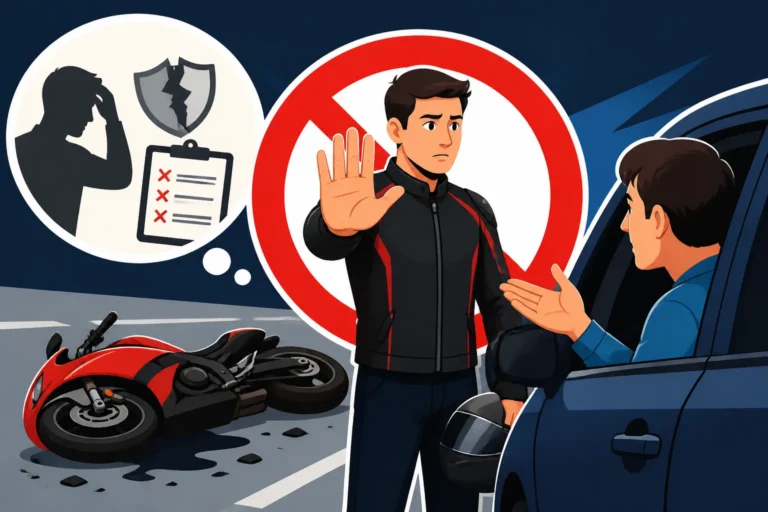
Insurance adjusters are skilled negotiators. They might request a recorded statement from you, looking for inconsistencies or admissions of fault, even minor ones, that they can later use against your claim. They might also offer a quick, lowball settlement before you fully understand the extent of your injuries or the value of your claim, hoping you'll accept it before consulting with a legal professional. It's crucial to remember that what you say and do in the immediate aftermath of an accident can significantly impact the insurance company's fault assessment and, consequently, your eventual settlement. Knowing How Insurance Companies Assign Blame to Riders helps you understand the tactics you might face.
The Indispensable Role of a Texas Motorcycle Accident Attorney
Given the complexities of Texas's modified comparative negligence law and the often-biased approach of insurance companies, attempting to handle a serious motorcycle accident claim on your own can be an uphill battle. This is where a knowledgeable Texas motorcycle accident attorney becomes an indispensable ally. They understand the nuances of state law, including the critical 51% bar rule, and can effectively counter the strategies employed by insurance adjusters who seek to minimize your payout.
An attorney will meticulously investigate your accident, gathering all necessary evidence, including police reports, witness statements, accident reconstruction data, and medical records, to build a strong case proving the other party's fault. They can work with experts to clearly illustrate how the other driver's negligence caused your injuries and how your actions (if any) contributed minimally or not at all. Furthermore, an attorney will handle all communication and negotiations with insurance companies, protecting you from unfair tactics and ensuring your rights are upheld. If the insurers refuse to offer a fair settlement, your lawyer can prepare your case for trial, fighting aggressively in court. Engaging an attorney early can significantly impact your ability to secure maximum compensation, allowing you to focus on your physical recovery. For those wondering, Do You Need a Motorcycle Accident Lawyer after a crash, the answer is often a resounding yes, especially when fault is disputed. They are your best defense when you need to How to Fight an Unfair Fault Assignment.
| Percentage of Rider's Fault | Ability to Recover Damages (Texas) | Impact on Payout (Example: $100,000 in damages) |
|---|---|---|
| 0% | Full recovery | $100,000 |
| 1% – 50% | Partial recovery | Reduced proportionately (e.g., 25% fault = $75,000) |
| 51% or more | No recovery | $0 |
Disclaimer
Please note that this guide provides general information about motorcycle accident fault laws in Texas and should not be considered legal advice. Every accident case is unique, and the outcome depends on specific facts and circumstances. For personalized legal guidance regarding your motorcycle accident claim, it is crucial to consult with a qualified personal injury attorney in Texas.