Motorcycle Accident Fault Laws in Arizona
Experiencing a motorcycle accident is one of the most frightening and disorienting events a rider can face. Beyond the physical pain and property damage, many riders find themselves instantly overwhelmed by questions of who is responsible and how the legal system in their state, like Arizona, will determine fault. This guide aims to demystify Arizona's motorcycle accident fault laws, giving you a clear understanding of your rights and the legal landscape so you can navigate the aftermath with confidence.
Understanding Arizona's At-Fault System
When a motorcycle accident happens in Arizona, the state operates under an "at-fault" system. This means that the person or entity determined to be responsible for causing the accident is generally liable for the resulting damages, including medical expenses, lost wages, and pain and suffering. However, this isn't always a black-and-white determination. Often, more than one party might share some degree of blame, which is where Arizona's specific rules on comparative negligence come into play. It's not about finding one single person 100% at fault, but rather assessing each party's contribution to the crash.
Pure Comparative Negligence in Practice
Arizona follows a "pure comparative negligence" standard. This is incredibly important for motorcyclists to understand, as it means you can still recover damages even if you are found partially at fault for the accident. Unlike some states that bar recovery if you are 50% or 51% or more at fault, Arizona allows you to recover damages regardless of your percentage of fault, as long as you are not solely at fault. Your total compensation, however, will be reduced by your assigned percentage of fault.
Let's imagine a scenario: you're riding your motorcycle on a scenic route near Sedona, and a distracted driver veers into your lane, causing a collision. However, investigations reveal you were also slightly exceeding the speed limit at the time. A jury might determine the driver was 80% at fault for distracted driving, but you were 20% at fault for speeding. If your total damages (medical bills, lost wages, bike repair, pain and suffering) amount to $100,000, your recoverable amount would be reduced by your 20% fault, leaving you with $80,000. This system directly impacts how insurance companies calculate offers and how much a settlement for your injuries could be. Knowing that you can still recover even if you contributed to the accident is a significant detail many riders overlook.
The Impact of Shared Fault on Your Claim
The concept of shared fault can feel discouraging, especially when you feel the other driver was clearly the primary cause of the crash. Insurance adjusters, and even opposing legal teams, will often try to pin as much blame as possible on the motorcyclist, leveraging common biases against riders. They might argue you were riding recklessly, didn't wear appropriate gear, or simply weren't visible. This is where strong evidence and a clear understanding of the law become paramount. Every percentage point of fault attributed to you directly reduces your potential compensation. For example, if you were deemed 30% at fault, a $200,000 claim would only pay out $140,000.
This is why proving fault in a motorcycle accident is so critical. It's not just about pointing fingers; it's about building a case that minimizes your comparative negligence and maximizes the other party's liability. The initial assessment of fault often starts with the police report, but it certainly doesn't end there. Insurance companies will conduct their own investigations, often seeking ways to reduce their payout by assigning some blame to the rider.
Key Factors in Determining Fault in Arizona Motorcycle Accidents
Determining fault in a motorcycle accident is rarely straightforward, especially when adrenaline is high and emotions are running wild at the scene. In Arizona, several key factors come into play, and understanding them can significantly impact the outcome of your claim. These elements form the foundation of any investigation, whether it's by law enforcement, insurance adjusters, or legal professionals.
Role of Traffic Laws and Violations
Traffic laws are the rulebook of the road, and any violation of these laws can be a strong indicator of fault. If a driver runs a red light on Scottsdale Road, fails to yield while turning left on Bell Road, or makes an unsafe lane change on I-10, they are generally in violation of Arizona traffic statutes. For motorcyclists, common violations that might be considered include speeding, unsafe lane changes, or driving under the influence. It's crucial to understand how traffic violations affect fault in an accident claim.
For instance, if a car driver makes a sudden left turn in front of you, causing a collision, they are likely to be found primarily at fault for a left-turn motorcycle accident. However, if it can be proven that you were traveling significantly above the posted speed limit, your percentage of fault could increase, even if the other driver initiated the dangerous maneuver. This is where the subtleties of the pure comparative negligence system really manifest. Documenting all potential traffic violations by all parties involved is a key step in building a strong case.
Evidence Collection and Its Importance
In the chaos following a motorcycle crash, gathering evidence might be the last thing on your mind, but it's arguably the most critical step after ensuring your safety and seeking medical attention. The evidence collected at the scene and shortly thereafter forms the backbone of your claim and is essential for establishing who is at fault in a motorcycle accident. Without concrete proof, it becomes a "he said, she said" scenario, which often unfairly prejudices the motorcyclist.
Here’s a table outlining crucial types of evidence and their significance:
| Type of Evidence | Description | Importance in Arizona Fault Determination |
|---|---|---|
| Police Reports | Official documentation by law enforcement, including details of the crash, statements, citations issued, and initial fault assessment. | Often the first piece of evidence insurance companies consider. While not always definitive, a well-documented report can strongly support or challenge fault assignments. How Police Reports Establish Fault |
| Witness Statements | Accounts from independent bystanders who saw the accident occur. | Provides objective perspectives. Crucial in countering self-serving accounts from the opposing driver. |
| Photographs/Videos | Images/footage of the accident scene, vehicle damage, skid marks, road conditions, traffic signals, injuries, and surrounding area. | Irrefutable visual proof. Can show points of impact, vehicle positions, road hazards, and environmental factors at the time of the crash. Photos to Take to Prove Motorcycle Fault |
| Dashcam Footage | Video recordings from your motorcycle's dashcam, the other vehicle's dashcam, or nearby surveillance cameras. | Invaluable for definitively proving sequences of events, traffic violations, and driver behavior leading up to the accident. How Dashcam Footage Proves Fault |
| Medical Records | Documentation of your injuries, diagnoses, treatments, and prognosis. | Links your injuries directly to the accident and substantiates the extent of your damages. Essential for calculating compensation for medical expenses and pain and suffering. |
| Vehicle Damage | Inspection reports and photos detailing the extent and nature of damage to your motorcycle and the other vehicle(s). | Can indicate the angle and force of impact, helping accident reconstructionists determine how the collision occurred and often supporting one party's account over another. |
Remember, the more evidence you can gather, the stronger your position will be when challenging unfair fault assignments and negotiating with insurance companies.
Specific Scenarios and Arizona Fault Rules
Motorcycle accidents often involve unique circumstances that require specific consideration under Arizona law. What might seem like a straightforward situation on the surface can quickly become complicated when you delve into the nuances of specific maneuvers or environmental factors.
Left-Turn Collisions and "I Didn't See You" Defenses
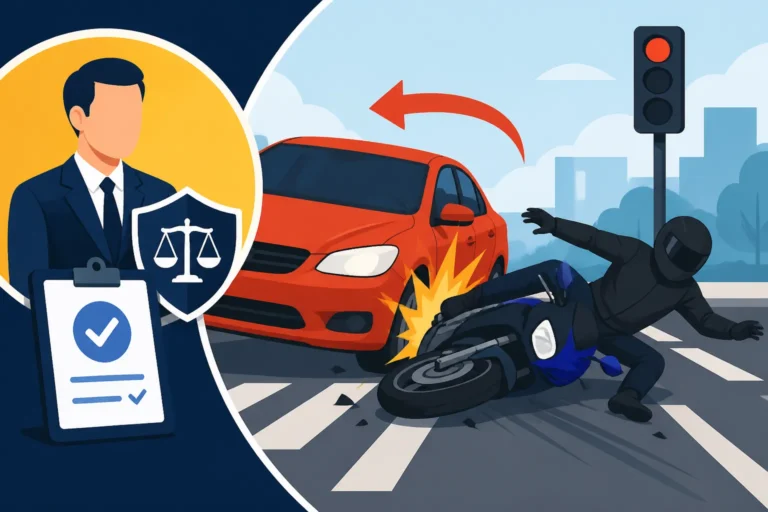
One of the most common and dangerous types of motorcycle accidents involves a car making a left turn directly in front of an oncoming motorcycle. This scenario frequently leads to serious injuries for riders. In Arizona, as in most states, the driver making the left turn typically has the responsibility to yield to oncoming traffic. Therefore, in the majority of left-turn motorcycle accidents, the turning driver is found at fault.
However, it's not uncommon for the at-fault driver to claim, "I didn't see the motorcycle." This is a defense tactic often used to shift blame or mitigate their liability. While motorcycles can be smaller and harder to spot than cars, drivers have a legal duty to be attentive and observe all traffic. This defense is rarely successful on its own, especially with strong evidence. Factors that might complicate this include if the motorcyclist was speeding, riding without a headlight at dusk, or was obscured by other vehicles. Still, the primary responsibility often remains with the turning vehicle.
Lane Splitting and Liability
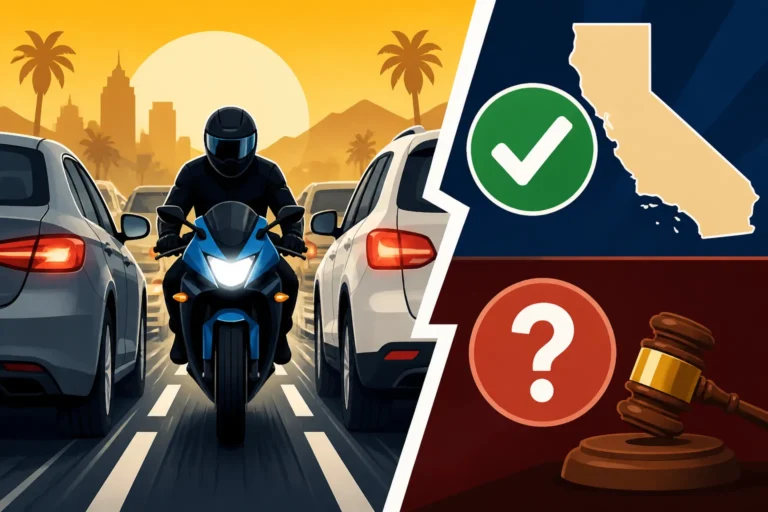
Lane splitting, the act of riding a motorcycle between lanes of stopped or slow-moving traffic, is a practice with varying legality across the United States. In Arizona, lane splitting is currently illegal. This is a critical point for any rider to understand because if you are involved in an accident while lane splitting, it can significantly impact your fault determination.
Even if another driver makes an unsafe maneuver, if you were actively lane splitting at the time, a portion of the fault could be assigned to you under Arizona's pure comparative negligence system. This doesn't mean you automatically lose your right to compensation, but it will almost certainly reduce the amount you can recover. For example, if a car suddenly swerves into your path while you're lane splitting on a congested Phoenix freeway, the driver might still be found mostly at fault for unsafe driving, but your illegal lane splitting could assign you 20-30% of the blame, reducing your settlement.
Road Hazards and Government Liability
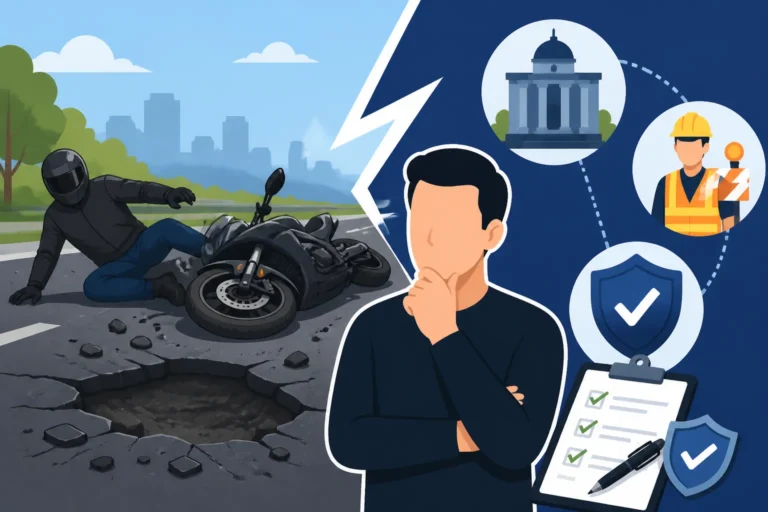
Not all accidents are caused by another driver's negligence. Sometimes, the road itself is to blame. Potholes, crumbling pavement, unexpected gravel or debris, missing guardrails, or improperly designed intersections can all contribute to a motorcycle crash. These are often referred to as road hazards. In such cases, the entity responsible for maintaining that section of road—which could be a city, county, state, or even a private contractor—might be held liable.
Successfully pursuing a claim against a government entity for a road hazard is more complex than a standard car-on-motorcycle claim. These cases often involve specific legal requirements, such as strict notice deadlines (sometimes as short as 180 days in Arizona to file a notice of claim) and caps on damages. If you hit a massive pothole in a Tucson residential area that caused you to lose control, you would need to prove that the city was aware of the hazard (or should have been) and failed to address it in a timely manner. Documenting the specific hazard with photos and location details immediately after the accident is crucial for these types of claims.
Steps to Take After an Arizona Motorcycle Accident
The moments immediately following a motorcycle accident in Arizona can be chaotic and overwhelming. Yet, the actions you take (or don't take) in the immediate aftermath can profoundly affect your health, your legal rights, and your ability to pursue a successful claim for damages. It's crucial to prioritize safety, but also to understand how to protect your interests from the outset.
Immediate Actions at the Scene
Your first priority should always be safety and assessing injuries. Even if you feel fine, the adrenaline from the crash can mask serious internal injuries.
- Move to Safety (If Possible): If your motorcycle is safely movable and you are physically able, try to get it and yourself out of active traffic. If not, stay put and wait for help.
- Check for Injuries: Assess yourself and anyone else involved. Call 911 immediately if anyone is injured or if there's significant property damage. Never minimize your pain or decline medical attention at the scene; this can be used against you later by insurance companies.
- Contact Law Enforcement: Even for seemingly minor accidents, having a police report is invaluable. An officer can document the scene, gather witness information, and make an initial determination of fault. This is a vital piece of Motorcycle Accident Evidence for Proving Fault.
- Exchange Information: Get the other driver's name, contact information, insurance details, driver's license number, and vehicle license plate number. Do not engage in arguments or admit fault, even casually. Simply exchange facts.
- Document the Scene: If you're able, take photos and videos of everything: vehicle damage, road conditions, traffic signs, skid marks, debris, your injuries, and the surrounding environment. This is critical for How to Document the Scene to Prove Fault.
- Seek Witness Information: If anyone saw the crash, get their names and contact information. Independent witnesses can be key to corroborating your story.
- Do Not Discuss Fault: Politely refuse to discuss who was at fault with anyone other than the police. Do not apologize or make statements that could be misconstrued as admitting responsibility.
Protecting Your Rights and Claim
The period immediately following the accident can be just as crucial as the scene itself. What you do in the days and weeks after the crash will lay the groundwork for any claim you pursue.
- Seek Medical Attention Immediately: Even if paramedics cleared you at the scene, see a doctor as soon as possible. Some injuries, like whiplash or a concussion, may not manifest symptoms for hours or even days. A delay in medical treatment can allow insurance companies to argue your injuries weren't caused by the accident. Maintain all medical records and follow all doctor's recommendations.
- Report the Accident to Your Insurance Company: Notify your own insurance company promptly, but be cautious about giving detailed statements, especially to the other driver's insurer. Stick to the facts: when, where, and who was involved. Do not speculate or discuss your injuries or fault in detail without legal advice.
- Avoid Social Media: Refrain from posting about your accident, injuries, or daily activities on social media. Anything you post can be twisted and used by insurance companies to undermine your claim.
- Do Not Accept Early Settlement Offers: Insurance companies often try to offer quick, lowball settlements before the full extent of your injuries or damages is known. It's almost always in your best interest to fully understand How Motorcycle Accident Settlements Are Calculated and get legal advice before accepting any offer.
- Consult with a Motorcycle Accident Lawyer: Navigating Arizona's fault laws and dealing with insurance companies can be incredibly complex. A lawyer experienced in motorcycle accidents can help you understand your rights, gather evidence, negotiate with insurers, and pursue a fair settlement. They can help with issues like How Comparative Negligence Reduces Your Payout and ensure you receive compensation for all your damages, including pain and suffering.
By taking these steps, you put yourself in the best possible position to protect your rights and recover maximum compensation under Arizona's motorcycle accident fault laws.
Disclaimer
The information provided in this guide is for general informational purposes only and does not constitute legal advice. Motorcycle accident laws are complex and vary by jurisdiction. You should consult with a qualified legal professional for advice regarding your specific situation.