Motorcycle Helmet Law in Kentucky
Riding through the rolling hills and scenic highways of Kentucky offers an incredible sense of freedom, but navigating the state’s specific traffic statutes can feel overwhelming, especially if you are involved in a collision. Understanding the exact requirements of the Kentucky motorcycle helmet law is crucial for keeping yourself safe on the road and protecting your legal rights during an insurance claim.
Kentucky Motorcycle Helmet Laws Explained
Kentucky takes a distinct approach to motorcycle helmet legislation compared to many of its neighboring states. While some places enforce universal helmet mandates where every rider must cover up regardless of age or experience, Kentucky operates under a partial helmet law framework. This legal structure creates specific categories of riders who are required by law to wear protective headgear, while granting choice to others who meet strict eligibility criteria.
Navigating these regulations requires understanding not just age limits, but also how licensing tiers and insurance coverage factor into legal compliance. If you ride frequently across state lines, you might notice that crossing from Louisville into Indiana or traveling south toward the border to compare the Motorcycle Helmet Law in Tennessee reveals stark differences in how local law enforcement manages rider equipment. In Kentucky, state statute KRS 189.285 dictates the exact parameters for helmet usage and vehicle equipment.
Who Must Wear a Helmet Under Kentucky Law
Under Kentucky law, universal helmet rules do not apply to every motorcyclist on the road, but specific groups face strict legal mandates. First and foremost, any operator or passenger under the age of 21 must wear a protective helmet approved by the Department of Transportation at all times while the motorcycle is in motion. This law is strictly enforced to protect younger, less experienced riders who are statistically at a higher risk of accidents.
Experience level also dictates helmet requirements. If you are operating a motorcycle with an instruction permit rather than a full motorcycle endorsement, you are legally obligated to wear a helmet. Furthermore, any rider who has held their motorcycle license for less than one full year must remain helmeted. The state views this initial year as a critical probationary period during which riders develop essential road handling skills and spatial awareness.
Insurance and Licensing Exemptions
For motorcyclists who are 21 years of age or older, have held a valid motorcycle license for more than one year, and are no longer riding on a permit, wearing a helmet becomes optional under state law—provided a crucial condition is met. Kentucky requires fully licensed adult riders who choose to ride without a helmet to carry specific medical insurance coverage to absorb potential medical costs arising from a crash.
If an adult rider opts out of wearing protective headgear without carrying the required health or medical payments coverage, they commit a traffic violation. Insurance adjusters frequently scrutinize this detail during post-crash investigations. Demonstrating that you were fully compliant with both licensing duration and insurance coverage parameters helps eliminate preliminary arguments regarding your legal right to ride without a helmet.
Mandatory Eye Protection and Equipment Rules
While wearing a helmet may be optional for certain adult riders in Kentucky, protective eye gear is non-negotiable for everyone. Kentucky statute mandates that no person shall operate a motorcycle unless they are wearing an approved eye-protective device. This can include a full-face helmet visor, shatterproof goggles, or protective glasses equipped with side shields. Standard eyeglasses or everyday sunglasses generally do not meet the strict impact resistance guidelines required by law.
Beyond personal gear, the motorcycle itself must meet strict safety standards before taking to Kentucky roadways. The bike must be equipped with permanent footrests for the operator and any passenger, rear-view mirrors, compliant turn signals, and a headlight that remains illuminated whenever the vehicle is in operation. Failing to adhere to these vehicle equipment standards can give an insurance company grounds to question your overall attention to road safety after a collision.
| Rider Category | Helmet Requirement | Eye Protection Requirement |
|---|---|---|
| Riders Under 21 Years Old | Mandatory | Mandatory |
| Instruction Permit Holders | Mandatory | Mandatory |
| Licensed Less Than 1 Year | Mandatory | Mandatory |
| Fully Licensed Adults (21+) | Optional (with medical coverage) | Mandatory |
| Motorcycle Passengers Under 21 | Mandatory | Mandatory |
How Kentucky Helmet Laws Impact Motorcycle Accident Claims
Understanding the mechanics of state law is only half the battle; the real complexity arises when you need to file an insurance claim after a crash. Many riders mistakenly believe that because they were riding legally without a helmet, an insurance company cannot use their gear choice against them. Unfortunately, the civil legal system operates quite differently from traffic court.
When an accident occurs, insurance adjusters look for any opportunity to minimize payout amounts. Understanding How Helmet Laws Affect Your Accident Claim can mean the difference between receiving full compensation for your injuries and taking a massive financial hit. Insurers frequently try to turn a rider’s lawful choice not to wear a helmet into an argument about personal negligence.
Kentucky Pure Comparative Fault System
Kentucky is a pure comparative fault state, which heavily influences how compensation is calculated in personal injury lawsuits. Under this legal doctrine, an injured party can recover damages even if they were partially at fault for their own injuries, but their financial recovery is reduced in direct proportion to their percentage of fault. Learning about Pure vs Modified Comparative Negligence highlights how Kentucky’s system allows victims to seek damages even if a jury assigns them a significant portion of blame.
For example, if a court determines that a negligent driver was 80 percent responsible for causing an intersection collision, but finds you 20 percent at fault for contributing to the severity of your injuries, your final financial award will be reduced by 20 percent. Insurers actively exploit this rule by attempting to shift as much fault onto the motorcyclist as possible, often relying on equipment and helmet choices to build their defense.
The Helmet Defense and Head Injury Disputes
When a rider suffers a head or neck injury while riding without a helmet, the opposing insurance company almost certainly raises The Helmet Defense Explained. This strategy involves arguing that while the at-fault driver may have caused the crash, the motorcyclist’s failure to wear protective headgear directly caused or worsened their head injuries.
To succeed with this argument, the insurance company cannot simply state that helmets are safer. They must present expert medical and biomechanical evidence proving that a DOT-approved helmet would have prevented or significantly lessened the specific traumatic brain injury or skull fracture sustained in the wreck. If you are struggling with medical bills and complex legal disputes, evaluating Does Not Wearing a Helmet Affect a Claim in Kentucky will show that non-use of a helmet does not automatically bar you from receiving compensation, especially for injuries to other parts of your body.
Non-Head Injuries and Gear Evidence
It is critical to remember that the helmet defense is generally irrelevant if your injuries are isolated to areas below the neck. If a negligent driver turns directly across your path and causes you to suffer a broken leg, fractured wrist, or internal organ damage, whether or not you were wearing a helmet played zero role in causing those specific physical traumas.
However, insurance representatives may still try to use a lack of helmet or riding gear to paint a subtle picture of reckless behavior to a jury. They try to imply that a rider who skips a helmet is inherently careless about safety. Overcoming this implicit rider bias requires presenting solid evidence that demonstrates the driver’s exclusive fault in causing the collision, establishing clear grounds for Proving Fault in a Motorcycle Accident.
Gear, Safety, and Protecting Your Claim After a Crash
Wearing high-quality protective gear is the single most effective way to shield your body from severe trauma and protect your legal position following an incident on the road. When you invest in quality protective apparel, you create a tangible layer of defense against both asphalt and insurance company disputes.
Whether you buy your helmets and armored jackets online or visit a regional retail hub like Cycle Gear to fit your equipment in person, preserving that gear after a crash is vital. The condition of your helmet, jacket, gloves, and boots serves as silent, unbiased evidence that tells the story of the crash dynamics to accident reconstruction experts.
Selecting Approved Safety Gear
Choosing the right helmet requires looking beyond aesthetic appeal and focusing on safety certifications. To comply with Kentucky law where helmets are mandated—and to ensure actual impact protection—your headgear must meet Department of Transportation standards. Understanding What Is a DOT-Compliant Helmet helps riders distinguish between certified protective gear and ineffective novelty helmets that fail to absorb impact forces.
When shopping for gear at stores like Cycle Gear, look for helmets that feature the official DOT symbol permanently affixed to the outer back shell. For maximum safety, Snell or ECE certified full-face helmets offer comprehensive protection by safeguarding the chin and facial structures, which frequently bear the brunt of an initial ground impact. Choosing gear from reputable suppliers like Cycle Gear ensures that you are wearing items engineered with impact-absorbing EPS foam density and shatterproof face shields.
Documenting Gear Damage After an Accident
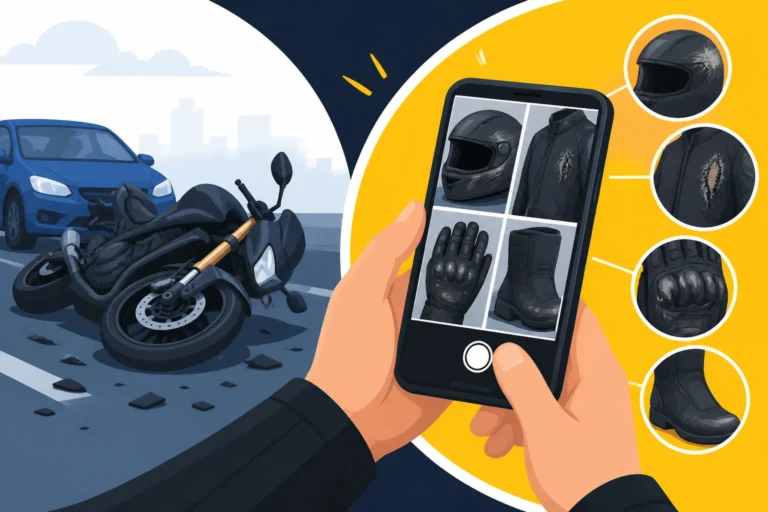
In the immediate aftermath of a collision, physical evidence begins to disappear quickly. Vehicles are towed, road debris is cleared, and weather wipes away skid marks. However, your damaged riding apparel remains in your possession. Knowing How Gear Damage Supports Your Claim allows you to leverage your torn leather, scuffed helmet shells, and cracked armor to demonstrate the violent physical forces involved in the crash.
Never throw away damaged protective gear after a wreck, even if it looks entirely ruined. Store your helmet, jacket, pants, and boots in a safe place, and take high-resolution photographs of all scuffs, tears, and impact points. If you purchased your riding gear from Cycle Gear or a similar retailer, keep your receipts or order histories. These documents establish the monetary value of your personal property claim and prove that you were utilizing quality, compliant equipment at the time of the impact.
Steps to Take Following a Motorcycle Collision in Kentucky
The actions you take immediately following a road incident heavily dictate the outcome of both your medical recovery and your financial claim. Knowing What to Do After a Motorcycle Accident empowers you to collect crucial details right at the scene while keeping yourself safe from further harm.
- Prioritize Physical Safety: Move away from active traffic lanes if you are physically able, and call emergency services immediately to request medical assistance and police intervention.
- Document the Crash Scene: Take clear photographs of all involved vehicles, pavement markings, road hazards, traffic signs, and your motorcycle’s final position.
- Gather Information: Exchange insurance information and contact details with all involved drivers, and secure contact information from any independent eyewitnesses.
- Seek Medical Evaluation: Visit an emergency room or urgent care facility immediately, even if you feel fine. Adrenaline often masks serious internal injuries or concussion symptoms.
- Preserve Your Equipment: Keep your damaged helmet, cracked visor, and torn clothing intact without attempting to clean or repair them.
Common Misconceptions About Riding in Kentucky
Misunderstandings surrounding state traffic laws can lead riders into unnecessary legal trouble or leave them vulnerable during insurance negotiations. Because laws vary wildly from state to state, out-of-state visitors and local riders alike often fall victim to persistent myths about helmet compliance and passenger liability.
Clearing up these misconceptions ensures that you remain fully compliant with state statutes while riding through Kentucky, whether you are taking a weekend trip through the Red River Gorge or commuting daily through urban centers.
Out-of-State Riders and Kentucky Helmet Compliance
A frequent source of confusion involves how Kentucky helmet laws apply to out-of-state motorcyclists traveling through the Commonwealth. Some riders incorrectly assume that as long as they comply with the helmet laws of their home state, those same rules protect them anywhere they ride.
Traffic laws are strictly jurisdictional. When you cross the state line into Kentucky, you are bound by Kentucky traffic statutes regardless of where your motorcycle is registered or where your driver’s license was issued. If an out-of-state rider is under 21 years old, or has held their motorcycle endorsement for less than a year, they must wear a helmet while operating a motorcycle in Kentucky—even if their home state has no helmet requirement at all.
Passenger Helmet Requirements and Liability
Another area where riders frequently run into legal trouble involves carrying passengers. Kentucky law dictates that passenger helmet requirements mirror operator rules based on the passenger’s age. If you carry a passenger who is under 21 years of age, that passenger must wear a DOT-approved helmet, regardless of whether you, the adult operator, are legally exempt from wearing one.
Allowing a minor passenger to ride without a helmet not only exposes them to severe injury risks, but also opens the operator up to significant legal liability. If a crash occurs and an unhelmeted minor passenger suffers a head injury, the operator could face personal liability claims for failing to enforce state safety laws. When picking up passenger equipment from Cycle Gear, always ensure that passenger helmets fit correctly and meet all federal safety certifications to avoid putting loved ones—and your legal standing—at risk.
By understanding how Kentucky helmet statutes intersect with comparative fault principles, you can take proactive steps to protect your physical safety on the highway and safeguard your financial wellbeing if an unexpected crash occurs. Understanding How Comparative Negligence Reduces Your Payout helps you navigate complex conversations with insurance adjusters, allowing you to focus on what matters most: your physical recovery and returning safely to the road.
Disclaimer
This article is for general informational purposes only and does not constitute professional advice. Laws and regulations vary by location and change over time. Consult a qualified professional for guidance on your specific situation.