How to Preserve Your Helmet as Evidence
After the shock and immediate aftermath of a motorcycle accident, it's easy to overlook crucial details in the whirlwind of pain, adrenaline, and confusion. Many riders are focused on their injuries and getting medical attention, and the thought of what to do with their damaged gear, especially their helmet, often comes as an afterthought. But trust me, that damaged helmet isn't just a shattered piece of plastic and foam; it's a silent witness, packed with critical evidence that could profoundly impact your injury claim. This guide will walk you through exactly how to preserve your helmet, turning it from a casualty of the crash into a powerful tool for your case.
Why Your Helmet Is More Than Just Head Protection After a Crash
When you're dealing with the immediate chaos of a motorcycle accident, your helmet is usually the last thing on your mind beyond being thankful it protected your head. However, that damaged piece of gear holds a wealth of information that can be invaluable in reconstructing the accident, proving fault, and demonstrating the severity of your injuries. It's not just about protecting your brain; it's about protecting your rights after a crash.
The Immediate Value of Your Damaged Helmet
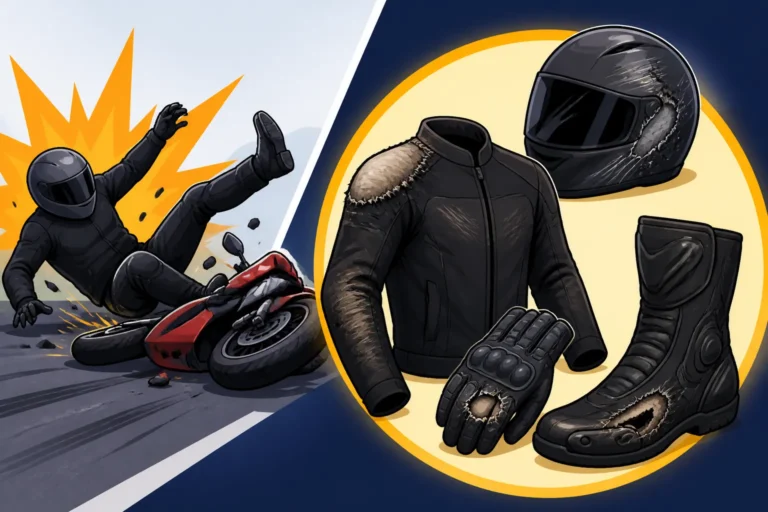
Think of your helmet as a black box for your head. Every scuff, crack, and abrasion tells a story about the forces it endured and, by extension, the forces your head and body experienced. It’s a physical record of the impact. While your first instinct might be to toss the mangled helmet and get a new one from a place like Cycle Gear, resisting that urge is crucial. The nature and location of the damage on your helmet can provide concrete proof of how the accident unfolded. For example, a deep scuff on the left side of your full-face helmet might perfectly align with a driver's mirror or bumper if they made an illegal lane change. This kind of physical evidence can be far more persuasive than conflicting witness testimonies alone, offering tangible proof of what actually happened.
How Helmet Damage Contradicts "Rider Error" Narratives
It's an unfortunate truth that in many motorcycle accidents, there's a bias against riders. Insurance companies and even law enforcement sometimes jump to conclusions, implying the rider was speeding, reckless, or simply "unseen." This often leads to arguments of shared fault or even attempts to entirely shift blame to you. However, the damage patterns on your helmet can be a powerful counter-argument. If your helmet shows clear signs of impact from the front right side, it directly challenges a claim that you veered into a vehicle from the left. This evidence can be instrumental in determining who is at fault in a motorcycle accident. The way your helmet is damaged can illustrate the precise angle of impact, the force involved, and which parts of your body, specifically your head, bore the brunt of the collision. This objective data helps cut through subjective assumptions and focus on the undeniable physics of the crash.
Linking Helmet Damage to Specific Injuries
Beyond proving impact and fault, your helmet is direct evidence of the potential for severe head injuries. Even if a helmet performed its job admirably, preventing catastrophic trauma, the very fact that it sustained damage indicates a significant impact force that could still lead to concussions, traumatic brain injuries (TBIs), or other neurological issues. Cracks in the outer shell, compression of the EPS (Expanded Polystyrene) foam liner, or even damage to the chin bar can correlate directly with diagnoses like a concussion or even a more severe traumatic brain injury. Documenting these specific points of damage on your helmet can provide a tangible link to your medical records and help demonstrate the severity of your injuries, which directly impacts your potential settlement for pain and suffering.
Step-by-Step Guide to Preserving Your Helmet as Evidence
Preserving your helmet properly isn't complicated, but it does require a bit of mindful action in a stressful situation. Think of it like handling a delicate archaeological artifact; you want to maintain its integrity so experts can learn its full story.
Documenting the Helmet at the Scene
The moment after a crash, if you are able and safe to do so, your priority should be documenting everything. This includes your helmet. Grab your phone and take a series of comprehensive photos and videos. Start with wide shots showing the helmet's position relative to your motorcycle and other vehicles involved in the crash. Then, move in for close-up shots of every angle of the helmet, focusing on any and all damage – scuffs, scratches, cracks, dents, and even internal damage if visible. Don't just take one or two pictures; snap dozens.
Think about the light, too. Is the sun causing glare? Can you move to get a clearer shot without disturbing the helmet? Capture the date and time, if your phone does that automatically, and verbally narrate what you're seeing in videos. Mention any nearby debris or paint transfer that might corroborate the impact. This initial documentation is a critical component of Motorcycle Accident Evidence for Proving Fault. Remember, once the scene is cleared, you can't go back and recreate these initial observations.
Safe Handling and Storage Post-Accident
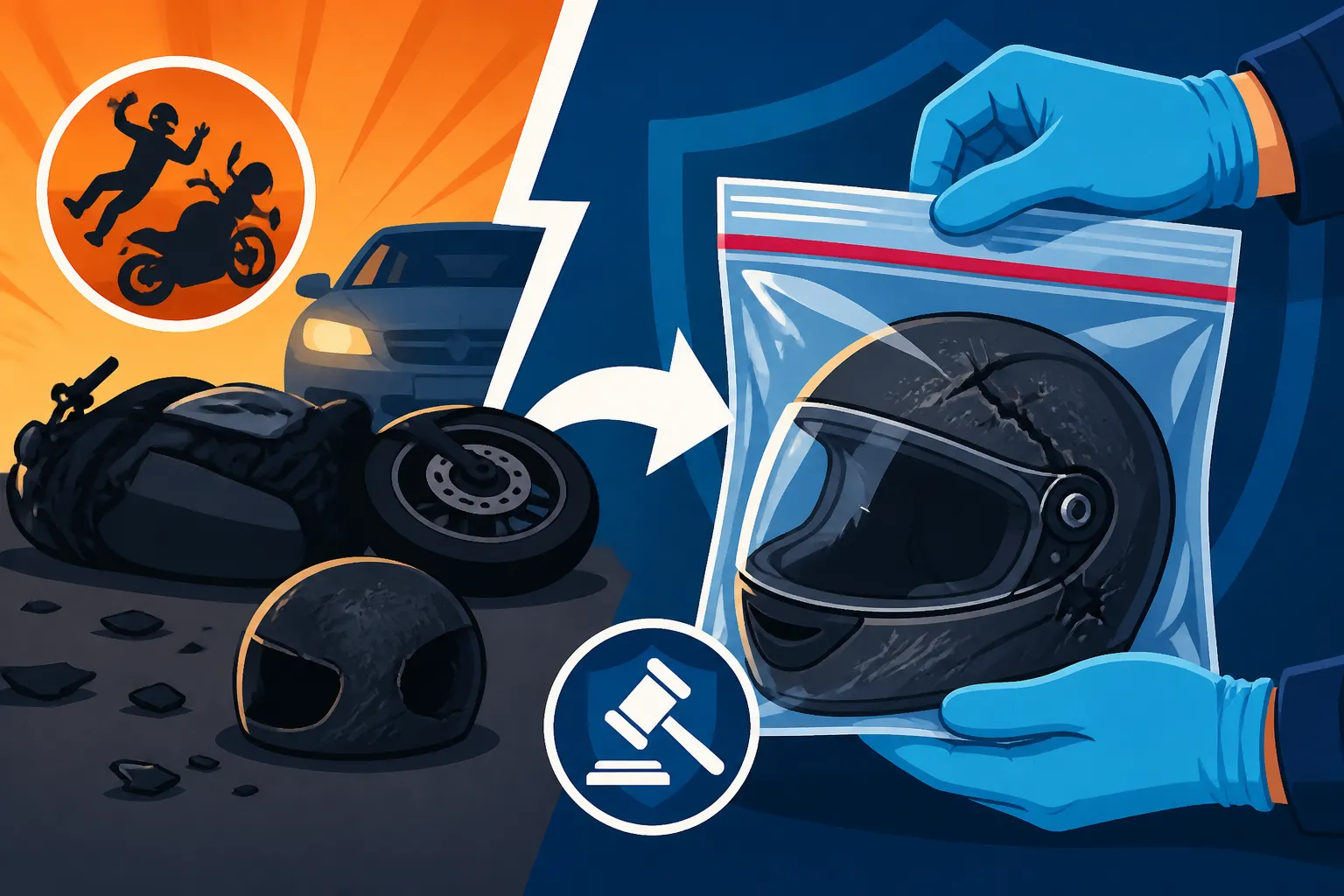
Once the police have documented the scene and your helmet is released (or you've removed it after initial photos), the next step is careful handling and storage. Resist the powerful urge to clean your helmet, wipe away scuffs, or try to piece together cracked parts. Any alteration, no matter how well-intentioned, can compromise its evidentiary value. Forensic experts rely on the helmet being in its post-accident state to accurately assess impact forces and directions.
Place the helmet in a sturdy box or bag, ideally one that allows for minimal movement. Store it in a dry, safe place where it won't be further damaged, lost, or mistakenly thrown away. A closet shelf, a dedicated spot in your garage, or even your attorney's office are good options. Label the box clearly with the date of the accident and "EVIDENCE – DO NOT DISCARD OR ALTER." This helps ensure that no one accidentally interferes with this vital piece of evidence.
Involving Your Attorney and Accident Reconstruction Experts
As soon as you can, reach out to an attorney specializing in motorcycle accidents. They will understand the importance of your helmet as evidence and guide you on the next steps. A good attorney, like those you might find after asking, "Do You Need a Motorcycle Accident Lawyer?", will likely want to take possession of the helmet themselves or instruct you on how to deliver it securely. They might also engage an accident reconstruction expert.
These experts are professionals who can meticulously examine the helmet. They use specialized tools and knowledge to analyze impact points, stress fractures in the materials, and the extent of internal foam compression. They can even use sophisticated software to simulate the forces involved in the crash based on the helmet's damage. Their analysis can definitively prove how impact occurred, often corroborating your account of the accident and dismantling any opposing claims from insurance adjusters. For instance, if you were wearing a Shoei or Arai helmet, experts would know exactly how its specific construction should react to impact, adding another layer of scientific data to your case.
What Information Your Helmet Can Reveal
It's astounding how much a damaged helmet can communicate about a collision. Every imperfection on its surface and internal structure tells part of the story, serving as invaluable forensic data.
Impact Points and Force Vectors
Imagine your helmet after a crash, with a distinct scrape on the left side of the jawline and a corresponding spiderweb crack extending across the forehead. An accident reconstruction expert can meticulously analyze these impact points and the specific patterns of damage. These aren't just random marks; they're precise indicators of where and how the force was applied. They can determine the exact angle at which your head made contact, whether with another vehicle, the road surface, or an object.
This analysis helps establish force vectors, which are crucial for understanding the dynamics of the crash. For example, if the damage suggests a forceful impact from a specific direction, it can corroborate your statement that a car turned left in front of you without yielding, or that another driver performed an Unsafe Lane Changes Motorcycle Accident. This objective, scientific data is incredibly difficult for opposing insurance companies or defense attorneys to dispute, as it's based on physical evidence rather than potentially biased testimonies.
Proving Helmet Compliance and Effectiveness
One of the common tactics used by insurance companies to reduce payouts, known as the "The Helmet Defense Explained", involves arguing that your head injury was either caused or worsened by not wearing a helmet, or by wearing a non-compliant "novelty" helmet. Your preserved helmet, if it's DOT (Department of Transportation) compliant (and ideally Snell or ECE certified, depending on the standard), can directly counter this argument.
When your attorney presents a damaged helmet that clearly displays its DOT certification sticker and shows the damage consistent with its design meant to absorb impact, it becomes powerful evidence. Even if you sustained a serious head injury, the helmet's damaged state demonstrates it performed its job as designed, reducing the severity of what could have been a catastrophic injury. It shows you took reasonable precautions and that the injury wasn't due to your negligence in choosing proper gear. This can be crucial in states with Motorcycle Helmet Laws by State or where comparative negligence might apply, as it helps prevent the "helmet defense" from significantly reducing your settlement.
The Importance of Internal Structure Damage
While visible exterior cracks are obvious, some of the most critical evidence lies within the helmet's internal structure, specifically the EPS (Expanded Polystyrene) foam liner. This dense foam layer is designed to crush and dissipate impact energy, protecting your brain. After a significant impact, this foam will compress, even if the outer shell appears relatively intact. Once the EPS liner has compressed, it's done its job and cannot effectively protect your head again.
An expert examination can often detect areas of internal compression, even if they aren't immediately visible to the untrained eye. This internal damage is vital because it proves that significant force was transferred to your head, regardless of the cosmetic appearance of the outer shell. It can provide concrete proof of the mechanism of a concussion or even a more serious traumatic brain injury, tying the physical evidence directly to your medical diagnosis. This depth of analysis can be crucial for understanding How Injury Severity Affects Compensation and ensuring you receive adequate compensation for your long-term medical needs.
Common Pitfalls to Avoid When Handling Helmet Evidence
Even with the best intentions, it's easy to make mistakes after a traumatic event like a motorcycle accident. Knowing what to avoid can be just as important as knowing what to do.
Don't Dispose of It Too Soon
This is perhaps the biggest mistake a rider can make: discarding their helmet before their claim is fully resolved. It's understandable; a damaged helmet is a constant, unpleasant reminder of the crash. You might want to get rid of it, replace it with a shiny new one from Cycle Gear, and move on. However, once that helmet is gone, so is a significant piece of irrefutable evidence.
Insurance companies are notorious for scrutinizing every aspect of a motorcycle accident claim, and they will absolutely question the severity of an impact or injury if you cannot produce the damaged helmet for their inspection. Without it, you lose a powerful tool that can prove impact points, force, and even adherence to safety regulations. Hold onto that helmet, no matter how much you want to throw it away, until your attorney advises you that it is safe to do so – usually, well after your case has been settled or adjudicated.
Resist the Urge to "Fix" or "Clean" It
As mentioned earlier, any alteration to your helmet's post-accident condition can be detrimental to your case. This includes attempting to glue cracks, sand down scrapes, or even thoroughly cleaning off road grime or paint transfer. While these actions might seem harmless or even helpful in the moment, they effectively erase critical forensic data.
For example, tiny flecks of paint on your helmet could match the paint of the other vehicle involved, definitively proving contact. Wiping them away destroys that evidence. Gluing a crack might prevent an expert from seeing the true extent of the fracture or the direction of the force that caused it. The integrity of the helmet as untouched, post-accident evidence is paramount. Let the professionals handle the analysis; your job is merely to preserve it as is.
Guard Against Loss or Further Damage
In the aftermath of a crash, your belongings might be scattered, moved by first responders, or collected and stored in various locations. It's vital to ensure your helmet doesn't get lost in this shuffle or sustain additional damage after the initial incident. If it's left at the scene, ensure the police document its collection. If it's taken to the hospital with you, ensure it's securely stored and not accidentally misplaced or damaged during transfer.
Once it's in your possession, the same rules apply. Don't leave it in a precarious spot where it could fall and incur new damage, or where it could be picked up and handled carelessly by others. A secure, labeled box in a designated, safe storage area is your best bet. Protecting this evidence is part of the larger task of documenting your recovery and building a strong case. Your efforts in safeguarding the helmet demonstrate your commitment to pursuing a just claim and respecting the legal process.
Here's a quick summary of what to do and what not to do with your helmet after a motorcycle accident:
| Action Category | Do This | Don't Do This | Why It Matters |
|---|---|---|---|
| Documentation | Take extensive photos/videos at the scene from all angles. | Rely on memory or a few quick snaps. | Captures crucial, time-sensitive details of damage and position. |
| Handling | Carefully place in a sturdy box/bag. | Clean, alter, or attempt to repair any damage. | Preserves forensic integrity; alterations destroy evidence. |
| Storage | Store in a dry, safe, secure, labeled location. | Leave it lying around, dispose of it, or allow further damage. | Prevents loss, tampering, or degradation of evidence. |
| Legal Involvement | Inform your attorney immediately; allow experts to examine. | Try to interpret damage yourself or discuss with insurers. | Ensures professional analysis and proper legal strategy. |
| Insurance Claims | Provide only when requested by your attorney. | Give it to the insurance company directly without counsel. | Your attorney controls the narrative and presentation of evidence to protect you. |
Remember, your helmet isn't just a piece of gear; it's a testament to the forces involved in your accident and a key piece of evidence that can help you recover fairly.
Disclaimer
The information provided in this article is for general informational purposes only and does not constitute legal advice. Motorcycle accident claims are complex, and the specific laws and procedures vary by state. It is highly recommended to consult with a qualified motorcycle accident attorney to discuss the specifics of your case and obtain personalized legal guidance.