How Damaged Gear Proves Impact Severity
When you've been in a motorcycle accident, the immediate aftermath is often a whirlwind of pain, confusion, and shock. Amidst the chaos of injuries, damaged bike parts, and flashing emergency lights, one critical piece of evidence often goes overlooked: your riding gear. It might seem like just a collection of ruined clothes and a cracked helmet, but I'm here to tell you that your damaged gear isn't just debris—it's a silent witness to the exact forces you endured, and it's incredibly powerful in proving the severity of the impact.
Your helmet, jacket, pants, gloves, and boots absorb monumental forces in a crash. They take the brunt of the impact, abrasion, and compression that your body would otherwise suffer. That wreckage of gear isn't merely a testament to what could have been worse; it's tangible, undeniable proof of the violence of the crash itself. Understanding how to leverage this evidence can be a game-changer for your motorcycle accident claim, helping you fight back against insurance companies who often try to downplay the true nature of your injuries.
The Silent Witness Your Gear Provides
It’s easy to look at a torn jacket or a scuffed helmet and think, "Well, that's gone, time to get new stuff." But before you toss that damaged gear, remember that each scuff, tear, and crack tells a story. It’s a narrative of speed, impact angles, and the sheer force involved in your crash—details that are absolutely crucial for your case. This isn't just about showing you wore gear; it's about showing what that gear went through to protect you.
Helmets Tell the Toughest Tales
Your helmet is arguably the most critical piece of safety gear, and its damage often provides the clearest evidence of impact severity. When you look at a helmet after a crash, don't just see a broken shell. See the science.
Every DOT-approved helmet is designed to absorb and distribute impact energy. When a helmet hits the ground or another vehicle, the outer shell might show gouges, cracks, or deep scrapes. These visible marks indicate the point of impact and the direction of force. But the real story is often hidden beneath the surface. The EPS (expanded polystyrene) foam liner inside is designed to crush and deform upon impact, slowing down your head's movement and preventing your brain from slamming against your skull. This internal compression is vital evidence. If the foam liner is compressed, it means it did its job, absorbing significant energy. Without that compression, you would have likely sustained a much more severe brain injury, such as a traumatic brain injury (TBI). The extent of this compression, often only visible upon careful inspection, can be scientifically linked to the g-forces your head experienced. This becomes critical evidence when discussing potential head injuries, even if they aren't immediately apparent. Understanding Motorcycle Helmet Laws by State is important, but even more so is understanding how your helmet's performance proves the violent nature of the crash.
Jackets, Pants, and Boots as Impact Recorders
Beyond your helmet, the rest of your riding ensemble also serves as a crucial record. Your riding jacket, pants, and boots are not just for looking good on the road; they're your primary defense against road rash, fractures, and blunt force trauma.
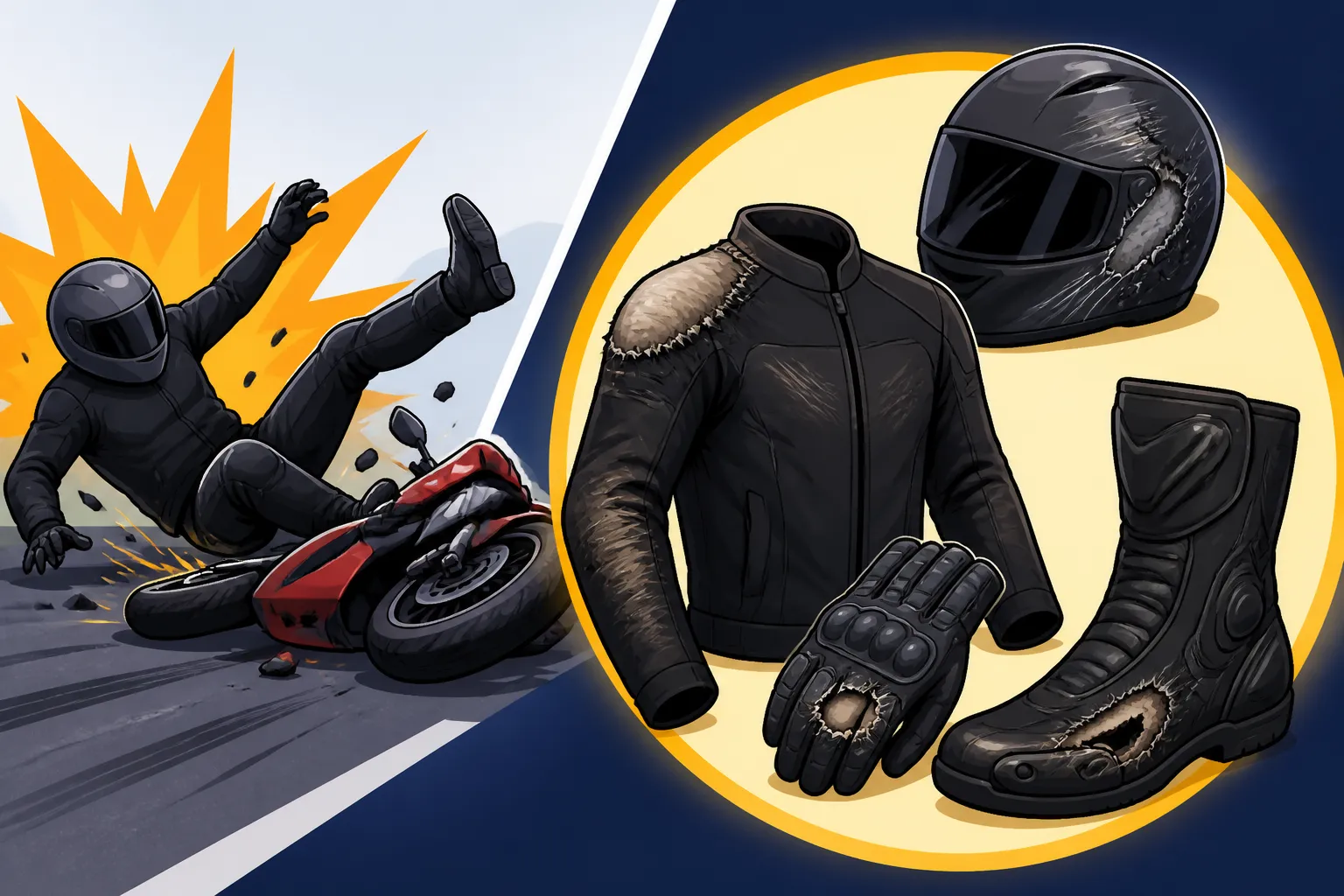
Consider your riding jacket. If it's made from abrasion-resistant materials like heavy-duty leather, Cordura, or Kevlar, it's designed to slide and absorb friction, protecting your skin from the devastating effects of road rash. A shredded or deeply scuffed jacket, especially at key impact points like the shoulders, elbows, or back, proves that your body made significant contact with the ground or another object. The presence of internal armor that is now cracked, deformed, or displaced further indicates a high-energy impact that could lead to broken bones or soft tissue injuries. Similarly, your riding pants, whether textile or leather, will show where your hips, knees, and shins bore the brunt. A large tear or a hole worn through multiple layers of fabric is undeniable proof of a harsh slide or impact. Even with quality gear from retailers like Cycle Gear, the material has its limits, and the damage it sustains directly correlates to the forces it encountered.
Boots, too, play a crucial role. Scrapes, deep gouges on the toe or heel, or even a twisted sole can indicate serious impact to your feet and ankles. It's not uncommon for riders to suffer fractures in their feet or ankles, and damaged boots can directly correlate to those specific injuries, showing where the force was transferred.
Gloves and Footwear, Small but Mighty Indicators
While perhaps not as visually dramatic as a shattered helmet or a torn jacket, your gloves and riding footwear also carry significant evidentiary weight. Think about what happens in a crash: instinctually, many riders put out their hands to break a fall. This often results in scuffed palms, torn knuckles, or even bent finger components if your gloves have hard armor. The degree of damage to your gloves can directly illustrate the force of impact on your hands and wrists, which are notoriously fragile. If your gloves are shredded, it's strong evidence of severe abrasion and impact to your hands, which can be linked to broken bones in the hands or wrists, or even complex nerve damage.
Similarly, your riding boots, even if they appear less damaged than other gear, can still tell a powerful story. Scrapes on the outside of the boot, compression marks on the toe box, or even stress fractures in the sole can correlate directly to foot or ankle injuries. If your boot is twisted or deformed, it shows the rotational forces applied to your lower leg, which can lead to tibia or fibula fractures. These seemingly minor details are invaluable in painting a full picture of the crash dynamics and the potential for severe, even debilitating, injuries.
Connecting Gear Damage to Injury Severity and Claim Value
Insurance adjusters are notorious for trying to minimize claims. They might suggest your accident was "minor" or that your injuries aren't as severe as you claim. This is where your damaged gear becomes your most powerful advocate, providing irrefutable physical proof that the crash was anything but minor.
Visual Proof of Force and Trauma
Imagine standing in front of an insurance adjuster or a jury, trying to describe the terrifying moment your bike went down. Words often fall short. But a photograph of your deeply gouged helmet, showing where the road ripped through the protective layers, speaks volumes. It’s visual, tangible proof of the blunt force trauma your head experienced. When coupled with medical records detailing a concussion or a mild traumatic brain injury, this gear damage provides a powerful link. It moves your claim beyond mere subjective testimony to objective, physical evidence. Similarly, a jacket shredded at the elbow, revealing where the ground gnawed through the fabric, directly supports a claim for extensive road rash injuries and the potential need for skin grafts.
This visual evidence is crucial because it helps third parties understand the sheer physics involved in a motorcycle accident. The damage to your gear visually corroborates the forces at play, which can also be explained by an expert in accident reconstruction. If you're wondering How Accident Reconstruction Determines Fault, remember that damaged gear often serves as a key input for these experts, allowing them to precisely model the impact.
Counteracting the "Minor Accident" Narrative
One of the most frustrating things a rider hears after a crash is when an insurance company representative tries to call it a "fender bender" or imply it wasn't a serious event. This narrative is designed to reduce your settlement amount by downplaying your pain, suffering, and the true cost of your medical treatment. Your damaged gear directly challenges this.
A helmet with a clear impact mark shows it absorbed a significant blow, which in turn protected your brain from more severe injury. A jacket that's been torn through or shows extensive abrasion tells the story of impact and friction that would have otherwise stripped your skin. This evidence directly supports your claims for significant medical expenses, lost wages, and the very real pain and suffering you've endured. It's much harder for an insurance adjuster to argue a crash was "minor" when faced with physical proof of extensive gear damage, especially when that gear damage prevented catastrophic injuries like severe Spinal Cord Injuries from Motorcycle Accidents or deep Road Rash Injuries and Claims.
The Role of Expert Witnesses
In more complex or severely injured cases, expert witnesses become invaluable. Accident reconstructionists, engineers, and medical professionals can examine your damaged gear and provide expert testimony on the forces involved and their correlation to your injuries.
An accident reconstruction expert can analyze the scuff marks, tears, and deformation patterns on your gear to determine the angle of impact, the speed, and the type of forces exerted on your body. They can then correlate this data with the mechanics of your injuries. For instance, if your helmet shows a specific type of impact, an expert can explain how that impact could lead to a particular brain injury. Medical experts can then use this information to bolster their diagnosis and prognosis, explaining why your specific injuries are consistent with the forces indicated by your damaged gear. This multidisciplinary approach can significantly strengthen your claim, providing a robust, scientific foundation for your demands.
Preserving and Documenting Your Damaged Gear
The value of your damaged gear as evidence hinges entirely on how well you preserve and document it. This isn't just about taking a quick snapshot; it's about a methodical approach to securing crucial physical proof.
The Immediate Aftermath: Secure the Evidence
The moments right after a motorcycle accident are chaotic, but if you are physically able, securing your gear should be a priority once your safety and medical needs are met. Many riders, either out of shock, frustration, or simply not knowing better, discard their damaged gear or leave it at the accident scene. This is a critical mistake. That gear is evidence.
Once emergency services have cleared you and you've addressed immediate medical concerns, ask police or a trusted friend to gather all pieces of your riding gear. This includes your helmet, jacket, pants, gloves, and boots. Do not try to clean them. Do not try to "fix" them. Leave them exactly as they are. If you're unable to do this yourself, instruct someone else explicitly to collect everything. This initial preservation is a vital step in What to Do After a Motorcycle Accident to protect your claim.
Detailed Documentation: Photos and Descriptions
Photographs are your best friend when it comes to documenting damaged gear. Take a comprehensive series of photos from various angles and distances, capturing every aspect of the damage.
Here’s a breakdown of how to photograph your gear:
- Overall Shots: Start with wide shots of your entire gear ensemble laid out, showing all items together. This gives context.
- Medium Shots: Photograph each item individually, showing the overall condition and location of major damage.
- Close-Up Shots: Zoom in on specific areas of damage—cracks, tears, deep abrasions, deformed armor, or compressed helmet foam. Use a ruler or a common object (like a coin) in the frame to provide a sense of scale.
- Contextual Shots: If possible, photograph your gear in relation to your motorcycle or the accident scene (if it's safe and hasn't been moved). This helps establish where you were wearing it and how it might have been damaged.
- Interior and Exterior: Don't forget to photograph the inside of your helmet, especially the EPS liner, for signs of compression. Do the same for the interior of jackets and pants, showing any shifted or damaged armor.
Alongside photos, write detailed descriptions of the damage. Note the date and time the photos were taken, who took them, and a precise description of what each photo shows. This meticulous process significantly strengthens your case, just as it would for documenting the accident scene itself, as outlined in guides like Photos to Take to Prove Motorcycle Fault.
Here’s a simple table to guide your documentation:
| Gear Item | Type of Damage (Examples) | Photo Angles / Details | Notes |
|---|---|---|---|
| Helmet | Cracks, gouges, deep scrapes, internal foam compression | Exterior (all sides), interior (lining), close-ups of impact points | Note DOT sticker visibility, brand (e.g., Shoei, Arai) |
| Jacket | Tears, rips, abrasions, scuffs, deformed/displaced armor | Front, back, sleeves, close-ups of damaged areas, interior armor | Material type (leather, textile), brand (e.g., Dainese, Alpinestars) |
| Pants | Tears, abrasions, holes, knee/hip pad damage | Front, back, close-ups of knees, hips, seat area, interior armor | Material type, brand |
| Gloves | Torn palms, scuffed knuckles, bent fingers, stitching rips | Palm side, back of hand, close-ups of fingertips and knuckles | Material type, brand |
| Boots | Scrapes, gouges, twisted soles, crushed toe box | All sides, close-ups of toe, heel, ankle areas | Material type, brand |
Storage and Presentation of Evidence
Once documented, store your damaged gear in a secure place where it won't be further damaged or altered. A large box or plastic bin in a dry, safe environment is ideal. Keep it away from curious hands or pets. This ensures a clear "chain of custody" for the evidence, meaning you can prove it hasn't been tampered with since the accident.
When it comes time to present this evidence to your attorney or to the insurance company, the detailed photos and descriptions will be invaluable. Your lawyer might even recommend having the physical gear inspected by an expert. The clearer your documentation and the safer your storage, the stronger this evidence will be.
How Damaged Gear Influences Your Overall Claim
Ultimately, all this effort in preserving and documenting your gear comes down to one thing: maximizing your motorcycle accident settlement and ensuring you receive fair compensation for your injuries and losses.
Strengthening Your Negotiating Position
When you approach an insurance company, especially after a serious motorcycle crash, they are looking for weaknesses in your claim. They want to find ways to reduce their payout. However, presenting clear, undeniable physical evidence like your damaged riding gear makes it significantly harder for them to deny the severity of the accident or your injuries.
This visual proof of impact forces bolsters your entire case. It corroborates your account of the crash, the police report, and your medical records. With such tangible evidence, your negotiating position is much stronger, often leading to more favorable settlement offers without the need for prolonged legal battles. Knowing How to Negotiate a Motorcycle Accident Settlement becomes much easier when you have compelling evidence on your side.
Supporting Claims for Economic and Non-Economic Damages
Motorcycle accidents often result in severe injuries, leading to substantial economic and non-economic damages. Economic damages include tangible costs like medical bills, lost wages, and property damage. Non-economic damages, on the other hand, cover subjective losses like pain and suffering, emotional distress, and loss of enjoyment of life.
Your damaged gear helps support both types of claims. Visually demonstrating the violent forces involved in the crash helps justify the extent of your medical treatment, including surgeries, rehabilitation, and ongoing care. It makes it clear why your injuries are severe enough to cause significant lost wages or even affect your future earning capacity. Furthermore, seeing the destruction of the gear that protected you can powerfully convey the pain and suffering you endured, strengthening your claim for non-economic damages. This connection between the physical evidence of the crash and the full scope of your losses is essential for a comprehensive claim, as explored in Economic vs Non-Economic Damages Explained.
Mitigating the Helmet Defense and Rider Blame
Unfortunately, there's a pervasive bias against motorcyclists. Insurance companies, and sometimes even juries, are quick to blame the rider or suggest that their injuries were self-inflicted or worsened by their own actions. One common tactic is the "helmet defense," where the at-fault driver's insurance company argues that if you hadn't been wearing a helmet, your head injuries would have been even worse, implying you contributed to your own injuries or that the helmet didn't completely prevent them. Or, if you weren't wearing a helmet in a state where it was required, they might argue that this contributed to your head injuries.
By presenting your damaged DOT-approved helmet, you can powerfully counteract these arguments. The damage proves that the helmet did its job, absorbing critical energy and preventing a potentially fatal or much more severe injury. It shows that you acted responsibly by wearing appropriate safety gear from a reputable source like Cycle Gear. Even in states with partial helmet laws or in situations where How the Helmet Defense Reduces Settlements could be an issue, providing evidence of your gear's performance helps demonstrate your commitment to safety and shifts the focus back to the at-fault driver's negligence. This also ties into the broader issue of How Insurance Companies Assign Blame to Riders, where proper gear can be a strong counter-argument.
Your damaged motorcycle gear is far more than just ruined possessions; it's a critical piece of evidence that can speak volumes about the forces you endured in a crash. By understanding its value, meticulously preserving it, and using it effectively, you can build a much stronger case and ensure you receive the compensation you truly deserve.
Disclaimer
The information provided in this article is for general informational purposes only and does not constitute legal advice. Every motorcycle accident claim is unique, and the laws governing personal injury claims vary by jurisdiction. It is crucial to consult with a qualified motorcycle accident attorney to discuss the specifics of your case and receive advice tailored to your situation.