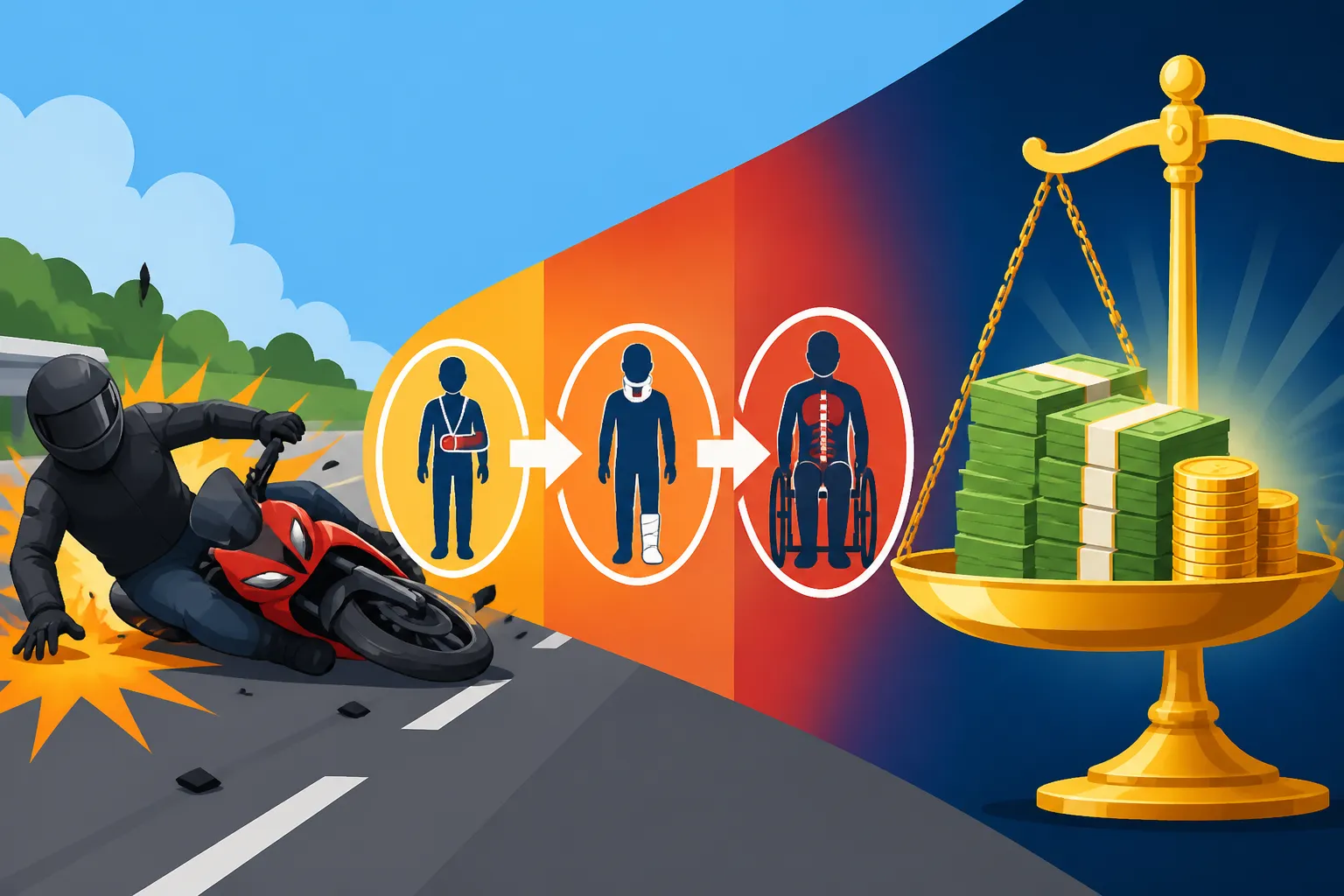
How Injury Severity Drives Settlement Value
It’s a tough reality, but motorcycle accidents often result in far more severe injuries than typical car crashes. The sheer vulnerability of a rider, lacking the protective shell of a vehicle, means even a seemingly minor collision can lead to life-altering trauma. When you're facing mounting medical bills, lost wages, and profound personal suffering, understanding how the severity of your injuries directly impacts your motorcycle accident settlement value isn't just helpful – it's absolutely crucial for your recovery and future.
Understanding the Spectrum of Motorcycle Injuries
The human body is incredibly resilient, but it has its limits, and a motorcycle accident often pushes those limits to their breaking point. The types and extent of injuries you sustain are the foundational elements in determining the potential value of your accident claim. It's not just about what hurts, but how much that pain and damage will cost you, both now and in the long run.
Minor Injuries and Their Limited Impact
Let's be real: there's no such thing as a "minor" motorcycle accident if you've been hurt, but in the legal sense, some injuries are categorized as less severe. These might include things like whiplash, sprains, bruises, or even a degree of Road Rash Injuries and Claims that don't require skin grafting. While these are certainly painful and disruptive, their impact on a settlement is generally lower.
For example, if you sustain a sprained ankle and some scrapes, you'll have initial medical bills for doctor visits, perhaps some physical therapy, and a few days or weeks of lost work. Your recovery is typically straightforward, and you're expected to return to your pre-accident health. The settlement would primarily cover these concrete economic damages, along with a more modest amount for pain and suffering. Insurance adjusters will scrutinize these claims, often pushing for quick, lower settlements, arguing that the injuries are not significant enough to warrant extensive compensation. They might even try to minimize the extent of your pain, which can be incredibly frustrating when you're genuinely suffering.
Moderate Injuries Requiring Significant Treatment
Moving up the severity scale, we encounter injuries that demand more intensive medical intervention and a longer recovery period. This category often includes broken bones, concussions, more severe whiplash, or deeper road rash that might necessitate minor surgery or extensive wound care. These injuries don't just hurt more; they disrupt your life for much longer.
Consider a rider who suffers a fractured femur. This isn't just a simple break; it often means surgery to insert rods or plates, followed by weeks or months of non-weight bearing, extensive physical therapy, and a significant period away from work. The medical costs skyrocket, and the impact on daily life, from driving to simple chores, is immense. Here, the settlement value will significantly increase to account for the extended treatment, the prolonged period of lost income, and the much greater physical and emotional distress. Insurers still look for ways to reduce payouts, perhaps by questioning the necessity of certain treatments or the length of your recovery, but the objective evidence of a fracture or a documented concussion makes their arguments harder to sustain.
Catastrophic and Permanent Injuries
This is where the true gravity of a motorcycle accident often becomes clear. Catastrophic injuries are those that result in permanent impairment, disfigurement, or a long-term reduction in quality of life. We're talking about Motorcycle Accident Traumatic Brain Injuries, Spinal Cord Injuries from Motorcycle Accidents, amputations, severe burns, or organ damage. These aren't injuries you "recover" from in the traditional sense; they're injuries you learn to live with, forever changing your physical and often mental landscape.
If you sustain an injury like paraplegia from a spinal cord injury, the settlement must account for a lifetime of care. This includes future medical expenses, assistive devices, home modifications, ongoing therapy, and often, a complete inability to return to your previous occupation. The non-economic damages for pain, suffering, emotional distress, and loss of enjoyment of life become astronomical. In these cases, settlement values can reach hundreds of thousands, if not millions, of dollars. The entire calculation shifts from mere recovery to comprehensive long-term support. The insurance companies know this, and while they will still fight vigorously, the stakes are so high that they often prefer to settle rather than risk a devastating jury verdict.
Economic Damages The Tangible Costs of Injury Severity
When you've been in a motorcycle accident, the costs start piling up immediately, and they don't stop. These "economic damages" are the quantifiable financial losses you incur due to your injuries. The more severe your injuries, the higher these tangible costs tend to be, and they form a substantial part of your overall settlement.
Medical Bills and Future Care
This is often the most significant economic component of a severe injury claim. It's not just the ambulance ride and emergency room visit; it encompasses everything that comes after. Think about hospital stays, multiple surgeries, specialist consultations, diagnostic tests like MRIs and CT scans, medications, physical therapy, occupational therapy, and psychological counseling. For catastrophic injuries, the cost of future medical care can be staggering, including long-term rehabilitation, assistive devices (like wheelchairs or prosthetics), home healthcare, and even modifications to your home or vehicle to accommodate a disability.
Insurance companies will try to limit these costs, often questioning the necessity of certain treatments or arguing that you've reached "Maximum Medical Improvement" (MMI) sooner than your doctors suggest. However, with severe injuries, documenting every single medical expense and getting clear prognoses for future care from your doctors is paramount. An expert medical opinion forecasting decades of future medical needs can transform a settlement from merely covering past bills to securing your financial future. This meticulous record-keeping is part of How to Document Injuries for a Claim.
Lost Wages and Earning Capacity
Another critical piece of the economic puzzle is your ability to work. A motorcycle accident can suddenly yank away your livelihood. Lost wages cover the income you've already missed because of your injuries and recovery. For many riders, especially those with severe injuries, the impact extends far beyond just missed paychecks. It can affect your future earning capacity.
If your injuries prevent you from returning to your previous job, or limit your ability to work full-time or perform certain tasks, that represents a significant future financial loss. For example, a construction worker who suffers a debilitating back injury might never be able to perform physically demanding labor again. A severe traumatic brain injury could affect a professional's cognitive function, limiting their career trajectory. These losses are calculated based on your past income, your potential career path, and the expert opinions of vocational rehabilitation specialists and economists. The more severe and permanent the injury, the greater the loss of earning capacity, and consequently, the higher this component of your settlement will be.
Property Damage and Other Out-of-Pocket Expenses
While often overshadowed by medical and wage losses, property damage to your beloved motorcycle is still a crucial economic damage. Whether it's a total loss or requires extensive repairs, getting fair compensation for your bike is important. But beyond that, there are many other out-of-pocket expenses that add up after an accident.
These can include rental car costs if you needed one while your bike was being assessed, transportation costs to and from medical appointments (especially if you can't drive yourself), modifications to your home or vehicle, over-the-counter medications, assistive devices not covered by health insurance, or even childcare expenses if your injuries prevent you from caring for your children. Every receipt, every bill, every canceled appointment that cost you money – these all contribute to the economic damages. While individually small, collectively they can be significant, reinforcing the breadth of Types of Damages in a Motorcycle Accident Claim.
Non-Economic Damages The Intangible Impact
Beyond the hard numbers of medical bills and lost income, there's a profound, often invisible, layer of suffering that severe motorcycle accidents inflict. These are "non-economic damages," and they compensate you for the intangible losses that drastically impact your quality of life. The more severe your injuries, the greater the justification for higher non-economic damages.
Pain and Suffering
This is perhaps the most well-known non-economic damage, and for good reason. Pain and Suffering in Motorcycle Settlements refers to the physical pain and discomfort you endure because of your injuries. This isn't just the initial acute pain at the scene of the crash or during surgery. It encompasses chronic pain that lingers for months or even years, the discomfort of physical therapy, the persistent aches, stiffness, and limitations that become a daily part of your life.
The severity of your injuries directly correlates with the amount of pain and suffering. A minor sprain causes temporary pain, whereas a shattered limb or severe burns involve excruciating, prolonged agony, and often, lifelong discomfort. Insurance companies typically use formulas or multipliers based on your economic damages to calculate pain and suffering. The higher your medical bills and lost wages, the higher the multiplier applied for your pain and suffering. For severe and debilitating injuries, this component of the settlement can be very substantial, often far exceeding your economic damages, because it acknowledges the profound impact on your human experience.
Emotional Distress and Loss of Enjoyment of Life
A motorcycle accident doesn't just damage your body; it can shatter your peace of mind. Emotional distress includes anxiety, depression, PTSD, fear, anger, and humiliation that can follow a traumatic event. It's the psychological toll of the accident and its aftermath. Many riders experience flashbacks, nightmares, or a newfound fear of riding or even being a passenger in a vehicle.
Equally important is the loss of enjoyment of life. This covers your inability to participate in hobbies, activities, or aspects of daily life that you once loved. If you were an avid hiker, musician, or simply enjoyed playing with your kids in the park, and your injuries prevent you from doing so, that is a legitimate loss. For instance, a rider who can no longer enjoy long rides on their Harley-Davidson or participate in their regular charity runs due to a permanent injury suffers a profound loss of life enjoyment. The more severe and permanent your physical injuries, the more profoundly they impact your ability to engage with life, and thus, the greater the compensation for this type of non-economic damage. This is a critical distinction in understanding Economic vs Non-Economic Damages Explained.
Scarring, Disfigurement, and Permanent Impairment
Some injuries leave lasting physical marks, and these too warrant significant compensation. Severe road rash can lead to permanent scarring, disfigurement from facial injuries can alter your appearance, and amputations are profoundly life-altering. These physical changes can lead to significant psychological distress, affecting self-esteem, social interactions, and even career prospects.
Permanent impairment, even if not outwardly visible, also falls into this category. A permanent nerve injury, chronic weakness in a limb, or a permanent cognitive deficit from a brain injury means you are no longer the same person you were before the accident. These are losses that money can't truly fix, but compensation aims to acknowledge the profound, irreversible change to your body and your life. The more visible, extensive, or functionally limiting these permanent effects are, the higher the settlement value will typically be to reflect the lifelong consequences.
Factors That Magnify or Mitigate Settlement Value Beyond Injury Itself
While injury severity is paramount, it's not the only piece of the puzzle. Several other factors play a critical role in shaping the final settlement amount you might receive for your motorcycle accident claim. Understanding these can help you strategize How to Maximize Your Motorcycle Accident Settlement.
The Role of Fault and Comparative Negligence
Even with severe injuries, if you are found to be partially at fault for the accident, your settlement can be significantly reduced. Most states operate under some form of comparative negligence. This means that if you are, for instance, deemed 20% responsible for the crash, your total damages would be reduced by 20%.
Imagine a scenario where a car driver failed to yield, causing a collision, but you were found to be speeding slightly. Your severe injuries might be worth $500,000, but if the jury or insurance adjuster assigns you 20% fault, your payout could drop to $400,000. Some states, like California, follow "pure comparative negligence," meaning you can recover even if you're 99% at fault, though your payout would be minimal. Other states have "modified comparative negligence" rules, where you can't recover anything if you're found to be 50% or 51% or more at fault, depending on the specific state law. This is a complex area, and understanding nuances like How Comparative Negligence Reduces Your Payout is vital for any rider.
Insurance Policy Limits and Coverage Types
Even if your injuries are catastrophic and the other driver is clearly at fault, their insurance policy limits can act as a hard cap on your recovery. If the at-fault driver only has the minimum liability coverage, say $25,000, and your damages exceed $500,000, you might only be able to recover up to their policy limits from their insurance.
This is where your own uninsured/underinsured motorist (UM/UIM) coverage becomes incredibly important. If you carry UM/UIM insurance, it can kick in to cover the difference between the at-fault driver's insufficient coverage and your actual damages, up to your policy's limits. Without adequate coverage, even the most severe injuries might not yield the settlement you truly deserve. It's a harsh truth that a severely injured person can be left financially devastated not because their case lacks merit, but because of insufficient insurance coverage. This highlights the importance of understanding How Insurance Policy Limits Affect Your Payout.
Legal Representation and Litigation Potential
While it might feel like a no-brainer, having experienced legal representation significantly impacts settlement value, especially with severe injuries. An attorney specializing in motorcycle accidents understands the unique biases against riders, knows how to properly calculate damages (including future medical costs and lost earning capacity), and isn't afraid to take on stubborn insurance companies.
Insurance adjusters often make lowball offers, especially to unrepresented individuals, hoping they'll settle quickly. They might try to use common stereotypes against riders or downplay the seriousness of certain injuries. A skilled attorney can counter these tactics, meticulously gather evidence, bring in expert witnesses (medical, vocational, accident reconstruction specialists), and demonstrate a willingness to take the case to trial if a fair settlement isn't offered. This willingness to litigate creates leverage and often forces insurance companies to negotiate more seriously, leading to a much higher settlement that truly reflects the severity of your injuries and losses. Knowing How to Negotiate a Motorcycle Accident Settlement is often best handled by an expert.
Here's a quick look at how injury severity influences settlement components:
| Injury Severity Level | Typical Economic Damages (e.g., medical, lost wages) | Typical Non-Economic Damages (e.g., pain, suffering) | Overall Settlement Impact |
|---|---|---|---|
| Minor | Relatively low (ER, few follow-ups, short time off) | Modest (temporary discomfort, minor disruption) | Lower |
| Moderate | Significant (surgeries, extended therapy, months off) | Substantial (prolonged pain, moderate life impact) | Medium to High |
| Catastrophic | Very high (lifelong care, permanent loss of income) | Extreme (severe, chronic pain, profound life alteration) | Highest |
It's clear that the more profound and lasting the impact of your injuries, the more comprehensive and substantial your compensation needs to be. For instance, knowing the Common Causes of Motorcycle Accidents can help establish fault, but it's the aftermath that truly determines the financial recovery.
Disclaimer
Please remember that this information is for educational purposes only and should not be considered legal advice. Every motorcycle accident claim is unique, and the value of your case will depend on its specific facts and the laws of your jurisdiction. It is always recommended to consult with a qualified legal professional to discuss your individual situation.