Eye Protection Requirements by State
Riding a motorcycle offers unparalleled freedom, a connection to the open road that's hard to beat. But that freedom comes with serious responsibilities, especially regarding safety gear. Many riders might not realize how critical proper eye protection is, not just for staying safe from road debris and wind, but also for safeguarding their personal injury claim should an accident ever occur. This guide will clarify the often-confusing state-by-state requirements for motorcycle eye protection and explore how complying with these laws can significantly impact your legal and financial recovery after a crash.
The Unseen Dangers and the Need for Eye Protection
Out on the open road, it’s easy to focus on the thrill of the ride, the wind in your face – or at least, the wind hitting your visor. What many don't actively consider is the constant barrage of hazards our eyes are exposed to while riding. It's not just about comfort; it's about preventing potentially devastating injuries and maintaining control of your bike.
Guarding Against Road Debris and Environmental Elements
Imagine cruising down the highway at 60 mph, and suddenly, a pebble or a discarded cigarette butt flies up and hits you square in the eye. Or a rogue insect, maybe even a bee, decides to make a direct impact. Without proper eye protection, that momentary distraction, that sharp pain, can lead to losing control of your motorcycle, veering into another lane, or even a full-blown crash. It's not just solid objects, either. Wind, dust, rain, and even harsh sunlight can impair your vision, causing your eyes to tear up, squint uncontrollably, or simply blur your view of the road ahead. These are split-second decisions that riders make, and any compromise to vision can be catastrophic. Even something as seemingly benign as pollen in the spring can cause watery, itchy eyes that demand attention, pulling your focus from the critical task of riding.
Preventing Accidents Caused by Impaired Vision
Beyond direct impacts, sustained exposure to wind can cause your eyes to dry out, leading to irritation and a burning sensation. In prolonged rides, this can lead to severe eye fatigue, making it harder to focus on potential hazards or react quickly to changing traffic conditions. Think about riding into a sunset or sunrise, where the glare can be absolutely blinding. A tinted visor or sunglasses designed for riding can mitigate this, ensuring you maintain a clear line of sight. Poor visibility due to weather, like heavy rain or fog, further underscores the need for effective eye protection that can channel water away or prevent fogging, allowing you to see the road markings and other vehicles. Without it, you're essentially riding blind, and that's a recipe for disaster. This proactive step is crucial for preventing common causes of motorcycle accidents, such as those caused by road hazards or failure to yield, where clear vision is paramount.
Decoding State-Specific Eye Protection Requirements
Navigating the patchwork of motorcycle laws across the United States can be confusing, to say the least. While many states have clear mandates for helmets, the rules around eye protection can be a bit more nuanced. Some states explicitly require it, while others have more conditional stipulations. It’s not a one-size-fits-all situation, and what’s perfectly legal in California might land you a ticket in Florida, or vice-versa. Understanding your local laws, and those of any state you plan to ride through, is absolutely essential.
States with Mandatory Eye Protection Laws
Many states recognize the inherent danger of riding without eye protection and have made it a legal requirement. These laws typically state that if your motorcycle doesn't have a windshield, or if the windshield isn't tall enough to adequately protect your eyes, you must wear some form of eye protection. This usually includes items like goggles, a face shield, or safety glasses. For instance, in states like New York, riders are required to wear approved eye protection unless their motorcycle has a windscreen or shield of sufficient height. If you're riding through Arizona, you'll find similar requirements; if your bike isn't equipped with a windshield, you need to have your eyes covered.
This isn't just about preventing minor irritation; it's about minimizing the risk of severe injury and maintaining control. Imagine a gust of wind kicking up sand directly into your eyes on a sunny afternoon ride through the desert. A proper set of riding glasses or a sealed visor from a trusted brand like Cycle Gear would prevent a momentary blindness that could lead to a crash. It’s important to check the specific wording in your state’s Vehicle Code, as "sufficient height" for a windshield can sometimes be subjective, making dedicated eye protection the safest bet regardless.
States with Conditional or No Explicit Eye Protection Laws
On the other side of the spectrum, some states have more relaxed or less explicit rules regarding eye protection. In these areas, while eye protection might not be universally mandated, it's often highly recommended or becomes a requirement under certain conditions, such as for younger riders. For example, some states might not have a universal eye protection law for all riders, but they might have partial helmet laws that require riders under a certain age (e.g., 18 or 21) to wear a helmet, which often comes with an integrated visor, thereby providing eye protection.
Then there are states that simply don't have a specific law addressing eye protection for motorcycles. This absence of a law, however, shouldn't be interpreted as an invitation to ride without it. Even in states with no helmet law, the practical risks remain. If you're riding without eye protection in a state with no explicit law and you get into an accident, the other side's insurance company might still try to argue that your injuries were exacerbated by your choice not to wear protection, even if it wasn't legally required. This can complicate your personal injury claim significantly, as discussed in How Insurance Companies Assign Blame to Riders. Always prioritize safety over minimal legal compliance.
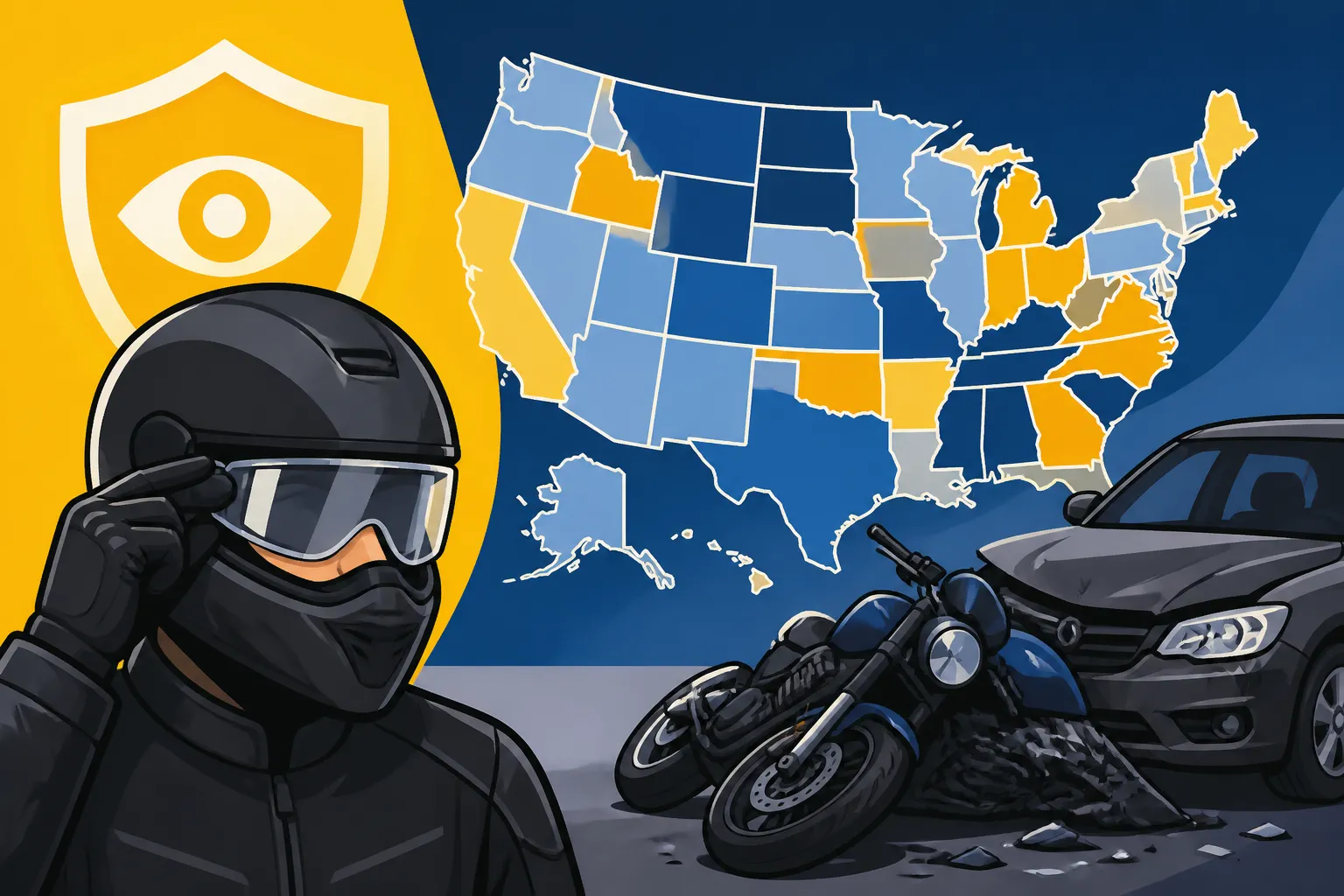
Here's a quick look at how eye protection requirements generally stack up across different states. Keep in mind, laws can change, and it's always best to verify with your state's DMV or Department of Transportation.
| State | General Eye Protection Requirement | Helmet Law Type | Notes |
|---|---|---|---|
| California | Required (integrated with helmet) | Universal (all riders) | Helmet visors or separate eye protection with open-face. |
| Texas | Required (if no windshield) | Partial (under 21) | Otherwise, if 21+, optional with insurance/training. |
| Florida | Required (if no windshield) | Partial (under 21) | Otherwise, if 21+, optional with insurance. |
| New York | Required (if no windshield) | Universal (all riders) | Windshield must be "of sufficient height". |
| Illinois | Required (if no windshield) | Partial (under 18) | Otherwise, if 18+, not legally required. |
| Pennsylvania | Required (if no windshield) | Partial (under 21) | Otherwise, if 21+, optional. |
| Iowa | Not explicitly required | Partial (under 18) | No specific law, but highly recommended. |
| New Hampshire | Not explicitly required | No helmet law | No specific law for helmets or eye protection. |
| Washington | Required (integrated with helmet) | Universal (all riders) | Helmet visors or separate eye protection with open-face. |
Disclaimer: This table provides general information. Specific laws and interpretations can vary and are subject to change. Always consult official state resources for the most current requirements.
Types of Eye Protection and Their Effectiveness
When it comes to safeguarding your eyes on a motorcycle, you've got options. But not all eye protection is created equal, and what offers robust defense in one scenario might fall short in another. Understanding the different types available and their respective pros and cons is crucial for making an informed choice that prioritizes your safety and potentially, your accident claim.
Full-Face Helmet Visors and Shields
A full-face helmet is often considered the gold standard for motorcycle safety, and its integrated visor or face shield is a primary reason why. These shields offer comprehensive protection, covering your entire face from the chin up, effectively sealing your eyes off from wind, dust, debris, and even rain. They're designed to withstand impacts, often meeting strict safety standards like DOT, Snell, or ECE certifications. The advantage here is convenience – the visor is always there, ready to be pulled down, and many come with anti-fog coatings or can be easily swapped for tinted versions to deal with varying light conditions. For instance, a clear visor is perfect for night riding, while a smoked or iridium shield helps immensely during bright daytime rides.
However, even with a full-face helmet, proper maintenance is key. Scratched or dirty visors can impair vision, making them less effective. Also, in humid conditions or at low speeds, even anti-fog visors can sometimes struggle, leading to temporary visibility issues. Still, the overall protection offered by a quality full-face helmet and its visor is unmatched. When considering a new lid, check out options at Cycle Gear where you can compare different brands and features to find one that suits your riding style and protection needs.
Goggles and Riding Glasses
For riders who prefer open-face or modular helmets (when the chin bar is up), or even those in states with no helmet law who still want protection, goggles and riding glasses are the go-to. Goggles, particularly those designed for motorcycling, offer excellent peripheral vision and form a seal around your eyes, providing a barrier against wind, dust, and debris. They come in various tints and can often be worn over prescription glasses, though specialized over-the-glasses (OTG) goggles exist for better comfort. Riding glasses, on the other hand, look more like regular sunglasses but are typically made from impact-resistant materials (like polycarbonate) and often feature wraparound designs to minimize wind entry.
The effectiveness of goggles and riding glasses varies. Goggles generally provide superior protection due to their sealed fit, especially against fine dust or severe wind. However, they can sometimes fog up more easily than vented visors. Riding glasses are more comfortable for many and offer better airflow, but they might not completely seal out wind or fine particles, especially at higher speeds. They're a good choice for casual rides or specific aesthetics, but for maximum protection, especially on long trips or high-speed runs, impact-rated goggles or a full-face visor are usually preferred. Regardless of your choice, ensuring they meet ANSI Z87.1 safety standards for impact resistance is a smart move for any rider.
How Eye Protection Impacts Your Accident Claim
When the unthinkable happens and you're involved in a motorcycle accident, the immediate priority is your health and safety. But soon after, your mind will turn to the practicalities of recovery, including your personal injury claim. This is where your choice of gear, especially eye protection, can play a surprisingly significant role, potentially influencing everything from the determination of fault to the final settlement amount.
The "Helmet Defense" and Eye Protection
You've probably heard of the "helmet defense," where insurance companies or opposing counsel argue that a rider's head injuries would have been less severe, or even avoided, had they been wearing a helmet, regardless of state law. This same principle can extend to eye protection. If you suffer an eye injury in an accident and weren't wearing legally required eye protection, the other side's legal team might very well invoke a "protective gear defense." They could argue that your injuries were either caused or exacerbated by your negligence in not wearing appropriate gear. For a deeper dive into how this works, see The Helmet Defense Explained.
This argument isn't about proving their driver wasn't at fault for the accident itself. It's about minimizing the damages they have to pay for your injuries. For instance, if you sustain corneal abrasions or even permanent vision loss due to debris hitting your eye during a crash, and you were riding without a visor or goggles in a state where they are required, the defense could claim that your failure to comply directly contributed to the severity of that specific injury. This doesn't mean you can't recover damages, but it can significantly complicate your case and potentially reduce the compensation you receive under comparative negligence laws, which we'll discuss next.
Comparative Negligence and Reduced Payouts
Most states operate under some form of comparative negligence. This legal doctrine allows an injured party to recover damages even if they were partially at fault for their injuries, but the amount they can recover is reduced by their percentage of fault. So, if you're found 10% responsible for your eye injury because you weren't wearing required eye protection, your total compensation for that injury could be reduced by 10%. This is outlined more broadly in Comparative Negligence in Motorcycle Accidents.
For example, imagine you're in an accident in Ohio, a state with partial eye protection requirements, and you suffer a serious eye injury. The driver who hit you was clearly distracted, making them primarily at fault for the crash. However, because you weren't wearing eye protection, which was legally required because your bike didn't have a tall enough windshield, the insurance company for the at-fault driver might argue that your negligence in not protecting your eyes contributed to your vision damage. A jury or negotiator might then assign 20% of the fault for your eye injury (not necessarily the entire accident) to you. If your total damages for that eye injury were valued at $50,000, that 20% fault could mean you only recover $40,000 for that specific component of your claim. This makes it incredibly difficult to maximize your motorcycle accident settlement.
Best Practices and Common Misconceptions
Beyond the letter of the law, there are always best practices that every rider should embrace. Relying solely on minimum legal requirements can leave you vulnerable, both on the road and in the aftermath of an accident. Clearing up common misconceptions about eye protection can also empower you to make safer, more informed choices.
Going Beyond Minimum Legal Requirements
Just because a state doesn't explicitly require a full-face helmet or specific eye protection for all riders doesn't mean it's a good idea to forgo it. The minimum legal standard is often just that – the absolute minimum. For true safety and peace of mind, consider investing in gear that offers superior protection, like a DOT, ECE, or Snell-approved full-face helmet with a high-quality, scratch-resistant visor. Many experienced riders will tell you that the cost of top-tier gear is a tiny fraction of the potential cost of medical bills and lost wages after a serious injury.
Think about it: even if your state has a partial helmet law that only requires helmets for riders under 21, or no explicit eye protection law at all, your eyes are still susceptible to impacts and environmental damage. Why take the chance? When shopping for gear, whether it's at Cycle Gear or another reputable retailer, prioritize protection and comfort. Look for visors with good optical clarity, anti-fog properties, and UV protection. For goggles, ensure they have a comfortable seal and good ventilation. Being proactive about your safety gear is one of the best steps you can take after a motorcycle accident to protect yourself and your claim. This proactive approach is also critical for your overall safety, as outlined in Motorcycle Safety Gear and Legal Protection.
Debunking Eye Protection Myths
There are a few persistent myths surrounding eye protection that can lead riders astray:
- "My sunglasses are enough." While sunglasses offer UV protection, most regular sunglasses are not impact-resistant and can shatter on impact, potentially causing more harm than good. Riding-specific glasses or goggles are designed with polycarbonate lenses that are far more durable.
- "My small windshield protects me." Many factory-installed windshields on cruisers or choppers are primarily for aesthetics and may not be tall enough to deflect debris from your eyes, especially at higher speeds. Always err on the side of caution and wear additional eye protection if you're unsure.
- "Eye protection is uncomfortable or blocks my view." Modern visors and goggles are designed for comfort and excellent optical clarity. Quality gear shouldn't distort your vision or cause significant discomfort. If it does, it might be ill-fitting or of poor quality. Take the time to try on different options.
- "It makes me look less 'cool'." This is a purely subjective aesthetic argument that pales in comparison to the benefits of preventing vision loss or facial disfigurement. There are many stylish and protective options available today that blend form and function seamlessly.
Understanding the real risks and equipping yourself with appropriate, high-quality eye protection is a testament to your commitment to safe riding and can be invaluable in the event you ever need to prove your diligent safety practices in a motorcycle accident claim. Always document your gear and injuries thoroughly after a crash to strengthen your position, as advised in How to Document Injuries for a Claim.
Documenting Eye Protection After an Accident
The moments immediately following a motorcycle accident are often chaotic and overwhelming. However, what you do—or don’t do—in these critical hours can have a profound impact on your personal injury claim. This includes how you document the scene, your injuries, and critically, the safety gear you were wearing, especially your eye protection. Insurance adjusters and opposing legal teams will scrutinize every detail to find reasons to minimize your payout. Having clear, undeniable evidence of your adherence to safety practices can be a powerful counterargument.
Preserving Evidence of Your Protective Gear
After an accident, assuming you are physically able to do so safely, your immediate priority should be seeking medical attention. However, once that is addressed, or if you have others who can assist at the scene, documenting your gear is paramount. This means taking detailed photographs of your helmet (if applicable), visor, goggles, or riding glasses. Capture multiple angles, showing any damage to the gear itself. If your visor is scratched or cracked from an impact, that's crucial evidence that it did its job and protected your eyes. Similarly, if your riding glasses are broken but the lenses held, it demonstrates their protective qualities.
Do not discard damaged gear. In fact, if your helmet or eye protection shows signs of impact, preserving it can be invaluable. It serves as tangible evidence that you were wearing protective equipment, and that the equipment absorbed forces that would have otherwise impacted your face and eyes directly. This material evidence can contradict any claims from the opposing side that you were negligent in protecting yourself. Even if the gear seems minorly damaged, it's often best to save it, as a detailed inspection by an expert could reveal important information about the force and direction of impact, strengthening your overall motorcycle accident evidence for proving fault.
Connecting Eye Protection to Injury Prevention
Beyond simply showing you were wearing it, you need to connect your eye protection directly to the prevention or mitigation of injuries. For example, if you were wearing a full-face helmet with a visor and sustained a significant head injury but no eye injuries, this strengthens the argument that your visor performed its function effectively. Conversely, if you did sustain an eye injury, but your eye protection was damaged in a way that clearly shows it absorbed some of the impact, that still helps your case by showing you were attempting to protect yourself and that the injury might have been much worse without it.
Medical records are key here. Your doctor's notes, especially regarding the absence of certain injuries or the severity of those you did sustain, can be used to illustrate how your gear made a difference. If you experience any eye discomfort or vision issues after an accident, even if seemingly minor, seek immediate medical evaluation. Documenting these symptoms and their relation to the crash is vital. Your adherence to safety standards, including wearing appropriate eye protection, can significantly influence the perception of your claim. It helps counter the pervasive "rider bias" that often assumes motorcyclists are inherently reckless, making your case stronger for liability, damages, and ultimately, a fair settlement. This due diligence is part of a broader strategy to protect your claim, following steps like What to Do Immediately After a Motorcycle Accident.
Disclaimer
The information provided in this guide is for general informational purposes only and does not constitute legal advice. Motorcycle laws, including those pertaining to eye protection and accident claims, vary significantly by state and are subject to change. It is always recommended to consult with a qualified legal professional for advice tailored to your specific situation and jurisdiction.