Does Not Wearing a Helmet Affect a Claim in Pennsylvania
Riding a motorcycle in Pennsylvania offers an incredible sense of freedom, but the open road also comes with unique challenges, especially when an accident occurs. One of the most common worries riders face after a crash, beyond their injuries, is how their choice of safety gear, or lack thereof, might impact their ability to recover damages. It’s a frustrating situation to be in when you’re already hurting, and this guide will demystify how not wearing a helmet can affect your motorcycle accident claim in the Keystone State.
Understanding Pennsylvania's Motorcycle Helmet Law
Pennsylvania's motorcycle helmet laws are often misunderstood, leading to a lot of confusion among riders about their legal obligations and rights. Unlike some states with universal helmet mandates, Pennsylvania operates under a partial helmet law, which means not all riders are legally required to wear a helmet at all times. This nuance is crucial when discussing how a helmet — or the absence of one — impacts a personal injury claim after an accident.
Specific Requirements for Riders
In Pennsylvania, if you're under the age of 21, the law is very clear: you must wear a DOT-compliant helmet. There are no exceptions for younger riders, and failing to adhere to this rule can result in penalties. For riders aged 21 and older, the rules change significantly. You are generally exempt from the mandatory helmet law if you meet one of two conditions: you've been licensed to operate a motorcycle for at least two years, or you have successfully completed a motorcycle safety course approved by either PennDOT or the Motorcycle Safety Foundation. This means many experienced adult riders have the legal option to ride helmet-free. However, it's always a good idea to consider the added protection, regardless of the law. You can find excellent options, from full-face to modular designs, at places like Cycle Gear, ensuring you get a helmet that meets safety standards.
The Role of Eye Protection
While the helmet law has specific age and experience requirements, Pennsylvania law is unwavering when it comes to eye protection. All motorcycle operators and passengers, regardless of age or experience level, are legally required to wear eye protection. This could be a face shield attached to your helmet, goggles, or a windshield that meets certain height and clarity standards. The rationale here is clear: debris, insects, and wind can severely impair a rider's vision, making an accident far more likely. Failing to wear proper eye protection can not only lead to a ticket but could also be cited as a contributing factor in an accident, potentially affecting your ability to recover full damages, even if you were wearing a helmet. It's a key aspect of Motorcycle Gear Laws and Requirements.
The "Helmet Defense" in Pennsylvania Claims
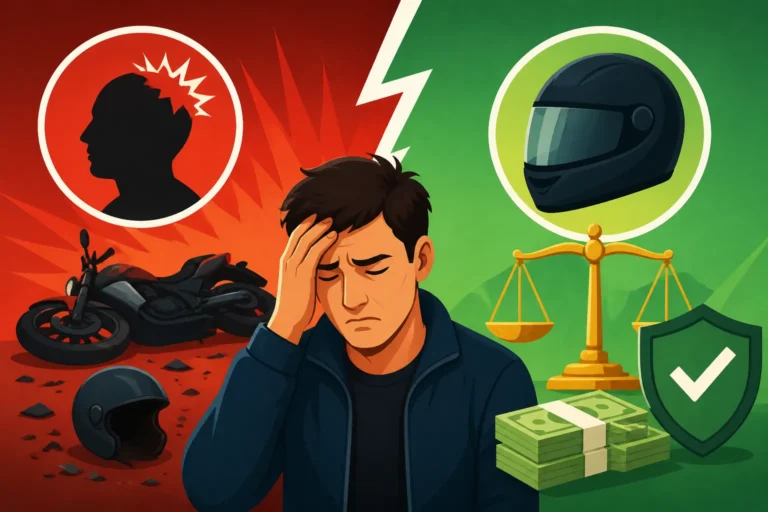
Even if you were legally allowed to ride without a helmet in Pennsylvania, the decision can become a contentious point if you're involved in a motorcycle accident. Insurance companies, always looking to minimize payouts, frequently employ what's known as the "helmet defense." This isn't about whether you broke the law by not wearing a helmet; it's about whether your choice contributed to the severity of your injuries, particularly head injuries.
How Insurers Use This Argument
Imagine you're cruising down I-81 near Harrisburg, enjoying the ride, legally helmet-free, when an inattentive driver swerves into your lane, causing a collision. You suffer a severe head injury, along with road rash and a broken arm. The insurance company for the at-fault driver will likely acknowledge their client's responsibility for causing the accident. However, they will then pivot to argue that your head injury would have been less severe, or perhaps even avoided, had you been wearing a DOT-compliant helmet. They'll claim that your decision not to wear a helmet constitutes a failure to mitigate your own damages, effectively trying to shift some of the blame for the extent of your head injury back onto you. This tactic is a direct challenge to your right to full compensation for those specific injuries, and it's a common strategy when Insurance Companies Assign Blame to Riders.
Causation Versus Negligence
It's crucial to understand that the helmet defense doesn't necessarily argue that you were at fault for causing the accident itself. If the other driver was clearly negligent – perhaps they ran a red light or were distracted – their fault for the collision remains. Instead, the helmet defense focuses on causation regarding the injuries. Did the absence of a helmet cause your specific head injury, or make it worse? If so, the argument goes, you shouldn't be fully compensated for that portion of your injury because you could have prevented or lessened it. This can be a complex legal battle, as proving a direct causal link between not wearing a helmet and the specific severity of a head injury can be challenging for both sides. Expert testimony from medical professionals and accident reconstructionists often becomes vital in these disputes, highlighting the nuances of How Helmet Laws Affect Your Accident Claim.
Impact on Your Motorcycle Accident Claim and Damages
The presence or absence of a helmet can significantly impact the value of your motorcycle accident claim in Pennsylvania, primarily affecting the compensation you can receive for certain types of injuries. It’s not a cut-and-dry situation, and the outcome often depends on the specific facts of your case and the skill of legal representation.
Reduction in Compensation for Head Injuries
If you sustain a head injury, and you weren't wearing a helmet (even if legally allowed), the insurance company will almost certainly argue that your damages should be reduced. This is where the concept of comparative negligence comes into play. Pennsylvania follows a modified comparative negligence rule, specifically the 51% rule. This means that if you are found to be 51% or more at fault for an accident, you cannot recover any damages. However, in the context of the helmet defense, it's not about being at fault for the accident, but at fault for the severity of your head injury.
For instance, if a jury determines that while the other driver was 100% at fault for the collision, your head injury would have been 30% less severe had you worn a helmet, your compensation for that specific head injury could be reduced by 30%. This doesn't affect compensation for other injuries like a broken leg or road rash, which wouldn't have been prevented by a helmet. It creates a nuanced calculation where different categories of damages might be treated differently. Understanding Comparative Negligence in Motorcycle Accidents is key here.
Other Injuries Remain Compensable
It’s important to remember that not wearing a helmet generally does not affect your ability to recover damages for other injuries. If you suffer from severe road rash, a broken collarbone, a spinal injury, or internal injuries, these are typically considered independent of your helmet choice. The primary purpose of a helmet is to protect the head. Therefore, the argument that not wearing one contributed to a foot injury, for example, holds no legal weight.
Your claim for medical expenses, lost wages, and pain and suffering related to these non-head injuries should, in most cases, remain fully compensable, assuming the other driver was at fault for the accident. This distinction is vital; insurers will try to paint a broad stroke, implying your entire claim is weakened, but the legal reality is often more specific. Documenting all your injuries meticulously, from Road Rash Injuries and Claims to Spinal Cord Injuries from Motorcycle Accidents, is always crucial.
The Financial Stakes: Medical Bills and Lost Wages
Motorcycle accidents often result in devastating injuries that lead to astronomical medical bills, long recovery times, and significant lost wages. If you're a skilled welder in Philadelphia, for example, a severe head injury could mean months, or even years, out of work, impacting not just your current income but your future earning capacity. When a helmet defense successfully reduces compensation for a traumatic brain injury, it doesn't just cut into a "pain and suffering" award; it can directly reduce the funds available to cover life-altering medical treatments, rehabilitation, and the income you desperately need to support yourself and your family. This is why accurately calculating Lost Wages in a Motorcycle Claim is so important, as is understanding the full scope of your Motorcycle Accident Traumatic Brain Injuries.
Consider a scenario: you have $200,000 in medical bills and lost wages from a TBI. If the insurer successfully argues that not wearing a helmet made your TBI 25% worse, they might only pay $150,000 of those TBI-related costs. This shortfall can be financially crippling, emphasizing the high stakes involved in disputing the helmet defense.
Protecting Your Claim Even Without a Helmet
Even if you weren't wearing a helmet at the time of your accident, and were legally permitted to ride without one in Pennsylvania, all hope is not lost for your claim. There are crucial steps you can take to protect your rights and maximize your potential compensation.
Document Everything Immediately
The moments immediately following an accident are chaotic, but what you do (or don't do) can profoundly impact your claim. First and foremost, if you are able, document the scene thoroughly. Take photos and videos of everything: the position of the vehicles, damage to your motorcycle, damage to the other vehicle, skid marks, road conditions, traffic signs, and any visible injuries you or others sustained. Get contact information from witnesses. If you own a Dashcam, save the footage immediately. This objective evidence can be invaluable in proving who was at fault for the collision itself, irrespective of your helmet use. Knowing What to Do After a Motorcycle Accident is paramount.
It's also essential to seek medical attention immediately, even if you feel fine. Some injuries, especially head injuries, have delayed symptoms. A prompt medical evaluation creates an official record of your injuries, linking them directly to the accident. Be honest and thorough with medical professionals about all your symptoms, no matter how minor they seem. This forms the bedrock of proving your damages.
Understand the Burden of Proof for the Defense
It's not enough for an insurance company to simply claim that your lack of a helmet worsened your injuries. In Pennsylvania, the burden of proof for the helmet defense rests squarely on the shoulders of the at-fault driver's insurance company. They must demonstrate two things:
- That you were not wearing a DOT-compliant helmet (if required by law or if they're arguing mitigation).
- That your failure to wear a helmet was a direct and substantial cause of specific head injuries, or significantly aggravated them.
This often requires expert testimony from medical professionals or accident reconstructionists. They have to show a clear causal link, not just a possibility. For example, if you only suffered a broken leg and road rash, the helmet defense would be irrelevant. If you sustained a concussion, they would need to prove that a helmet would have prevented or substantially lessened the severity of that specific concussion. This can be a challenging hurdle for the defense, especially if your injuries are not solely head-related. It speaks to the complexity of How Fault Is Determined in Motorcycle Accidents.
The Value of Experienced Legal Counsel
Navigating a motorcycle accident claim in Pennsylvania, especially when the helmet defense is raised, is incredibly complex. Insurance adjusters are trained negotiators whose goal is to minimize payouts. They will use every tactic available to them, including rider stereotypes, to undervalue your claim.
An experienced motorcycle accident attorney understands Pennsylvania's specific laws, knows how to counter the helmet defense, and can gather the necessary evidence, including expert testimony, to prove your damages. They can help you understand How Not Wearing a Helmet Affects Your Settlement and work to ensure that you receive the maximum compensation you deserve for all your injuries, regardless of your helmet choice. They will also handle all communications with insurance companies, allowing you to focus on your recovery without the added stress of legal battles. When considering the Average Motorcycle Accident Settlement Amounts, having skilled representation can make a significant difference.
Table: Impact of Helmet Use on a Pennsylvania Motorcycle Accident Claim
To help you visualize the potential implications, here's a summary of how helmet use, or lack thereof, can affect different aspects of your claim in Pennsylvania:
| Aspect of Claim | Wearing a Helmet (Legally Compliant) | Not Wearing a Helmet (Legally Allowed) | Not Wearing a Helmet (Legally Required) |
|---|---|---|---|
| Legal Status | Compliant with PA law | Compliant with PA law (if conditions met) | Violation of PA law |
| Fault for Accident | Unaffected; based on collision facts | Unaffected; based on collision facts | Unaffected; based on collision facts |
| Head Injury Compensation | Less susceptible to reduction | Potentially reduced via helmet defense | Highly susceptible to reduction |
| Non-Head Injury Compensation | Generally fully compensable | Generally fully compensable | Generally fully compensable |
| Insurance Defense Tactics | Less likely to employ helmet defense | Highly likely to employ helmet defense | Almost certainly employ helmet defense |
| Burden of Proof for Defense | N/A | Defense must prove causation to injuries | Defense must prove causation to injuries |
| Impact on Overall Settlement | Maximized for all damages | Potentially reduced for head injury portion | Significant risk of reduction for head injuries, potential legal fines |
This table illustrates that while legal compliance is one factor, the impact on your claim’s value for specific injuries can vary significantly. Even if you were legally allowed to ride without a helmet, your choice can create additional hurdles during the claims process. Protecting yourself with quality gear from retailers like Cycle Gear, even when not legally mandated, often makes a strong statement about your commitment to safety.
Final Thoughts on Helmet Laws and Your Claim
Navigating a motorcycle accident claim is never simple, and when the issue of helmet use enters the picture, it adds another layer of complexity. In Pennsylvania, while many adult riders have the legal right to choose whether or not to wear a helmet, that choice can become a significant point of contention for insurance companies if you suffer a head injury in a crash. They will, without a doubt, try to use the "helmet defense" to reduce the compensation you receive for those specific injuries, even if they concede their client was entirely at fault for causing the accident.
Ultimately, your best defense against such arguments is preparation and proactive action. Always prioritize safety gear, document everything meticulously after a crash, seek immediate medical attention, and never underestimate the value of experienced legal counsel. An attorney who specializes in motorcycle accidents can make all the difference in protecting your rights and ensuring you receive fair compensation, regardless of the nuances of Pennsylvania's helmet laws.
Disclaimer
Please remember that this article provides general information and insights into motorcycle helmet laws and their potential impact on accident claims in Pennsylvania. It is not intended as legal advice. Laws can be complex and may change, and the specifics of your individual situation are unique. For personalized legal guidance regarding your motorcycle accident claim, it is essential to consult with a qualified attorney specializing in personal injury law in Pennsylvania.