How to Prove Fault in a Speeding Crash
Dealing with the aftermath of a motorcycle accident is tough enough, but when you know the other driver was flying down the road, making an already dangerous situation catastrophic, the frustration can boil over. Proving that their excessive speed was the root cause of the crash, and not some preconceived notion about motorcyclists, is absolutely critical. This guide is here to walk you through exactly how to gather the right evidence and build a rock-solid case to prove fault in a speeding collision.
Understanding Speeding and Its Impact on Fault
It's a common misconception that "speeding" only means going over the posted limit. While that's certainly a clear violation, the reality is far more nuanced, especially when we talk about how it impacts fault in a motorcycle accident. Many drivers, unfortunately, simply aren't paying enough attention, and when they combine that with excessive speed, motorcyclists are often the ones who pay the steepest price.
The Definition of Speeding and Exceeding Safe Limits
When we talk about speeding in the context of an accident, it’s not just about that number on the speed limit sign. It's also about driving "too fast for conditions." Think about it: going 45 mph in a 45 mph zone might be perfectly legal on a clear, dry day. But what if it’s pouring rain, there's heavy fog, or you're navigating a busy school zone at dismissal time? That same 45 mph suddenly becomes incredibly dangerous, far exceeding what's safe or reasonable for the situation.
For motorcyclists, this distinction is particularly crucial. A car driver might not exceed the posted limit but could still be driving unsafely fast on a winding road, near an intersection with limited visibility, or during rush hour traffic in a dense city like Los Angeles or Miami. This "unsafe speed" significantly reduces their reaction time to unexpected events, like a motorcyclist legally turning or merging. This negligence, even if technically "within the limit," can be a direct cause of a collision. It highlights how the legal definition extends beyond just the numbers on the signs to encompass the prevailing circumstances on the road.
How Speed Contributes to Motorcycle Accidents
The physics of a crash are unforgiving, and speed is a massive factor. The faster a vehicle is traveling, the longer it takes to stop, and the greater the force of impact if a collision occurs. For a motorcyclist, who has little to no external protection, this translates directly into more severe injuries – often catastrophic. Imagine a driver doing 70 mph on a highway when traffic ahead suddenly brakes. Their stopping distance is exponentially greater than if they were doing 55 mph. If a motorcycle is caught in that suddenly slowing traffic, the speeding driver might not have enough space or time to avoid a rear-end collision.
Furthermore, a speeding driver might genuinely claim they "didn't see the motorcycle," and while that's rarely a valid excuse, excessive speed exacerbates the problem. When a vehicle approaches another at high speed, the time available for the driver's brain to register and process the presence of the motorcycle is drastically reduced. This is particularly true for drivers making turns, as the rapid approach of a speeding vehicle can make it seem as though the motorcycle is further away or traveling slower than it actually is. This distorted perception, often caused by the other driver's speed, is a common factor in motorcycle accidents and leads to devastating consequences for riders. Proving the other driver's speed is a fundamental aspect of demonstrating Common Causes of Motorcycle Accidents.
Essential Evidence to Prove Speeding Fault
When you're trying to prove that the other driver's speeding caused your motorcycle accident, it's not enough to just feel like they were going too fast. You need concrete evidence. This isn't about guesswork; it's about building a factual narrative that stands up to scrutiny, especially when insurance companies or opposing counsel try to downplay the other driver's actions or shift blame.
Police Reports and Accident Reconstruction
The police report is often the first official document detailing the accident, and it's a critical piece of evidence. When law enforcement arrives at the scene, they'll document a lot of vital information: their initial observations, statements from all parties involved, witness contact information, and often, whether any traffic citations were issued, like for speeding. If the police officer notes excessive speed as a contributing factor or issues a speeding ticket to the other driver, this can significantly bolster your claim. However, it's important to remember that a police report isn't the final word on fault. While it's a strong indicator, especially if it accurately captures the scene, insurers might still try to dispute its findings. Learn more about How Police Reports Establish Fault.
For more complex cases, especially where speeding is disputed, an accident reconstruction expert becomes invaluable. These professionals are like real-life detectives, using scientific principles, physics, and advanced tools to piece together exactly what happened. They can analyze:
- Skid marks: The length and type of skid marks can be used to calculate the minimum speed a vehicle was traveling before braking.
- Vehicle damage: The extent and nature of damage to both vehicles provide clues about the force and angle of impact, which are directly related to speed.
- Debris fields: The spread of shattered glass, plastic, and metal can indicate the point of impact and the trajectory of the vehicles.
- Vehicle data recorders (EDRs/black boxes): Many modern cars are equipped with event data recorders that record crucial information in the moments before a crash, including speed, braking, and steering inputs. This data can be incredibly powerful in proving excessive speed.
An accident reconstruction expert can provide an objective, data-driven analysis that cuts through subjective claims and provides compelling evidence of the other driver's speed, often making the difference in proving How Fault Is Determined in Motorcycle Accidents.
Witness Statements and Dashcam Footage
In the chaotic aftermath of an accident, it's easy for details to get muddled. That's why independent witness statements are gold. People who saw the collision happen, or even just saw the other vehicle speeding recklessly in the moments leading up to it, can provide crucial corroborating testimony. They don't have a vested interest in the outcome, making their accounts often more credible to insurers and juries. Always make an effort to get contact information for any witnesses at the scene. Even if they didn't see the exact impact, their observations of the other driver's behavior could be vital.
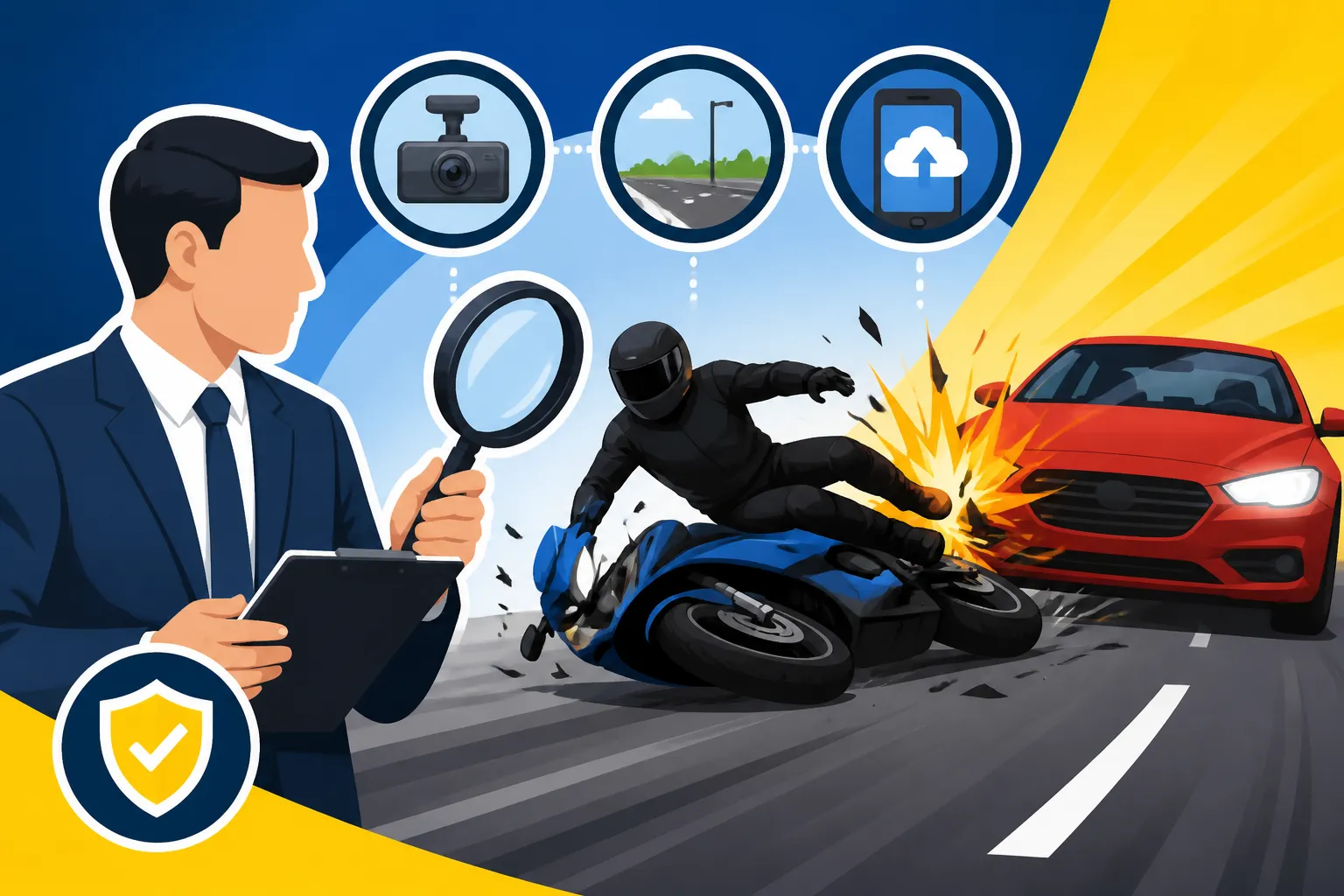
Even more powerful than witness testimony in many cases is dashcam footage. With the rise of affordable dashcams and helmet cameras, more vehicles and riders are recording their journeys. If the accident was captured on video – whether from your own helmet camera, another vehicle's dashcam, or even a nearby surveillance camera from a business – it can provide irrefutable evidence of the other driver's speed and actions. For instance, if a commercial truck driver has a dashcam running, that footage could clearly show them traveling well above the posted limit or too fast for conditions. This visual evidence removes all doubt and makes it incredibly difficult for the at-fault driver or their insurance company to deny liability. The clarity a dashcam provides can be absolutely game-changing in Proving Fault in a Motorcycle Accident.
Physical Evidence at the Scene
Never underestimate the power of physical evidence left behind at the crash scene. Even after the vehicles are towed, careful documentation of the environment can yield critical insights into the speeds involved.
- Skid Marks: These are probably the most classic indicator of braking and speed. The length of skid marks left by the other vehicle can be measured and used by experts to calculate a minimum speed at the time the brakes were applied. Different road surfaces and tire conditions will affect the calculations, which is why an expert's analysis is so valuable. For example, if you were hit by a car whose skid marks extended 100 feet on dry asphalt, that's a strong indication of excessive speed.
- Debris Field: The area where shattered glass, broken plastics, and vehicle parts are scattered after an impact is called the debris field. The size and spread of this field can give accident reconstructionists clues about the force of the collision and, by extension, the speeds involved. A wider, more dispersed debris field often suggests a higher-energy impact.
- Vehicle Damage: The type and severity of damage to both your motorcycle and the other vehicle are also vital. High-speed impacts typically result in more extensive and severe deformation, crushing, and shearing of metal. Analyzing the crush patterns can help determine the force of the impact and the delta-V (change in velocity) of each vehicle, which is a key component in understanding speed at impact.
- Final Resting Positions: Where your motorcycle and the other vehicle ended up after the crash, relative to the point of impact, is another piece of the puzzle. How far were they pushed? What direction did they travel? These trajectories and distances are influenced by the vehicles' speeds and masses and can be fed into accident reconstruction models to validate speed estimates.
Taking clear, comprehensive photographs of all this evidence before it's cleared away is paramount. These visuals, combined with expert analysis, form a powerful foundation for demonstrating the other driver's culpability due to speeding.
Legal Considerations When Proving Speeding Fault
Even when the evidence strongly points to the other driver's speeding, the legal landscape surrounding motorcycle accidents can be tricky. It's not always a straightforward case of "they sped, they pay." There are important legal principles at play that can affect your ability to recover full compensation, and you need to be prepared for the challenges.
Comparative Negligence and Shared Fault
One of the biggest hurdles you might face is the concept of comparative negligence. This legal doctrine allows for damages to be apportioned based on each party's degree of fault. In essence, if the other driver was speeding and caused the crash, but you were also found to be partially at fault – maybe for not wearing proper gear, lane splitting where it wasn't legal, or having a minor traffic violation yourself – your total compensation could be reduced.
States handle comparative negligence differently:
- Pure Comparative Negligence: States like California follow this rule. Even if you are 99% at fault, you can still recover 1% of your damages. So, if the speeding driver was 80% at fault and you were 20% at fault for some contributing factor (like slightly speeding yourself, or perhaps a turn without signaling properly, though the speeding driver caused the impact), your $100,000 settlement would be reduced by 20% to $80,000.
- Modified Comparative Negligence: Many states, including Texas and Florida, operate under a modified comparative negligence rule, often called the "51% Rule" or "50% Rule." Under the 51% rule, if you are found 51% or more at fault, you cannot recover any damages. If you are 50% or less at fault, your damages are reduced by your percentage of fault. So, if you're in a state with the 51% rule, and a jury determines you were 60% at fault for the accident, you would receive nothing, even if the other driver was clearly speeding.
This is why having a skilled legal team to fight allegations of shared fault is critical. They can present evidence to minimize any perceived fault on your part and ensure that the blame for the speeding crash rests squarely with the negligent driver. Understanding How Comparative Negligence Reduces Your Payout is key to navigating your claim effectively.
Overcoming Rider Bias
It's an unfortunate truth that motorcyclists often face an uphill battle against inherent biases. In some circles, there's a prevailing stereotype that all riders are reckless thrill-seekers, weaving in and out of traffic and pushing the limits. This "rider bias" can subtly (or not so subtly) influence police officers, insurance adjusters, and even jury members. When a speeding crash involves a motorcycle, the first instinct for some might be to question what the rider was doing, rather than immediately focusing on the speeding car driver.
Insurance companies are particularly adept at leveraging these biases. They might try to argue that even if their client was speeding, your presence on a motorcycle somehow made the situation inherently more dangerous, or that your riding style contributed to the crash. For instance, they might scrutinize your lane position, equipment, or even past traffic violations to try and paint you as an irresponsible rider. This is where an experienced legal team steps in. They understand these tactics and know how to counteract them effectively.
Strategies to overcome rider bias include:
- Presenting Yourself as a Responsible Rider: If you consistently rode safely, wore all your gear, and followed traffic laws, this should be highlighted. Photos of you in full gear, a clean driving record, and testimony about your commitment to safety can help.
- Meticulous Documentation: Every piece of evidence – from helmet camera footage showing you riding responsibly, to accident reconstruction reports demonstrating the other driver's egregious speed – serves to dismantle unfair stereotypes.
- Expert Testimony: Accident reconstructionists and even motorcycle safety experts can explain the dynamics of motorcycle crashes and dispel myths about rider behavior, focusing on the scientific facts rather than prejudice.
Fighting this bias is an integral part of proving Rider Bias in Fault Determination and securing fair compensation. Your legal team's ability to focus the narrative on the facts of the speeding driver's negligence, rather than assumptions about your lifestyle, is paramount.
Steps to Take Immediately After a Speeding Crash
The moments immediately following a motorcycle accident, especially one caused by a speeding driver, can be disorienting and terrifying. Your adrenaline will be pumping, and it can be hard to think straight. However, what you do in these critical minutes and hours can profoundly impact your ability to prove fault and recover damages later on.
Secure the Scene and Seek Medical Attention
Your absolute top priority after any crash is your safety and well-being. Even if you feel "okay" and don't see any obvious injuries, the shock and adrenaline can mask pain and serious internal issues.
- Move to Safety (If Possible): If your motorcycle is safely movable and you are able to move without risking further injury, get yourself and your bike to the side of the road, away from ongoing traffic. If not, stay put and wait for emergency services. Do not compromise your safety to move evidence, but also do not remain in harm's way.
- Call 911 Immediately: Even if it seems like a minor fender bender, a speeding crash is rarely minor for a motorcyclist. Call emergency services to report the accident and request medical assistance. Paramedics can assess you on-site and transport you to a hospital if needed.
- Seek Medical Treatment Promptly: This cannot be stressed enough. Go to the emergency room or your doctor as soon as possible after the crash, even if you initially decline ambulance transport. A rapid medical evaluation creates an official record that links your injuries directly to the accident. Any delay gives insurance companies an opening to argue that your injuries weren't caused by the crash or weren't severe. Your medical records are the bedrock of your injury claim.
Remember, taking care of yourself is paramount, and ensuring your medical needs are met also lays the groundwork for any future legal action. For a comprehensive overview, see What to Do After a Motorcycle Accident.
Document Everything
In the chaos of an accident, details can blur. But clear, comprehensive documentation is your best friend when proving fault, especially in a speeding crash. Think of yourself as an investigative journalist for your own case.
- Photographs and Videos: Use your phone to take as many pictures and videos as possible.
- Scene Overview: Capture the entire accident scene from multiple angles. Show the position of both vehicles, any traffic signals, road signs, and intersection layouts.
- Vehicle Damage: Document the damage to your motorcycle and the other vehicle in detail. Get close-ups and wider shots.
- Skid Marks and Debris: Photograph any skid marks, tire marks, and scattered debris (glass, plastic, metal). Measure skid marks if you can do so safely, or use objects of known size (like your shoe) for scale in photos.
- Road Conditions: Capture photos of the road surface, weather conditions, lighting, and any hazards (potholes, gravel) that might be relevant.
- Your Injuries: Photograph any visible injuries you have, such as road rash, cuts, or bruises.
- Exchange Information: Get the following from the other driver:
- Full name and contact information
- Insurance company and policy number
- Driver's license number
- Vehicle make, model, year, and license plate number
- Identify Witnesses: If anyone saw the crash, get their names and contact information. Their testimony can be invaluable in confirming the other driver's speeding.
- Note Down Details: As soon as you can, write down everything you remember about the accident:
- Date, time, and exact location
- Weather and road conditions
- How the accident happened, in your own words
- What the other driver said
- Any specific observations about the other driver's speed before the impact
This meticulous collection of evidence will be crucial when you need to prove Motorcycle Accident Evidence for Proving Fault.
Contact Law Enforcement and Legal Counsel
These two steps are intertwined and critical for protecting your rights and building a strong case.
- File a Police Report: As mentioned earlier, contacting the police to generate an official accident report is vital. When the officer arrives, calmly and clearly explain what happened, focusing on facts. If you observed the other driver speeding, state that explicitly. If they issue a citation for speeding, that's a powerful piece of evidence. Remember, never admit fault, even if you're not sure. Stick to the facts.
- Consult with a Motorcycle Accident Lawyer: This is perhaps the most important step you can take after securing your immediate safety. Insurance companies are not on your side; their goal is to pay out as little as possible. They will try to minimize the other driver's speeding, shift blame onto you, or settle your claim for far less than it's worth.
An experienced motorcycle accident lawyer specializing in these types of crashes understands the nuances of proving fault in a speeding collision. They can:
- Investigate Thoroughly: They'll know what evidence to look for, how to obtain police reports, witness statements, dashcam footage, and potentially vehicle data recorder information.
- Work with Experts: They have access to accident reconstruction experts who can scientifically prove the other driver's speed.
- Handle Insurance Companies: They will deal with all communications with the insurance adjusters, protecting you from common tactics designed to devalue your claim.
- Fight Rider Bias: They are well-versed in countering the negative stereotypes sometimes leveled against motorcyclists and will advocate for you fiercely.
- Navigate Legal Complexities: They understand state-specific laws regarding comparative negligence and how to apply them to your advantage.
Bringing in legal counsel early on ensures that crucial evidence is preserved and your rights are protected from the outset. Don't wait until you're overwhelmed or an insurance company makes a lowball offer. Finding a good lawyer is paramount, and it's something to do soon after the crash. Consider learning more about Do You Need a Motorcycle Accident Lawyer to understand the full scope of their assistance.
Summary of Evidence for Proving Speeding Fault
To effectively demonstrate that the other driver's speeding caused your motorcycle accident, a combination of evidence types is usually necessary. Each piece plays a role in building a comprehensive picture of negligence.
| Type of Evidence | What It Proves Regarding Speeding | Why It's Crucial |
|---|---|---|
| Police Report | Officer's observations, citations issued (e.g., speeding), witness details, initial scene description. | Official documentation that provides initial support for your claim and factual basis. |
| Accident Reconstruction | Scientific calculation of vehicles' speeds at impact, trajectories, and points of collision. | Objective, expert analysis to overcome disputes about speed and causation. |
| Witness Statements | Eyewitness accounts of erratic driving, excessive speed, or direct observation of the crash. | Independent, unbiased confirmation of the other driver's dangerous behavior. |
| Dashcam/Helmet Cam Footage | Visual record of the moments leading up to and during the crash, showing speeds and actions. | Irrefutable, real-time evidence that eliminates doubt and strengthens your case. |
| Skid Marks | Length and type of marks indicating minimum braking speed before impact. | Physical evidence on the road that directly correlates to vehicle speed. |
| Vehicle Damage | Severity and pattern of damage indicating impact force and speed of involved vehicles. | Physical manifestation of the energy exchanged in the collision, related to speed. |
| Event Data Recorder (EDR) | "Black box" data from vehicles detailing speed, braking, and other actions before the crash. | Direct electronic evidence from the vehicle itself, often highly accurate. |
| Cell Phone Records | Can potentially show distracted driving (texting, calls) which often accompanies unsafe speeds. | Indirect evidence of distracted driving contributing to an inability to react to speed. |
By meticulously gathering and presenting these forms of evidence, you significantly enhance your ability to prove that the other driver's speeding was the direct cause of your motorcycle accident, securing the justice and compensation you deserve.
Disclaimer
Please remember that this article provides general information and is not legal advice. Every motorcycle accident case is unique, and the laws governing personal injury claims vary by state. For specific advice regarding your situation, it is crucial to consult with a qualified motorcycle accident attorney.