Moped and Scooter Helmet Rules
It can be incredibly frustrating trying to figure out the rules of the road when you’re riding something other than a full-sized motorcycle, especially with so many different terms thrown around. You might be zipping around town on a moped or a scooter, feeling the wind in your hair, and suddenly a nagging question pops up: do I really need a helmet for this? The answer isn't always as straightforward as you'd hope, varying wildly depending on where you live and even the exact specs of your ride. This guide is here to clear up that confusion, offering a deep dive into the specific helmet rules for mopeds and scooters, explaining why these distinctions matter, and how they can even affect your legal standing after an accident.
The Confusion Around Moped and Scooter Definitions
One of the biggest headaches for riders, and even law enforcement, is the sheer variety in how states classify mopeds and scooters. What one state calls a "moped," another might consider a "motor-driven cycle" or even a "limited-speed motorcycle." This isn't just bureaucratic jargon; these definitions directly dictate whether you're required to wear a helmet, need a special license endorsement, or if your vehicle even needs registration. It’s enough to make your head spin, and it's a common point of contention after an incident.
How States Define Mopeds and Scooters Differently
The core of the definitional dilemma usually comes down to two main factors: engine size and top speed. Most states use these metrics to draw lines in the sand, separating what they consider a bicycle (no engine, human-powered), an electric bicycle (small electric motor, pedal assist), a moped/scooter, and a full-fledged motorcycle.
For instance, many states define a moped as a two- or three-wheeled vehicle with an engine displacement of 50 cubic centimeters (cc) or less and a top speed not exceeding 30 miles per hour. If it has pedals, even better, as that often reinforces its "moped" status. A scooter, on the other hand, can be a bit trickier. While many smaller scooters fit within the moped definition, larger models might have engines over 50cc and can reach speeds well above 30 mph, effectively placing them in the "motorcycle" category for legal purposes. Take California, for example. A vehicle with an engine displacement of 150cc is generally considered a motorcycle, requiring a full motorcycle endorsement and adherence to California's universal helmet law. But a 49cc scooter might fall under different rules. These arbitrary-seeming cutoffs can feel frustratingly precise when you're just trying to enjoy a ride, but they are the legal backbone for everything from licensing to insurance requirements.
Why These Definitions Matter for Helmet Laws
The way your state classifies your ride isn't just an interesting fact; it's the fundamental determinant of whether you legally must strap on a helmet. If your vehicle falls under the definition of a "motorcycle," even if it looks and feels like a scooter to you, then you're typically subject to the same helmet laws as someone riding a Harley-Davidson. This means if your state has a Universal vs Partial Helmet Laws Explained requirement for all motorcycle riders, that often includes your larger scooter.
Conversely, if your ride perfectly fits the "moped" definition—small engine, low top speed, maybe even pedals—you might find yourself in a different legal category. Some states exempt mopeds from helmet laws entirely, or only require helmets for riders under a certain age, like 18 or 21. This distinction is crucial, not only for avoiding a ticket but also for understanding your rights and potential liabilities if you ever get into an accident. An insurance adjuster or court will refer to these specific legal definitions to determine if you were in compliance with the law at the time of an incident. It can feel like a bureaucratic labyrinth, but knowing where your specific vehicle stands is your first line of defense.
State-Specific Moped and Scooter Helmet Laws
It's nearly impossible to give a blanket statement about moped and scooter helmet laws because they are truly a patchwork across the United States. What's legal in Oregon might get you a hefty fine in Florida, and vice-versa. This regional variance can be a real pain for riders, especially if you travel across state lines. The key is to check the Department of Motor Vehicles (DMV) or equivalent agency website for your specific state and, ideally, any state you plan to ride in.
Universal Helmet Laws for All Two-Wheeled Vehicles
Some states, in the interest of maximum safety and simplicity, simply say: if it has two wheels and a motor, you need a helmet. These are typically states with Motorcycle Helmet Laws by State that require all motorcycle riders, regardless of age or experience, to wear helmets. In these jurisdictions, the nuanced definitions of "moped" or "scooter" often become less relevant, as most motorized two-wheelers will fall under the umbrella of requiring a helmet. For instance, states like California and Georgia generally mandate helmets for all riders of motorized two-wheeled vehicles.
If you live in a state with universal helmet laws, the decision is essentially made for you. This straightforward approach eliminates much of the guesswork. It also means that if you're involved in an accident, proving compliance with the helmet law is usually clear-cut, which can be beneficial to your claim. Even if your scooter has a tiny 50cc engine and tops out at 25 mph, if your state has a universal helmet law for all motorcycles, you're usually included. It's always best to err on the side of caution and assume a helmet is required, especially if you're unsure.
Age-Based or Engine Size-Based Helmet Laws
More commonly, states adopt a more nuanced approach, often requiring helmets only for certain age groups or for vehicles with engines above a certain size threshold. This is where the confusion really sets in for many riders.
For example, a state might have a law stating that riders under the age of 18 must wear a helmet on any motorized two-wheeler, including mopeds and scooters. Riders 18 and over, however, might be exempt. This is a common form of "partial" helmet law, also seen in many states for regular motorcycles where riders over 21 with adequate insurance can often forgo a helmet. Another variation might hinge on engine size: any motorized two-wheeler with an engine under 50cc might not require a helmet, while anything over 50cc might, effectively treating the larger scooters as full motorcycles.
Consider a state like Texas, where riders over 21 are exempt from helmet laws if they complete a motorcycle safety course or carry sufficient medical insurance. However, this exemption might not specifically extend to mopeds, which could have their own separate set of rules, often requiring helmets for all riders regardless of age. Similarly, Florida's partial helmet law allows adults over 21 to ride without a helmet if they have at least $10,000 in medical insurance. But again, mopeds are often treated differently, with specific rules sometimes mandating helmets for all moped riders. It’s crucial to understand these granular distinctions, as being found in violation could complicate things significantly in the event of an accident.
States with No Specific Moped/Scooter Helmet Laws
While increasingly rare, a handful of states might have extremely limited or no specific helmet laws for mopeds or scooters, or their general motorcycle helmet laws might explicitly exclude them. These states often view very low-power mopeds as closer to bicycles than motorcycles. However, even in these states, there are usually other stipulations. You might still need to be a certain age, possess a valid driver's license (not necessarily a motorcycle endorsement), and your vehicle must still meet basic safety equipment requirements like headlights and taillights.
It's vital to stress that "no specific law" doesn't equate to "no risk." Even if you're legally allowed to ride without a helmet in such a state, the safety implications remain profound. A minor fall or collision that might result in road rash or a broken limb when wearing a helmet could turn into a catastrophic Motorcycle Accident Traumatic Brain Injuries without one. Furthermore, while the state might not require a helmet, not wearing one could still impact your ability to recover damages in a personal injury claim, a concept often referred to as The Helmet Defense Explained. Insurance companies are keen to reduce payouts, and they will absolutely use your lack of a helmet against you, arguing you contributed to your own injuries.
Table of Example State Moped/Scooter Helmet Law Approaches:
| State Example | Moped Definition (e.g., cc/mph) | General Motorcycle Helmet Law | Moped/Scooter Helmet Requirement | Notable Exceptions/Details |
|---|---|---|---|---|
| California | Under 50cc, under 30mph (often) | Universal (all riders) | Universal | Most scooters/mopeds fall under universal law. |
| Florida | Under 50cc, under 30mph | Partial (over 21 w/ insurance) | Universal for Mopeds | Moped riders often require helmets regardless of age/insurance. |
| Texas | Under 50cc, under 30mph | Partial (over 21 w/ course/insurance) | Universal for Mopeds | Similar to Florida; specific moped rules may override general motorcycle rules. |
| Washington | Under 50cc, under 30mph | Universal (all riders) | Universal | All motorized two-wheelers. |
| Iowa | Under 50cc, under 30mph | Partial (under 18) | Partial (under 18) | Riders 18 and over may not need a helmet. |
Note: This table provides generalized examples and laws can change. Always verify current regulations for your specific location.
The Importance of Helmet Choice and Compliance
Beyond the letter of the law, the type of helmet you choose—or whether you wear one at all—can have massive repercussions. It's not just about avoiding a ticket; it's about protecting your brain and ensuring you're not inadvertently undermining any future accident claim. There's a big difference between wearing a helmet and wearing a protective helmet, and insurance companies are acutely aware of this distinction.
DOT-Compliant Helmets vs. Novelty Helmets for Scooters and Mopeds
When it comes to helmets, not all are created equal, and the legal system knows it. The key distinction is between a What Is a DOT-Compliant Helmet and a novelty helmet. A DOT-compliant helmet means it meets the safety standards set by the U.S. Department of Transportation (DOT). These standards ensure the helmet can withstand certain impacts, has sufficient penetration resistance, and offers adequate peripheral vision. They are rigorously tested to protect your head in a crash. When you buy a helmet from a reputable retailer like Cycle Gear, you’re almost always guaranteed to be getting a DOT-compliant model, often with additional certifications like Snell or ECE.
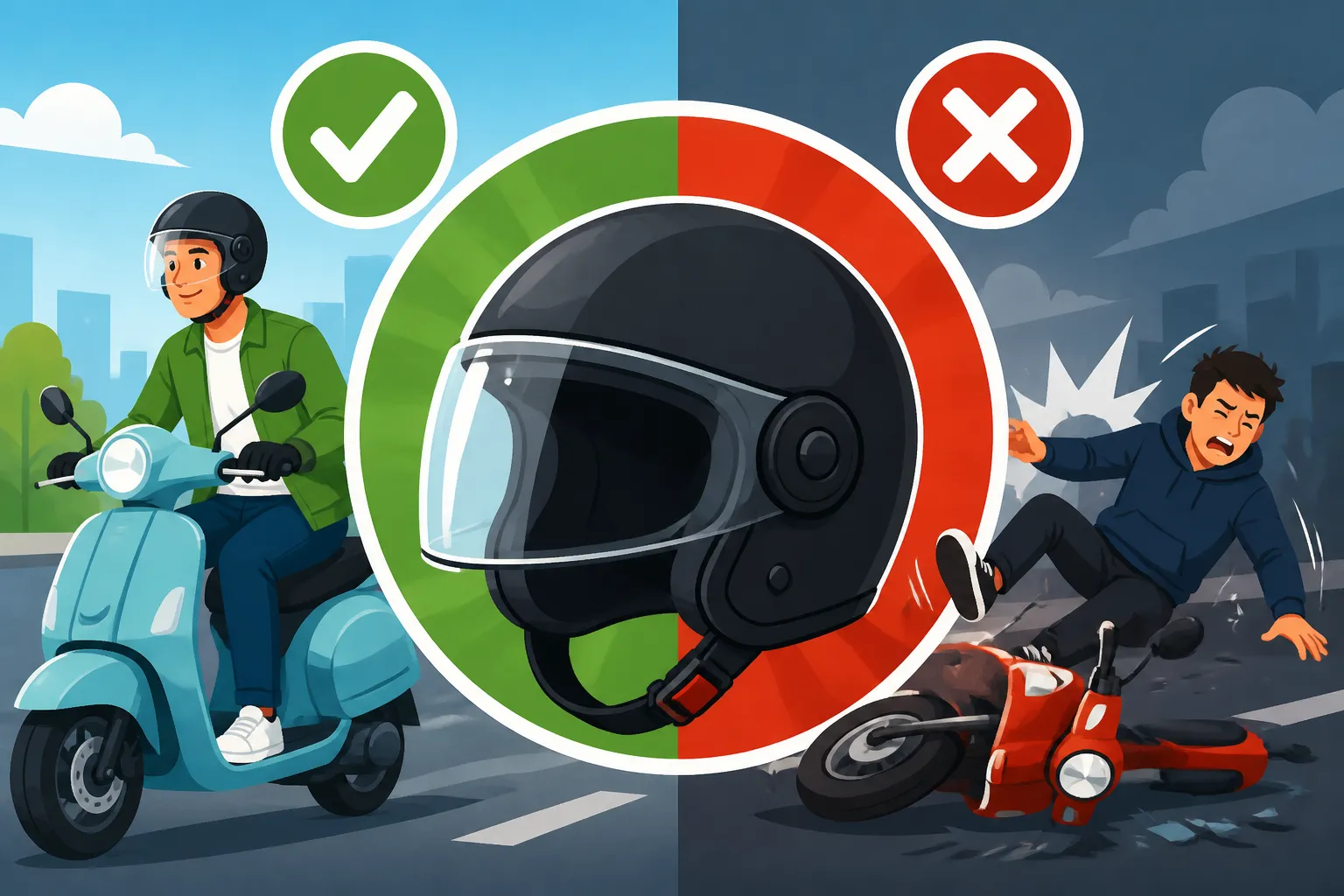
Novelty helmets, on the other hand, offer little to no real protection. They might look cool, or match your scooter's aesthetic perfectly, but they are essentially decorative headwear. They do not meet DOT safety standards and will often carry a sticker explicitly stating they are not DOT-approved. While wearing a novelty helmet might feel like you're complying with a helmet law, legally and practically, you often aren't. In the eyes of the law and insurance adjusters, wearing a novelty helmet is often treated the same as wearing no helmet at all, which can be devastating for your well-being and your claim if you suffer a head injury. So, even if your state has lax laws, always choose a DOT-compliant helmet for genuine protection.
How Helmet Use Impacts Your Claim After an Accident
This is where rubber meets the road, or rather, where your choices impact your wallet and recovery. If you're involved in a motorcycle accident and suffered injuries, whether or not you were wearing a helmet, and specifically a DOT-compliant helmet, can significantly impact your personal injury claim. Insurance companies and defense attorneys will aggressively employ what's known as the "helmet defense" to try and reduce their liability.
The core of the helmet defense argument is that if you weren't wearing a legally required and DOT-compliant helmet, you contributed to your own head injuries, or at least exacerbated them. This is a common tactic to argue How Comparative Negligence Reduces Your Payout. Even if the other driver was clearly at fault for the collision, they will contend that your injuries would have been less severe had you been properly geared up. For example, if you weren't wearing a helmet in a state with a universal helmet law and sustained a traumatic brain injury, the defense might argue that a significant portion of your medical bills and pain and suffering could have been avoided. They might even cite How Not Wearing a Helmet Affects Your Settlement and push for a drastically reduced settlement.
This doesn't mean you automatically lose your claim if you weren't wearing a helmet. The defense usually has the burden of proof to demonstrate a direct causal link between your non-helmet use and the specific head injuries sustained. They'd need expert testimony, often from accident reconstructionists or medical professionals, to make this case. However, fighting this argument adds complexity, time, and stress to your claim. It emphasizes why investing in Motorcycle Safety Gear and Legal Protection from a trusted source like Cycle Gear is not just about physical safety, but also about protecting your legal and financial future. Choosing the right helmet, and always wearing it, is one of the simplest yet most effective ways to strengthen your position should the unthinkable happen.
Disclaimer
Please remember that this article provides general information and insights into motorcycle, moped, and scooter helmet laws and their potential impact on accident claims. Laws are constantly changing and vary significantly by jurisdiction. This content is not a substitute for professional legal advice. For personalized guidance regarding your specific situation, vehicle type, and location, it is essential to consult with a qualified legal professional.