How Comparative Negligence Affects Settlements in New York
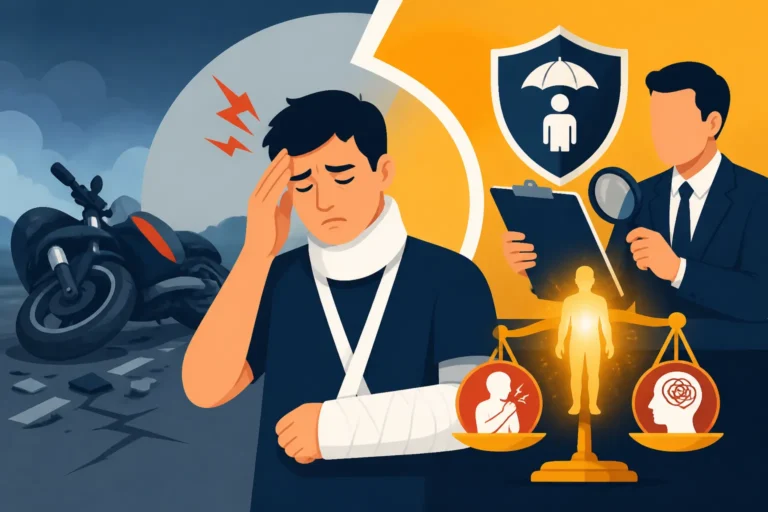
Being involved in a motorcycle accident is an incredibly traumatic experience, often leaving you with severe injuries, mounting medical bills, and a wrecked bike. Just when you're trying to heal and figure out how to put your life back together, you might hear confusing legal terms like "comparative negligence" that can make you wonder if you'll ever get a fair shake, especially if you think you might have been partly at fault. This guide is here to cut through the legal jargon and explain exactly how comparative negligence affects motorcycle accident settlements in New York, helping you understand your rights and what to expect.
Understanding New York's Pure Comparative Negligence Rule
The concept of fault in a motorcycle accident claim can be incredibly complex, and it’s one of the first things insurance companies and legal teams focus on. When a crash happens, it's rare that only one party is 100% responsible. Often, both the motorcyclist and the other driver might share some degree of blame. This is where comparative negligence comes into play, and New York has a specific system that every rider needs to understand.
What Pure Comparative Negligence Really Means
In the simplest terms, pure comparative negligence means that even if you were partially at fault for a motorcycle accident in New York, you can still recover damages from the other responsible parties. The "pure" aspect is crucial because it means there's no arbitrary cutoff point for fault. Your compensation will simply be reduced by the percentage of fault assigned to you. For instance, if a jury determines your total damages are $100,000, but you were found to be 30% at fault for the crash, your recoverable damages would be reduced by $30,000, leaving you with a $70,000 settlement.
This system is designed to allow injured parties to seek justice and compensation even when they bear some responsibility, acknowledging that accidents are rarely black and white. It’s a significant departure from older legal doctrines like "contributory negligence," which would completely bar you from recovering any damages if you were found even 1% at fault. Imagine being seriously injured and losing everything because a tiny misjudgment on your part meant you got nothing – that’s the harsh reality of contributory negligence that New York wisely moved away from. This system ensures that the financial burden of an accident doesn't fall entirely on the injured party just because they shared a small percentage of fault.
How New York's Rule Differs from Other States
It’s easy to get confused by different state laws, especially if you’ve ridden in or heard about accidents in other parts of the country. Many states operate under what's called "modified comparative negligence." These states typically have a threshold, often 50% or 51%. This means if you are found to be 50% or 51% or more at fault (depending on the specific state law), you are completely barred from recovering any damages. For example, in a state with a 51% bar, if you're deemed 51% at fault, you get nothing. If you're 50% at fault, you can still recover a reduced amount. This can be a huge hurdle for motorcyclists who often face unfair bias in fault determination.
New York's pure comparative negligence system is far more forgiving for accident victims. There's no such threshold. You could theoretically be found 99% at fault, and you would still be able to recover 1% of your total damages. While that might not sound like much, it's still a stark contrast to states where a high percentage of fault means absolutely no compensation. This system is designed to provide a fairer avenue for recovery, especially given the common perception and inherent vulnerability of motorcyclists on the road. Understanding this difference is critical, as it directly impacts your potential settlement value and the negotiation strategies employed by insurance companies and legal teams. When you’re dealing with the aftermath of a motorcycle accident, it's vital to know your state's specific laws, and New York's approach offers a crucial layer of protection.
How Fault is Determined and Assigned in New York Motorcycle Accidents
After a motorcycle accident, one of the most contentious aspects is often the determination and assignment of fault. This isn't a simple process; it involves a detailed investigation by various parties, each looking at the evidence from their own perspective. The outcome of this investigation directly impacts your ability to recover compensation under New York’s comparative negligence laws.
The Investigation Process and Evidence Gathering
Determining who is at fault in a motorcycle accident in New York is a meticulous process that begins immediately after the crash. First responders, particularly the police, will arrive on the scene to secure the area, attend to injuries, and conduct their initial investigation. They'll often create a police report, which can be a critical piece of evidence, detailing their observations, witness statements, and sometimes even their preliminary assessment of fault. However, it's important to remember that a police report isn't always the final word on liability; it's a snapshot, and sometimes it can even be inaccurate. For instance, if you're dealing with a complex scenario like a left-turn motorcycle accident, the police might not capture every nuance that an expert later would.
Beyond the initial police involvement, insurance adjusters for all parties will launch their own investigations. They'll review the police report, talk to their insured, and potentially contact witnesses. Crucial evidence that is typically gathered includes photographs and videos from the scene, statements from eyewitnesses, any available dashcam or surveillance footage, and even cell phone records if distracted driving is suspected. Accident reconstruction experts might be brought in for serious crashes to meticulously analyze skid marks, vehicle damage, debris fields, and other physical evidence to recreate the sequence of events. Medical records and bills are also essential, not just to prove injuries, but sometimes to corroborate the mechanism of injury, which can indirectly support fault arguments. Every piece of evidence, no matter how small, contributes to building a comprehensive picture of what happened, allowing a clear understanding of how fault is determined in motorcycle accidents.
The Role of Insurance Companies in Fault Allocation
This is where things can get truly frustrating for motorcyclists. Insurance companies, even those from reputable carriers like State Farm or Allstate, often approach motorcycle accident claims with an inherent bias. There's a persistent stereotype that motorcyclists are inherently reckless, and insurers frequently attempt to assign as much fault as possible to the rider, regardless of the actual circumstances. Their goal, quite simply, is to minimize their payout. They might scrutinize your riding habits, your speed, or even suggest you were in a "blind spot," arguing that you contributed significantly to the crash. This tactic is a key part of how insurance companies assign blame to riders.
You might hear arguments like, "The driver didn't see the motorcycle," which is a common defense in car-motorcycle collisions. While this phrase is frequently used, it doesn't automatically mean the motorcyclist is at fault; often, it points to the driver's inattention. Insurers will look for any perceived misstep on your part – perhaps you were slightly exceeding the speed limit, or they might try to argue you changed lanes unsafely, even if the primary cause was the other driver's negligence. This immediate attempt to shift blame is why it's so vital to be prepared and understand rider bias in fault determination. They are masters at finding loopholes or exaggerating minor contributions to reduce their financial responsibility. Without a strong counter-argument and solid evidence, you can quickly find your rightful compensation significantly diminished, even under New York's favorable pure comparative negligence system.
Practical Impact on Your Motorcycle Accident Settlement in New York
New York's pure comparative negligence rule, while generally favorable to accident victims, still has a very real and tangible impact on the amount of compensation you might receive. Understanding how this calculation works and what factors influence it is crucial for anyone navigating a motorcycle accident claim in the Empire State.
Calculating Your Reduced Settlement Amount
Let's get down to brass tacks: how does New York's comparative negligence rule actually affect the money in your pocket? The principle is straightforward: your total damages are calculated, and then that amount is reduced by your assigned percentage of fault. This reduction applies to all categories of damages – your medical bills, lost wages, pain and suffering, and even property damage.
Imagine you've been in a severe motorcycle accident in Queens, resulting in significant injuries and expenses. After reviewing all your medical bills, lost income, pain and suffering, and property damage to your bike, your total recoverable damages are assessed at $200,000. During the investigation or negotiation process, it's determined that you were, say, 25% at fault for the accident – perhaps you were slightly exceeding the speed limit, or you made a judgment call that contributed to the incident. Under New York's pure comparative negligence rule, your $200,000 in damages would be reduced by 25%. This means you would be eligible to recover $150,000 (75% of $200,000). The same logic applies if you were found 50% at fault; your settlement would be halved, resulting in $100,000. Even if you were 75% at fault, you could still recover $50,000. This system directly influences how comparative negligence reduces your payout.
Here's a quick table to illustrate how fault percentage impacts a hypothetical $100,000 in total damages:
| Rider's Percentage of Fault | Driver's Percentage of Fault | Total Damages | Reduced Settlement Amount |
|---|---|---|---|
| 0% | 100% | $100,000 | $100,000 |
| 10% | 90% | $100,000 | $90,000 |
| 25% | 75% | $100,000 | $75,000 |
| 50% | 50% | $100,000 | $50,000 |
| 75% | 25% | $100,000 | $25,000 |
| 90% | 10% | $100,000 | $10,000 |
This table clearly shows that every percentage point of fault assigned to you directly diminishes your potential recovery. This is why disputing fault, even minor percentages, is a critical component of any motorcycle accident claim in New York.
Negotiating with Shared Fault in Mind
The presence of shared fault profoundly impacts the negotiation process with insurance companies. Once an insurer believes there's a plausible argument for assigning some degree of fault to you, they will use it aggressively to push for a lower settlement offer. They'll often start with a very lowball offer, highlighting your alleged contribution to the accident as justification. They might present evidence, such as a skewed police report or a witness statement, to bolster their claims of your fault. This is where the importance of a skilled legal advocate really shines, as they can counter these arguments with strong evidence and legal precedent.
It's absolutely crucial that you never admit fault at the scene of an accident or in any conversation with an insurance adjuster. Any statement you make can and will be used against you to increase your assigned fault percentage. Instead, stick to the facts and let your legal team handle the nuanced discussions. Your attorney's job will be to minimize your assigned fault, or ideally, disprove it entirely, by presenting compelling evidence and arguments that the other party was primarily, if not solely, responsible. For instance, if the other driver made an unsafe lane change, your lawyer would focus on demonstrating that their action was the direct cause, not any perceived minor infraction on your part. This often involves detailed investigations into who is at fault in an unsafe lane changes motorcycle accident and gathering concrete evidence. They understand how to push back against insurance companies and ensure you receive the maximum possible compensation, even when shared fault in motorcycle accidents is a factor.
The "Helmet Defense" and Other Factors
Beyond the direct actions that lead to a collision, other factors can influence fault assignment and settlement amounts in New York, particularly the "helmet defense." New York has a universal helmet law, meaning all motorcyclists and their passengers must wear DOT-approved helmets. If you are involved in an accident and were not wearing a helmet, or if your helmet wasn't DOT-compliant, the other side's insurance company may raise the "helmet defense." This defense argues that your head injuries would have been less severe had you been wearing a proper helmet, and therefore, they shouldn't be fully liable for the extent of those specific injuries. It doesn't mean you were at fault for the accident itself, but it can reduce the compensation specifically for your head injuries. This directly affects how helmet laws affect your accident claim.
Furthermore, other factors, such as your riding endorsements and adherence to traffic laws, can also influence fault. If you were riding without a valid motorcycle endorsement, or if you had any traffic violations associated with the accident (like speeding or an expired registration), the defense might try to use these against you. While these issues might not directly cause the accident, insurers will argue they show a general disregard for safety or legality, attempting to paint you in a negative light and imply a higher degree of fault. This is why adhering to all motorcycle helmet laws by state and traffic regulations is not just about safety, but also about protecting your potential claim. Even seemingly minor infractions can provide fodder for the defense to reduce your settlement under New York's comparative negligence framework.
Strategies for Protecting Your Claim Under New York's Law
When you've been in a motorcycle accident, especially in a state like New York with pure comparative negligence, taking the right steps from the very beginning can significantly impact your ability to recover fair compensation. You need to be proactive and strategic to protect your interests.
Gathering Strong Evidence at the Scene
The moments immediately following a motorcycle accident are chaotic and often painful, but what you do (or don't do) during this critical time can make or break your claim. The primary goal is to gather as much evidence as possible to establish what happened and, more importantly, to clearly demonstrate the other party's fault and minimize any potential fault assigned to you. First and foremost, if you are able, document the scene thoroughly. Take numerous photos and videos from different angles: of your motorcycle, the other vehicle(s), road conditions, traffic signs, skid marks, and any debris. Capture the surrounding environment, weather conditions, and visible injuries. This meticulous documentation is essential for how to document the scene to prove fault.
Beyond visuals, always exchange insurance and contact information with all involved parties. If there are any witnesses, politely ask for their contact details; their unbiased accounts can be invaluable, especially when insurers try to assign you greater fault. And no matter how you feel, always seek immediate medical attention. Even if you think your injuries are minor, some symptoms, like those for a concussion or internal injuries, can be delayed. Gaps in medical treatment can be used by insurance companies to argue that your injuries weren't serious or weren't caused by the accident. Every piece of evidence you gather, from the precise location of the vehicles to the testimony of an impartial bystander, strengthens your position and helps counter any attempts to shift blame, proving crucial when it comes to proving fault in a motorcycle accident.
The Value of Legal Representation
Navigating a motorcycle accident claim in New York, particularly with the complexities of comparative negligence and often aggressive insurance companies, is not something you should attempt on your own. This is precisely where a knowledgeable New York motorcycle accident lawyer becomes your most powerful asset. An experienced attorney understands the nuances of New York's specific laws and how to effectively combat the inherent biases against motorcyclists. They will thoroughly investigate your accident, working to gather additional evidence, such as accident reconstruction reports, expert witness testimony, and traffic camera footage, that you might not even know exists or how to obtain.
Your lawyer will meticulously compile all your damages, including not just your current medical bills and lost wages, but also future medical expenses, lost earning capacity, and the significant pain and suffering you’ve endured. They know how to accurately calculate these values to ensure you are pursuing maximum compensation. Most importantly, they will handle all communications and negotiations with the insurance companies on your behalf. They are skilled at countering lowball offers and aggressively challenging any attempts to assign undue fault to you. Having a dedicated advocate fighting for your rights ensures that you are not taken advantage of and significantly increases your chances of securing a fair settlement, even when a rider is partially at fault. If you're wondering do you need a motorcycle accident lawyer, the answer is almost always yes, especially in complex cases where shared fault is a factor. A specialized motorcycle accident lawyer understands the legal landscape in New York and knows how a lawyer increases your settlement by protecting your interests every step of the way.
Disclaimer
Please remember that this article provides general information and is not a substitute for professional legal advice. Every motorcycle accident claim is unique, and the information presented here may not apply to your specific situation. If you have been involved in a motorcycle accident in New York, you should consult with a qualified attorney to discuss your individual case and legal options.