How Comparative Negligence Affects Settlements in North Carolina
Riding a motorcycle in North Carolina offers some of the most breathtaking scenic routes, from the Blue Ridge Parkway to the coastal highways. However, the open road also comes with unique risks, and when an accident happens, the aftermath can be incredibly stressful and confusing. One of the most significant challenges riders face when trying to recover after a crash, especially here in North Carolina, is the state's incredibly strict fault laws, known as contributory negligence. It’s a rule that can quickly turn your world upside down, potentially leaving you with devastating injuries and no compensation if you're found even slightly to blame. This guide will walk you through exactly how North Carolina's stringent negligence rules impact motorcycle accident settlements and what you can do to protect your rights.
Understanding North Carolina's Contributory Negligence Rule
Many people assume that if another driver caused their motorcycle accident, they'll be able to recover damages for their injuries and losses. While that's often true in most states, North Carolina operates under a far more unforgiving system known as contributory negligence. This isn't just a minor difference; it's a fundamental aspect that can completely derail your claim, making it vital to understand from the outset.
The Harsh Reality of "All or Nothing" Fault
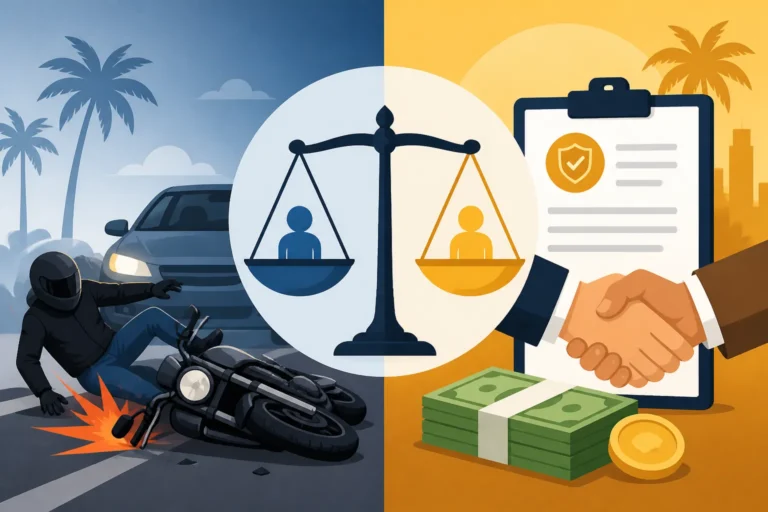
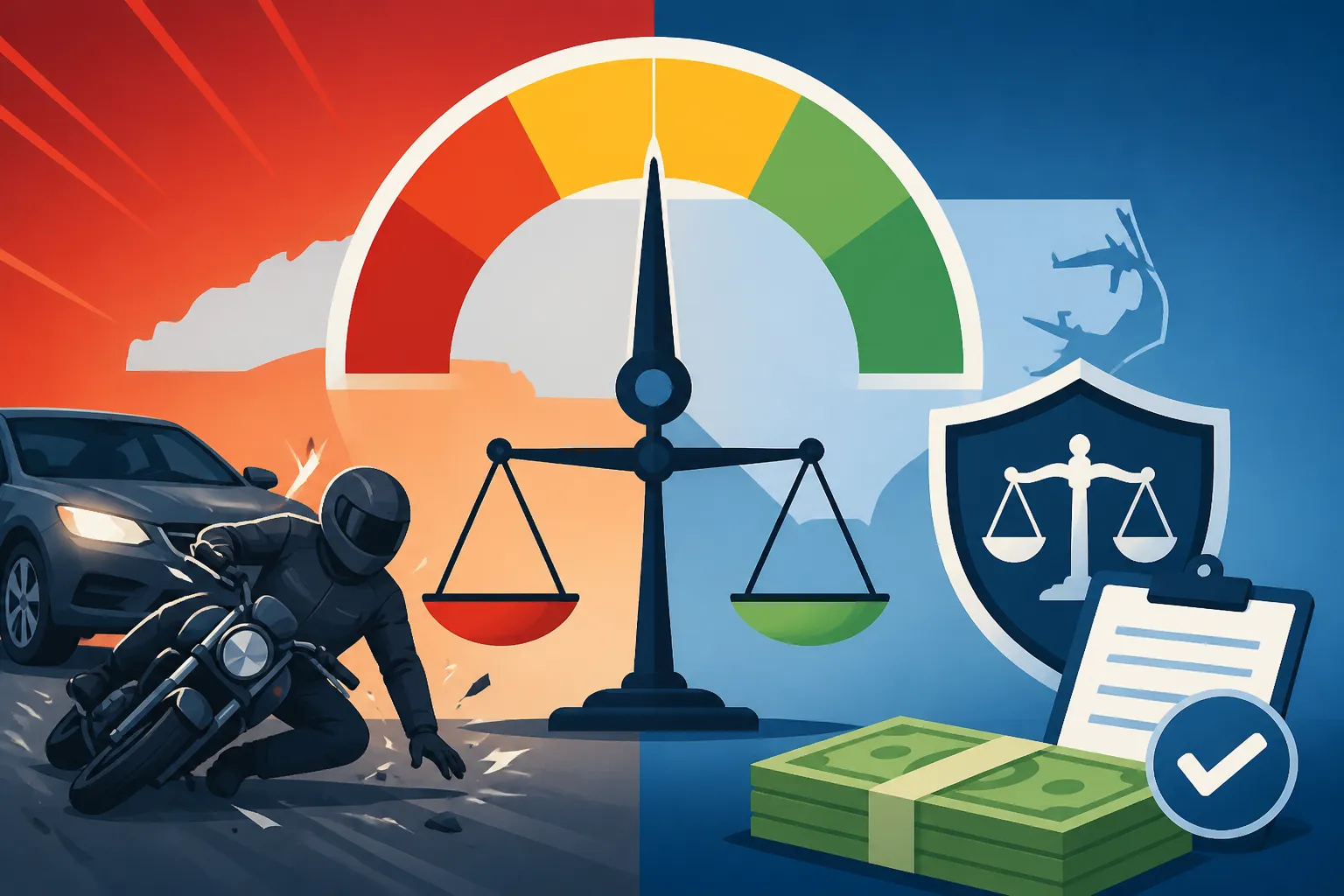
In a nutshell, North Carolina's contributory negligence rule means that if you, the injured party, are found to be even one percent at fault for the accident, you are legally barred from recovering any damages from the other driver. Think about that for a moment: if a car driver undeniably blew through a stop sign and hit you, but an insurance adjuster or jury somehow determines you were distracted for a split second, or perhaps going just a mile or two over the speed limit, your entire claim could be wiped out. This is a stark contrast to most other states, which employ some form of comparative negligence.
To give you some perspective, imagine you're cruising down a road near Asheville, enjoying the scenery, when a driver suddenly makes a left turn directly in front of you. You might swerve, try to brake, but still collide. If it's later determined that you were maybe 5% responsible for not reacting quite fast enough, or for an imperceptible error, under contributory negligence, the at-fault driver's insurance company owes you absolutely nothing. This "all or nothing" approach places an immense burden on the injured motorcyclist, who often suffers far more severe injuries in a collision. It completely ignores the idea of shared blame where both parties contribute to an accident, which is a common occurrence on our busy roads. For a deeper dive into the nuances of shared fault, you might want to read our article on Shared Fault in Motorcycle Accidents.
How Insurance Companies Exploit This Rule
Given the severe implications of contributory negligence, it's no surprise that insurance companies in North Carolina are incredibly aggressive in trying to assign any percentage of fault to the motorcyclist. For them, it's the ultimate defense. If they can stick even a tiny bit of blame on you, they don't have to pay out anything. This means they will scrutinize every detail of the accident, looking for any possible way to shift responsibility.
You can expect adjusters to investigate:
- Your speed: Even if it was slightly over the limit, or perceived to be.
- Your lane position: Was it perfect? Could you have been more visible?
- Your awareness: Were you looking straight ahead? Did you react immediately?
- Your gear: Were you wearing appropriate protective gear? (More on the "helmet defense" later.)
- Your vehicle's condition: Were your brakes, tires, or lights in perfect working order?
They'll often try to paint a picture where, despite the other driver's clear negligence, your actions somehow contributed to the crash. This isn't about fairness; it's about minimizing their financial exposure. They understand that most people aren't familiar with the strictness of North Carolina's laws, and they will use that lack of knowledge to their advantage. They know that if they can prove you were even marginally negligent, their obligation to pay is completely eliminated. For further information on how insurance companies approach these situations, consider reviewing How Insurance Companies Assign Blame to Riders.
How "The Helmet Defense" and Other Factors Can Impact Your Claim
Beyond general riding behaviors, specific aspects of how you ride and what gear you wear can become critical battlegrounds for insurance companies in North Carolina, especially when they're trying to leverage the contributory negligence rule. These factors are often bundled together under what's colloquially known as "the helmet defense" or other claims of rider negligence.
The Helmet Defense: A Specific North Carolina Challenge
North Carolina has a universal helmet law, meaning all motorcyclists and their passengers must wear a helmet. This is a common-sense safety measure that significantly reduces the risk of serious head injuries. However, in the context of an accident claim, an insurance company might try to use your helmet use—or lack thereof—against you.
If you were not wearing a DOT-compliant helmet, the other side will almost certainly argue that this contributed to your injuries. Even if your injuries were to a leg or arm, they might try to claim that your non-compliance demonstrates a general disregard for safety, inferring a level of negligence that could bar your claim entirely under contributory negligence. They might even try to argue that if you had worn a helmet, you wouldn't have sustained any injuries, or that they would have been less severe. While this might seem illogical for non-head injuries, the goal is to establish any degree of fault on your part. To learn more about how this specific defense operates, check out The Helmet Defense Explained.
Even if you were wearing a helmet, they might scrutinize its type, fit, or condition to try and find fault. They're looking for any crack in your armor, so to speak, to shift blame. This is why properly documented Motorcycle Accident Evidence for Proving Fault, including photos of your helmet and gear, can be absolutely crucial.
Other Rider Behaviors Insurance Adjusters Scrutinize
Beyond helmet use, insurance adjusters are trained to look for any riding behavior or circumstance that they can twist into a claim of contributory negligence. They are experts at finding even the most minor details to build a case against you.
Here's a table outlining common areas of scrutiny:
| Rider Behavior/Factor | How Insurers Might Use It Against You |
|---|---|
| Speeding | Even slightly over the limit, or "too fast for conditions," could be blamed. |
| Improper Lane Position | Not riding defensively or being in a blind spot could be cited. |
| Lane Splitting | While legal in some states (like California), it's generally not in NC and can be considered negligent. |
| Improper Lookout | Not seeing the other vehicle soon enough, implying distraction or inattention. |
| Lack of Endorsement | Riding without a proper motorcycle endorsement could imply lack of training. |
| Faulty Equipment | Issues with brakes, tires, or lights could be claimed as contributing factors. |
| Alcohol/Drug Impairment | Any trace could lead to immediate fault assignment. |
For example, if you were riding your Harley-Davidson in a group and briefly separated, an adjuster might argue you weren't maintaining a proper distance. Or if you were on your Indian Motorcycle and momentarily looked at your mirrors, they could claim you weren't paying full attention to the road ahead. These subtle arguments are designed to reach that crucial 1% fault threshold. Understanding Common Causes of Motorcycle Accidents often means understanding how those causes can be twisted to point back at the rider.
This is why, after any accident, it's so important to be extremely careful about what you say and to whom. Insurance adjusters are not on your side, and anything you say can and will be used to attempt to prove contributory negligence.
Exceptions and Arguments Against Contributory Negligence
While North Carolina's contributory negligence rule is undeniably harsh, it's not always an absolute death sentence for a motorcycle accident claim. There are a couple of key exceptions and legal arguments that can sometimes allow an injured rider to recover damages, even if they had some minor role in the accident. These exceptions are complex and require sophisticated legal understanding to apply effectively.
Last Clear Chance Doctrine
The "last clear chance" doctrine is a crucial, albeit narrow, exception to contributory negligence in North Carolina. This rule states that even if the plaintiff (the injured motorcyclist) was negligent, they may still recover damages if the defendant (the at-fault driver) had the "last clear chance" to avoid the accident but failed to do so. Essentially, it means that if the other driver could have prevented the collision despite your own negligence, they might still be held fully responsible.
Let's imagine a scenario on a highway near Charlotte: You're riding and, perhaps due to a momentary lapse in judgment, drift slightly into the shoulder. A truck driver behind you sees your error and has ample time and space to slow down or change lanes to avoid hitting you. Instead, the truck driver continues without taking evasive action and crashes into you. In this situation, even if your initial drift was negligent, the truck driver had the "last clear chance" to prevent the collision. Proving this doctrine, however, is incredibly challenging. It requires demonstrating that the other driver knew or should have known of your peril and had a reasonable opportunity to avoid the crash, but consciously or carelessly failed to do so. This is a very fact-specific argument, often requiring expert testimony and detailed accident reconstruction.
Reckless or Intentional Conduct by the Other Driver
Another situation where the strict contributory negligence rule might be circumvented is if the other driver's conduct was particularly egregious. If the at-fault driver was acting with gross negligence, recklessness, or even intentionally caused the accident, the defense of contributory negligence can sometimes be overcome.
Consider a case where the other driver was severely intoxicated and driving erratically, clearly demonstrating a reckless disregard for the safety of others on the road. Or perhaps it was a road rage incident where a driver intentionally swerved into your lane. In such circumstances, a court might find that the defendant's extreme level of fault overrides any minor contributory negligence on your part. How Drunk Driving Affects a Motorcycle Claim is a great resource if you suspect the other driver was impaired, as their intoxication can significantly alter how fault is viewed. However, even in these extreme cases, the burden of proof remains high, and simply asserting recklessness isn't enough; it must be thoroughly proven with compelling evidence.
The Importance of Proving the Other Driver's Sole Fault
Ultimately, when dealing with North Carolina's contributory negligence laws, your strongest strategy is to unequivocally prove that the other driver was 100% at fault for the accident and that you were entirely free of any blame. This is a high bar, but it is the most direct path to a successful settlement.
This requires meticulous attention to detail in gathering evidence right from the start. This includes:
- Detailed photographs and videos: Capture the scene from multiple angles, vehicle damage, road conditions, traffic signs, and any visible injuries. A dashcam or helmet camera footage (How Dashcam Footage Proves Fault) can be invaluable.
- Witness statements: Independent witnesses can provide objective accounts, which are crucial. Refer to How Witnesses Affect Motorcycle Fault.
- Police reports: While not always definitive, a well-documented police report can be a strong piece of evidence for How Police Reports Establish Fault.
- Medical records: Thorough documentation of all your injuries and treatments.
- Accident reconstruction: In complex cases, an expert might be needed to recreate the accident to demonstrate the other driver's fault.
Your entire case will hinge on building an ironclad argument that removes even a sliver of blame from your shoulders. This often means anticipating and proactively countering every potential argument the insurance company might make about your actions. Understanding Who Is at Fault in a Motorcycle Accident and How Fault Is Determined in Motorcycle Accidents are crucial concepts here.
Steps to Protect Your Claim After an Accident in North Carolina
After the adrenaline fades and the initial shock wears off, the steps you take in the immediate aftermath of a motorcycle accident in North Carolina can profoundly impact your ability to recover compensation. Given the state's strict contributory negligence laws, every action you take (or don't take) is critical. Protecting your claim starts at the scene and continues through your recovery and legal process.
Immediate Actions at the Scene
What you do right after a crash isn't just about safety; it's about preserving crucial evidence that could mean the difference between getting a settlement and walking away with nothing in North Carolina.
- Prioritize Safety and Call 911: First and foremost, check for injuries. If you or anyone else is hurt, get immediate medical attention. Always call 911, even if you think the accident is minor. A police report is vital evidence, and What to Say to Police After a Motorcycle Accident can help guide your interaction. Officers will document the scene, gather witness information, and often issue citations, all of which can be powerful tools for your claim.
- Document Everything: If you are physically able, take out your phone and start taking photos and videos. Get wide shots of the entire accident scene, showing vehicle positions, road conditions (gravel, potholes, weather), traffic signs, and any skid marks. Then, get close-up photos of vehicle damage, your injuries, and any debris. Capture the other driver's license plate, driver's license, insurance card, and vehicle registration. This visual evidence is critical for How to Document the Scene to Prove Fault and helps counter any "he said, she said" arguments from the other side.
- Gather Witness Information: Eyewitnesses can provide unbiased accounts that are invaluable when proving fault. Ask for their names and contact information. Their testimony can be a powerful counter to an insurance company trying to pin blame on you.
- Do NOT Admit Fault: This is perhaps the most crucial piece of advice in a contributory negligence state. Even a casual apology like "I'm so sorry, I didn't see you" can be twisted by insurance companies into an admission of fault, completely tanking your claim. Simply state the facts of what happened without accepting blame or speculating. Our guide, Why You Should Never Admit Fault at the Scene, elaborates on this vital point. Exchange information politely but keep conversations about the accident's specifics to a minimum.
Seeking Medical Attention and Legal Counsel
Once the immediate chaos of the accident scene subsides, your focus needs to shift to your health and your legal protection. These two aspects are deeply intertwined, especially in North Carolina.
- Seek Immediate Medical Evaluation: Even if you feel fine, or only have minor aches, see a doctor right away. Many serious injuries, like concussions, internal bleeding, or soft tissue damage, have delayed symptoms. A gap in medical treatment can be used by the insurance company to argue that your injuries weren't caused by the accident or aren't as severe as you claim. Thorough medical records are the backbone of any personal injury claim and demonstrate the severity and causation of your injuries.
- Consult with a North Carolina Motorcycle Accident Lawyer Immediately: This cannot be stressed enough. In a contributory negligence state like North Carolina, going up against an insurance company on your own is like entering a boxing match with one hand tied behind your back. You need an advocate who understands the intricacies of North Carolina law and has experience fighting these particular battles. A lawyer can:
- Investigate the accident thoroughly: They'll gather evidence, interview witnesses, and potentially hire experts to reconstruct the crash.
- Identify and counter contributory negligence arguments: They know the tactics insurance companies use and how to build a case that proves the other driver's sole fault or applies exceptions like the "last clear chance" doctrine.
- Handle all communication: Your lawyer can communicate with insurance adjusters, preventing you from inadvertently saying something that could harm your claim.
- Negotiate a settlement: They understand How Motorcycle Accident Settlements Are Calculated and Average Motorcycle Accident Settlement Amounts, and will fight to maximize your compensation for medical bills, lost wages, pain, and suffering.
- Represent you in court: If a fair settlement can't be reached, they'll be prepared to take your case to trial.
Trying to navigate the complex legal landscape of a motorcycle accident claim in North Carolina, especially with its strict fault rules, without legal representation is a huge risk. The stakes are simply too high. Learning What to Do After a Motorcycle Accident typically begins with contacting an attorney who specializes in these unique cases. Our article Do You Need a Motorcycle Accident Lawyer provides a comprehensive overview of why legal representation is essential.
Disclaimer
Please remember that this information is intended for educational purposes only and does not constitute legal advice. Motorcycle accident laws, especially concerning negligence, are highly complex and vary by jurisdiction. You should always consult with a qualified legal professional in North Carolina for advice tailored to your specific situation.