How to Prove Fault in a Road Hazards Crash
Riding a motorcycle offers unparalleled freedom, but it also exposes us to dangers that car drivers rarely even notice. Hitting an unexpected pothole, an oil slick, or scattered debris can turn a beautiful ride into a terrifying crash in an instant, often leaving us injured and wondering how we'll ever prove it wasn't our fault. This guide is here to walk you through the essential steps and strategies for proving fault in a motorcycle accident caused by dangerous road conditions, helping you navigate the complex world of liability.
The Unique Dangers of Road Hazards for Motorcyclists
It’s an unfortunate reality that what might be a minor bump for a car can be a life-altering event for someone on two wheels. Road hazards are not just inconvenient; they are profoundly dangerous for motorcyclists. Understanding why they pose such a specific threat is the first step in building a strong case if you’ve been injured.
Why Road Hazards are Different for Bikes
When you're riding, you don't have the same four points of contact, the stability, or the protective cage of a car. A small divot in the pavement that a truck rolls over without a second thought can destabilize a motorcycle instantly. Gravel scattered across a curve, a common occurrence on rural roads or construction bypasses, can cause a sudden loss of traction, leading to a slide or a high-side crash. The frustration is real: you're riding safely, minding your own business, and then boom—the road itself becomes the enemy.
The minimal footprint of a motorcycle tire means concentrated pressure on a small area. This makes us incredibly sensitive to changes in road surface, from subtle elevation shifts to slick spots. We have less time to react, less opportunity to absorb impacts, and zero external protection. When we hit something unforeseen, the consequences are often catastrophic, leading to severe injuries that are far beyond what a car driver would experience in a similar incident. That's why understanding how to prove fault in a road hazards crash is so critical; you shouldn't bear the burden of someone else's negligence.
Common Types of Road Hazards Leading to Crashes
Road hazards come in many forms, each presenting its own unique challenge and potential for disaster. It's not just about the obvious, massive potholes; sometimes, it's the subtle, overlooked issues that cause the most damage.
- Potholes and Uneven Pavement: These are perhaps the most universally recognized road hazards. A deep pothole can bend rims, blow tires, and throw a rider from their seat, causing them to lose control. Uneven pavement, where one lane is significantly higher or lower than another, or where maintenance patches have created sudden drops or rises, can also lead to instability, especially when changing lanes or navigating turns. These are frequent culprits in Motorcycle Accidents Caused by Road Hazards.
- Gravel, Sand, and Debris: Often found on shoulders, in turns, or after bad weather, loose gravel or sand can completely eliminate tire grip, particularly during braking or cornering. Construction debris, fallen tree branches, spilled cargo from other vehicles, or even trash can become projectiles or obstacles that force evasive maneuvers, which can be just as dangerous as hitting the object itself.
- Oil Slicks and Spills: A shiny patch on the road might look like water, but if it’s oil or antifreeze, it's like riding on ice. These slick spots, often unseen until it's too late, can cause immediate loss of traction, especially if encountered mid-turn or while braking.
- Poorly Designed or Maintained Construction Zones: Construction areas are notorious for changing road conditions, often with little warning. Uneven steel plates, missing manhole covers, poorly marked lane shifts, or freshly milled surfaces without proper signage can all contribute to dangerous situations for motorcyclists. Cities and contractors have a responsibility to keep these areas safe, and when they don't, it can lead to devastating consequences.
- Missing or Damaged Road Signs and Markings: While not a physical hazard on the road surface, missing or obscured signs (like a stop sign hidden by overgrown trees) or faded lane markings can lead to confusion and accidents, effectively making the road itself unsafe due to a lack of proper guidance.
Each of these scenarios highlights the importance of detailed documentation if you've been involved in a crash. Knowing what to look for can significantly impact your ability to prove Who Is at Fault in a Road Hazards Motorcycle Accident.
Identifying Who Is Responsible for Road Hazards
The question of who is actually responsible for maintaining the roads can feel like a bureaucratic maze, especially when you're dealing with injuries and property damage. But pinpointing the negligent party is absolutely essential for building your claim. It's not always as simple as "the city."
Government Entities and Their Duties
Most roads are under the jurisdiction of a government entity, whether it’s a local municipality, a county, or a state transportation department. Each has a specific duty to maintain safe roadways.
- City and County Governments: Your local city or county is usually responsible for the maintenance of local streets, residential roads, and some arterial routes. This includes everything from filling potholes on Main Street to clearing storm debris on a county road. If you crashed due to a hazard on a city street in, say, Phoenix, Arizona, the City of Phoenix might be the responsible party. These claims often require very specific notice requirements and shorter filing deadlines, so it's crucial to act quickly. For a deeper dive, check out Suing a City for a Dangerous Road.
- State Departments of Transportation (DOTs): Larger highways, interstates, and major state routes typically fall under the purview of the state's Department of Transportation. For example, if your accident happened on I-10 in California, the California Department of Transportation (Caltrans) would likely be the entity responsible for that stretch of road. Their responsibilities include major resurfacing projects, bridge maintenance, and ensuring clear signage.
- Federal Government: While less common for direct liability in individual road hazard cases, federal agencies might have oversight on certain interstate projects or federal lands. However, most claims will be directed at state or local levels.
The key to holding a government entity accountable is proving they had "notice" of the hazard—meaning they either knew about it and failed to act, or they should have known about it through reasonable inspection. This is often the trickiest part of these cases, as government agencies frequently deny knowledge of specific issues. This is why thorough documentation, as discussed in How Road Defects Cause Motorcycle Crashes, becomes paramount.
Construction Companies and Private Property Owners
Sometimes, the hazard isn't the direct fault of a government body, but rather another party operating on or near the road.
- Construction Companies: When a road is undergoing repairs or construction, the private company contracted to do the work assumes a significant responsibility for safety. This includes clearly marking construction zones, ensuring even transitions between new and old pavement, properly securing equipment, and preventing debris from accumulating. If you hit an unmarked steel plate or loose gravel left by a construction crew, that company could be held liable. Their contracts with the government often specify these safety obligations.
- Private Property Owners: While less common for public roads, private property owners can be held liable if a hazard originates from their land and impacts a public thoroughfare. For instance, if a commercial building's drainage system consistently floods a public sidewalk or street, creating an ice hazard in winter, or if their poorly maintained landscaping obstructs a stop sign, they could be on the hook. Similarly, if you're on a private road, like in a large shopping complex or apartment community, the property owner or management company is responsible for its upkeep.
Understanding these different layers of responsibility is crucial. You might have a claim against multiple parties, which can complicate the process but also strengthen your overall case.
Vehicle Operators Causing Debris
In some instances, the road hazard isn't a permanent fixture or a defect in the road's construction, but rather something introduced by another vehicle.
- Unsecured Loads: Imagine you're cruising down the highway, and suddenly, a ladder, a mattress, or construction materials fly off the back of a truck in front of you. This type of incident is a classic example of negligence by another driver. If you crash trying to avoid this debris, or by hitting it, the driver of the vehicle that lost its load can be held liable. Proving this often requires quick thinking – getting license plate numbers, vehicle descriptions, or even dashcam footage if available.
- Accident Debris: After an initial collision, debris like broken glass, car parts, or spilled fluids can remain on the road, creating a secondary hazard for unsuspecting riders. While the original party at fault for the initial accident would generally be liable, demonstrating their continued negligence in failing to clear the scene or adequately warn others is part of the challenge.
These situations highlight that the source of a road hazard can be varied, and your investigation needs to be thorough to identify all potential at-fault parties.
Gathering Crucial Evidence at the Scene
The moments immediately following a motorcycle accident are chaotic and stressful, especially if you're injured. However, what you do right then and there can make or break your ability to prove fault later. It's about protecting yourself and your claim. If you're physically able, focusing on gathering evidence is paramount. Remember, your first priority should always be safety and medical attention, but if you can manage it, these steps are vital. You can find more general advice in What to Do Immediately After a Motorcycle Accident.
Documenting the Hazard and the Scene
This is where your smartphone becomes your most powerful tool. Photos and videos provide objective, undeniable proof of the hazard and the conditions at the time of the crash.
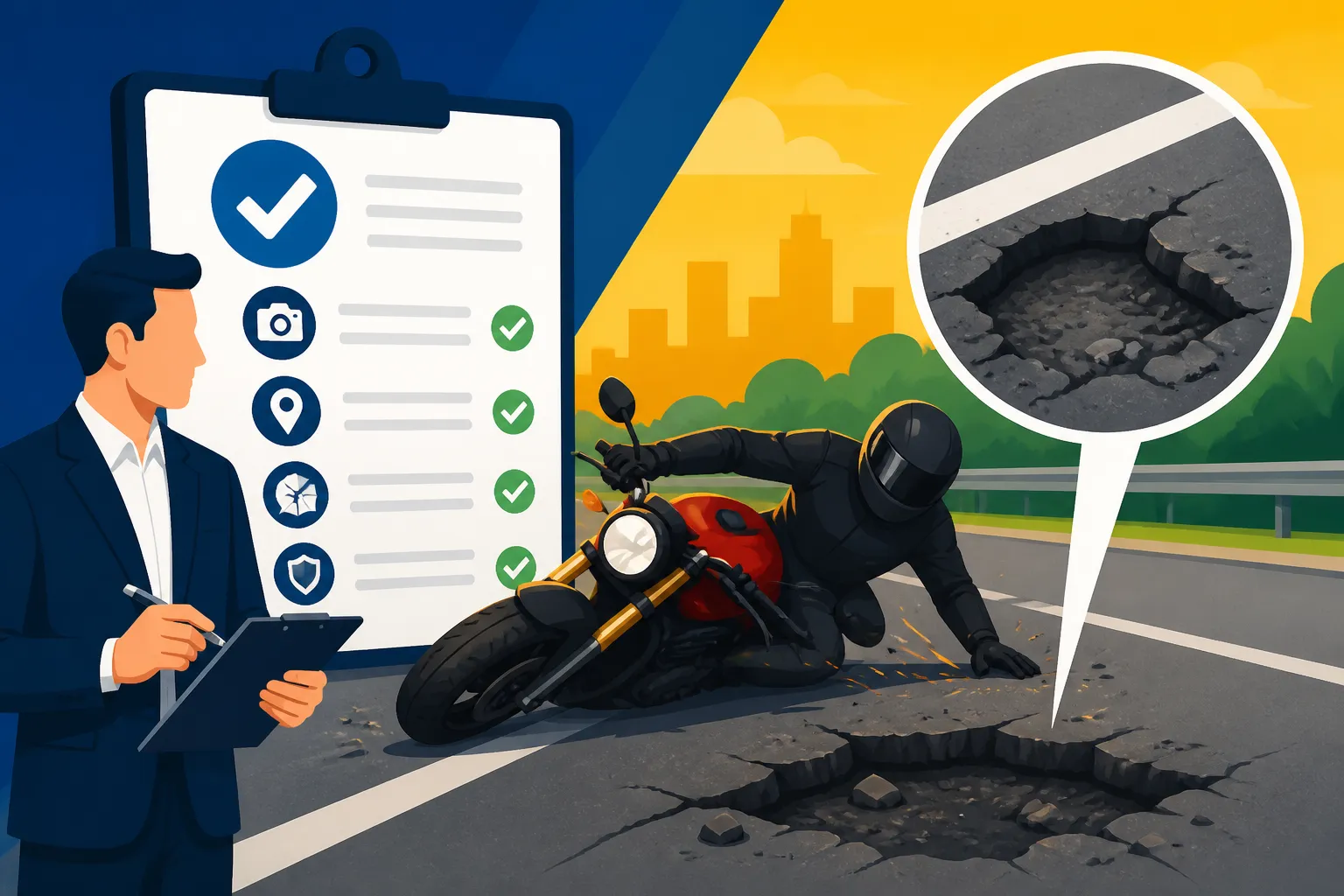
- Take Extensive Photos and Videos: Get close-up shots of the specific hazard that caused your crash – the depth of the pothole, the extent of the gravel, the size of the debris. Then, take wider shots that show the hazard in relation to landmarks, street signs, and cross streets. You need to establish the exact location beyond any doubt. Take pictures from your perspective as a rider approaching the hazard, showing how visible or invisible it was. Document the weather conditions, road conditions, and any warning signs (or lack thereof). Take photos of your bike's damage, your injuries, and any damaged gear. The more pictures, the better. Consider what's advised in Photos to Take to Prove Motorcycle Fault.
- Measure the Hazard: If it's a pothole, try to measure its depth and width if you have a tape measure handy (or use an object like a coin or key for scale in your photos). Note the dimensions and describe them in detail.
- Note Exact Location and Time: Use GPS on your phone to pinpoint the precise location. Note the date and time of the incident. This information is critical when reporting the incident and for later investigation.
- Look for Surveillance Footage: Scan the area for businesses, traffic cameras, or residential properties that might have security cameras. Such footage could be invaluable in showing the hazard and how the crash occurred. This is a powerful form of Motorcycle Accident Evidence for Proving Fault.
It's common for road hazards, especially temporary ones like debris or spills, to be cleared quickly. Even potholes might be filled in relatively swiftly once reported. That's why documenting it before it disappears is so crucial.
Securing Witness Statements and Police Reports
Eyewitnesses and official reports lend significant credibility to your account of events. Don't underestimate their power.
- Gather Witness Information: If anyone stopped to help or saw the crash, get their names, phone numbers, and email addresses. Ask them what they saw and make a note of it. Their impartial account can corroborate your story and counter any claims that you were at fault. Even if they didn't see the exact moment of impact but observed you on the ground near a specific hazard, that can still be helpful. This is particularly useful if the "I didn't see the motorcycle" defense is deployed against you, which often happens.
- Ensure a Police Report is Filed: Call 911 immediately after the accident, even if you think your injuries are minor. A police report creates an official record of the incident. When the officer arrives, calmly and clearly explain what happened, emphasizing the road hazard that caused the crash. Point out the hazard to the officer. Do not admit fault, but stick to the facts. The accuracy of the police report in describing the hazard is vital for your claim, as it can be a critical piece of evidence in determining How Police Reports Establish Fault. If the report doesn't mention the hazard, it can be a significant hurdle. Follow up later to get a copy of the official report.
Preserving Your Motorcycle and Gear
The physical evidence from your motorcycle and protective gear tells a story about the impact and the nature of the crash.
- Do Not Repair Your Motorcycle: It might be tempting to fix your bike immediately, but resist the urge. Your damaged motorcycle is key evidence. The type and location of damage can often confirm the angle and force of impact, which can directly relate to hitting a specific road hazard. A mechanic or an accident reconstruction expert can analyze this damage to support your claim.
- Keep Your Damaged Gear: Your helmet, jacket, pants, and boots, no matter how mangled, are also crucial pieces of evidence. Damage to your gear can demonstrate the severity of the impact and injuries, particularly if your helmet shows impact points consistent with hitting the ground after being thrown by a road hazard. This helps prove How to Document the Scene to Prove Fault effectively. Keep everything. Do not throw it away.
Proving Negligence and Causation
Even with compelling evidence of a road hazard, you still need to legally connect that hazard to the entity responsible and demonstrate that their negligence directly caused your injuries. This involves proving two key elements: notice and causation.
Establishing the Entity Knew or Should Have Known
One of the biggest hurdles in claims against government entities or private contractors is proving "notice." It's not enough to say the hazard existed; you usually have to show that the responsible party either actually knew about it or should have known about it.
- Actual Notice: This means the responsible party was directly informed about the hazard. This could be through a written complaint, a work order, a police report from a prior incident at the same location, or even an internal memo. For example, if a resident had called the city's public works department days before your accident to report a huge pothole, that's actual notice.
- Constructive Notice: This is trickier. It means the hazard existed for such a length of time, or was so obvious, that the responsible party should have known about it through reasonable inspection and maintenance practices. A massive, long-standing pothole that has been there for months might fall under constructive notice, even if no one formally reported it. Your photos and witness statements (e.g., "that pothole has been there forever") become vital here.
- Lack of Proper Inspection: Sometimes, the argument is that even if they didn't know about that specific hazard, their overall inspection and maintenance schedule was negligent. For instance, if a road hasn't been inspected for years, and a hazard develops, the responsible entity might be liable for failing to perform their duties.
Building this part of the case often requires extensive investigation, including public records requests to see maintenance logs, complaint records, and inspection schedules. This is where a legal professional who understands the nuances of government liability can be incredibly valuable.
Demonstrating the Hazard Directly Caused Your Crash
Establishing causation means drawing a clear, undeniable link between the road hazard and your accident, as well as your injuries and damages. This sounds straightforward, but insurance companies and defense attorneys will often try to break this link.
- Detailed Accident Reconstruction: An accident reconstruction expert can analyze all available evidence – your photos, witness statements, police report, bike damage, and even debris patterns – to scientifically demonstrate how the road hazard directly led to your loss of control and subsequent crash. They can calculate speeds, angles, and forces to paint a clear picture.
- Medical Records and Expert Testimony: Your medical records are crucial. They document your injuries, treatments, and prognosis. A doctor's testimony can link specific injuries to the type of impact caused by the road hazard crash. For instance, if you suffered a broken wrist from being thrown off your bike, the medical expert can confirm that this injury is consistent with the forces exerted during such an incident.
- Excluding Other Causes: The defense will often try to argue that something else caused your crash – rider error, excessive speed, poor maintenance of your motorcycle, or even a pre-existing condition. You need to present evidence that systematically rules out these alternative theories, firmly placing the blame on the road hazard. This could involve showing your motorcycle was well-maintained, that you were riding at a safe speed, and that the conditions of the road truly presented an unavoidable danger.
It's a process of connecting the dots, from the moment you encountered the hazard to the full extent of your recovery, or lack thereof.
Countering Claims of Rider Negligence
Unfortunately, motorcyclists often face a bias where they are automatically assumed to be at least partially at fault in an accident. When a road hazard is involved, the defense will almost certainly argue that you "should have seen it" or "were riding too fast for conditions." This is where the legal concept of Shared Fault in Motorcycle Accidents comes into play.
- "Should Have Seen It" Defense: The defense might argue that a reasonably prudent rider would have spotted the hazard and avoided it. You counter this by showing the hazard's poor visibility (e.g., hidden around a blind turn, obscured by shadows, camouflaged by lighting, or appearing suddenly) and that your speed was appropriate for the conditions as they appeared to you.
- Speeding or Reckless Riding Claims: If your speed was within legal limits and appropriate for the observed conditions, evidence like witness statements, police reports (if no speeding ticket was issued), or even accident reconstruction can refute claims of excessive speed. Remember, even if you were speeding slightly, it doesn't automatically mean you are 100% at fault, thanks to laws like How Comparative Negligence Reduces Your Payout in many states.
- The "Motorcyclist Stereotype": It’s a sad truth that some jurors and insurance adjusters hold negative stereotypes about motorcyclists. Your evidence needs to be so strong that it overrides any preconceived notions they might have. Presenting yourself as a responsible, careful rider is part of this.
By proactively addressing these potential arguments and presenting robust evidence, you strengthen your position and increase the likelihood of a successful claim.
Key Evidence for Proving Road Hazard Fault
| Evidence Type | Description | Why It's Crucial |
|---|---|---|
| Photos/Videos | Close-ups of hazard, wide shots of location, damage to bike/gear, surrounding area. | Undeniable visual proof of the hazard's existence, size, and location. Captures transient conditions. |
| Witness Statements | Contact info and accounts from anyone who saw the crash or the hazard. | Impartial corroboration of your version of events; can prove constructive notice (hazard existed for a while). |
| Police Report | Official documentation of the accident, including officer's observations. | Establishes official record; may include initial assessment of fault or details about the hazard. |
| Medical Records | Doctor's notes, diagnoses, treatment plans, hospital bills. | Links your injuries directly to the accident; documents the severity and cost of damages. |
| Motorcycle/Gear Damage | Physical evidence of impact on your bike and protective equipment. | Shows how the accident occurred and the forces involved; helps counter claims of rider negligence. |
| Maintenance Records | For the road (from responsible entity) and your motorcycle. | Can prove "actual notice" for the road; shows your bike was well-maintained, refuting mechanical failure claims. |
| Accident Reconstruction | Expert analysis of the crash dynamics, speed, and impact points. | Scientifically links the hazard to the crash; refutes alternative theories of causation. |
| Communication Logs | Any records of complaints or reports about the hazard to responsible parties. | Directly proves "actual notice" if someone else reported the hazard prior to your accident. |
Disclaimer
The information provided in this article is for general informational purposes only and does not constitute legal advice. Every motorcycle accident claim is unique, and the laws regarding fault and liability can vary significantly by state and specific circumstances. It is highly recommended to consult with an experienced motorcycle accident attorney to discuss the specifics of your case and understand your legal rights and options.