What to Say to Police After a Motorcycle Accident
Experiencing a motorcycle accident is a chaotic and frightening ordeal, often leaving you shaken, injured, and unsure of your next steps. When law enforcement arrives, it can feel like you're suddenly under intense scrutiny, and knowing exactly what to say – and what not to say – is absolutely critical for your safety and any future injury claim. This comprehensive guide will walk you through how to effectively communicate with the police after a motorcycle crash, ensuring you protect your rights and provide accurate information without jeopardizing your case.
The Immediate Aftermath: What to Do (and Not Do) at the Scene
When you've just been involved in a motorcycle accident, your adrenaline is probably through the roof, and it's easy to feel disoriented. However, the moments immediately following a crash are crucial, not just for your physical well-being, but for establishing the facts that will eventually form the bedrock of your accident claim. Before the police even arrive, there are vital steps you should take to ensure your safety and begin documenting the incident.
Prioritizing Safety and Seeking Medical Attention
Your health is paramount. The very first thing you should do after any motorcycle accident, even if you feel fine, is to assess yourself and any passengers for injuries. Road rash, broken bones, or even more serious internal injuries might not be immediately apparent due to shock. If you are able to move, get yourself and your bike to the safest possible location away from traffic, if it's safe to do so. If you suspect any serious injury, or if you feel any pain, do not hesitate to call for emergency medical services. Remember, many severe injuries, like a Motorcycle Traumatic Brain Injury Claims and Compensation, can have delayed symptoms, and a medical professional should always evaluate you.
Even if you don't think you're badly hurt, let the paramedics check you out. Refusing medical attention at the scene can be used by insurance companies later to argue that your injuries weren't severe or weren't caused by the accident. It's always better to be safe than sorry, and getting checked out creates an immediate medical record of the incident, which is incredibly valuable.
The Importance of Calling the Police
Some riders might be tempted to handle minor fender-benders without involving law enforcement, especially if they feel the damage is minimal or they're concerned about potential citations. However, for a motorcycle accident, calling the police is almost always a non-negotiable step. A formal police report, also known as an accident report or incident report, provides an official, third-party account of the crash. This report is often the first piece of objective evidence that insurance companies and legal teams will review.
Without a police report, it can become your word against the other driver's, which can be incredibly challenging to navigate, especially given common stereotypes about motorcyclists. The police report will document key details like the date, time, location, involved parties, vehicle information, and often the officer's initial assessment of what happened. This information is critical when determining Who Is at Fault in a Motorcycle Accident and pursuing a claim. Even if the police don't assign blame directly in their report, the factual information they collect can be instrumental in proving fault later on.
Documenting the Scene Before Officers Arrive
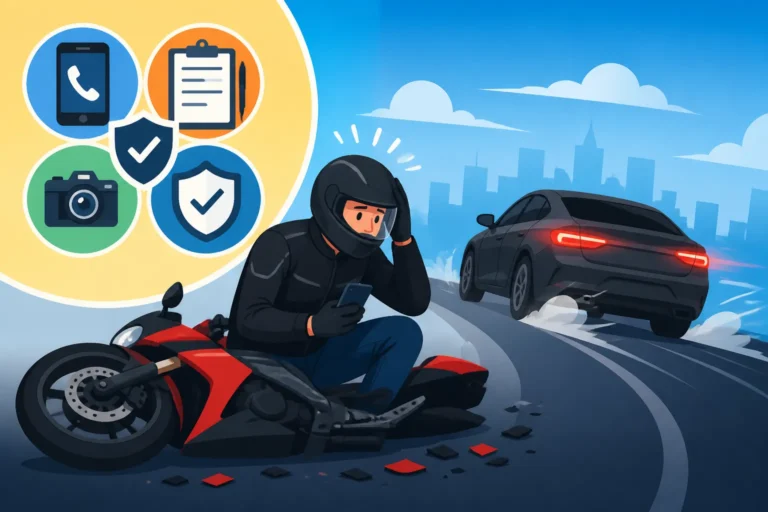
While waiting for law enforcement, if your condition allows, use this time wisely to gather crucial evidence. This is your chance to capture raw, unfiltered details that might otherwise be overlooked or forgotten. Start by taking extensive photos and videos with your smartphone. Document the position of all vehicles involved, damage to your motorcycle and the other vehicle, skid marks on the road, road debris, traffic signs, road conditions, and anything else that seems relevant. Get wide shots showing the overall scene and close-ups of specific damage or critical details.
Beyond visual evidence, try to identify any witnesses. Ask for their names and contact information. Independent witnesses can provide invaluable testimony, often counteracting biased narratives. If possible, make a mental note of the weather conditions, time of day, and any other environmental factors that might have contributed to the crash. This proactive documentation serves as a critical backup to the police report and can be especially useful for your legal team when they begin to Prove Fault in a Motorcycle Accident.
Navigating Your Conversation with Law Enforcement
The police officer arriving at the scene is there to investigate, gather facts, and potentially determine if any traffic laws were violated. While it's important to cooperate, it's equally important to understand your rights and responsibilities during this interaction. Your words at the scene can significantly impact the trajectory of your claim, so choose them carefully.
What Information You Must Provide
When an officer arrives, they will ask you for basic identifying information. You are legally obligated to provide your driver's license, vehicle registration, and proof of insurance. This is standard procedure for any vehicle accident. Be polite and cooperative, but stick to the facts requested.
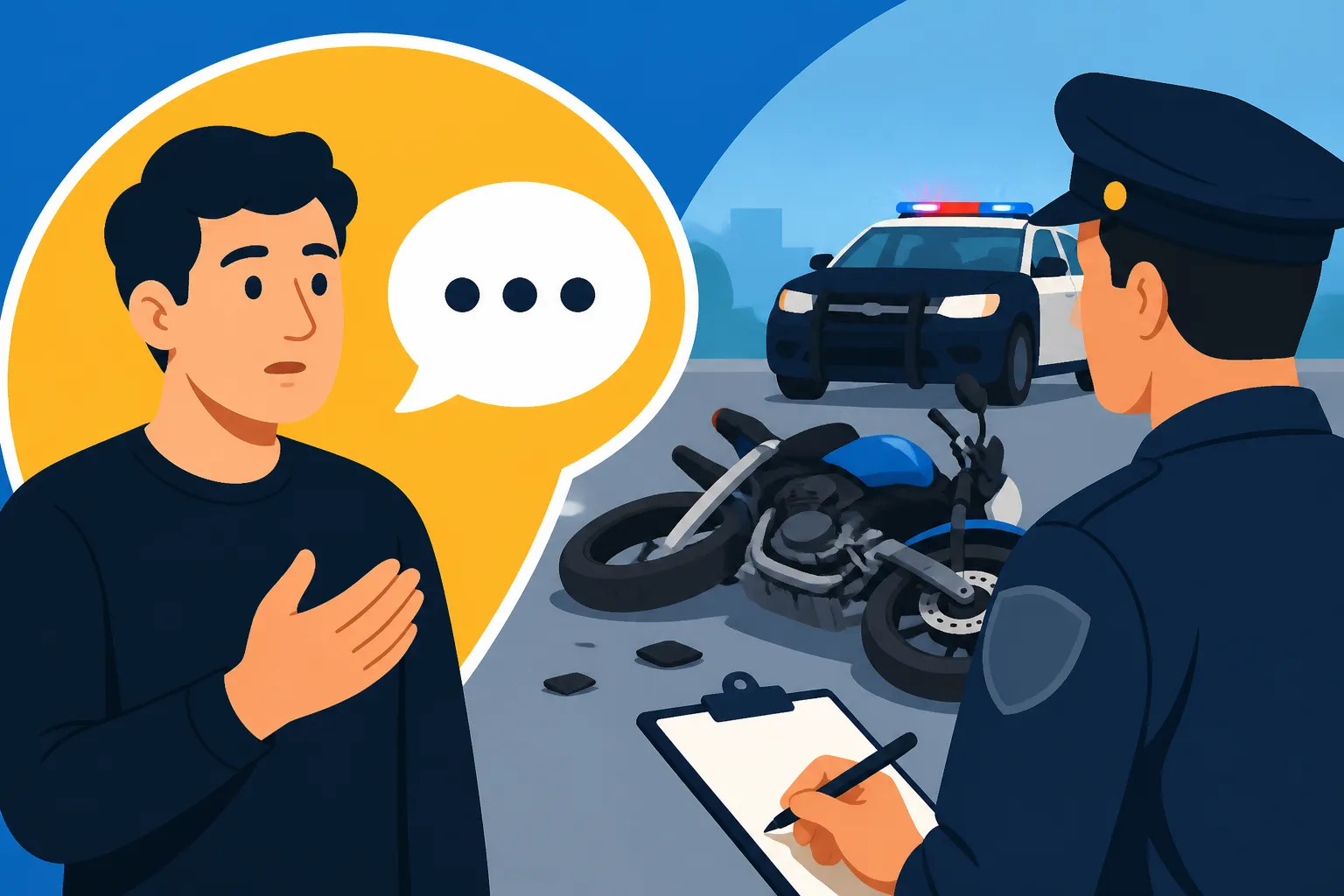
The officer may also ask for a brief statement about what happened. At this point, it's crucial to describe the accident objectively and truthfully, but without speculating or admitting fault. For example, you can state, "I was riding eastbound on Main Street, and a vehicle turning left from the westbound lane suddenly pulled out in front of me." This is a factual statement of what you observed. Avoid volunteering unnecessary details or engaging in lengthy conversations beyond the scope of their investigation. Remember that everything you say can be included in the police report and potentially used by insurance companies.
What You Should Avoid Saying or Doing
This is arguably the most critical section for any rider involved in an accident. There are certain things you absolutely, positively should not say or do after a motorcycle crash, especially when speaking to the police. First and foremost, never, under any circumstances, admit fault. Even if you think you might have made a mistake, you are not a trained accident reconstructionist, and the full circumstances of the crash are likely not yet clear. Phrases like "I'm so sorry, I didn't see them" or "It happened so fast, maybe I was going too fast" can be devastating to your claim. As we explore in Why You Should Never Admit Fault at the Scene, admitting fault can be interpreted as a legal admission of liability, even if you weren't truly at fault.
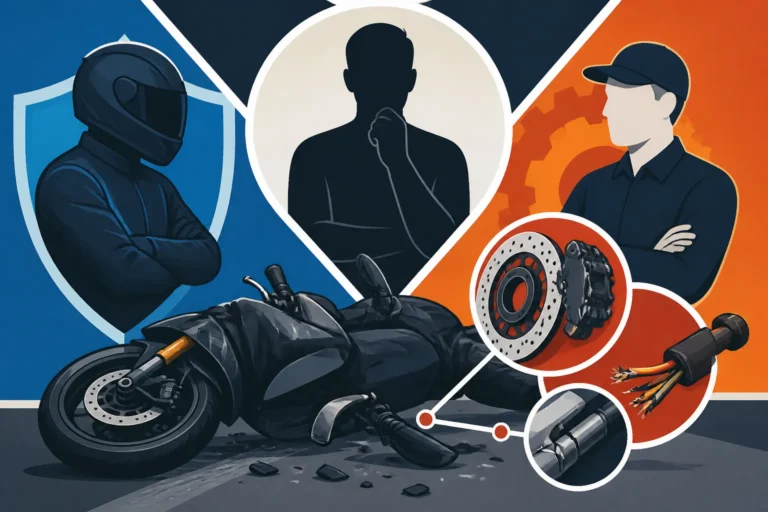
Similarly, avoid speculating about the cause of the accident. Don't say, "I think they were distracted" or "Maybe their brakes failed." Stick to what you know and what you observed. Emotional statements, expressions of anger, or arguing with the other driver are also unproductive and can be misconstrued. Remain calm and factual. If you're feeling pain or unsure about your injuries, simply state that you are hurt and need medical attention, rather than saying "I'm fine" if you're not certain. Insurance companies are notorious for trying to minimize payouts, and any statement that downplays your injuries or suggests you were at fault will be used against you.
How to Describe the Accident Objectively
When providing your statement to the police, aim for a clear, concise, and factual recount of the event. Think of yourself as a neutral observer describing what happened.
- Focus on observable facts: "The car in the left-turn lane turned directly into my path," or "I was in my lane, and the SUV drifted into me."
- Use precise locations and directions: "I was in the far-right lane heading north on Elm Street, approaching the intersection with Maple Avenue."
- Describe actions, not assumptions: "The light was green for my direction of travel," not "I think they ran a red light."
- Be honest about what you don't know: If you didn't see something, it's perfectly acceptable to say, "I didn't see the other vehicle until it was too late" or "I'm not sure what their speed was." This is better than guessing.
- Mention specifics that are relevant: If the other driver was clearly violating a traffic law, such as "They made an illegal U-turn directly in front of me," state that fact. This can be especially important in cases like Motorcycle Accidents Caused by Left-Turn Collisions where the other driver often fails to yield.
Remember, the officer's job is to gather information, and your objective statement helps them piece together the puzzle without introducing unnecessary conjecture that could complicate your claim down the line.
Understanding the Police Report and Its Impact
After the officers complete their on-scene investigation, they will typically file an official police report. This document carries significant weight in any subsequent insurance claim or legal proceedings. Understanding its purpose, how it's used, and your ability to address inaccuracies is vital for protecting your interests as a rider.
How the Police Report is Used in Your Claim
The police report serves as a foundational piece of evidence in nearly every motorcycle accident claim. Insurance companies, both yours and the other driver's, will lean heavily on this document to establish initial fault and liability. They'll look for details such as:
- Parties involved: Who was driving what, and contact information.
- Location and time: Crucial for verifying details and potentially identifying additional evidence like traffic camera footage.
- Description of the accident: The officer's summary of how the crash occurred, often based on witness statements and physical evidence.
- Damage incurred: Initial assessment of vehicle damage, though this is often not comprehensive.
- Injuries: Notation of apparent injuries at the scene.
- Diagram: A sketch of the accident scene, showing vehicle positions and direction of travel.
- Citations issued: Any traffic violations cited, which can strongly indicate fault.
- Officer's opinion on fault: While not always legally binding, an officer's conclusion on How Police Reports Establish Fault can heavily sway initial insurance adjustor assessments.
For example, if the report explicitly states the other driver failed to yield, this immediately puts your claim in a stronger position. Conversely, if the report unfairly assigns blame to you or suggests contributory factors on your part, it can complicate your efforts to secure fair compensation for your injuries and damages. This is particularly relevant when dealing with common biases against motorcyclists.
Correcting Inaccuracies in a Police Report
It's an unfortunate reality that police reports, while official, are not always 100% accurate. Officers are human, they arrive after the event, and they sometimes misinterpret witness statements or physical evidence. If you review the report (which you should always do once it's available) and find errors, it's crucial to take steps to correct them. These inaccuracies, no matter how small they seem, could be detrimental to your claim.
The process for correcting a police report varies by jurisdiction. Generally, you would need to contact the police department that filed the report and formally request an amendment or provide supplemental information. You'll need to clearly explain the factual discrepancy and provide evidence to support your claim – this is where your photos, witness statements, and even dashcam footage become incredibly important. Be prepared that correcting a report can be challenging, as departments are often hesitant to change official documents. However, demonstrating a clear factual error, such as an incorrect license plate number or a misstated direction of travel, usually has a better chance of success. For more on this, you might look into How to Correct a Wrong Police Report.
The Role of Traffic Citations
Traffic citations issued at the scene of an accident play a significant role in determining fault and, by extension, your personal injury claim. If the other driver receives a citation for a violation directly contributing to the crash, such as running a red light, making an unsafe lane change, or failing to yield, it creates a strong presumption of their negligence. This is a powerful piece of evidence that insurance companies will find difficult to ignore.
Conversely, if you receive a citation, even if you dispute it, it can potentially harm your claim. For instance, a ticket for speeding could be used to argue that you contributed to the accident, even if the other driver was primarily at fault. This brings up the concept of comparative negligence, which determines how Shared Fault in Motorcycle Accidents impacts your ability to recover damages. If you receive a citation that you believe is unjust, it's often advisable to contest it in court. A successful defense in traffic court can prevent that citation from being used against you in your civil injury claim.
| DO | DON'T |
|---|---|
| Prioritize safety and seek medical help | Say "I'm fine" if you're feeling pain |
| Call the police | Admit fault or apologize |
| Document the scene with photos/videos | Speculate about what happened |
| Get witness contact information | Argue with the other driver or police |
| Provide driver's license, registration, insurance | Discuss details beyond what's requested |
| State objective facts about the accident | Give a lengthy, emotional narrative |
| Report any discomfort or pain | Minimize your injuries or property damage |
| Cooperate politely with officers | Sign anything without understanding it |
| Get a copy of the police report | Procrastinate on seeking medical follow-up |
Protecting Your Rights Beyond the Scene
Your interaction with the police at the accident scene is just the first step in a much longer process. What you do in the days and weeks that follow is equally important for safeguarding your rights and ensuring you receive the compensation you deserve. The evidence you gather and the professionals you consult will form the backbone of your motorcycle accident claim.
Following Up on Medical Care and Documentation
The importance of continuous medical care cannot be overstated. After the initial examination, follow all of your doctor's recommendations for follow-up appointments, specialist referrals, physical therapy, and any prescribed medications. Gaps in medical treatment can severely hurt your claim, as insurance companies will argue that your injuries weren't serious or that you exacerbated them by not following doctor's orders. Keep meticulous records of all medical appointments, treatments, diagnoses, and bills. This documentation directly impacts the valuation of your Medical Expenses in a Motorcycle Claim and is crucial for proving the extent of your suffering.
An injury journal can also be incredibly helpful. Document your daily pain levels, limitations, emotional distress, and how your injuries affect your daily life. This personal account can provide powerful evidence of your Pain and Suffering Damages Explained and the true impact of the accident on your life, which may include aspects like Loss of Enjoyment of Life. Remember, your health is your top priority, but thorough medical documentation also becomes critical evidence for your claim.
Consulting with a Motorcycle Accident Attorney
The moments after a crash are fraught with stress, pain, and confusion. While this guide offers valuable information, it cannot replace the personalized advice of a legal professional. Consulting with a motorcycle accident attorney is one of the most proactive steps you can take to protect your rights. An attorney specializing in motorcycle accidents understands the unique challenges riders face, including the biases often held against them by insurers and juries.
A skilled attorney can help you navigate the complex legal landscape, ensure all necessary evidence is collected, negotiate with insurance companies on your behalf, and fight for the full compensation you deserve. They can interpret police reports, identify Common Causes of Motorcycle Accidents, challenge unfair fault assignments, and help you understand your options for recovering damages, including for things like Lost Wages in a Motorcycle Claim or even future medical costs. Many attorneys offer free consultations, so there's no financial risk in discussing your case and understanding how they can help you in maximizing your motorcycle accident settlement. Don't wait until the insurance company tries to lowball you; the sooner you have an experienced advocate on your side, the better your chances of a fair outcome.
Disclaimer
Please remember that this article provides general information and guidance regarding motorcycle accidents and interactions with law enforcement. It is not intended as legal advice. Laws vary by state, and the specifics of your situation are unique. For personalized legal advice regarding your motorcycle accident claim, it is crucial to consult with a qualified attorney in your jurisdiction.